100rubli 1919
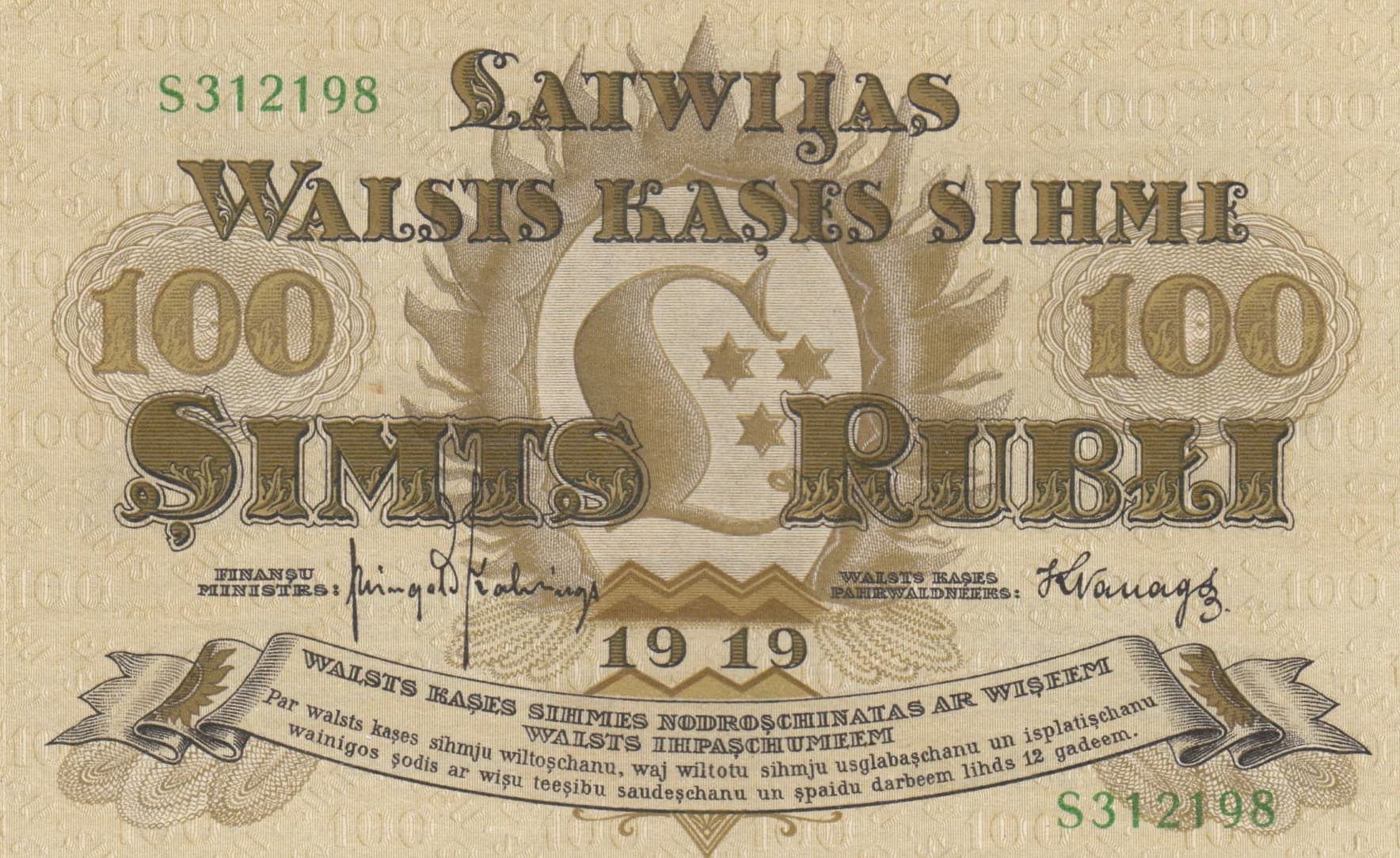
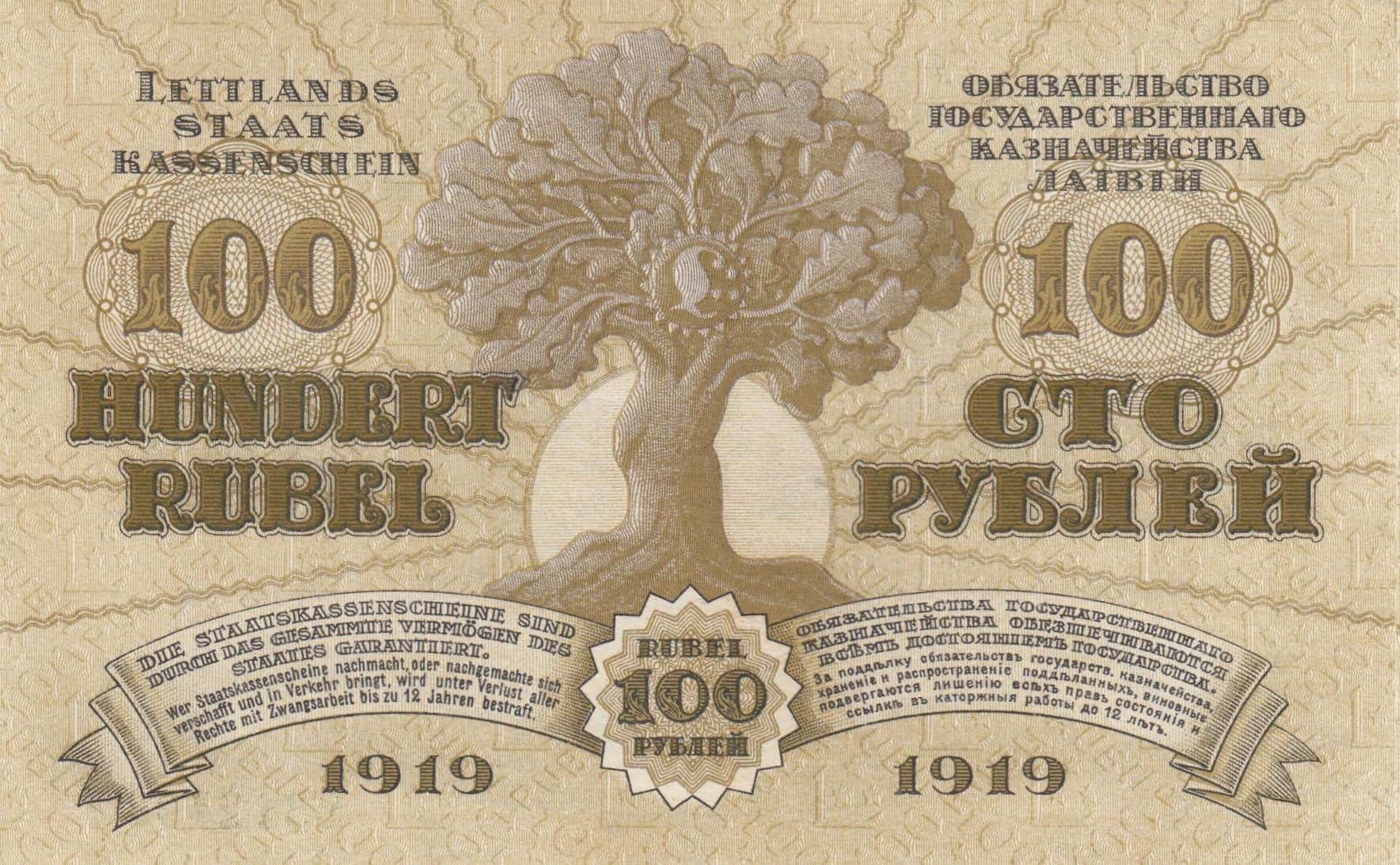
“serie S”
Market Prices
5 salesAbout This Note
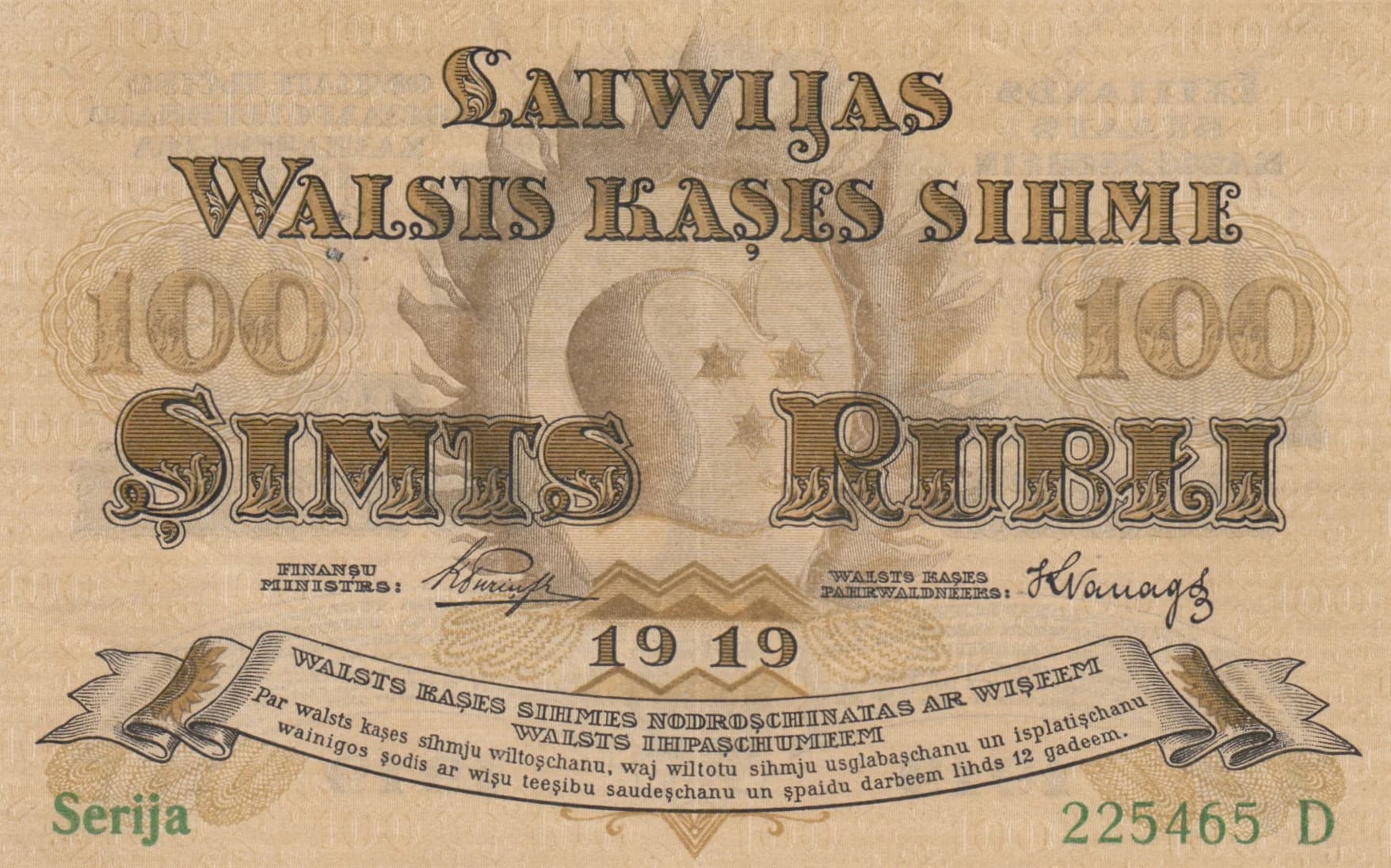
This is a striking example of Latvia's 1919 100 Rubli note in exceptional condition, displaying the dual-language design typical of the newly independent nation's early currency. The front features a heraldic shield with two stars representing Latvia's sovereignty, while the reverse showcases a prominent oak tree—a national symbol of strength and endurance. The note exhibits crisp printing with fine line engraving, minimal wear consistent with UNC grading, and represents an important piece of Latvian numismatic history from the turbulent post-WWI period.
Common. While this is an early Latvian banknote from a historically significant period, the 100 Rubli denomination appears to have had a substantial circulation. eBay market data shows consistent sales activity with notes in Fine condition selling for $17.50–$79.59 between 2013–2019, indicating steady supply in the collector market. The 2016 catalog value of $200 for UNC examples reflects premium pricing for high-grade specimens rather than scarcity of the issue itself. The existence of multiple series (N, P, R, S, T, U) and PMG population data for variants P-7a, P-7b, and P-7f further suggests adequate print runs.
Issued in 1919 by the Latvian Government during the nation's struggle for independence from Russian and German occupation, this banknote symbolizes Latvia's assertion of sovereignty through its bilingual design in Latvian and German. The heraldic arms with two stars on the obverse and the majestic oak tree on the reverse served as powerful national symbols during this transitional period when Latvia was establishing its own currency system independent of imperial Russian rubles. The multilingual inscriptions (Latvian, German, and Russian) reflect the complex geopolitical situation of the Baltic region immediately following World War I.
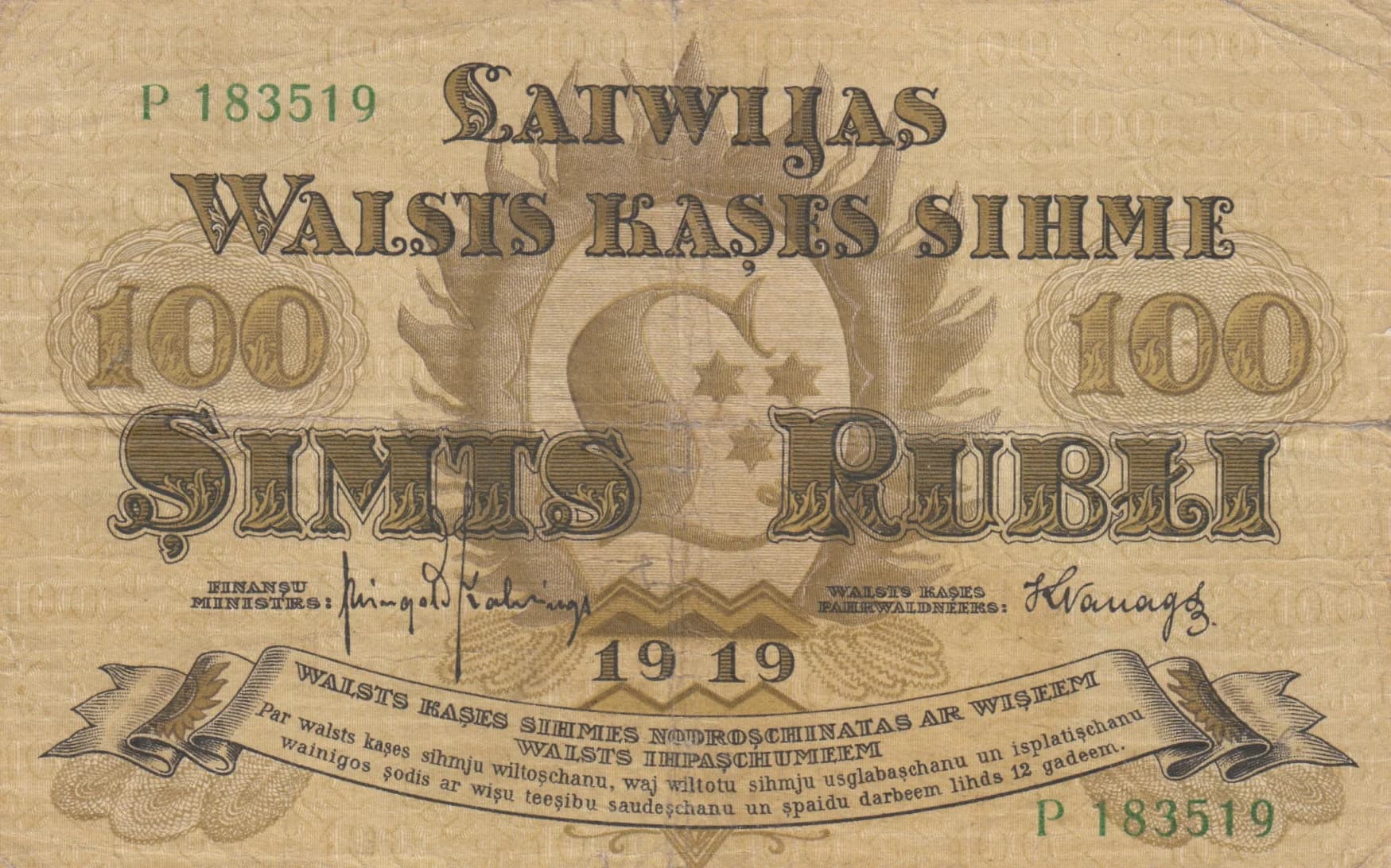
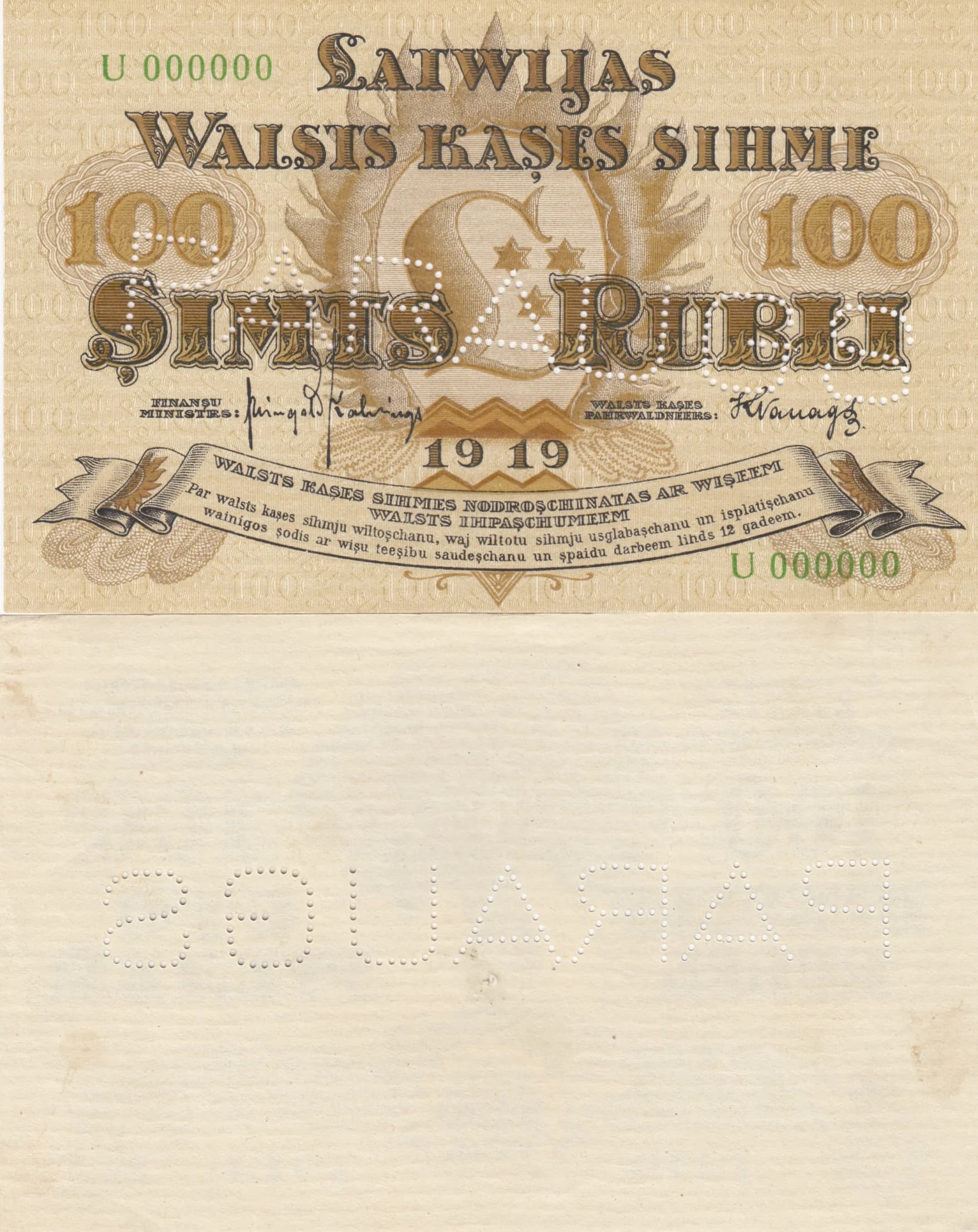
The obverse features Latvia's coat of arms—a heraldic shield containing two five-pointed stars arranged vertically in the center, symbolizing Latvia's aspirations for independence and sovereignty. The denomination '100' appears in large ornamental numerals with baroque-style wreath borders on both left and right edges. The design employs fine line engraving throughout with a cream/beige background, brown and green printing, and incorporates elaborate geometric and decorative frame elements. The reverse is dominated by a large, intricately engraved oak tree as the central design element, representing strength and national identity. The denomination appears again in large numerals flanking the tree, with legal text in rectangular banner sections warning against counterfeiting in both German and Russian. An ornamental circular badge displaying '100 RUBEL' anchors the composition at the center bottom.
FRONT SIDE: 'LATVIJAS VALSTS KASES SIHME' (Latvian State Treasury Note); 'SIMTS RUBLI' (One Hundred Rubles); '1919' (Year of issue); 'FINANŠU MINISTRES' (Finance Minister); 'VALSTS KASES PĀRVALDNIEKS' (State Treasury Administrator). BACK SIDE: 'LETTHLANDS STAATS KASSENSCHEIN' (Germany: Lettland State Treasury Certificate); 'OBSHCHESTVO POSUDARTVENNNATO KAZNACHEISTVA LATVII' (Russian: Public Treasury of Latvia); 'HUNDERT RUBEL' (German: One Hundred Rubles); 'RYBLI' (Russian: Rubles); Counterfeiting warning in German: 'DIE STAATSKASIENSCHEINE SIND... DUBEL NACHGEMACHT... ZWANGSARBEIT BIS ZU 1/2 JAHREN BESTRAF' (State treasury notes... counterfeiting... hard labor up to half a year penalty); Corresponding Russian legal text regarding penalties for counterfeiting. Serial number: 'S312198'.
Intaglio engraving (line engraving), evidenced by the fine line work visible throughout both sides, the crisp serif typography, and the dimensional quality of the printed imagery. The intricate background patterns, detailed oak tree rendering, and the fine line security patterns are characteristic of high-quality engraved banknote production typical of early 20th-century European currency manufacture. The multi-color printing (brown, green, and tan) was achieved through successive intaglio passes.
This note is identified as Pick-7f, one of three catalogued variants for the 100 Rubli denomination. The specimen bears series prefix 'S' (as noted in collector notes 'serie S'), which corresponds to the documented series range (N, P, R, S, T, U) for this issue. The watermark consists of light lines, consistent with P-7f specifications. The serial number S312198 places this within the series S range. The note represents the standard design type with bilingual German/Latvian and Russian inscriptions typical of this Pick number, distinguishing it from any overprinted or emergency variants that may exist within the broader 100 Rubli series.