100rubli 1919
“serie D”
Market Prices
3 salesAbout This Note
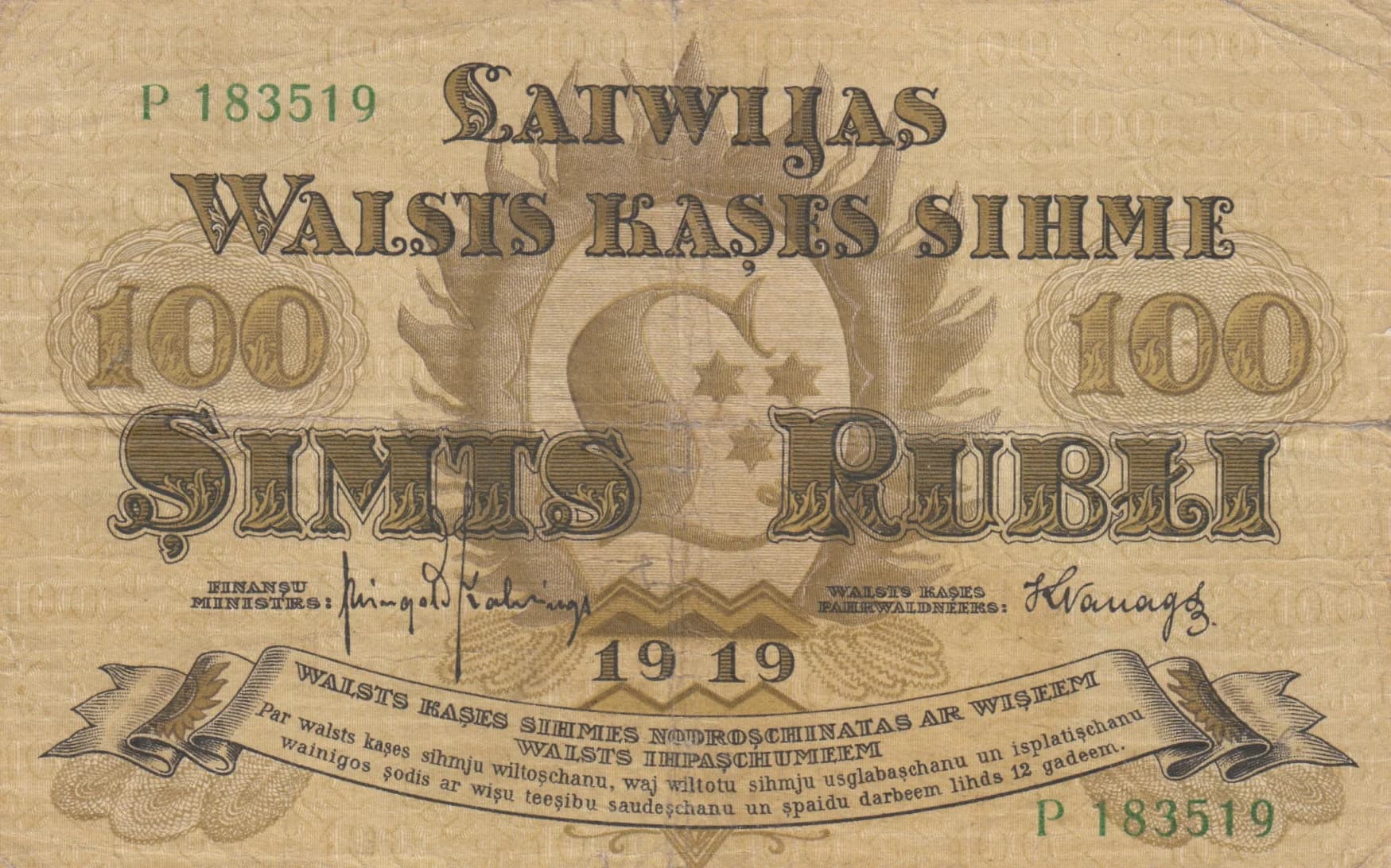
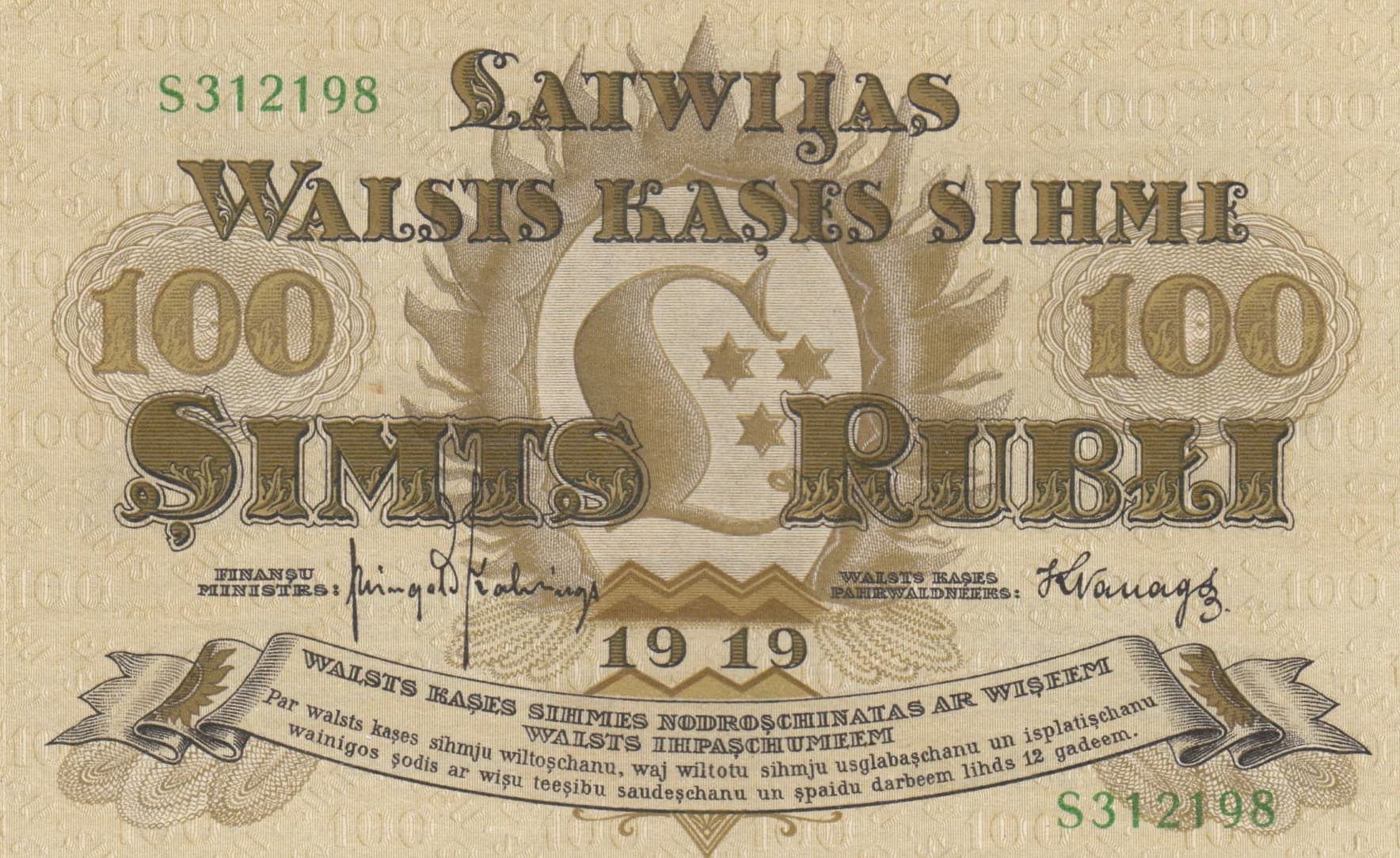
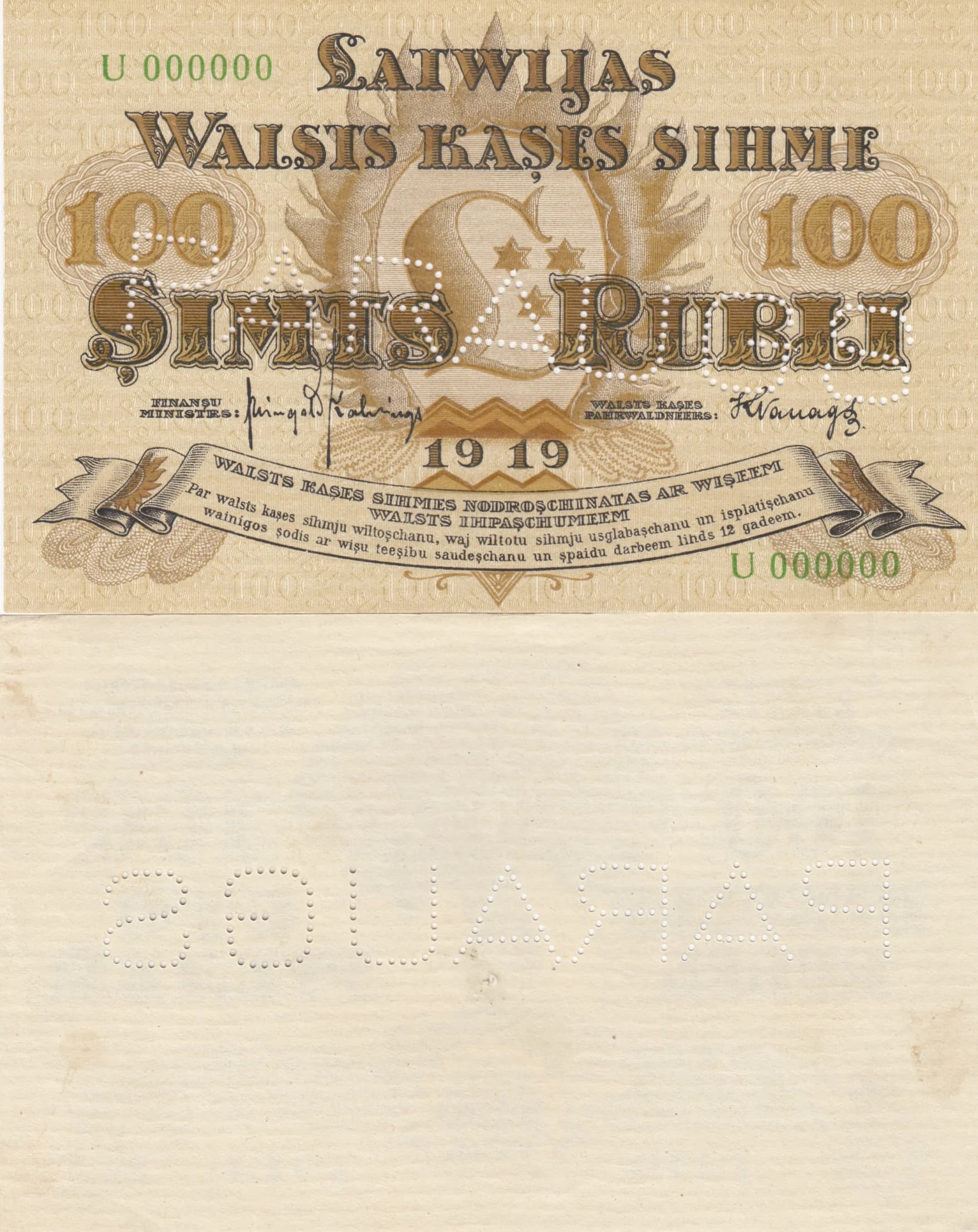
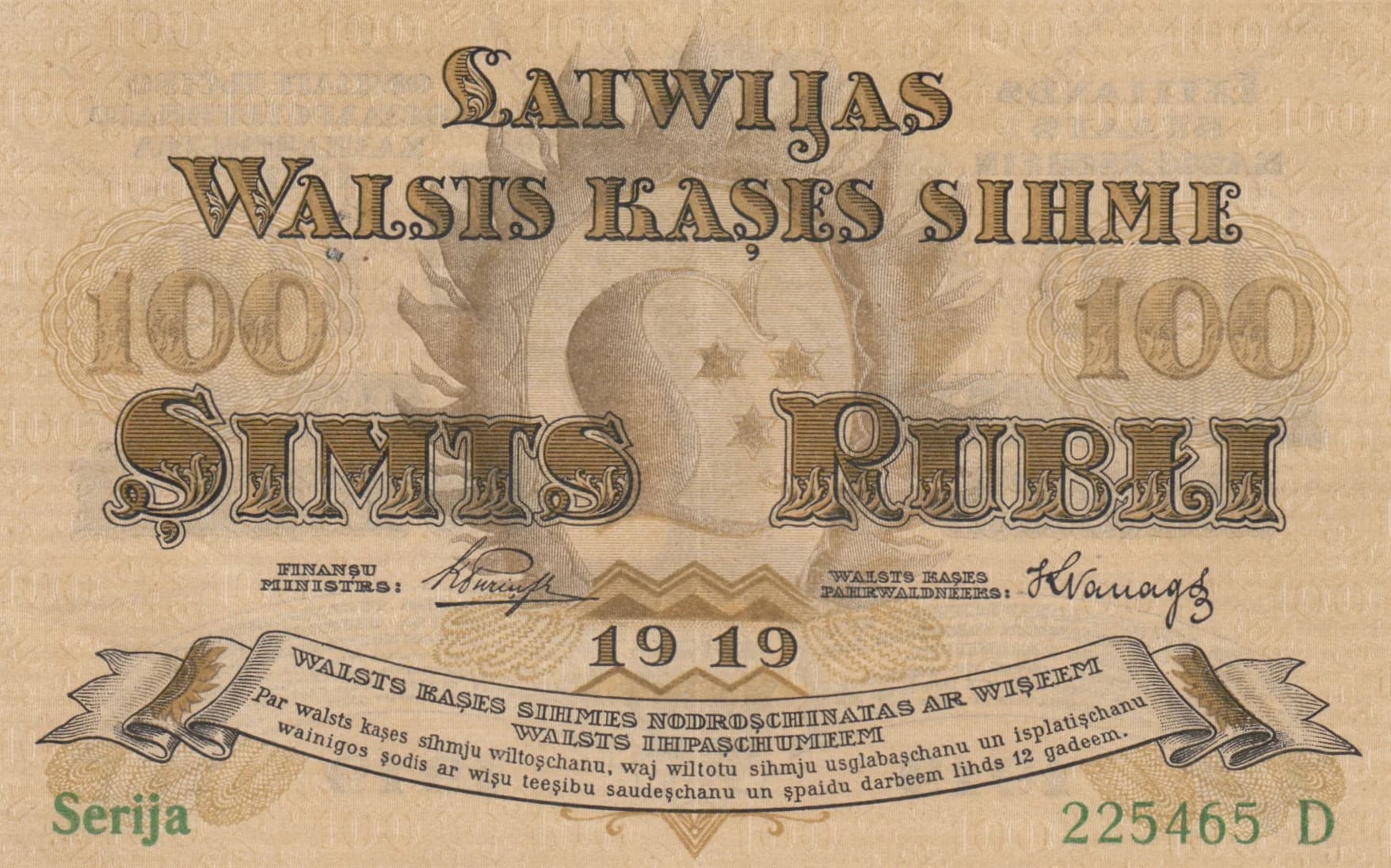
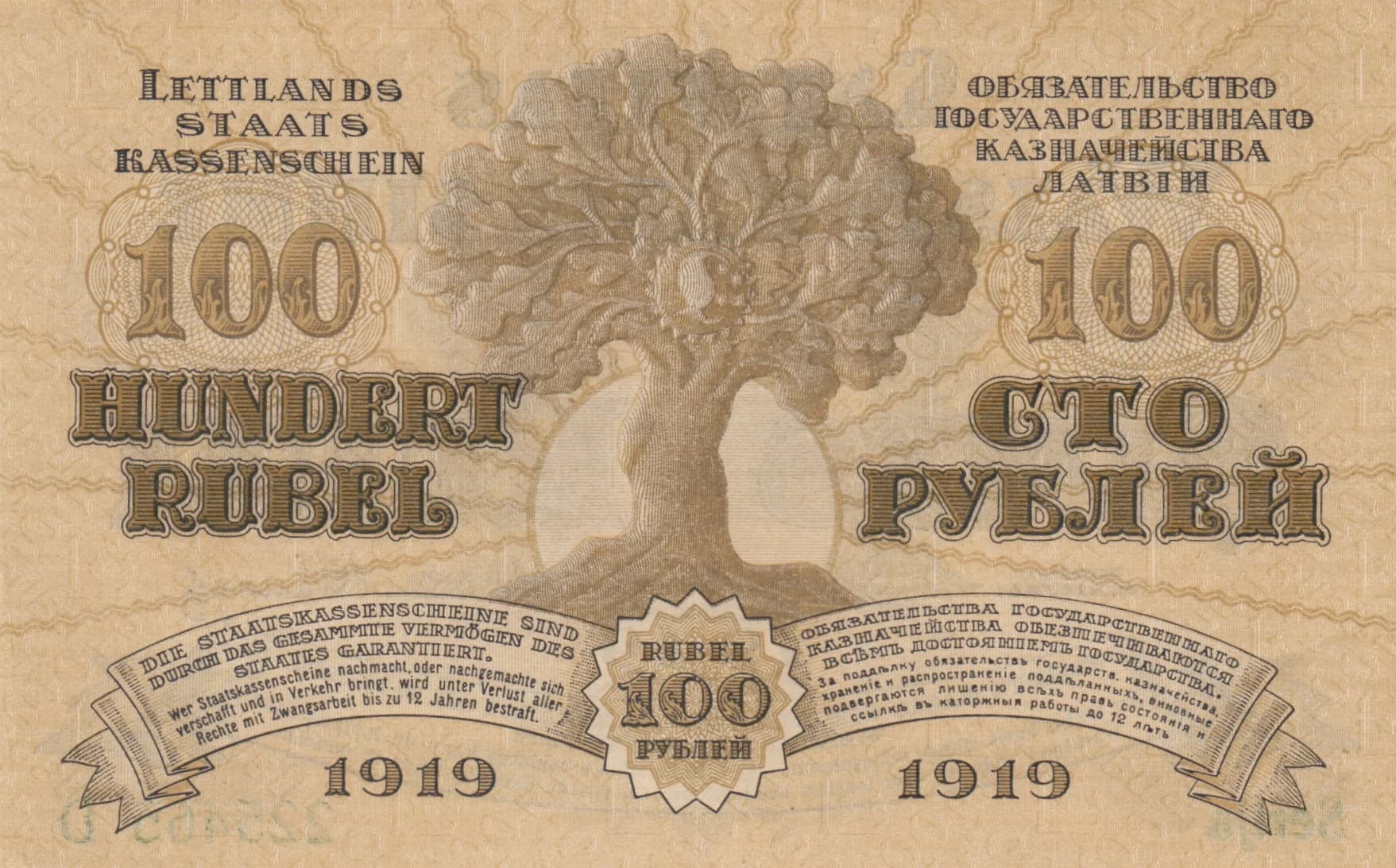
This is a well-preserved AU example of Latvia's 100 Rubli note from 1919, Pick P-7b, featuring Series D. The note displays the characteristic tan and brown coloring of early 20th-century Latvian currency with fine engraving throughout. The obverse presents a classical female portrait in the center with ornate Latvian text, while the reverse showcases an allegorical Liberty figure and multilingual inscriptions reflecting Latvia's transitional political status—a historically significant detail that makes this note particularly collectible for students of Baltic numismatics.
Common. The eBay market data provided shows consistent sales in the $37–$79 range across multiple condition grades (VG, F, VF) from 2016–2019, indicating steady collector demand and adequate supply. The 2016 catalog values place AU examples at approximately $110–$200, consistent with a frequently encountered early Latvian currency issue. Series D is documented as one of several known series (C, D, E, F, G, H, K), further confirming this is not a scarce variety. The note's historical importance ensures steady collector interest, but its availability in the market indicates it is not rare.
Issued during Latvia's declaration of independence in 1919, this banknote represents the nascent Latvian state's first assertion of monetary sovereignty following the Russian Revolution and World War I. The multilingual inscriptions in Latvian, German, and Russian on the reverse reflect the complex geopolitical environment of the newly independent nation, surrounded by former imperial powers and competing influences. The allegorical Liberty figure and heraldic elements on both sides symbolize the nation's newfound freedom and aspirations for stability during a turbulent period of Eastern European state formation.
The obverse features a centrally positioned classical female portrait rendered in fine engraving, identified as a personification of Latvia or the Latvian state. The reverse depicts an allegorical female figure representing Liberty or national prosperity, shown in elaborate classical drapery with flowing hair, rendered in three-quarter view. Both sides are surrounded by ornate decorative borders incorporating floral and geometric patterns typical of Central European banknote design of the period. Heraldic elements suggested in the framework reflect the national symbols of the newly independent Latvian state. The denomination '100' appears in prominent cartouches on both sides, with the numerical value emphasized through multiple presentations alongside Latvian ('SIMTS RUBĻI'), German ('HUNDERT RUBEL'), and Russian ('СТО РУБЛЕЙ') text. Fine line engraving throughout provides the primary security feature, with intricate portrait detailing and decorative elements serving as anti-counterfeiting measures.
OBVERSE (Front): 'LATVIJAS VALSTS KASES SIHMJE' (Latvia's State Treasury Note) — 'SIMTS RUBĻI' (One Hundred Rubles) — 'FINANŠU MINISTRES' (Finance Minister) — 'VALSTS KASES PĀRVALDNIEKS' (State Treasury Administrator) — '1919' (year of issue) — 'Serija' (Series) followed by serial number '225465 D' — Warning text: 'Par valsts kases sihmju wiltošanu, waj wiltotu sihmju usglabasanu un ispilašanu un spaldu darbeem lihds 12 gadeem' (For counterfeiting state treasury notes, or possession and use of counterfeit notes, punishment up to 12 years). REVERSE (Back): 'LETLANDS STAAT'S KASSENSCHEIN' (Latvia's State Treasury Note in German) — 'HUNDERT RUBEL' (One Hundred Rubles in German) — 'ОБЪЯВАТЕЛЬСТВО ГОСУДАРСТВЕННАГО КАЗНАЧЕИСТВА ЛАТВИИ' (Announcement of the State Treasury of Latvia in Russian) — 'СТО РУБЛЕЙ' (One Hundred Rubles in Russian) — Multiple denominations displayed as '100 RUBEL' and '100 РУБЛЕЙ' — '1919' (appears twice) — Security text in German: 'DIE STAATSKASCHEINE SIND DURCHES GAIRANPIERT' (The state treasury notes are guaranteed) — 'Wer Staatskascheine nachgemacht oder dergleiches nachgemachte zich unter Verlust seiner Rechte und Zwangsarbeit dis zu 12 Jahren Bestraf' (Whoever counterfeits state treasury notes or possesses counterfeited ones will be punished with loss of rights and forced labor up to 12 years).
Intaglio engraving (line engraving), the standard security printing technique for banknotes of this era. The fine detail visible in the portrait work, ornamental borders, and text inscription indicates professional banknote engraving characteristic of Central European security printers working for newly established nations in 1919. The printer is not definitively identified in the provided catalogs, though Latvian government notes of this period were produced by established European security printing facilities.
This note is identified as Pick P-7b, one of three cataloged variants (P-7a, P-7b, and P-7f), all featuring the watermark of light lines. The specimen examined belongs to Series D, as indicated by the serial number prefix '225465 D' visible on the obverse. The catalog reference notes three legend varieties exist for this denomination, though the specific legend variant of this example would require expert comparison. The series designation (D) places it within the documented range of series (C through K) known for this issue, representing a standard variety within the P-7b classification.