10 latu 1933
“serie C”
Market Prices
6 salesAbout This Note
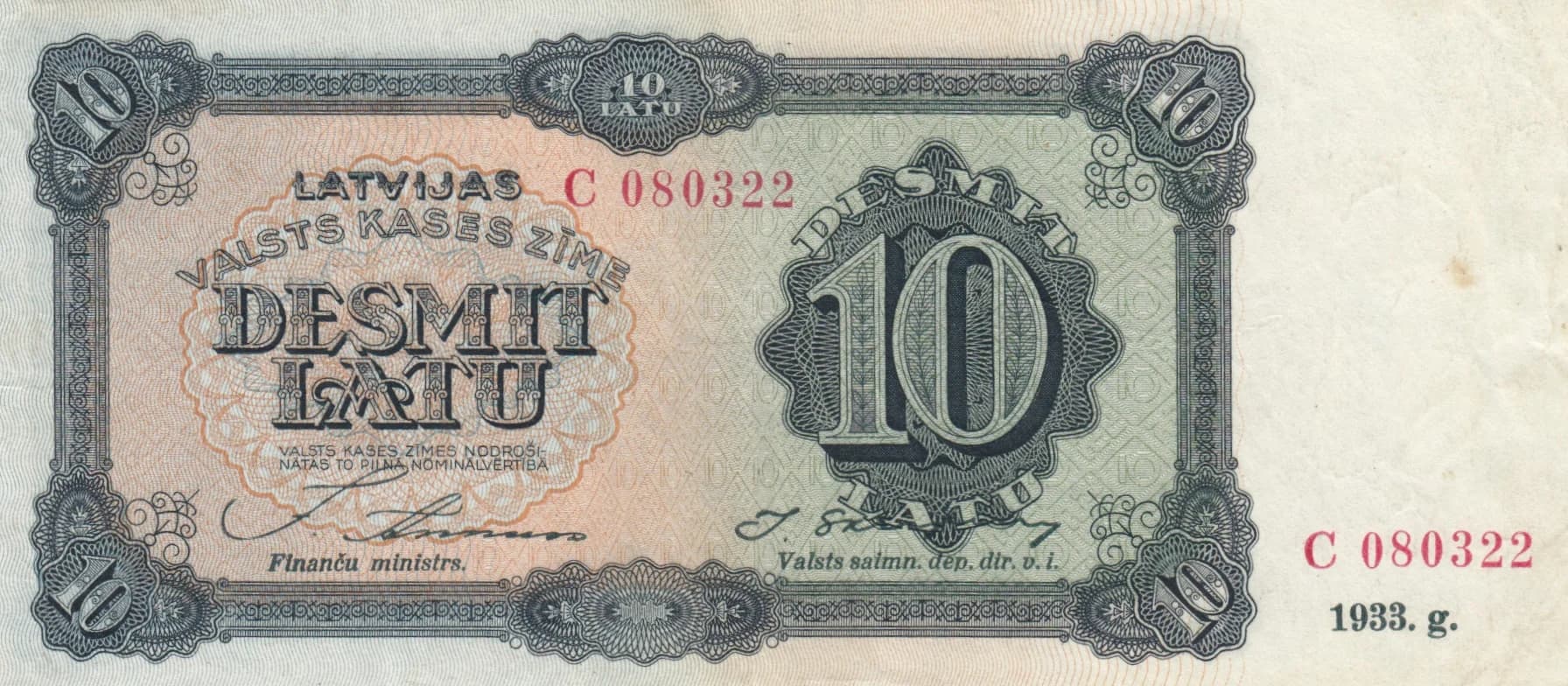
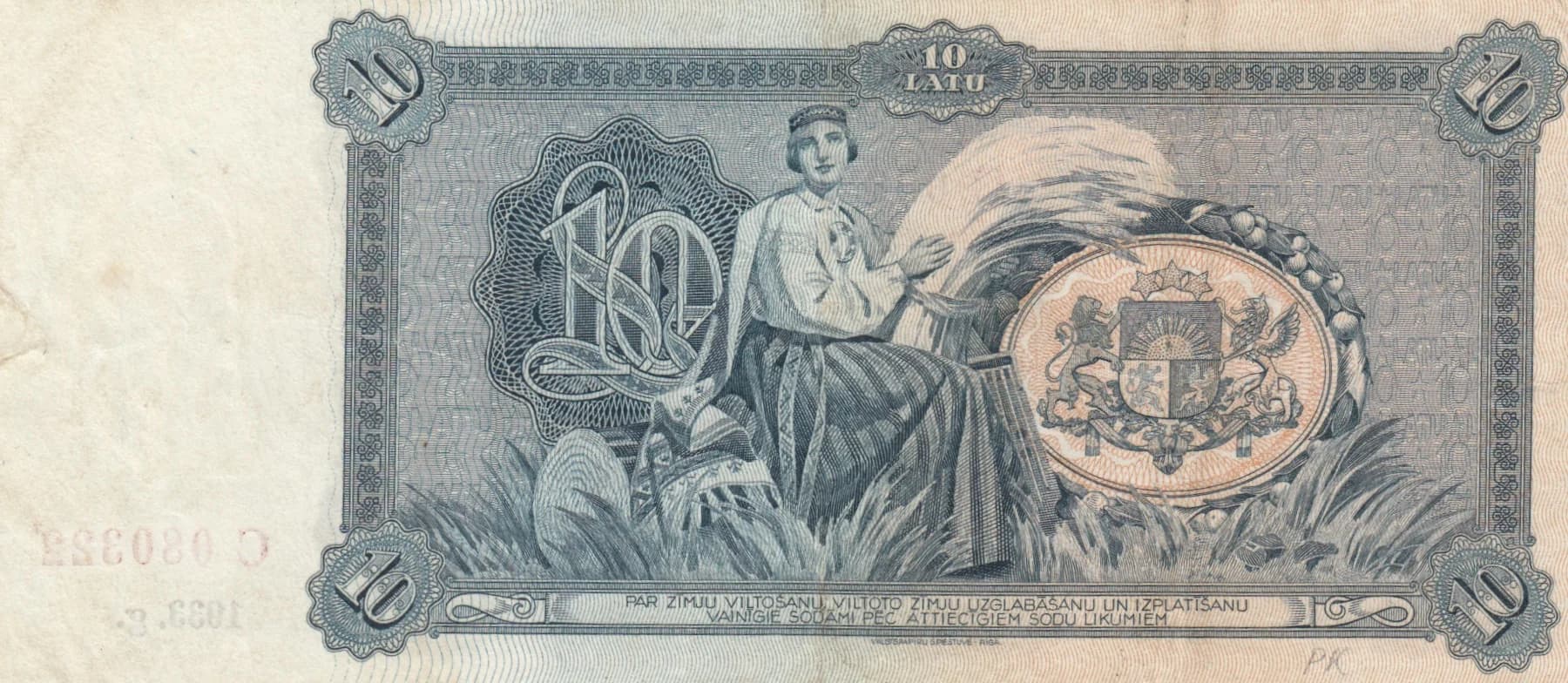
This VF-graded 10 Latu note from 1933 represents a well-preserved example of interwar Latvia's elegant currency design. The note displays crisp ornamental borders, clear inscriptions, and the characteristic allegorical imagery on the reverse, with only light aging consistent with its 91-year age. Serial number C 080322 places this in the early production run, and the VF condition aligns with eBay market performance where similar notes have consistently sold in the $40–$52 range.
Common. eBay market data shows consistent sales in the $40–$52 range for VF examples over the past decade, with prices remaining stable and auctions regularly achieving 14–22 bids. The 2016 catalog value of $100 VF reflects pre-market correction estimates; actual realized prices are considerably lower. As a regular-issue note from a 1933 production run by a stable government issuer, large quantities circulated and survived, making this denomination readily available to collectors.
Issued by the Latvijas Valsts Kases (Latvian State Treasury) during the interwar period, this 1933 note reflects Latvia's assertion of financial independence following the country's 1922 stabilization and adoption of the lats currency. The allegorical female figure on the reverse—depicted in classical style holding maritime symbols—embodies the nation's aspirations and connection to Baltic maritime trade, while the ornate heraldic coat of arms reinforces state sovereignty during a period of relative stability before Soviet occupation in 1940.
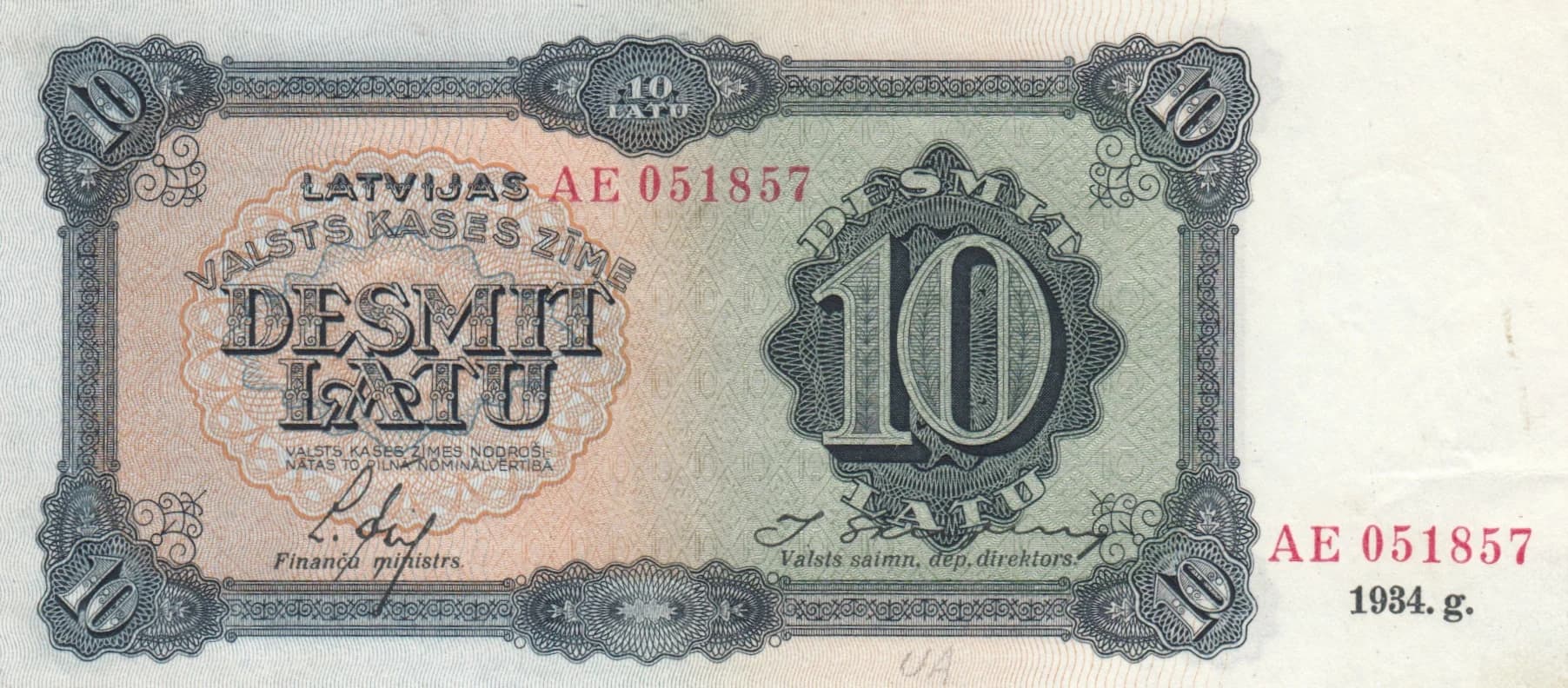
The obverse features a formal architectural composition with an ornamental shield cartouche containing the large numeral '10' as the dominant element, flanked by Latvian state inscriptions and signatures of the Finance Minister and State Economic Department Director. The reverse displays an allegorical female figure in classical style, seated and holding a ship's wheel—symbolizing Latvia's maritime heritage and economic aspirations. This female personification represents the nation itself (similar to Liberty or Britannia on other European notes). The reverse also bears the Latvian coat of arms in an ornamental heraldic frame, reinforcing state authority. Both sides employ fine-line engraving with intricate geometric and floral border patterns, and the color scheme uses black and dark gray printing on cream stock with subtle peachy-pink and light green tints.
FRONT SIDE: 'Latvijas Valsts Kases Zīme' (Latvian State Treasury Note); 'Desmit Lartu' (Ten Lats); 'Valsts Kases Zīmes Nodrošinājumā Naudas To Pilda Nominalvertībā' (This note is secured by the State Treasury Fund, redeemable at its face value); 'Finanču ministrs' (Finance Minister); 'Valsts saimn. dep. dir. v. i.' (State Economic Department Director, Acting); Serial number 'C 080322'. BACK SIDE: '10 Latu' (Ten Lats); 'Par Zīmu Viltošanu Viltotu Zīmju Uzglabāšanu Vai Izplatīšanu Vainīgie Sodāmi Pēc Attiecīgiem Sodu Likumiem' (Those responsible for counterfeiting, storage or distribution of forged notes shall be punished according to applicable laws).
Intaglio engraving (recess printing), executed by the Valsts Papīru Spiestuve (State Printing Works) in Riga. The fine-line detail work visible in the ornamental borders, the allegorical figure, and the heraldic shield, combined with the crisp registration and deep black color, are characteristic of high-security intaglio production. The serial number appears in red ink applied by a secondary printing method. No watermark is visible in the visual analysis, though PMG records indicate a Man's Head watermark for the P-25a variety.
This specimen is identified as Pick P-25a variant, characterized by a Man's Head watermark. The serial number format 'C 080322' indicates Series C production. PMG records document five variants for the base Pick number (P-25a through P-25f), primarily differentiated by watermark designs and signature combinations. The specific combination of Series C, the Man's Head watermark, and the Finance Minister/State Economic Department signatures confirms the P-25a classification. No unusual overprints or date variations are evident in this example.