5 kip 1957
Market Prices
12 salesAbout This Note
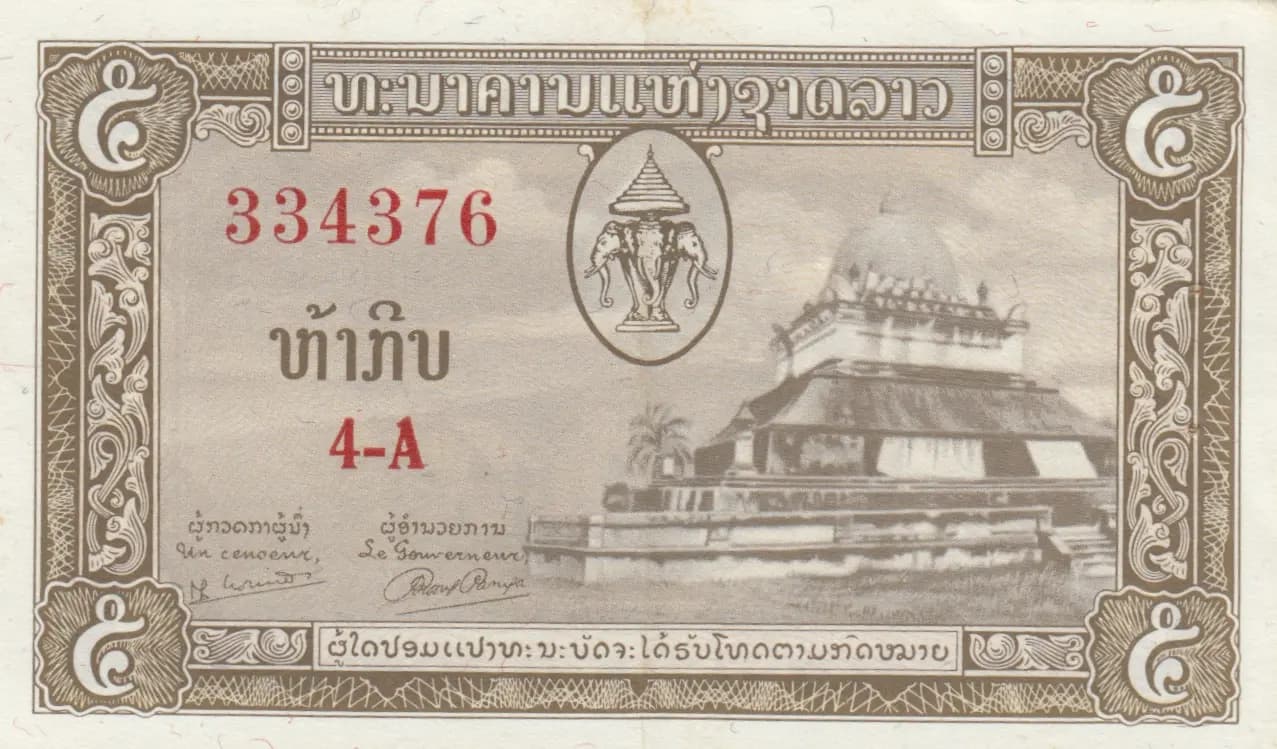
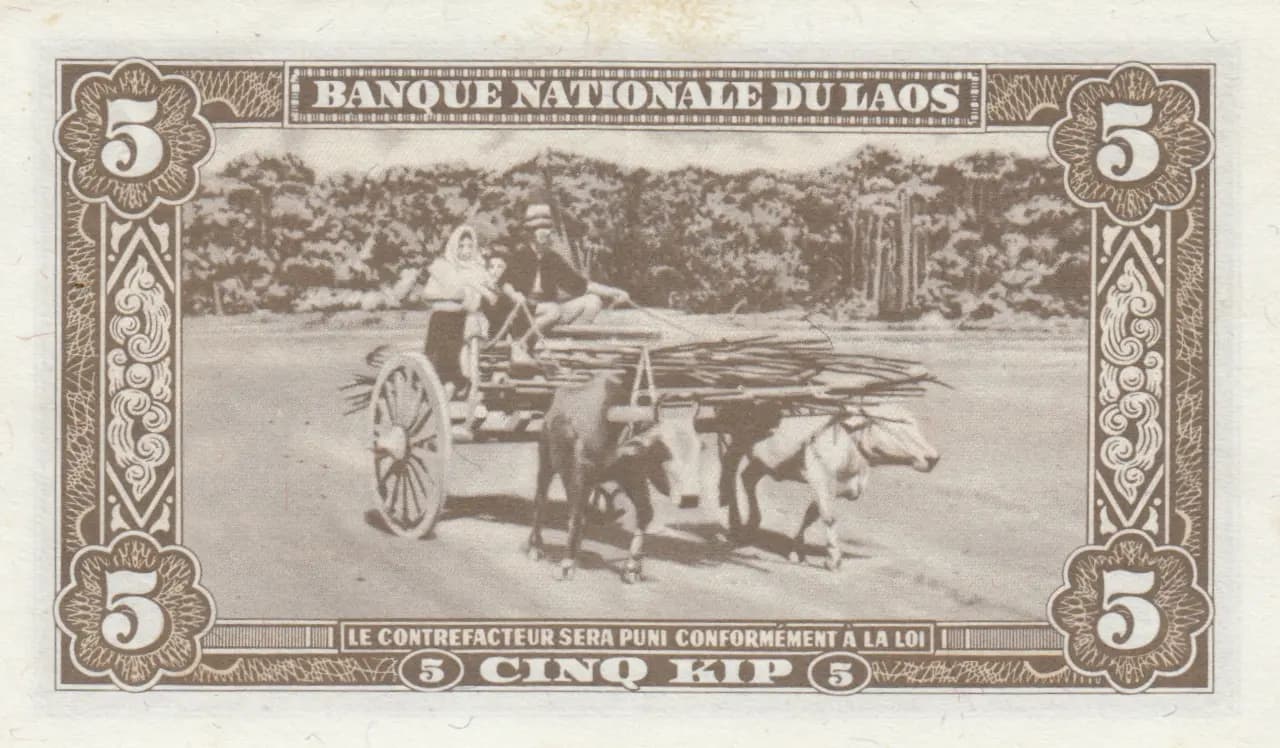
This is a well-preserved example of the Banque Nationale du Laos 5 kip note from 1957 (Pick P-2b), graded EF condition. The note displays the characteristic brown-on-pale orange color scheme with the iconic Makmo temple depicted on the obverse and an ox cart scene on the reverse, both rendered with fine detail despite visible aging patina consistent with a 65+ year old note. The crisp serial number (334376) in red ink and clear signature lines remain legible, making this an attractive representation of early Laotian currency.
Common. The P-2b variant (SBPF printing) of the 5 kip 1957 is a regular issue banknote with no apparent print run restrictions or recall history. eBay market data shows consistent sales in the $5–$13 range for EF-AUNC specimens from 2015–2020, with catalog values listed at $4 for UNC condition, indicating steady but modest collector demand typical of early post-colonial Southeast Asian currency. High print runs and continued availability in collections support a common classification.
Issued in 1957 by the newly independent Kingdom of Laos, this banknote reflects the nation's transition to sovereignty and cultural identity through its choice of imagery. The Makmo temple in Luang Prabang and the ox cart—depicted loaded with logs in a forested setting—represent the spiritual and economic foundations of mid-20th century Laos, emphasizing Buddhist heritage and the timber trade that was central to the regional economy. The bilingual French-Lao inscriptions reflect Laos's recent transition from French colonial administration.
The obverse features an ornate decorative border with Thai/Lao scrollwork and geometric patterns in tan and cream. The central design showcases a ceremonial four-elephant parasol (royal umbrella symbol) in an oval medallion, a symbol of prestige and Buddhist royal authority in Laotian culture. To the right stands the Makmo temple ("Watermelon" temple) in Luang Prabang, identifiable by its distinctive multi-tiered roofs and traditional Southeast Asian Buddhist architecture, with a palm tree in the composition. Two signature lines appear in the lower left. The reverse displays a robust ox cart laden with timber logs, driven by a figure, set against a lush forested backdrop with dense vegetation. The design employs classical banknote engraving with fine linework throughout. The denomination '5' appears in four ornate circular frames at the corners, with bilingual French-Lao text. Overall composition reflects Belle Époque-influenced design common to early-to-mid 20th century colonial and post-colonial Indochinese currency.
Front: Serial number 334376 (red, left side); "ບາດທານ" (Lao: Denomination marking); "4-A" (Note designation); "ສະຫະພາບປະຊາທິປະໄຕ ປະຊາຊົນລາວ" (Lao: Lao People's Democratic Republic — though this text appears anachronistic for a 1957 issue and may indicate overprinting or later republication). Back: "BANQUE NATIONALE DU LAOS" (French: National Bank of Laos, top center in white on brown band); "5" (Denomination numerals in four corners); "CINQ KIP" (French: Five kip, bottom center); "LE CONTREFACTEUR SERA PUNI CONFORMÉMENT À LA LOI" (French: Counterfeiters will be punished according to the law).
Intaglio engraving (recess printing), characteristic of security banknotes of the era. The printer for P-2b variant is identified as SBPF (Société de Banque et de Placement Français), distinguishing it from the P-2a variant printed by SBNC (Société Banque Nationale de Crédit). The fine detail, decorative borders, and security elements such as the ornate frames are consistent with traditional high-security intaglio processes used for currency production.
This note is catalogued as P-2b, the second printing variant of the 5 kip 1957 issue, distinguished from P-2a by its printer attribution to SBPF rather than SBNC. The visual analysis notes the absence of security dots, which aligns with documentation that the second issue (P-2b) omitted this security feature present in earlier variants. The 1957 date, brown-on-pale orange color scheme, Makmo temple obverse, and ox cart reverse are consistent across all 1957 5 kip variants (P-2a, P-2b, P-2s). Serial number prefixes and signature varieties may exist but cannot be definitively established from the single note image; the red serial number format (334376) appears standard for the type. No overprints are visible.