50 yen 1951
Market Prices
13 salesAbout This Note
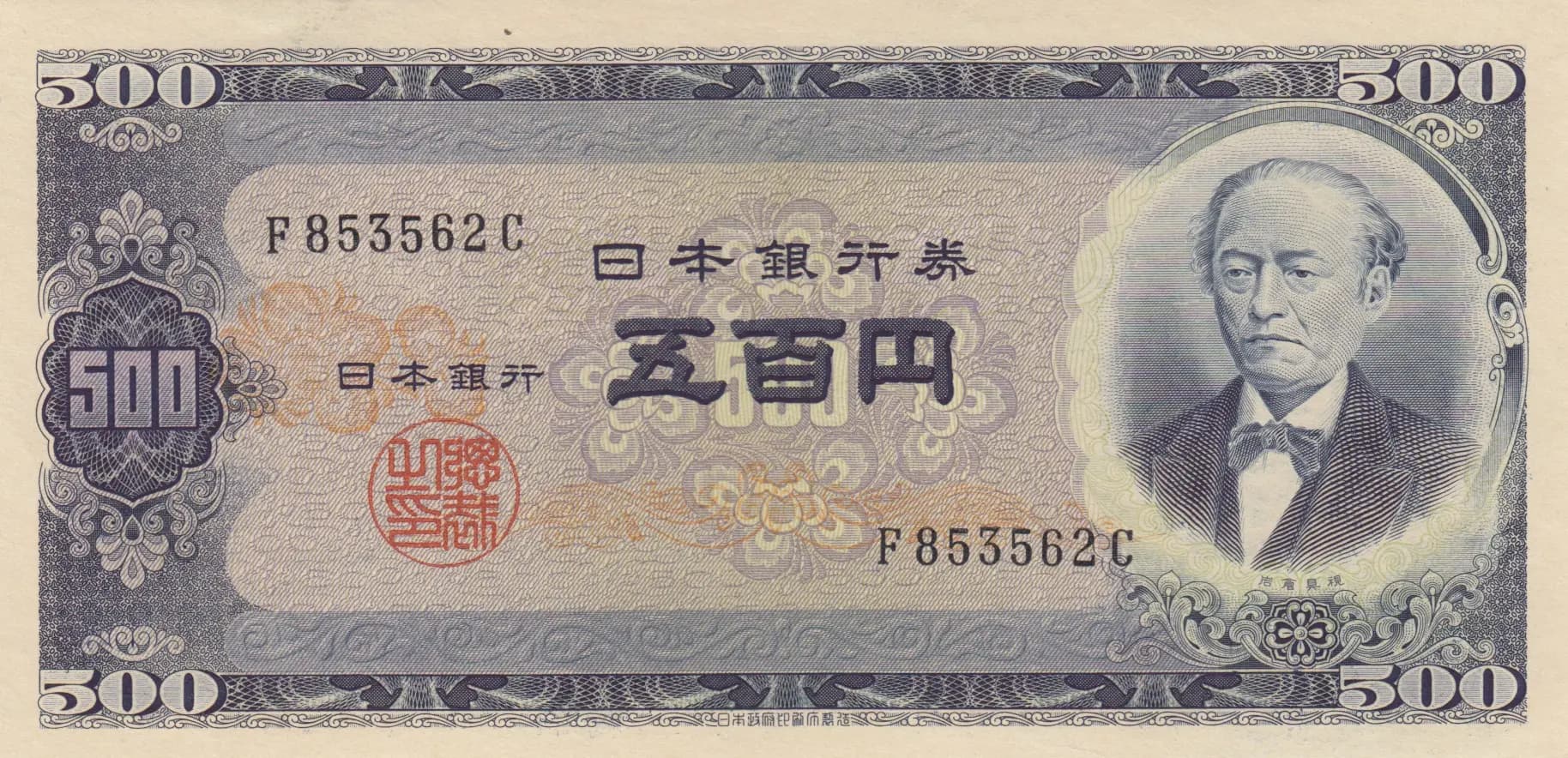
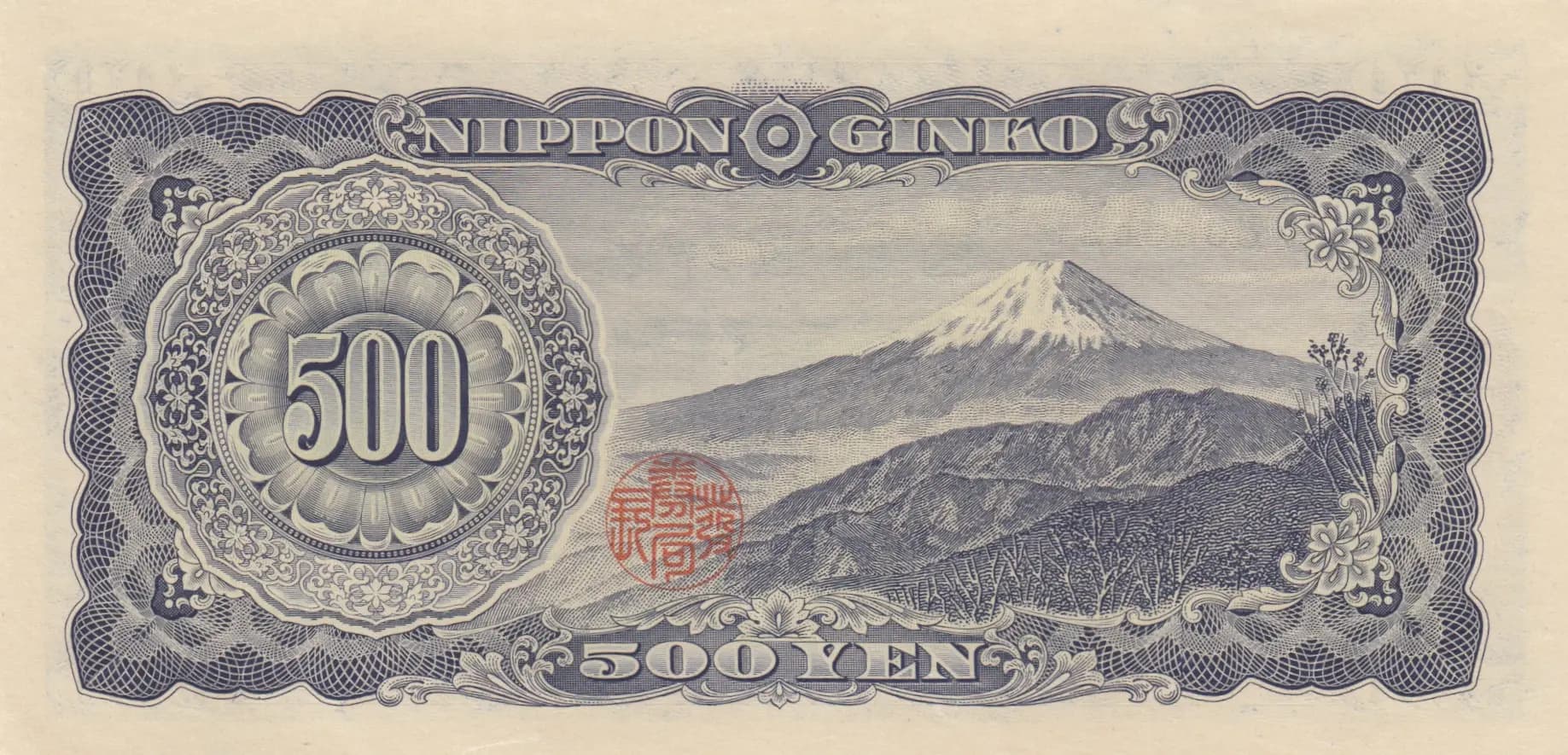
This is a beautifully preserved 500 Yen note from 1951 (Pick P-91), the early post-war Bank of Japan issue featuring a formal portrait of Iwakura Tomomi on the obverse and Mount Fuji on the reverse. The note exhibits exceptional uncirculated condition with crisp printing, vibrant colors (purple-blue on multicolor underprint), and no visible wear, creases, or stains. The ornate engraving work, red official government seal, and fine line detailing throughout demonstrate the high-quality security printing standards of the era.
Common. This is a regular circulation issue from 1951 with substantial print quantities, as evidenced by eBay auction data showing consistent sales across multiple grades (VF to PMG 66) at modest prices ranging from $1.38 to $89 USD depending on grade. Even in AU/UNC condition, comparable notes have sold in the $35-89 range in recent years, indicating healthy supply in the collector market. The catalog value for UNC is listed at $35 (2016), confirming this is a readily obtainable note for collectors.
This 1951 note was issued during Japan's post-war economic recovery period under Allied occupation, representing the Bank of Japan's effort to establish stable currency following World War II. The selection of Iwakura Tomomi, a Meiji-era statesman and modernizer, reflects Japan's cultural heritage and aspirations for renewed prosperity, while Mount Fuji on the reverse serves as a national symbol of Japan's enduring identity. The note's formal Western design elements with Japanese cultural imagery exemplify the blended aesthetic of Japan's post-war reconstruction era.
The obverse features a formal three-quarter portrait of Iwakura Tomomi (1825-1883), the prominent Meiji-era statesman and foreign minister, positioned on the right side wearing Western business attire (dark suit and bow tie). The reverse displays a landscape scene of Mount Fuji with its characteristic snow-capped peak dominating the background, rendered in fine engraved detail with forested hills in the foreground. Both sides feature ornate decorative borders with floral and geometric patterns typical of 1950s Japanese banknote design, elaborate corner medallions, and prominently displayed denomination numerals (500) in multiple locations. The color scheme of purple-blue with gray and cream underprinting creates a sophisticated, formal appearance.
Front side: '日本銀行券' (Nippon Ginko Ken / Bank of Japan Note), '五百円' (Go-hyaku en / Five Hundred Yen), '500' (Arabic numerals), and serial number 'F853562C'. Back side: 'NIPPON GINKO' (Bank of Japan in romanized form), '500 YEN' (English denomination), and '500' (Arabic numerals in ornamental frame). Red official government seals appear on both sides bearing Japanese characters indicating official Bank of Japan authorization.
This note was produced using intaglio (engraved) printing, evidenced by the fine line work visible in the portrait rendering, detailed landscape elements, ornate border designs, and the sharp definition of all text and numerical elements. The multi-color printing required multiple passes to achieve the purple-blue, gray, and cream color combinations. The Japanese government security printers (likely the Bureau of Engraving and Printing or contracted security printer) produced this issue with the characteristic high-quality detail and security features standard for Bank of Japan notes of this period.
Per PMG population data, this Pick number (P-91) exists in at least four cataloged varieties: P-91a (500 Yen with 500 watermark), P-91b (Cream Paper), P-91c (White Paper), and P-91s (specimen). The visual analysis shows single-letter serial number prefix 'F' (F853562C), consistent with the regular circulation issue. Without access to watermark examination or detailed paper analysis from the images provided, the specific variety cannot be definitively determined, but the cream/beige tone of the paper and overall appearance are consistent with standard circulation P-91c (White Paper) variety.