1/2 yen 1872
Market Prices
3 salesAbout This Note
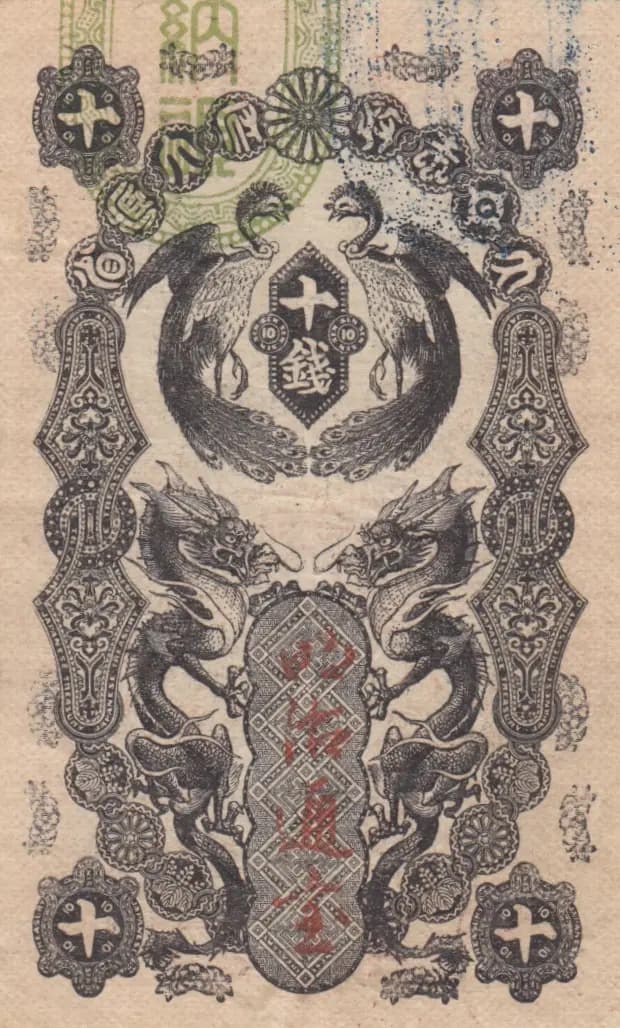
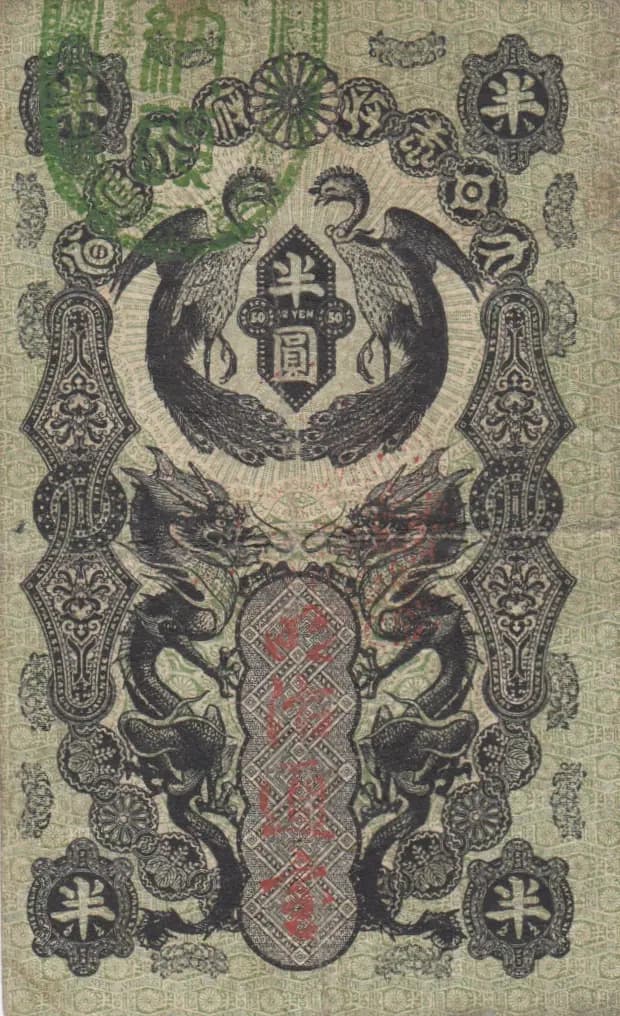
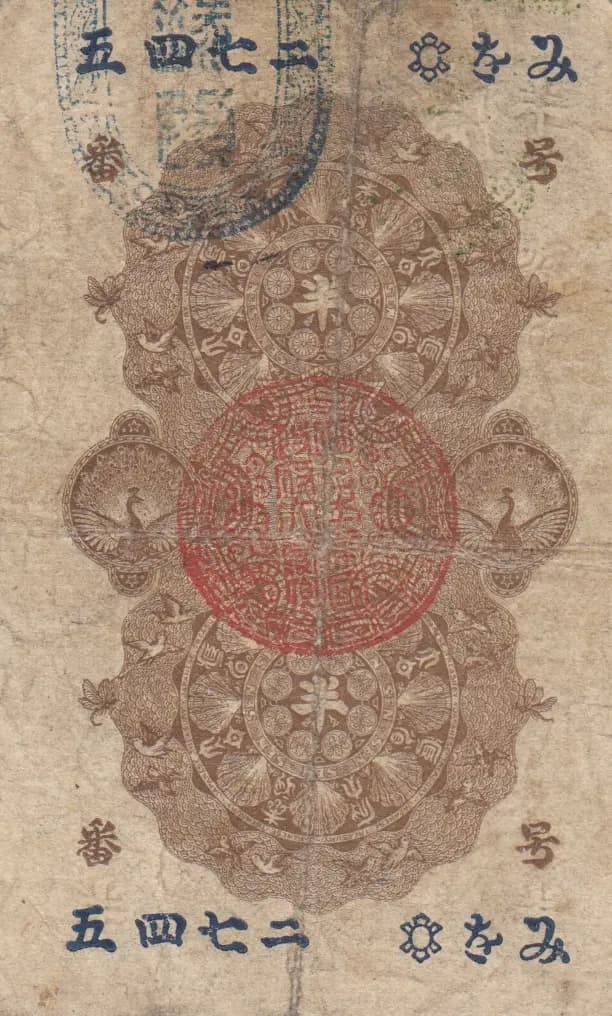
This 1872 Japanese 1/2 Yen (Pick-3) represents an early Meiji period government currency issue featuring distinctive East Asian iconography: stylized birds (likely Onagadori cockerels) and paired dragons arranged symmetrically around a central shield motif on the obverse, with an elaborate red seal design and fan-patterned emblems on the reverse. The note exhibits heavy age-related wear consistent with 19th-century paper deterioration, including creasing, yellowing, and fading typical of extensively circulated historical specimens. At catalog grade F with documented market values around $125, this represents a significant early Japanese banknote with multi-color security printing by the Frankfurt firm Dondorf and Naumann.
Common. While historically significant as an early Meiji banknote, the P-3 1/2 Yen denomination demonstrates common availability in the collector market. eBay transaction data shows regular sales activity with specimens grading PMG 30 selling for approximately $177-180 and VF examples bringing $123, indicating steady demand but not scarcity premiums. The 2016 catalog value of $125 for F-grade specimens aligns with observed market transactions, and the lack of any notation of restricted print runs or recalls suggests adequate original circulation. Age and condition-related wear account for market value rather than numismatic rarity.
This note was issued by the Dai Nippon Seifu Okurasho (Great Japanese Government Ministry of Finance) during the early Meiji Restoration (1872), a period of rapid modernization when Japan transitioned from feudal currency systems to Western-style banknotes. The symbolic imagery—crescent moons, dragons, and sacred shields with cross motifs—reflects the cultural synthesis occurring during this era, blending traditional Japanese artistic elements with European security printing techniques to establish governmental authority and financial legitimacy. The employment of Frankfurt-based Dondorf and Naumann as printers underscores Japan's deliberate engagement with Western technological expertise to create modern, counterfeit-resistant currency.
The obverse features a symmetrically balanced composition centered on an ornate circular medallion containing a crescent moon with two spread-winged birds (identified as Onagadori cockerels, a traditional Japanese breed) flanking a shield bearing a cross symbol. Below this primary motif sits a prominent red diamond-shaped pattern. Two large dragon or mythical beast figures (likely representing imperial or protective symbolism) occupy the flanking positions on either side of the central design. The entire composition is framed by elaborate engraved borders incorporating rosette corner decorations and continuous floral/geometric patterns throughout. The reverse displays a large red circular seal or official stamp as the central focus, with radiating fan-like or flower-petal emblems positioned above and below, complemented by smaller circular decorative elements on the lateral margins. Both sides employ fine crosshatch background patterns as a security measure. The overall design aesthetic reflects Meiji-era synthesis of Japanese artistic tradition with European heraldic and ornamental conventions.
FRONT SIDE: '半円' (Han'en / Half Yen) - the denomination; '明治' (Meiji) - indicating the Meiji era of issuance. BACK SIDE: '五四七二' (Go-Shi-Shichi-Ni / 5-4-7-2) - appears to represent either a serial number component or numerical sequence notation; 'みな' (Mina) - a hiragana particle or word fragment repeated at top and bottom, purpose unclear but possibly part of official notation or printer's mark. Additional Japanese characters appear throughout margins and corner decorations but are too stylized in the ornamental context to fully decipher from visual analysis alone.
Intaglio engraving with multi-color letterpress overprinting. The note was produced by Dondorf and Naumann of Frankfurt, Germany, employing color separation for the green, red, and brown inks visible across the design. The fine crosshatch background pattern, intricate engraved detail work, and precise geometric borders are hallmarks of high-security intaglio production typical of 1870s European banknote manufacture. The multi-pass color application (black primary design with green, red, and brown security inks) represents state-of-the-art anti-counterfeiting methodology for the period.
The observed specimen aligns with the standard P-3 1/2 Yen issue (ND 1872). The PMG Population Report indicates eight variants catalogued under this base Pick number, though this visual specimen does not show evidence of distinguishing features (such as watermarks, signature variants, or overprints) that would separate it into a numbered sub-variety (e.g., P-3a, P-3b). Serial number components visible on the reverse ('五四七二' and repeated notation) appear consistent with standard government serial numbering practices but do not constitute a distinct cataloged variety. This note should be cataloged as P-3 without further variety designation unless examination reveals watermarks or other variants visible only in direct inspection.