50 sen 1948
Market Prices
12 salesAbout This Note
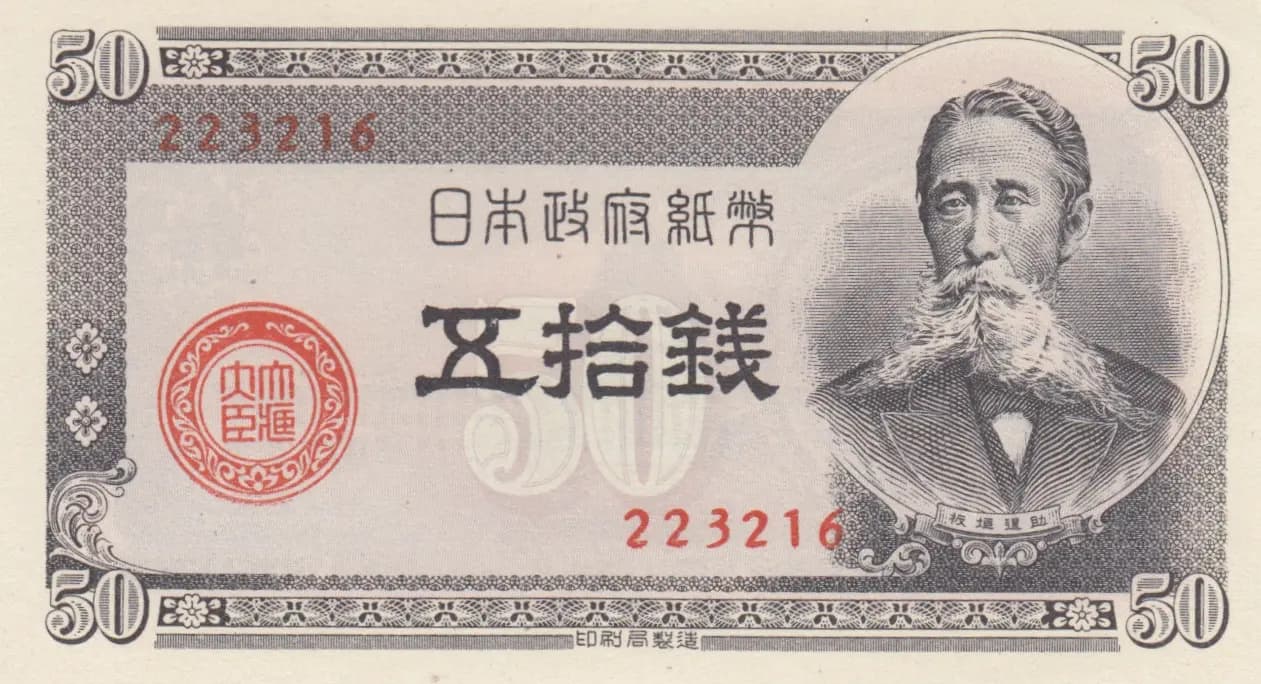
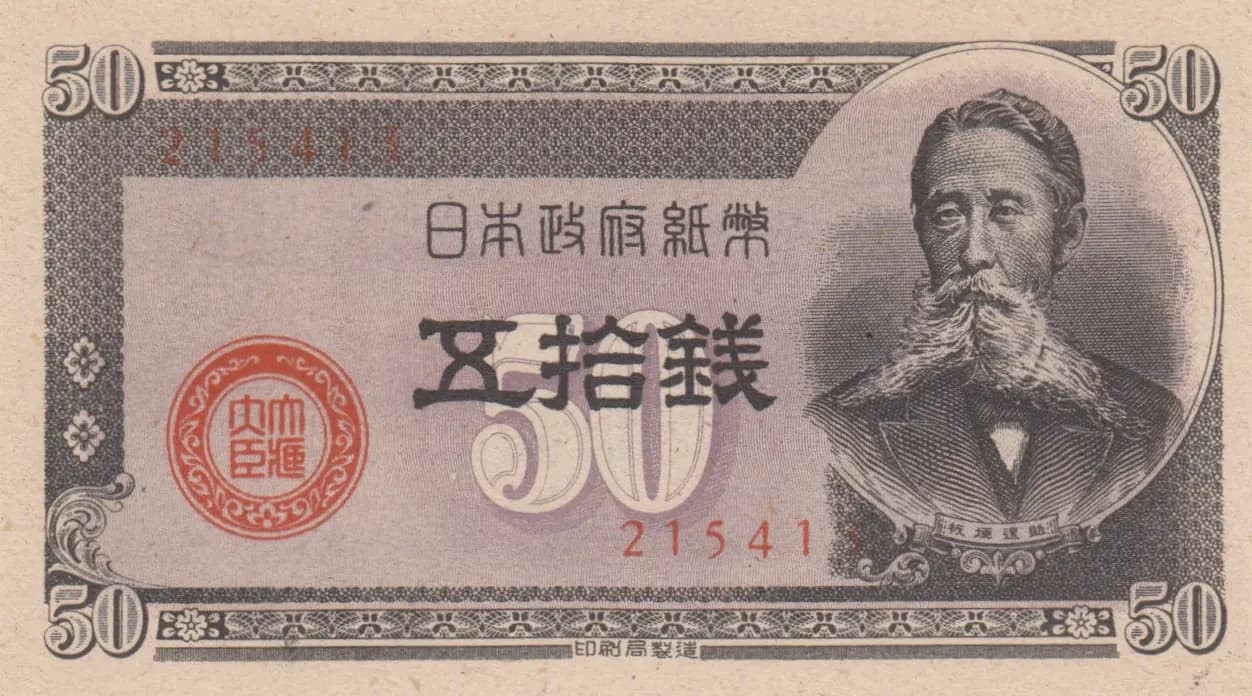
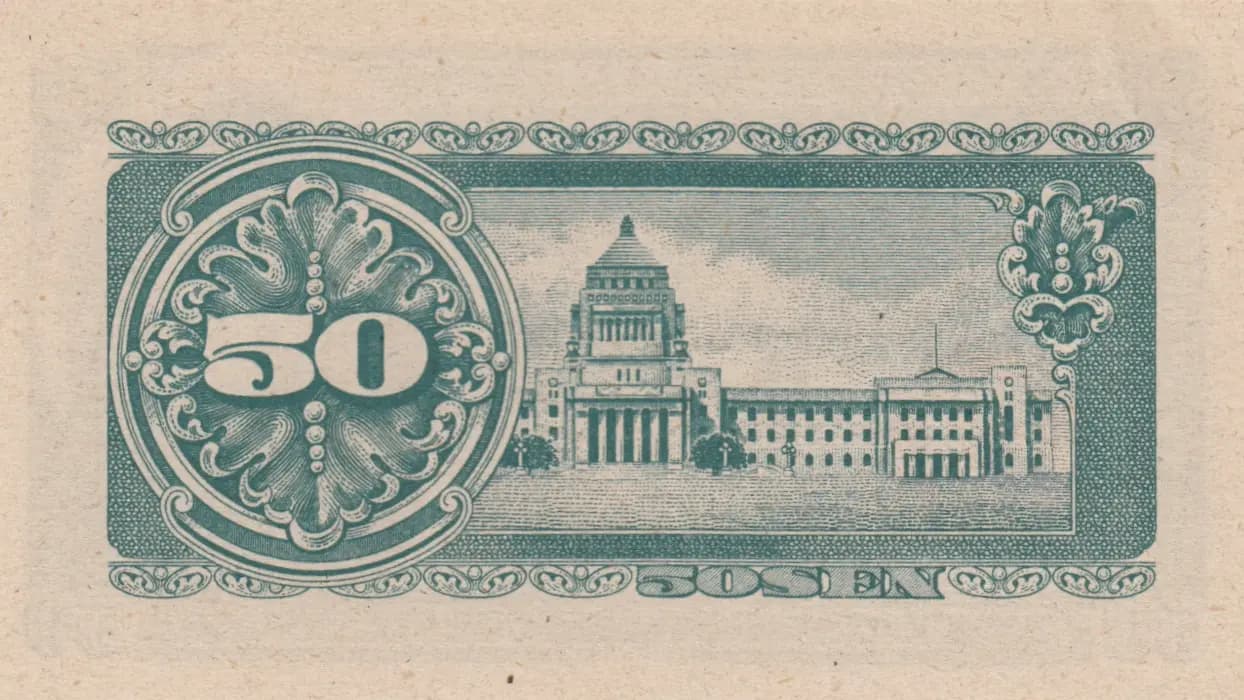
This 50 sen note from 1948 presents in AU condition with excellent preservation of its distinctive grayish-tan patina and clear impressions. The front features a striking portrait of Taisuke Itagaki rendered in brown and black inks against a lilac underprint, while the reverse showcases the iconic Japanese Diet building in green and teal tones. The note's ornate decorative borders, fine line security patterns, and well-preserved circular seals demonstrate the refined engraving quality typical of early postwar Japanese government currency.
Common. The eBay sales data provided shows consistent trading at modest prices ($3-$22.50 depending on grade), with numerous transactions across multiple years and conditions. Catalog values from 2016 list UNC examples at only $2, and VG at $0.25. The 50 sen denomination from 1948 had a substantial print run typical of regular-issue postwar currency, and examples remain readily available in the collector market. No print run restrictions or recall status affects rarity for this Pick number.
This note was issued during Japan's early postwar period under Allied occupation (1945-1952), when the Nippon Seifu Shihei (Japanese Government Notes) authority resumed currency production. The choice to honor Taisuke Itagaki, a prominent Meiji-era statesman and advocate for democratic reform, reflects Japan's postwar pivot toward democratic governance, while the depiction of the Diet building on the reverse reinforces this theme of parliamentary democracy during the reconstruction era.
The obverse features a right-facing profile portrait of Taisuke Itagaki (1837-1919), the bearded statesman and co-founder of Japan's first political party, rendered in brown and black tones. A prominent red circular seal with ornate decorative borders and Japanese characters is positioned on the left. The reverse displays the Japanese Diet (Parliament) building in Tokyo—a neoclassical structure with a distinctive central dome, multiple columns, and symmetrical architecture—rendered in green and teal inks. A large ornamental circular medallion containing the denomination '50' is featured on the left side. Both sides feature intricate fine-line background patterns and decorative borders with floral and geometric ornamental designs at top and bottom.
Front side: '日本銀行紙幣' (Bank of Japan Note / Japanese Government Note), '五十銭' (50 sen), '50' (Arabic numeral denomination), Serial number '21541', '日本銀行総裁' (Governor of Bank of Japan). Back side: '50' (Arabic numeral denomination). Note: The visual analysis references 'Bank of Japan' inscriptions, though this issue predates the Bank of Japan's resumption of note-issuing authority; the issuer is the Japanese Government (Nippon Seifu Shihei).
Intaglio (copperplate) engraving, the standard security printing method for Japanese government notes of this period. The fine line patterns, ornate circular seals, and detailed portrait rendering are characteristic of high-security intaglio production. The note was likely produced by the Japanese Government Printing Bureau (Kokka Insatsu Kyoku) or contracted security printers under their supervision.
The specific variety is Pick 61a, the standard 1948 issue. Serial number '21541' visible on this specimen is consistent with regular production runs. No obvious overprints, date variations, or signature varieties are apparent from the visual analysis. The note shows the standard lilac/brown front and green/teal back color scheme for this denomination and date.