50 sen 1942
Market Prices
14 salesAbout This Note
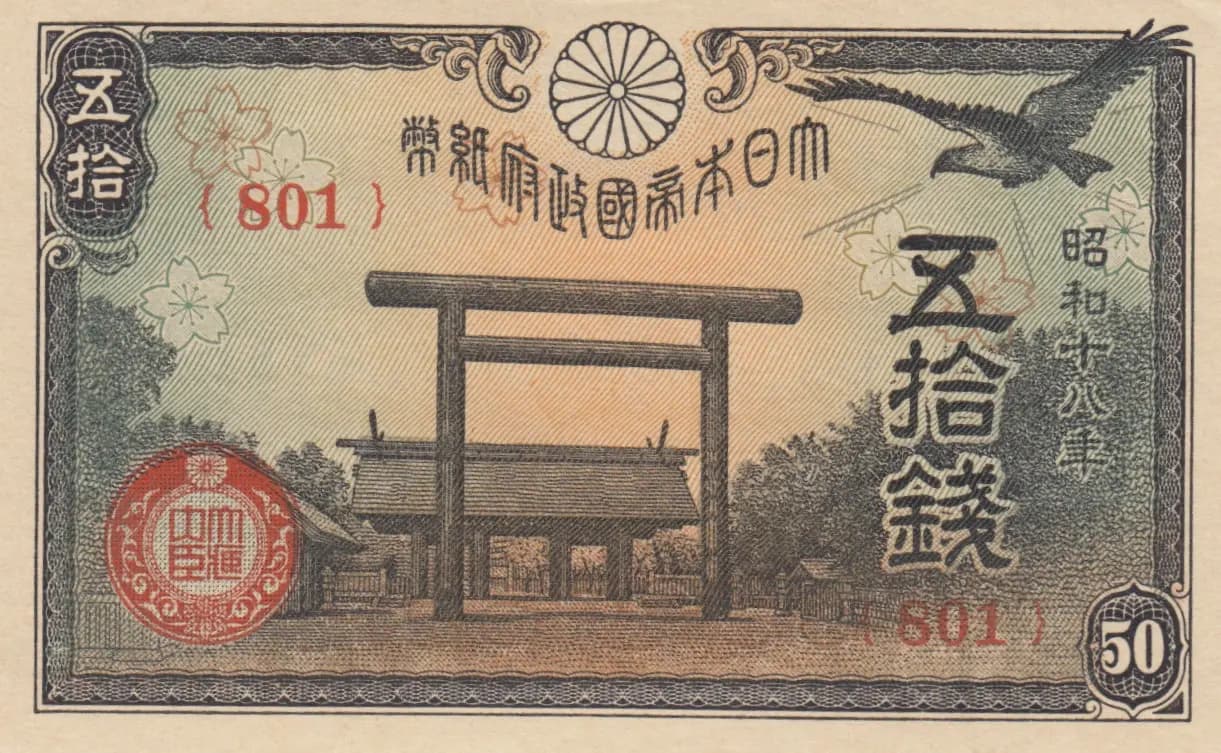
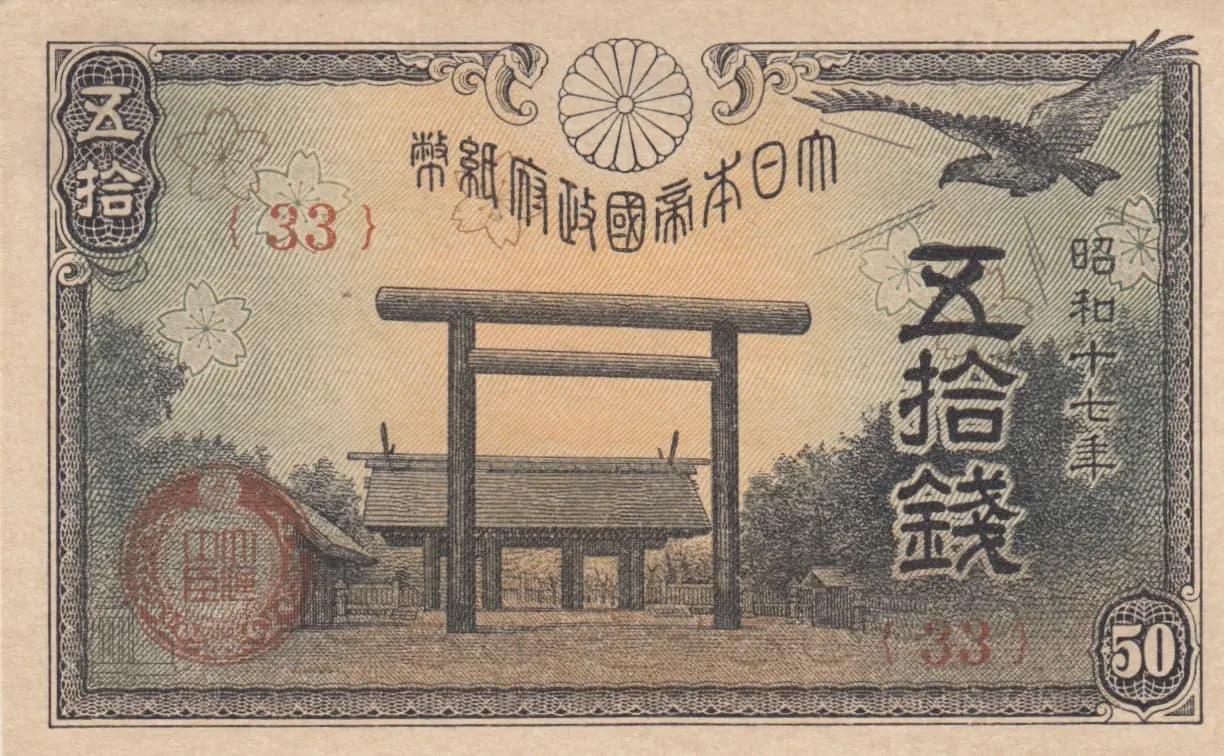
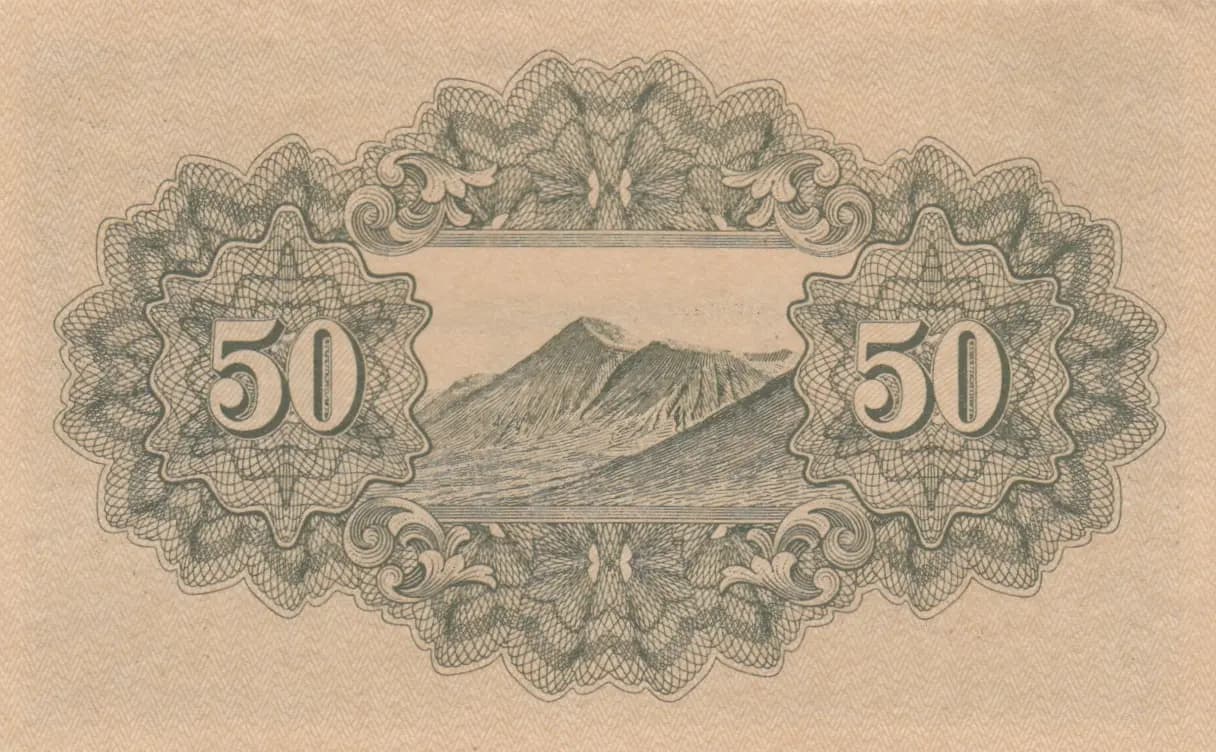
This is a splendid example of Japan's Showa 17 (1942) 50 sen note in AU condition, showcasing the iconic Yasukuni Shrine torii gate on the obverse with an imperial chrysanthemum and eagle, paired with a serene volcanic mountain landscape on the reverse. The note exhibits sharp, clear printing with no visible creases or tears, displaying only the subtle patina consistent with an 82-year-old banknote—a desirable specimen that captures the artistic refinement of wartime Japanese currency.
Common. This note has a catalogued denomination value of $8 UNC (2016 catalog values), and eBay auction data shows consistent sales in the $1-$5 range across multiple condition grades (F, VF, EF, AUNC) from 2009-2022, with the highest recorded sale at $27 in 2016 (likely an outlier or special lot). These low, stable market prices across numerous transactions indicate a note with substantial surviving examples in the collector market. Production was continuous across the 1942-1944 date range for this Pick number, and no historical evidence suggests a particularly limited print run or high redemption rate that would create scarcity.
Issued during Japan's Showa 17 (1942), this note was produced by the Dai Nippon Teikoku Seifu Shihei (Great Imperial Japanese Government) during the final years of World War II when Japan controlled vast territories across Asia. The Yasukuni Shrine depicted on the obverse held profound symbolic significance in imperial Japan as a Shinto shrine dedicated to those who died in service to the emperor, while the mountain on the reverse likely represents Mount Fuji or another sacred peak, reinforcing nationalist imagery during wartime.
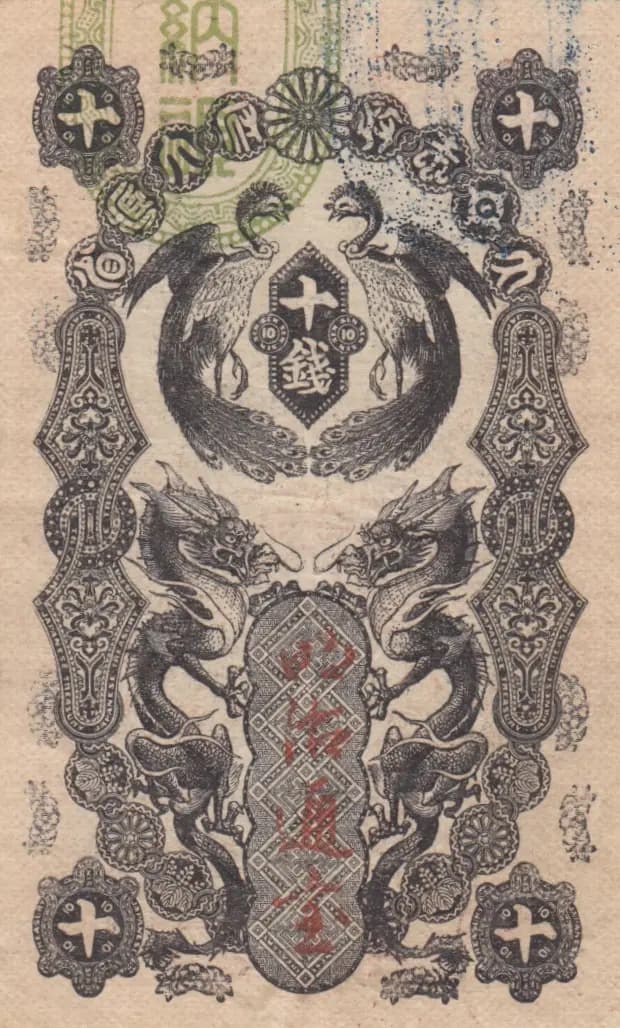
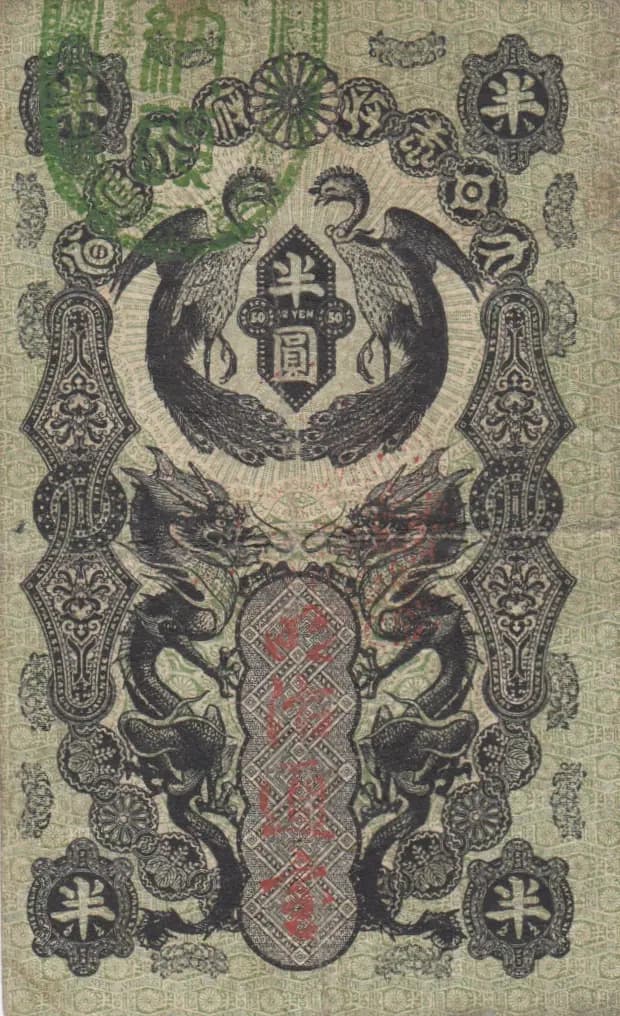
The obverse features the Yasukuni Shrine's characteristic torii gate as the central architectural motif, rendered in fine line engraving with trees and foliage in the background. At the top center is the imperial chrysanthemum, Japan's national flower and symbol of the imperial throne, with an eagle in flight depicted in the upper right—both potent symbols of imperial authority. A red circular seal (likely representing a government authority mark) is positioned on the left side. The reverse presents a landscape with a prominent volcanic mountain as the focal point, framed by an ornate decorative wreath featuring floral and leaf motifs. Large denomination numerals '50' flank the mountain scene, each enclosed in geometric mesh-pattern medallions. The entire design employs intricate line engraving throughout with complex border patterns and corner vignettes.
Front side: 日本帝国財務省 (Japanese Imperial Finance Ministry); 昭和十七年 (Showa 17 year, corresponding to 1942); 50 (denomination). Back side: 50 (denomination, appearing twice in the ornamental medallions flanking the central mountain design).
Intaglio (recess) printing with line engraving, the standard security printing method for Japanese government currency of this era. The fine detail work, intricate borders, and complex geometric patterns visible in both the obverse and reverse designs are characteristic of skilled intaglio production. The sharp clarity of the printed image observed in this specimen indicates high-quality plate work and impression.
This note is catalogued as Pick P-59a. The PMG population report indicates at least three catalogued variants (P-59b, P-59c, P-59s1), all featuring wavy line watermarks. The visual analysis does not reveal clear watermark details, but the note's dating to Showa 17 (1942) and its design characteristics are consistent with the P-59a designation. No overprints, signature variations, or serial number prefix anomalies are noted in the visual analysis that would indicate a sub-variety.