5 yen 1944
Market Prices
11 salesAbout This Note
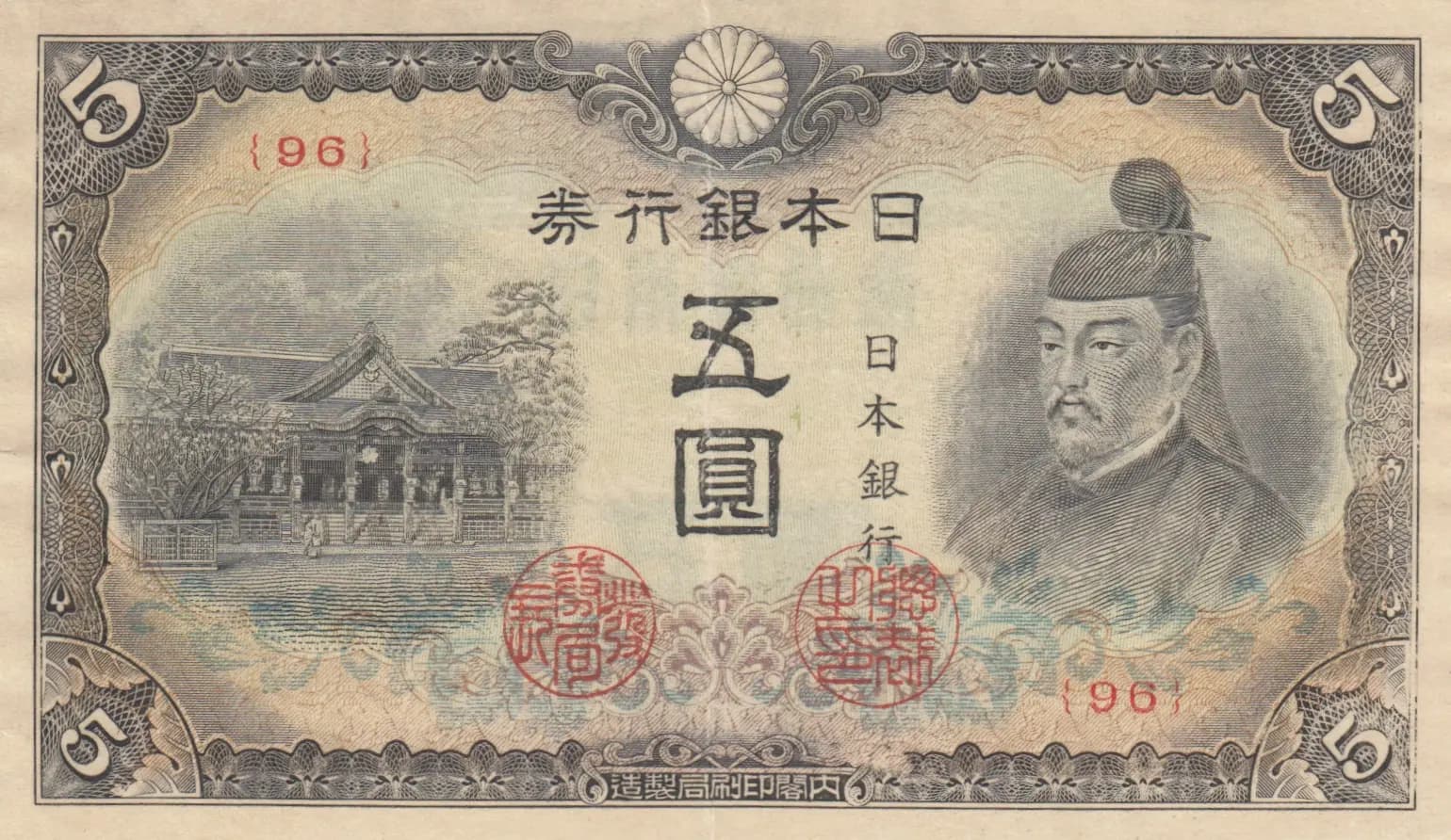
This is a Japan 5 Yen note from 1944 (Pick P-55), graded VF, featuring the iconic Kitano Shrine on the left and a portrait of Sugawara Michizane on the right. The note displays characteristic wartime Japanese design with ornate borders, red seals, and red series numbers in the 96 range. Despite age-appropriate yellowing and foxing typical of 80-year-old currency, the design elements remain clearly legible and the note shows no major damage, making it a desirable example of mid-war Japanese currency.
Common. The eBay price history shows consistent sales in the $5-$27 range across various grades (F, VF, EF, AUNC) spanning from 2013-2022, with VF examples averaging $15-27. The 2016 catalog value of $20 for VF grade aligns with observed market prices. The note experienced regular circulation during the war period and was produced in sufficient quantities that examples remain readily available to collectors. No evidence of scarcity or limited print run exists for this Pick number.
Issued in 1944 during Japan's final year of World War II, this banknote represents a period when the Imperial Japanese government was managing domestic currency amid wartime pressures. The Kitano Shrine depicted on the obverse is a historically significant Kyoto landmark dedicated to Sugawara Michizane, a 9th-century scholar and statesman, whose portrait appears on the reverse. The selection of these cultural and historical figures reflects Japan's emphasis on national heritage and continuity during the tumultuous wartime period.
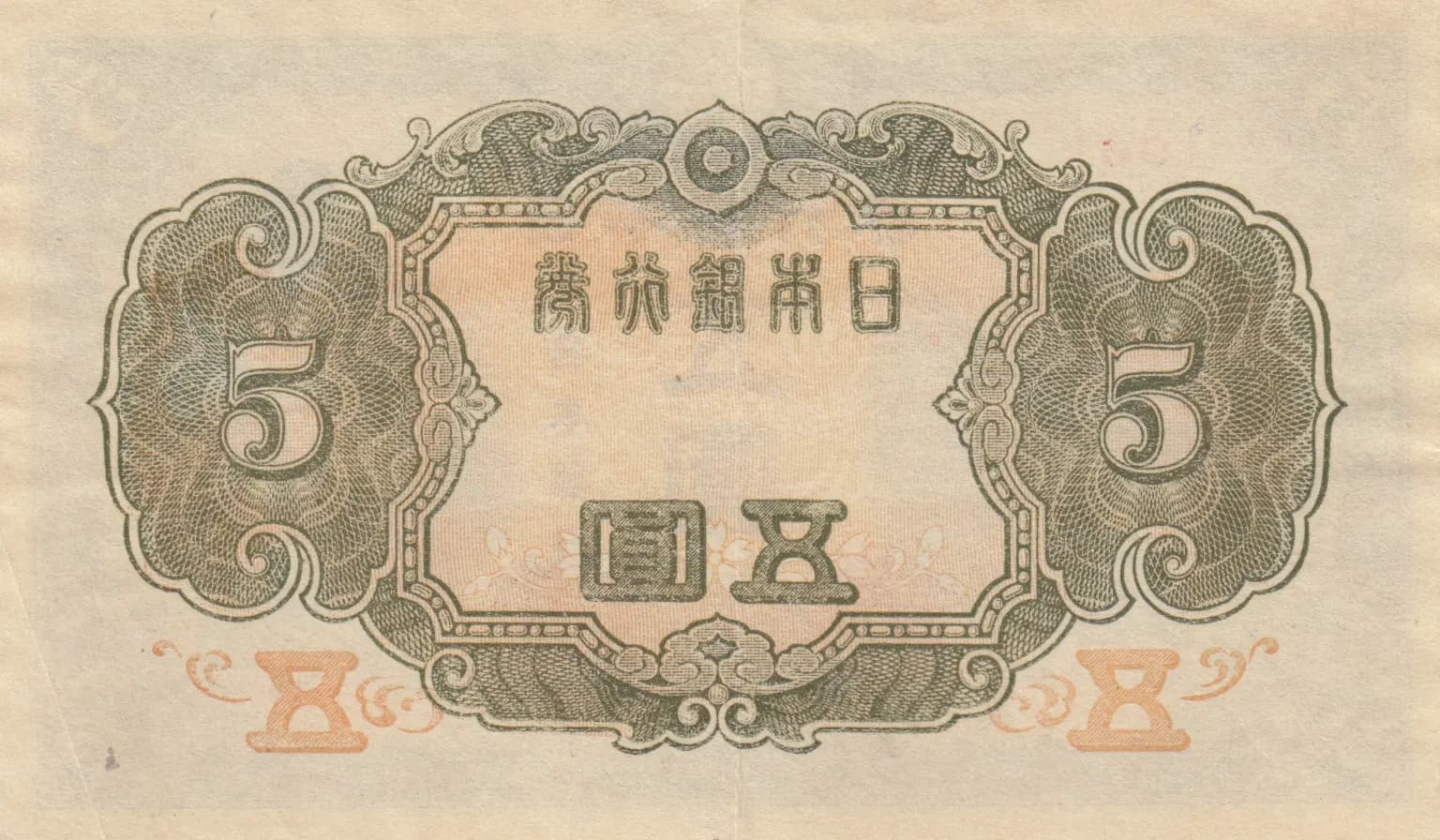
The obverse features Kitano Shrine (Kitano Tenmangu), the venerable Kyoto temple complex dedicated to Sugawara Michizane, rendered on the left side with characteristic curved roof architecture and fine architectural detail. The right side displays a formal portrait of Sugawara Michizane (845-903), the Heian period scholar-statesman and calligrapher whom the shrine honors, depicted with traditional topknot hairstyle and formal dress. The note employs an elaborate decorative border featuring floral and geometric patterns with scrollwork, ornamental shell or fan motif at top center, and two red circular official seals positioned symmetrically below the central denomination text. The reverse features an ornate rococo-style cartouche frame with symmetrical scrollwork and elaborate decorative flourishes, with large Arabic numeral '5' markers and Roman letter 'X' designations. The color scheme combines black/dark gray printing on cream/light green underprint with red and orange/tan accents.
Front: '日本銀行' (Nippon Ginko / Bank of Japan) - appears as main issuer text; '五円' (Go En / Five Yen) - denomination in center; '96' (series number in Arabic numerals) - appears in top left and bottom right corners in red. Back: '日本銀行' (Bank of Japan) - issuer text; '5' (large denomination markers in Arabic numerals on left and right sides in orange/tan); 'X' (Roman numeral or letter marking in orange/tan at bottom corners). All text conforms to standard Bank of Japan currency inscription format of the 1944 issuance period.
Intaglio (engraved line) printing, characteristic of Bank of Japan currency production during the 1940s. The fine hatching visible on the portrait and architectural elements, intricate border engraving with delicate line work, and the ornamental design precision all indicate professional engraving techniques. The sharp definition of security features and the complexity of the decorative patterns suggest this was produced by Japan's primary government security printing facility, consistent with standard Bank of Japan production protocols of the wartime period.
This example appears to be the standard P-55a variety with red block number only (matching the catalog notation 'Red Block # only'). The visual analysis confirms red series numbers in positions consistent with P-55a specification. PMG records indicate two cataloged variants exist: P-55a (standard) and P-55s2 (overprinted Red 'Mi-hon' specimen marking). This note shows no evidence of specimen overprint, confirming P-55a classification. The series number visible as '96' places it within the documented printing sequence for this issue.