5 yen 1943
Market Prices
32 salesAbout This Note
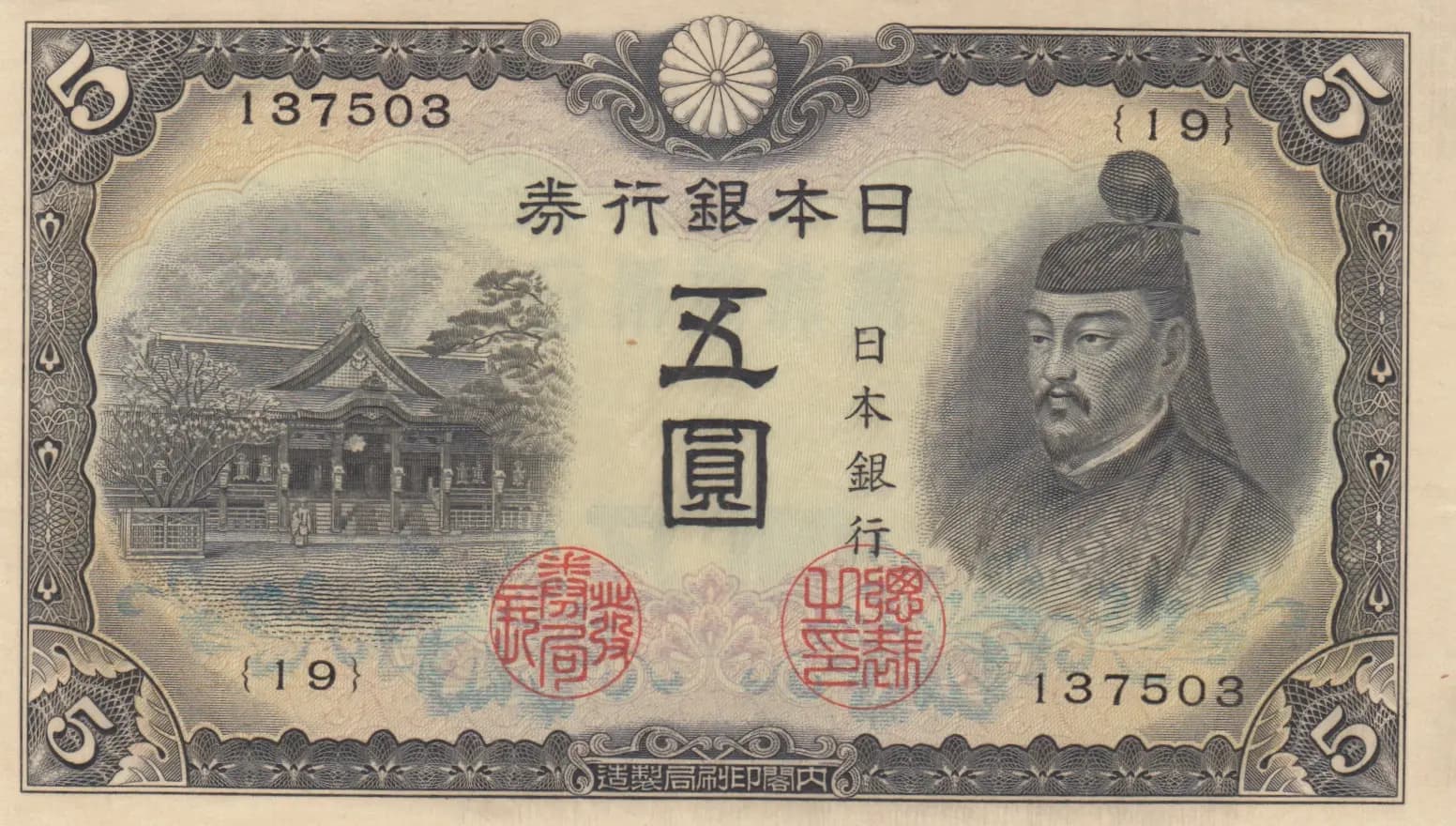
This Japanese 5 Yen note from 1943 (Pick P-50) presents in AU condition with excellent eye appeal and minimal signs of circulation. The note features a striking portrait of Sugawara Michizane on the right and the iconic Kitano Shrine on the left, rendered in black intaglio against a light green and purple underprint. The crisp margins, clean paper, and well-preserved decorative borders exemplify the quality of wartime Japanese currency production during this period.
Common. eBay market data demonstrates consistent and substantial circulation of this note in all grades, with numerous sales across a 13-year tracking period (2010–2023) at modest valuations. VF-grade examples typically command $4–8, while AU-grade specimens (comparable to the cataloged note) average $24–67. The consistent availability of PMG-certified examples and regular auction activity indicate a substantial original print run with plentiful survivors. The 2016 catalog value of $20 in UNC also reflects a common-grade note. No evidence of scarcity, recall status, or limited distribution exists in the available data.
Issued during the final years of Imperial Japan's involvement in World War II, this banknote reflects the sophisticated currency system maintained even as the nation faced mounting military pressure. The Kitano Shrine depicted on the obverse is a significant historical and cultural monument associated with Sugawara Michizane, a revered Heian-period statesman and scholar whose portrait appears opposite—a pairing that connected Japan's modern imperial system to its classical literary and administrative heritage during a period of intense nationalism.
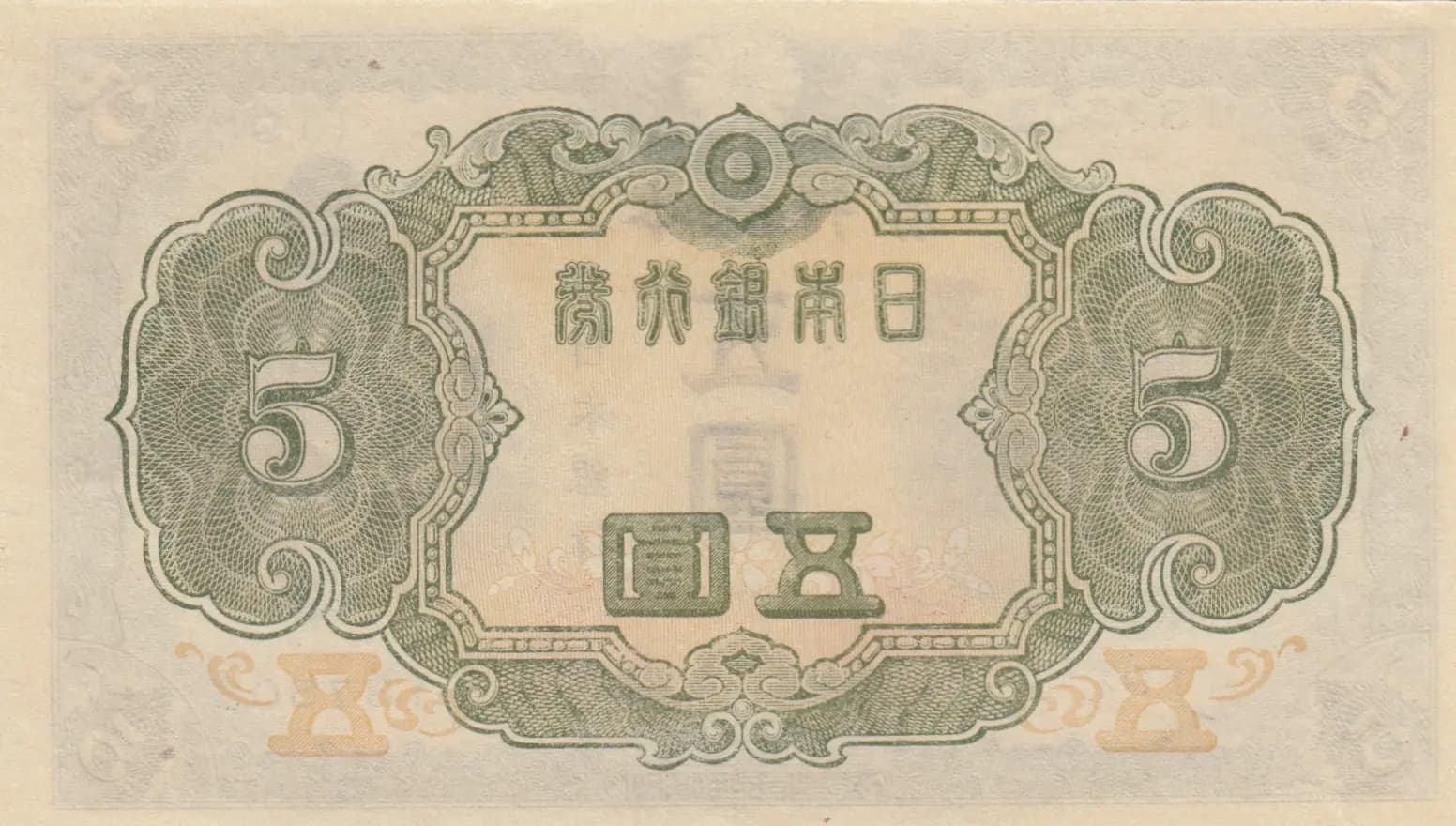
The obverse features a formal portrait of Sugawara Michizane (845–903 CE), the Heian-period scholar-statesman and later deified figure of the Shinto pantheon, depicted as a bearded man in traditional court robes with characteristic topknot hairstyle, positioned prominently on the right side. The left side displays the Kitano Tenman-gū (Kitano Shrine) in Kyoto, rendered with architectural detail showing its distinctive sloped roof and surrounding landscape elements. The design incorporates elaborate intaglio borders with floral and geometric ornamentation, including shell and fan motifs at the top center. Two red official seals bearing Japanese characters appear in the lower center, serving as issuing authority authentication marks. The reverse presents a symmetrical ornamental composition with an elaborate scrollwork frame containing denomination text, geometric corner elements, and integrated floral motifs, printed in green and light brown tones. The overall aesthetic reflects high-security Japanese banknote design standards of the 1940s wartime production.
Front: '日本銀行券' (Nippon Ginko Ken / Bank of Japan Note) at top center; '五円' (Go-en / Five Yen) as denomination marking; Serial number '1375503' in black; Block number marking '{19}'. Back: '日本銀行券' (Bank of Japan Note); '五円' (Five Yen). All text rendered in Japanese characters only, with no romanization or English text present.
Intaglio (recess) printing process, evidenced by the fine, precise line work visible throughout the decorative borders, the sharp detail in the portrait rendering, and the crisp registration of multiple color elements. The note exhibits the characteristic embossed quality and ink depth typical of Bank of Japan currency production during this era. Security printers for Japanese government notes of this period typically included the Bureau of Engraving and Printing (国立印刷局 / Kokuritsu Insatsu Kyoku), though specific attribution for Pick P-50 would require archival documentation.
This note is identified as Pick P-50 with block number marking visible in the lower center. The catalog reference notes distinction between P-50 (with both block and serial numbers) and P-55 (block number only), indicating this is the standard block/serial variant. The observed serial number '1375503' and block number '{19}' represent typical numbering for this issue. No overprints, date variations, or signature variants are apparent; this represents the standard 1943 issue of the 5 Yen denomination with no identified major varieties in the visual presentation.