5 yen 1942
Market Prices
2 salesAbout This Note
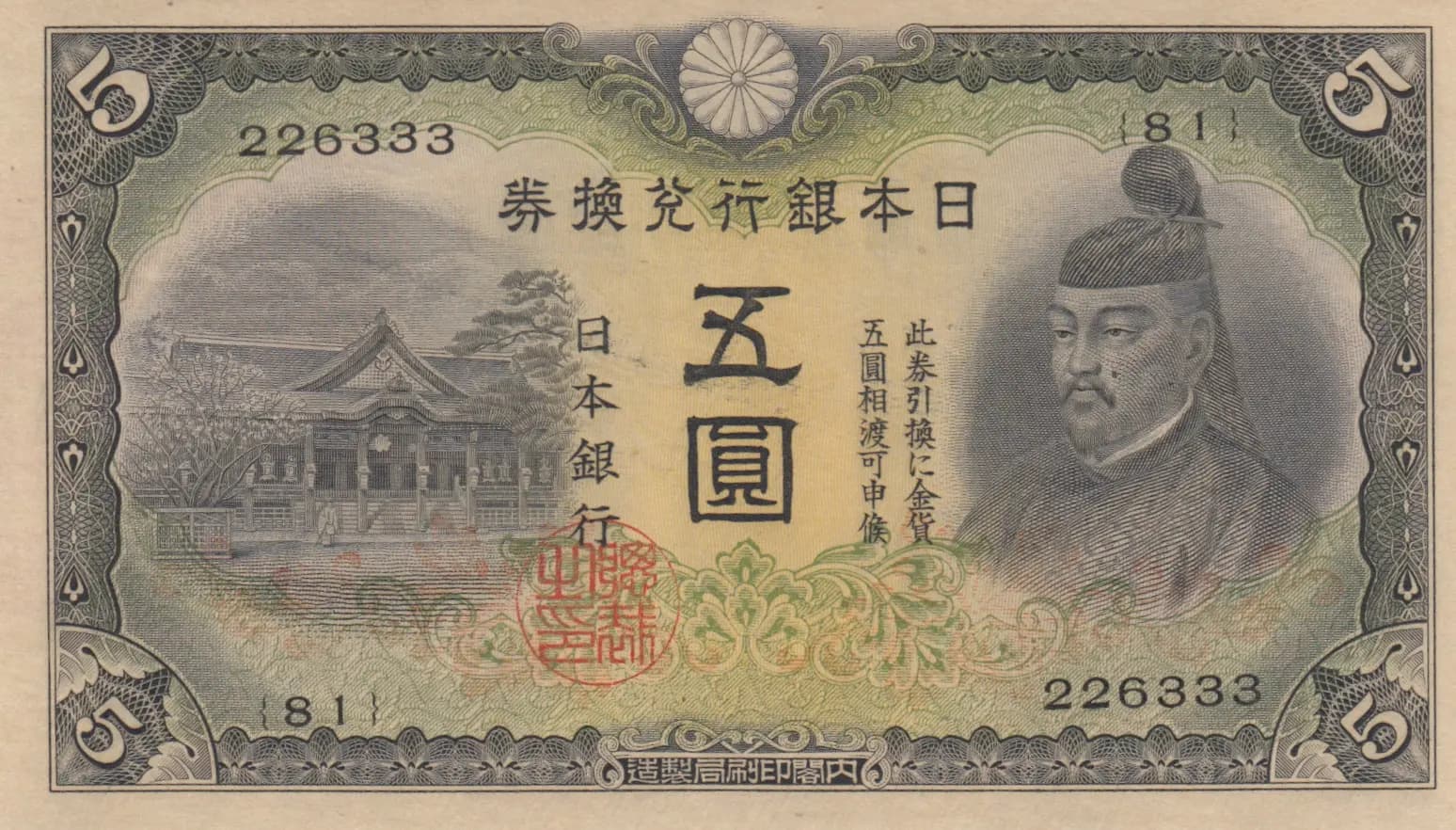
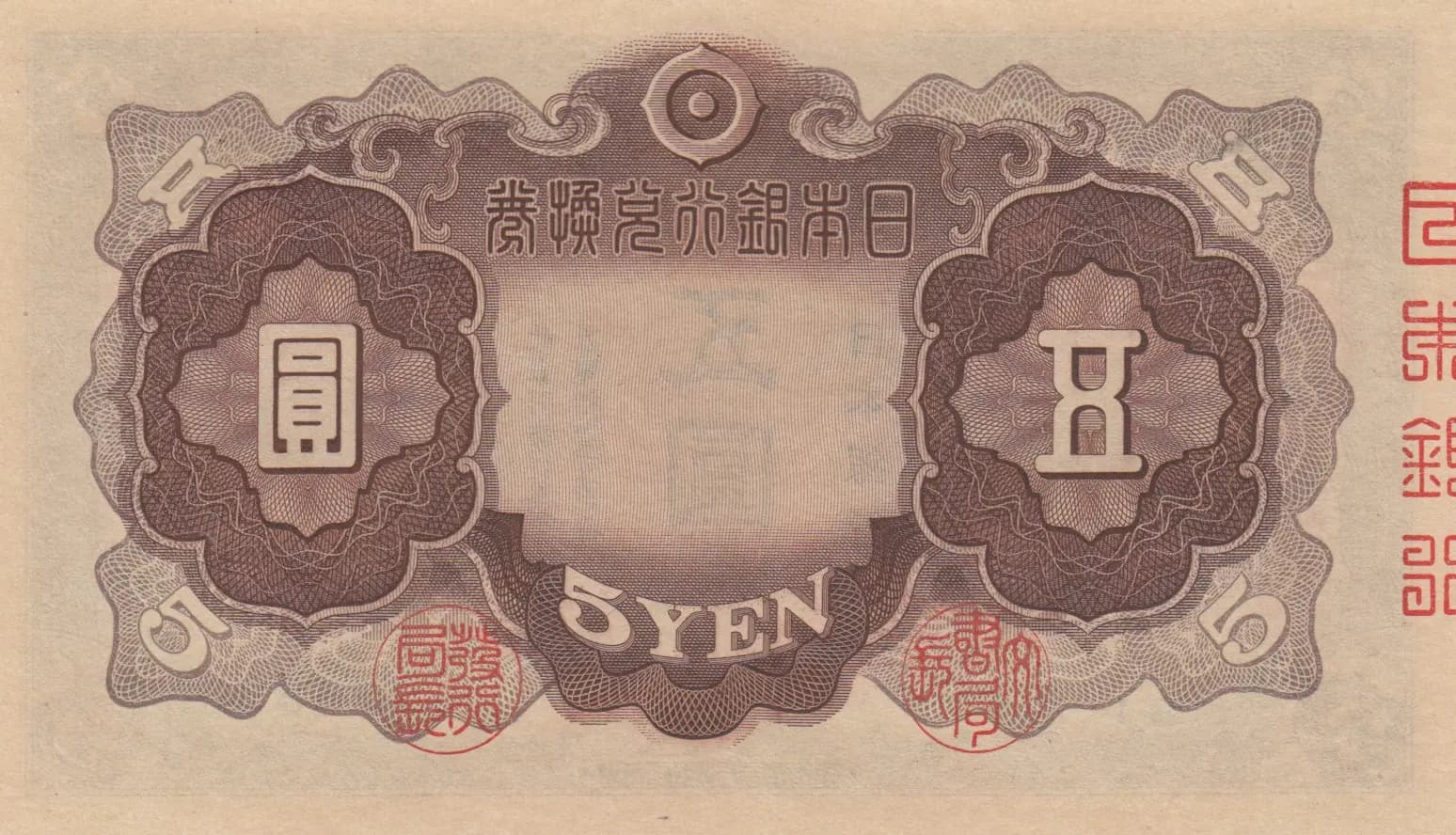
This is a Japanese 5 Yen note from 1942 (Pick P-43a) in UNC condition, displaying the characteristic ornate design of wartime Japanese currency. The front features a portrait of Sugawara Michizane in traditional dress and a depiction of Kitano Shrine, rendered in green, gray, and cream tones with a prominent red seal. The back displays symmetrical decorative patterns with red corner seals and bilingual English/Japanese denomination markings. The note shows excellent preservation with crisp impressions, fine line work, and minimal aging consistent with its age.
Common. While this is a pre-WWII/wartime issue, the 5 Yen P-43a was produced in substantial quantities. eBay market data shows PMG-graded examples selling in the $300–$1,500 range depending on condition (G-EF), with even well-graded specimens (PMG 53) achieving under $1,600. The circulation was broad enough that UNC examples, while desirable, remain accessible to collectors. No evidence of limited print run, recall, or short-lived issue status exists. This note is fundamentally common, though specific high-grade examples command collector premiums typical of early Japanese currency.
Issued during Japan's militarist period in 1942 by the Nippon Ginko (Bank of Japan), this note represents the currency circulating during World War II. The choice to feature Sugawara Michizane, the revered Heian scholar-statesman deified at Kitano Shrine, reflects Japan's cultural nationalism during this era. The inclusion of English denomination text suggests this series maintained some international currency recognition despite wartime tensions.
The front depicts Sugawara Michizane (845–903), a legendary scholar and statesman of Japan's Heian period, shown in right-facing profile wearing traditional court dress with a distinctive topknot headdress (likely a kanmuri formal headgear). To the left is Kitano Shrine (Kitano Tenmangu), the sacred temple in Kyoto dedicated to Sugawara's deified spirit, rendered with traditional Japanese architectural details including curved roof and structural elements. The design employs fine ornamental borders with geometric and floral motifs, shell-like decorative elements at top center, and fan-like corner flourishes. A large red circular seal dominates the center-lower portion, serving as an authenticity mark. The back features symmetrical ornamental patterns with decorative crown-like elements, wave or cloud-like motifs, and red official seals in the lower corners. The color palette of green primary frame, gray/beige underprint, black text, and red accents is consistent with Japanese monetary design of the 1920s-1940s period.
FRONT: 五圓 (Go En / Five Yen) — the primary denomination; 日本銀行券 (Nippon Ginko Ken / Bank of Japan Note) — issuing authority; 此券引換兑换兑换可也 (This note is redeemable); 五圓相渡可也候 (Five yen will be paid); Serial number: 226333; Plate/series marking: 81. BACK: 日本銀行券 (Bank of Japan Note); 日本銀行 (Bank of Japan); 5YEN (English denomination); SEN (English, referring to sen as subdivision); 十圓 (visible in ornamental boxes, though this appears to be design element rather than primary denomination marking).
Intaglio (engraved) printing, as evidenced by the fine line patterns, intricate border work, and crisp impression quality visible in the serial numbers and text. The multi-color design (green, gray, red, black) was produced using traditional multi-pass intaglio techniques. Security features include fine line background engraving and ornamental decorative elements typical of Bank of Japan notes from this era. The note was originally designed and printed in 1927, with this 1942 example representing a continuation of that design.
This note is catalogued as P-43a (5 Yen variety). The PMG population report indicates P-43Aa (200 Yen) as a separate variant, confirming that P-43 base number encompasses multiple denominations. This particular specimen, based on visual analysis showing clear '五圓' (5 Yen) markings and 5YEN English text, is the standard 5 Yen issue. Serial number 226333 with plate marking 81 is observable; individual serial number varieties are not typically significant for common notes of this period, though collectors may track specific prefixes or numbering sequences.