5 sen 1944
Market Prices
70 salesAbout This Note
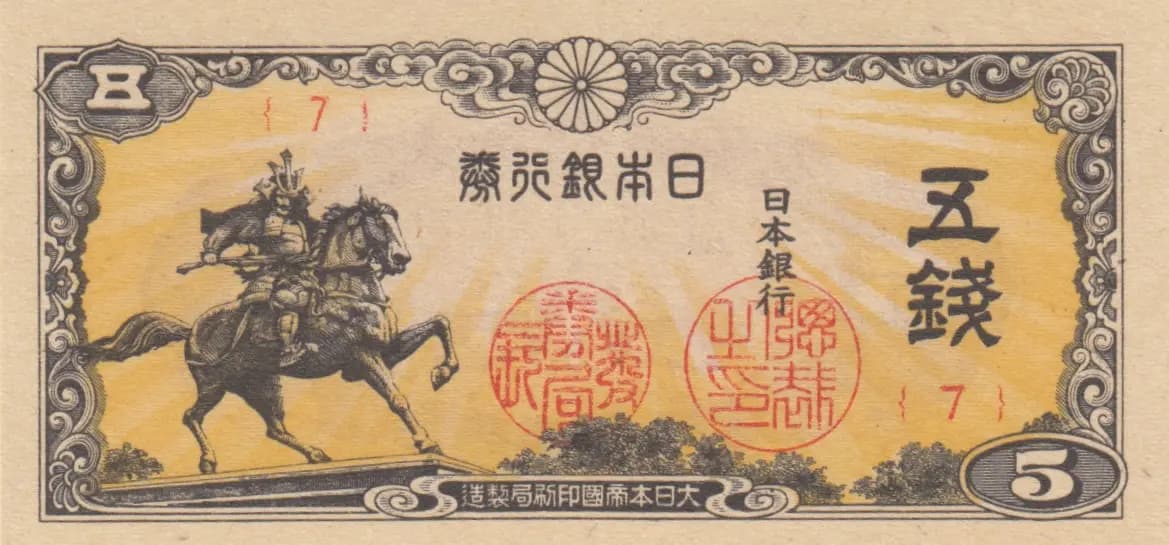
This is an exceptional example of Japan's 1944 5 sen banknote (Pick P-52) in Uncirculated condition, featuring a striking equestrian portrait of Kusunoki Masashige, the legendary samurai warrior, rendered in bold black ink against a warm yellow underprint. The note exhibits the classic wartime-era design with ornate decorative borders and official red seals, and despite its age remains well-preserved with only minor age-related toning, making it an excellent specimen for Japanese military-period currency collectors.
Common. The robust eBay sales data spanning multiple decades shows consistent trading activity with numerous examples sold in various grades (F through PMG 67) at modest prices ranging from under $1 to $67 in exceptional certified examples. The catalog 2016 valuation of $1.50 for UNC condition confirms this note's widespread availability in the secondary market. While UNC examples command higher prices than circulated grades, the sheer volume of historical sales demonstrates substantial production and survival rates, placing this firmly in the 'common' category despite its wartime historical significance.
Issued during the final year of World War II, this 5 sen note represents Japan's monetary production under the Empire of Japan's South Seas Bureau during a period of severe economic and military strain. The choice to feature Kusunoki Masashige, revered as a symbol of loyalty and martial virtue in Japanese culture, reflects the wartime government's attempt to inspire patriotic sentiment during Japan's escalating military crisis. The inscription noting printing by the 'South Seas Bureau of the Empire of Japan' emphasizes the territorial scope of Japanese authority at the time of this issue.
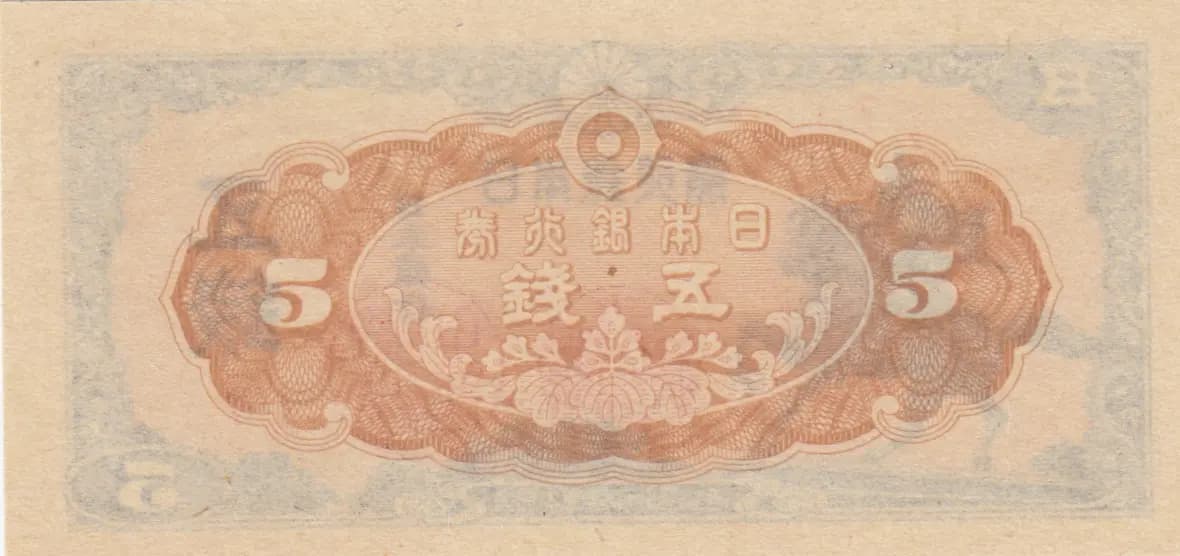
The obverse features a dynamic equestrian portrait of Kusunoki Masashige, the 14th-century samurai general and loyal subject of Emperor Go-Daigo, depicted mounted on a rearing horse in left-facing profile. The central vignette is rendered in fine black engraving with landscape elements (hills or mountains) visible in the lower portion, creating depth and historical gravitas. Ornamental decorative borders with sophisticated scrollwork and fan-shaped (shell-motif) designs frame the composition, while two red circular official seals of the issuing authority are positioned in the center-right area. Denomination numerals '5' appear in circular cartouches in the upper and lower right corners. The reverse presents a simpler, elegant design centered on a large scalloped oval cartouche containing fine floral or ornamental engraving, with denomination numerals '5' positioned symmetrically on either side against a pale cream background.
Front side: '五銭' (Go sen / 5 sen - denomination in kanji), '日本銀行券' (Nippon Ginko Ken / Bank of Japan Note), '大日本帝国南洋庁印製' (Dai Nippon Teikoku Nanyo-cho Insatsu / Printed by the South Seas Bureau of the Empire of Japan). Back side: '五銭' (Go sen / 5 sen), '日本銀行券' (Nippon Ginko Ken / Bank of Japan Note).
This note was produced using traditional intaglio engraving and letterpress printing methods, characteristic of Japanese banknote production of the 1940s. The fine line work visible in the equestrian portrait, decorative borders, and floral motifs on the reverse are consistent with steel or copper plate engraving. The yellow underprint and two-color printing (black primary design with red seal overprints) indicate multiplate printing technology typical of the Bank of Japan and South Seas Bureau facilities of the wartime period.
The specific variety of this 1944 5 sen note is determined by the South Seas Bureau printer designation visible in the inscriptions. The red circular seals and their precise positioning may vary between printings. The visual analysis notes a marking in red ink in the upper left area appearing to show '1.7.1', which may represent a collector's notation or internal catalog marking rather than a production variety marker. Serial number variations and seal placement differences would constitute the primary variety distinctions within this Pick number, though detailed variety cataloging for this wartime Japanese issue remains limited in major references.