20 sen 1919
Market Prices
3 salesAbout This Note
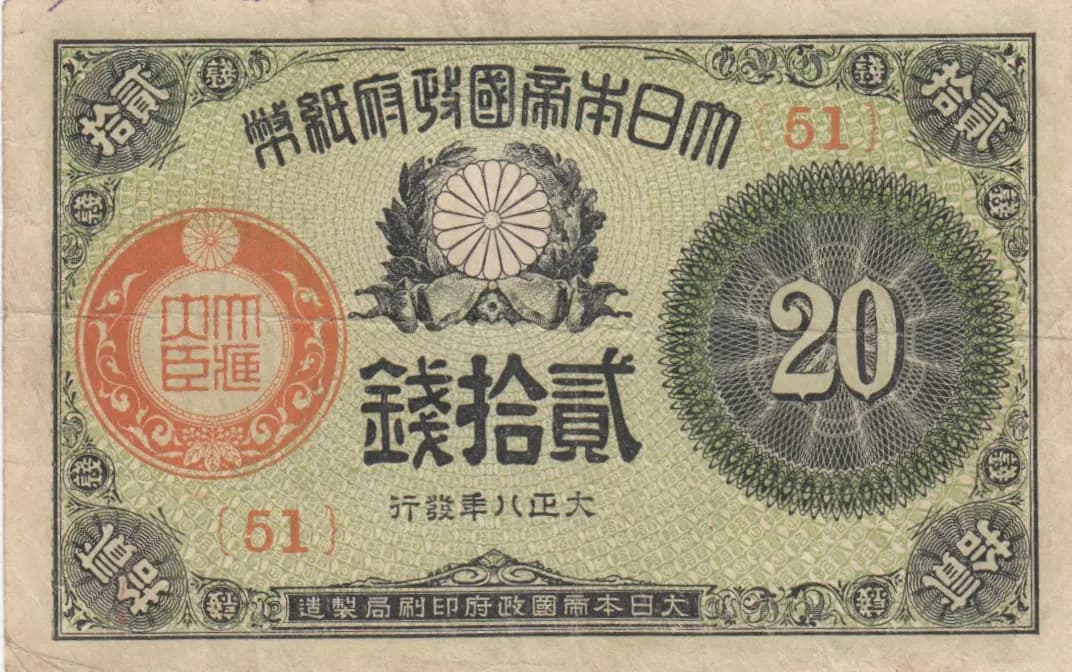
This is a Japanese Government 20 sen note from the Taisho era (1919), catalogued as Pick P-47b. The note features the Imperial chrysanthemum seal prominently on the obverse with denomination numerals in an ornate circular frame, printed on a light yellowish-green background with black and red inks. In Fair condition, the note displays age-appropriate wear including foxing, light creasing, and surface staining, but remains legible and displayable—a good example of early 20th-century Japanese currency design.
Common. The eBay market data provided shows VF examples selling for $6.63–$9.99 and catalogue values of only $5–$20 depending on grade, indicating regular availability. The 1917–1919 Taisho 6–8 issue of 20 sen notes was part of Japan's standard currency circulation during a stable period of government, with no evidence of short print runs or recall. Fair condition examples would be even more common and modestly priced.
Issued during Japan's Taisho period (1912–1926), this 20 sen note represents the government's regular currency circulation during the post-World War I era. The prominence of the Imperial chrysanthemum seal—the symbol of the Japanese imperial throne—reflects the deep integration of state authority and national identity into the nation's monetary system during this period of Japanese modernization and imperial consolidation.
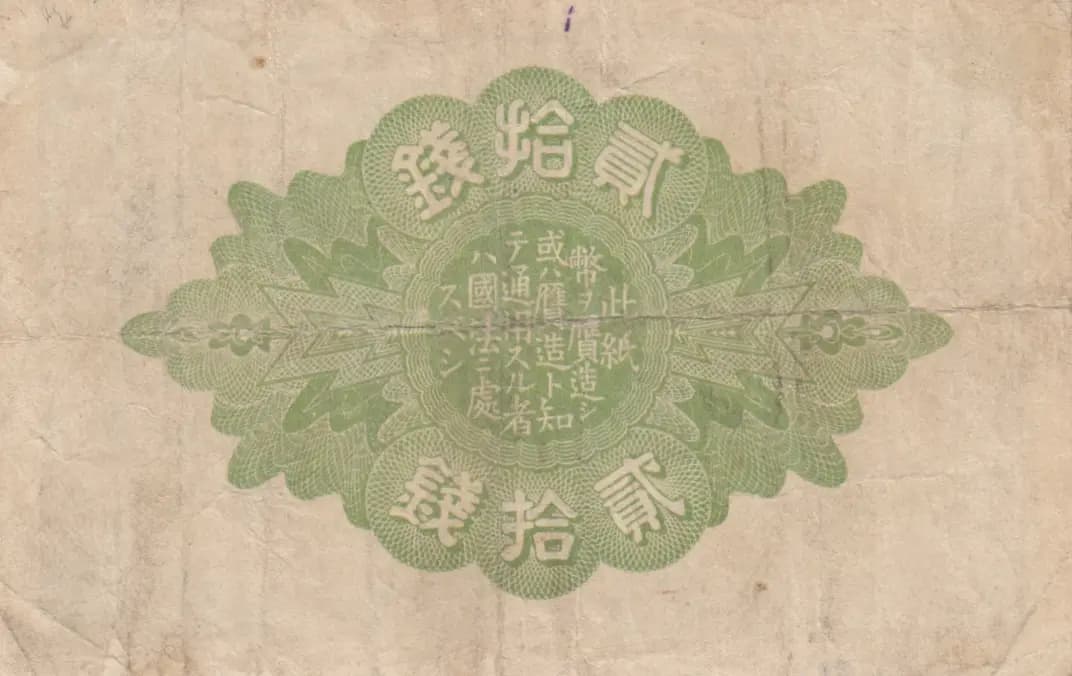
The obverse displays a central 16-petaled Imperial chrysanthemum seal—the mon (family crest) of the Japanese imperial house—surrounded by decorative floral corner ornaments and intricate engraved borders. A prominent ornamental circular rosette containing Arabic numerals '20' appears on the right side, establishing the denomination clearly for both domestic and international users. The reverse features a large, symmetrical botanical or floral starburst design in green, with circular medallions positioned at cardinal points containing Japanese characters, reflecting the aesthetic conventions of Meiji-Taisho era government currency design. The color scheme of yellowish-green obverse with cream/beige reverse was typical for this denomination and period.
Front side: '大日本帝國政府印刷局製造' (Made by the Imperial Japanese Government Printing Bureau); '銀行' (Bank); '拾貳銭' or '二十銭' (Twenty sen); '51' (serial or reference number); '20' (denomination). Back side: '拾' (Ten), '貳' (Two), '銭' (Sen/currency unit)—collectively forming '二十銭' (Twenty sen). Additional Japanese characters appear in circular medallions on the reverse but are partially obscured in the available images.
Intaglio (engraved) printing, evidenced by the fine line crosshatch patterns, detailed background engravings, and the precision of the delicate floral and geometric ornaments visible throughout both sides. The Imperial Japanese Government Printing Bureau (大日本帝國政府印刷局), established to produce state currency and securities, employed advanced intaglio techniques to ensure anti-counterfeiting security through complex engraved patterns that are difficult to replicate.
This note corresponds to Pick P-47b, the Taisho-period (years 6–8, 1917–1919) 20 sen regular issue. The visual analysis identifies the date reference as Taisho era, consistent with the 1919 catalogued year. Serial number or plate number elements (such as the '51' visible on the obverse) may indicate a specific printing plate variety, but without comprehensive reference material on all plate numbers used for this issue, precise variety attribution would require additional research. The note is part of the main issue type rather than a specialized overprint or emergency circulation variant.