1000 yen 1963
Market Prices
47 salesAbout This Note
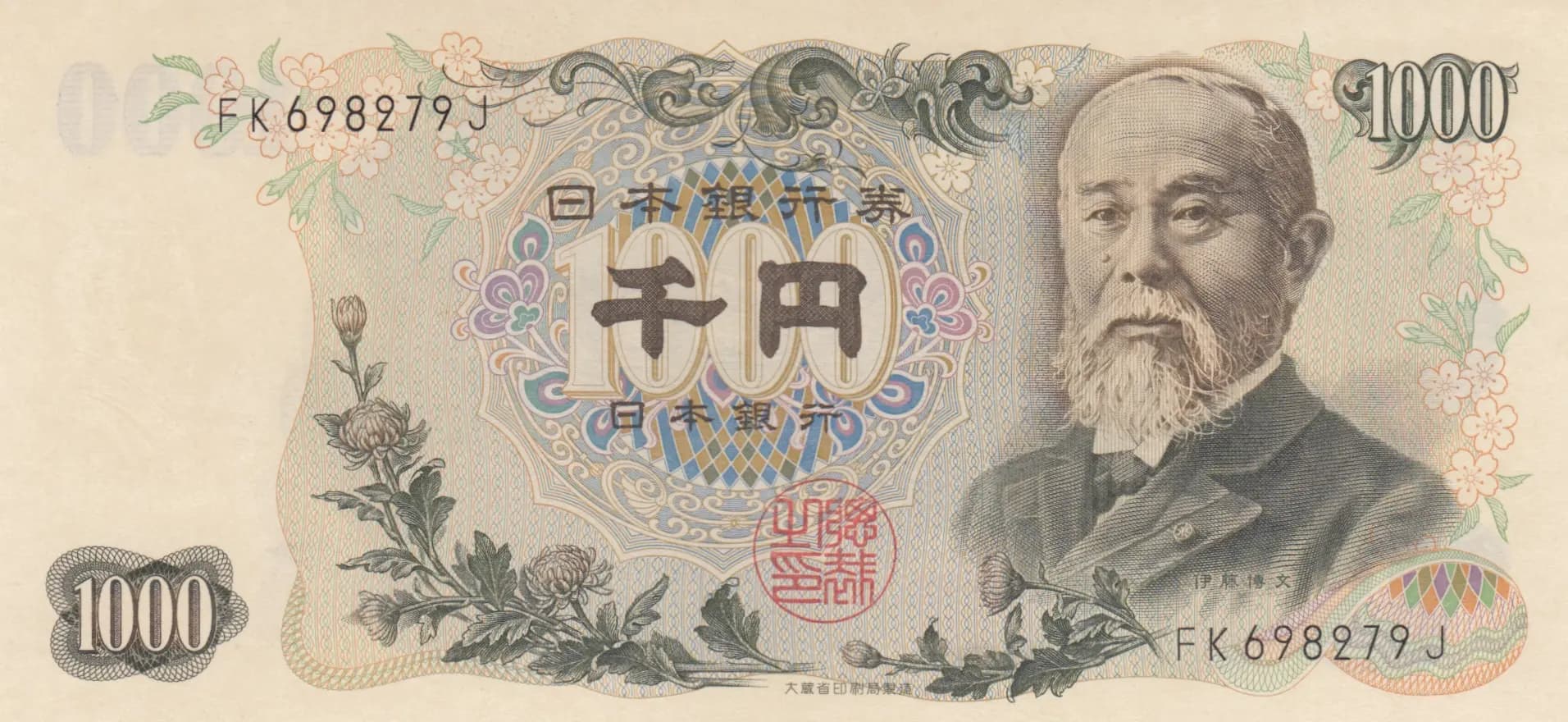
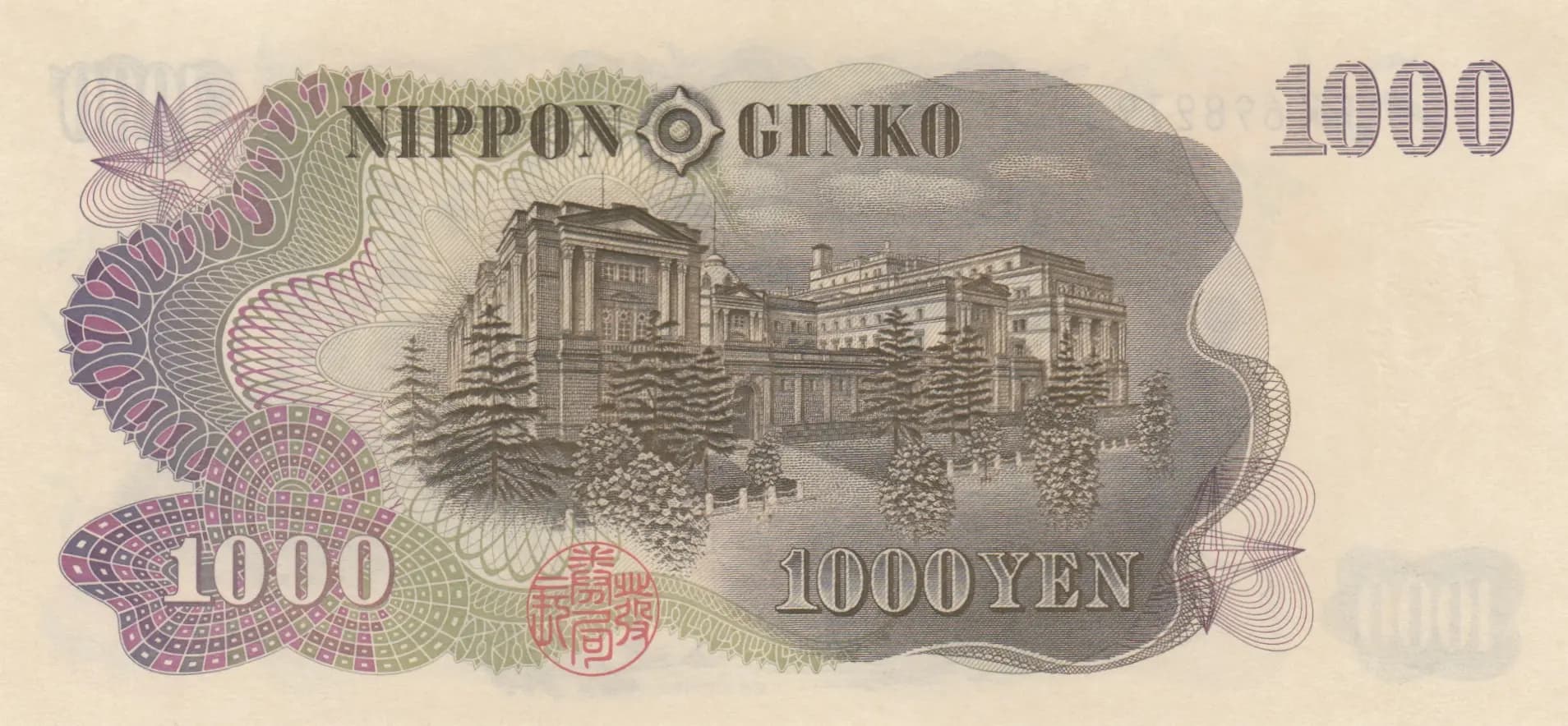
This is a pristine, uncirculated 1000 yen banknote from 1963 (Pick-96b), featuring portrait of Hirobumi Ito on the obverse and the Bank of Japan building on the reverse. The note displays excellent crisp paper quality, vibrant multicolored printing with dominant greens, browns, and accent colors, and exhibits no signs of circulation or wear—a desirable example for collectors seeking high-grade specimens of this classic Japanese currency issue.
Common. The 1963 1000 yen banknote (Pick-96b) is a regular issue with large print runs and remains readily available in numismatic markets. eBay market data shows consistent sales of UNC examples in the $15-$25 range (2019 catalog value: $25 UNC), with even higher-graded PMG specimens (PMG 67-68) typically ranging $35-$60. The abundance of recent sales transactions and modest pricing confirm this is a common date for collectors, though UNC examples command modest premiums over circulated grades.
Issued during Japan's high-growth economic period in 1963, this banknote reflects the nation's post-war modernization and institutional stability. The obverse features Hirobumi Ito, a prominent Meiji-era statesman and Japan's first Prime Minister, honoring his role in establishing the modern Japanese state. The reverse depicts the Bank of Japan building in Tokyo with classical Western-style architecture, symbolizing Japan's integration into the global financial system and institutional authority during the 1960s economic boom.
The obverse features a formal portrait of Hirobumi Ito (1841-1909), bearded and dressed in Western formal attire, positioned on the right side of the note. The design incorporates ornate baroque-style decorative medallions with geometric patterns and floral motifs (chrysanthemums) in the corners, characteristic of Japanese Meiji-era design aesthetics. The reverse displays a classical Western-style institutional building (Bank of Japan headquarters in Tokyo) in a landscape setting with evergreen trees, accompanied by a decorative purple and green medallion pattern on the left side. Denomination indicators are prominently placed in multiple formats and languages (Arabic numerals, Japanese characters, and English text) to ensure clarity for domestic and international use.
Front side: '1000' (Arabic numerals, denomination), '千円' (sen en/1000 yen in Japanese), '日本銀行券' (Nippon Ginko Ken/Bank of Japan Note), 'FK698279J' (serial number in alphanumeric format). Back side: '1000' (Arabic numerals), 'NIPPON GINKO' (Bank of Japan in romanized English), '1000YEN' (denomination in English). The official red circular seal appears on both sides.
This note was produced using traditional intaglio (steel engraving) printing, evidenced by the crisp, fine-line engraving patterns visible throughout both sides, the embossed texture characteristic of the era, and the precise registration of multiple color layers. The Bank of Japan engaged the highest-quality security printing standards typical of 1960s Japanese currency production, with multicolor overprinting creating the complex color scheme observed (beige/cream base with brown, green, pink, blue, and purple accent colors). No modern security features are present, consistent with 1963 printing technology.
This note is identified as Pick-96b variant, characterized by Hirobumi Ito watermark. The PMG population report indicates four cataloged variants for this base Pick number (96a, 96b, 96d, and 96s), suggesting variations in watermark designs or security features across the series. The observed double-letter serial number prefix 'FK' and black serial numbering are consistent with 1963 issuance standards for this variety. No specific overprints, signatures, or date variations are evident on this specimen.