100 yen 1950
Market Prices
4 salesAbout This Note
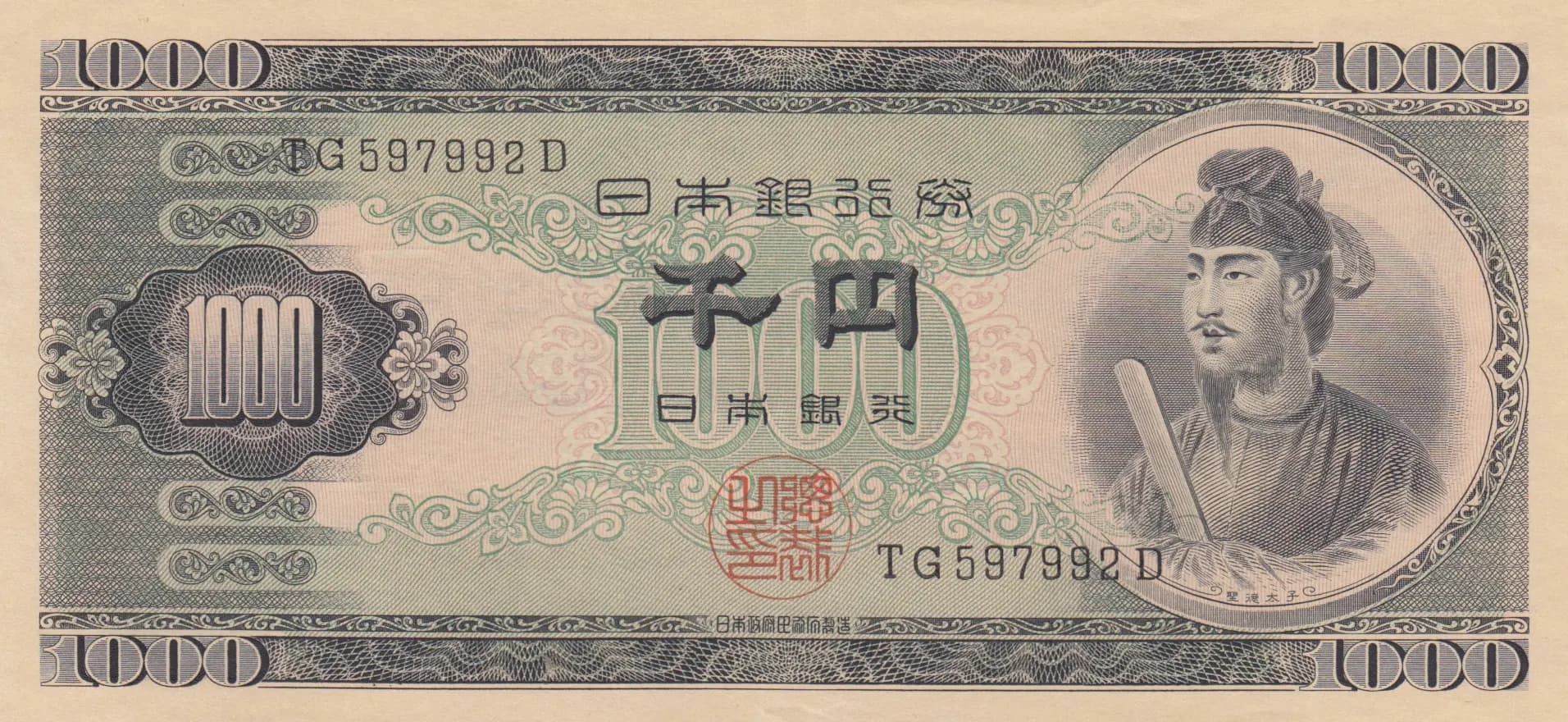
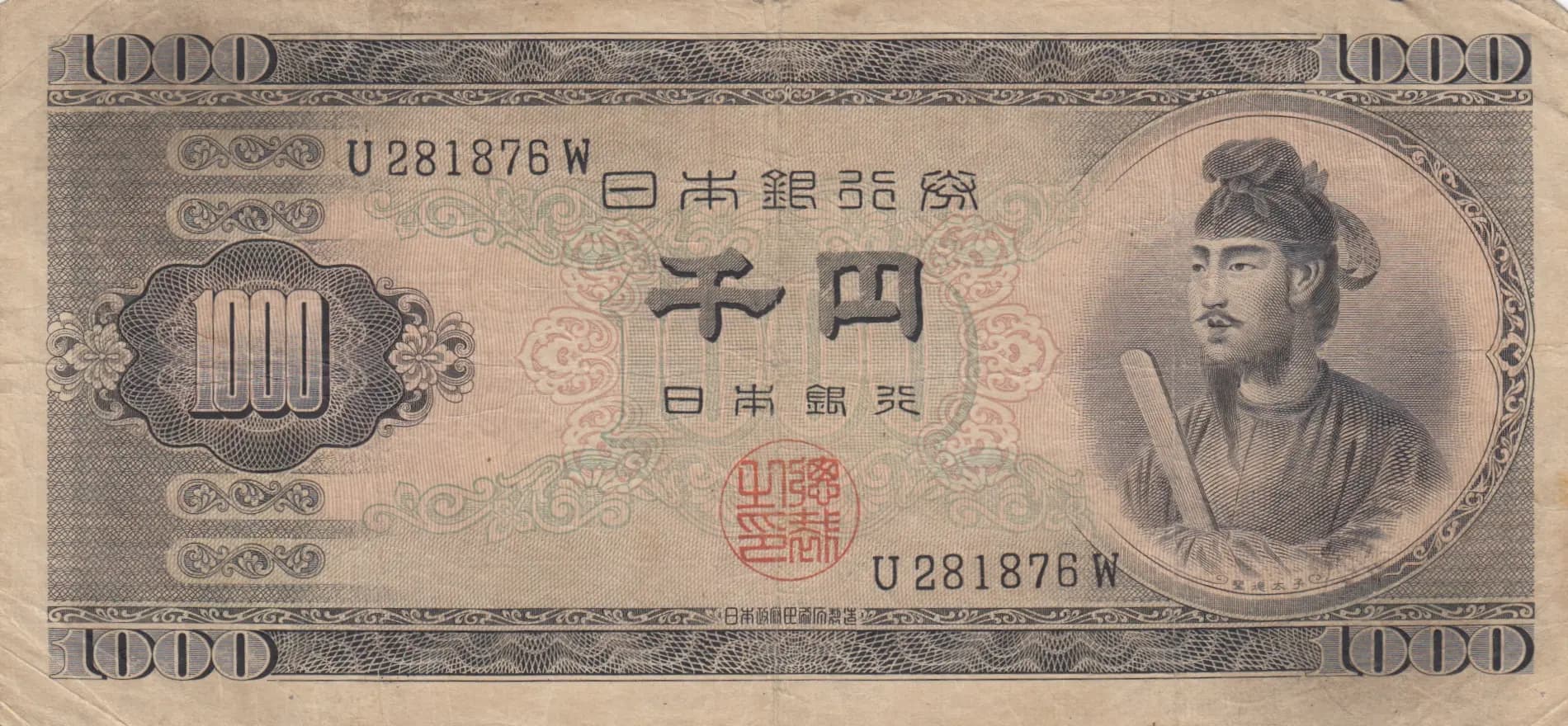
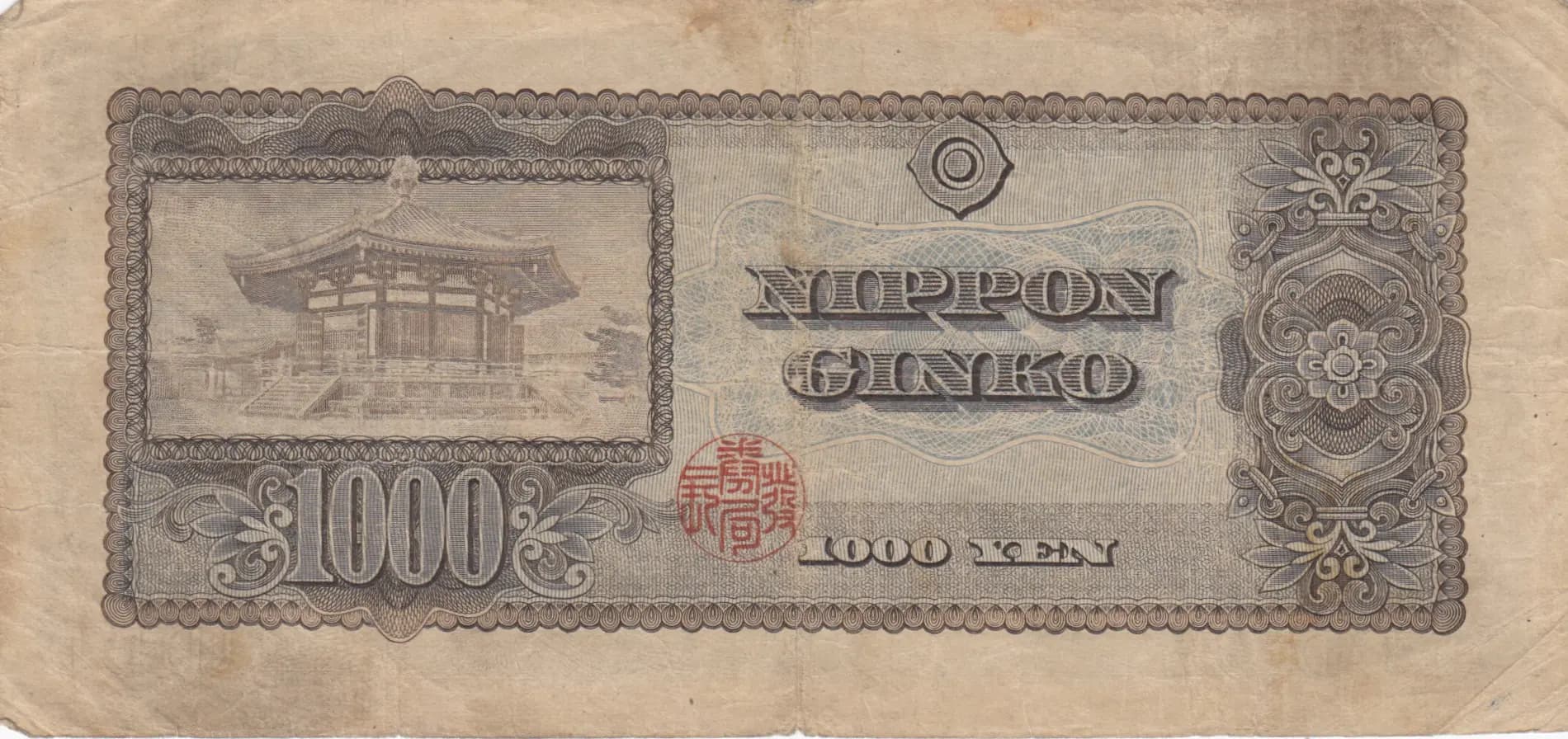
This is a 1000 Yen note from Japan's 1950 issue (Pick P-92a), featuring a portrait of Prince Shotoku in traditional Japanese attire within a circular frame on the obverse, with the Yumedono Pavilion depicted on the reverse. The note displays typical aging characteristics for a note of this vintage, with tan/beige discoloration, visible creasing from handling, and minor foxing throughout, consistent with a VG grade. The fine engraving quality and multi-colored underprinting are well-preserved despite the age-related patina.
Common. The 1950 1000 Yen note (P-92a) was a regular issue with substantial print run for circulation. eBay market data shows consistent sales in the $10-20 range for VF grades, with catalog values of $10 for VG, $30 for VF, and $75 for UNC—pricing patterns typical of commonly available post-war Japanese notes. The denomination and issue date ensure ready availability in the collector market.
This 1950 issue commemorates Prince Shotoku (574-622), a pivotal figure in early Japanese history and Buddhism's introduction to Japan, whose portrait was chosen to reflect post-war Japan's cultural heritage. The reverse features the Yumedono Pavilion (Hall of Dreams), an 8th-century Buddhist temple building at Horyu-ji, reinforcing the historical and spiritual significance of the depicted figure. This regular issue from the early post-war period represents Japan's monetary stabilization efforts under the Bank of Japan (Nippon Ginko) during the American occupation era.
The obverse features a formal portrait of Prince Shotoku (Shotoku-taishi) in traditional Asuka-period court dress, positioned on the right side within an elaborate circular frame with fine guilloche borders. The left and central areas display the denomination 1000 in ornamental frames with floral and geometric decorative patterns. A red circular seal (government stamp) is positioned in the lower center. The reverse depicts the Yumedono Pavilion, a distinctive wooden temple structure with curved traditional Japanese architecture, shown in a rectangular frame on the left. The right portion contains the issuer name 'NIPPON GINKO' in Romanized text with decorative Japanese characters. A red seal appears centrally, with large ornamental numerals '1000' in the lower left area. Both sides employ extensive fine-line engraving with multiple layers of decorative detail.
Front side: '日本銀行券' (Bank of Japan Note), '千円' (One Thousand Yen), '日本銀行兌換券' (Japan Bank Convertible Note), Serial number 'U281876W' (appears twice). Back side: 'NIPPON GINKO' (Bank of Japan in romanized form), '千円' (One Thousand Yen), denomination '1000' in ornamental numerals. Additional decorative Japanese characters and ornamental text appear throughout both sides as part of the design framework.
This note was produced using traditional intaglio engraving (copperplate printing), characteristic of Japanese currency of this period. The fine guilloche patterns, intricate line work, and multi-layered color printing with green and multicolor underprints on the obverse and brown-blue tones on the reverse are all consistent with high-security intaglio production methods. The Bank of Japan's security printers employed state-of-the-art engraving techniques typical of early post-war Japanese banknote production.
This note is cataloged as Pick P-92a (1000 Yen). Pick P-92b represents an alternative 1000 Yen variant according to PMG records. The serial number prefix observed is a single letter (U in the example shown: U281876W), which is consistent with the standard production specifications for this issue. No significant overprints or special markings are evident in this example.