100 yen 1946
Market Prices
25 salesAbout This Note
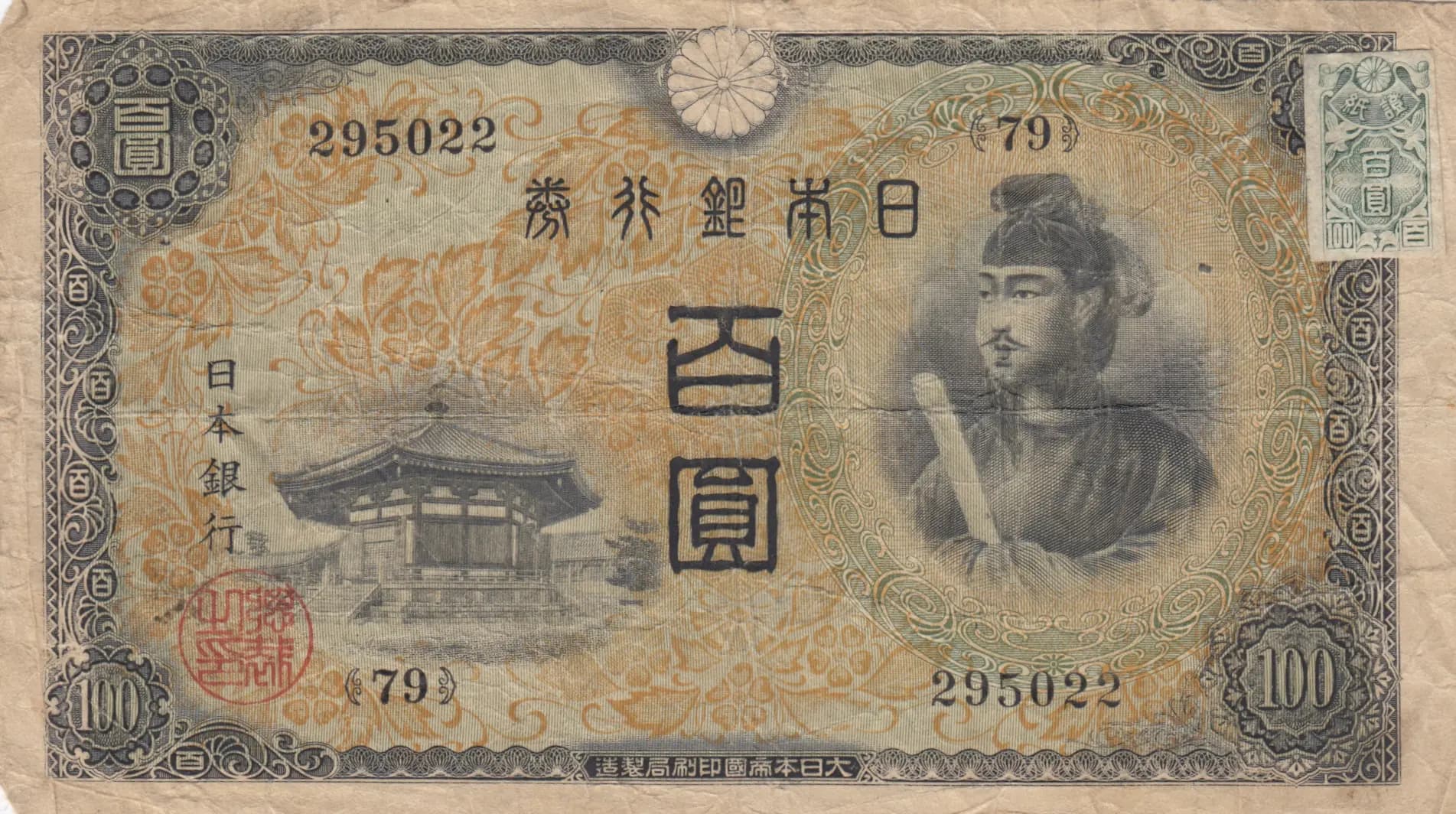
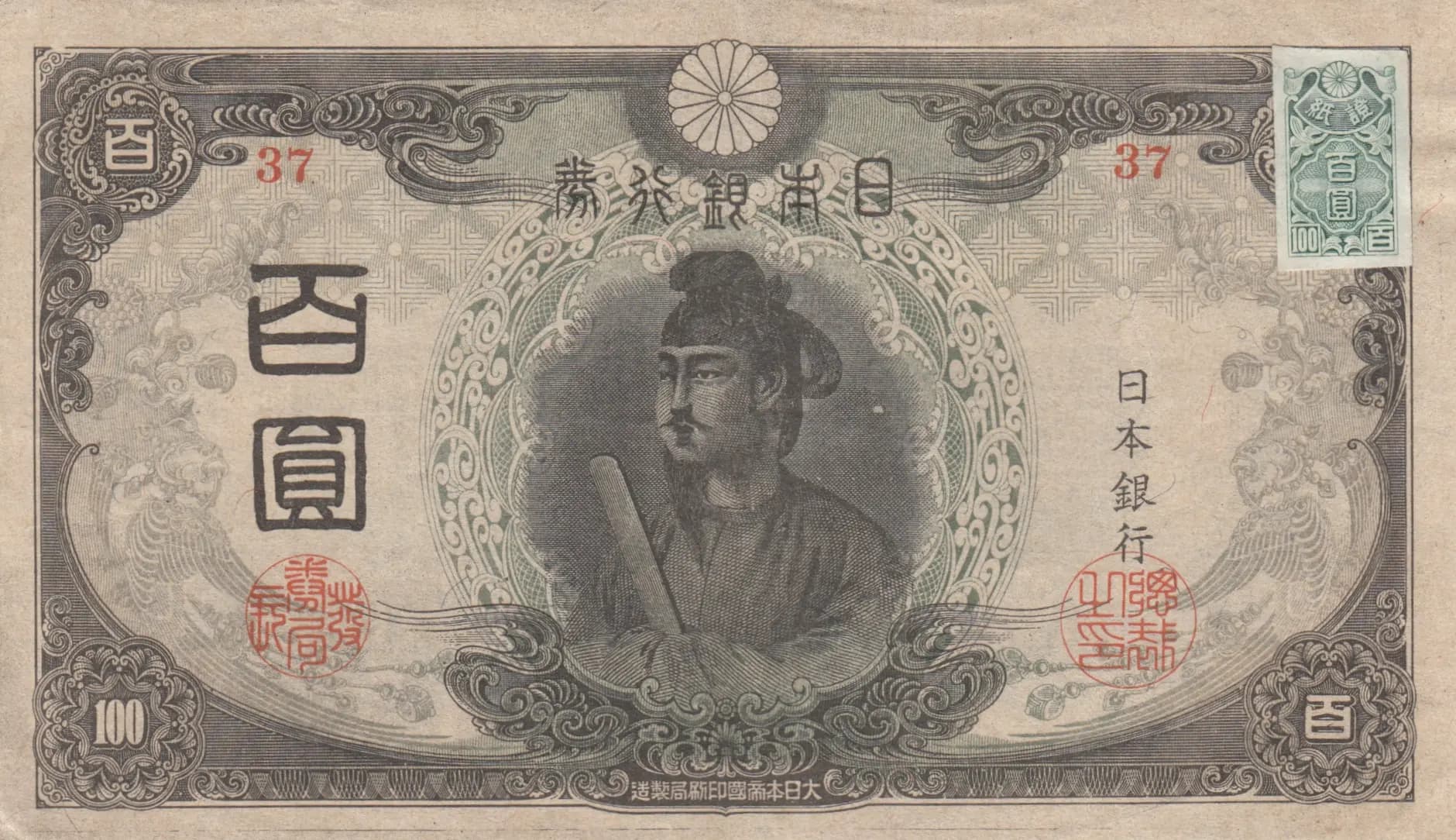
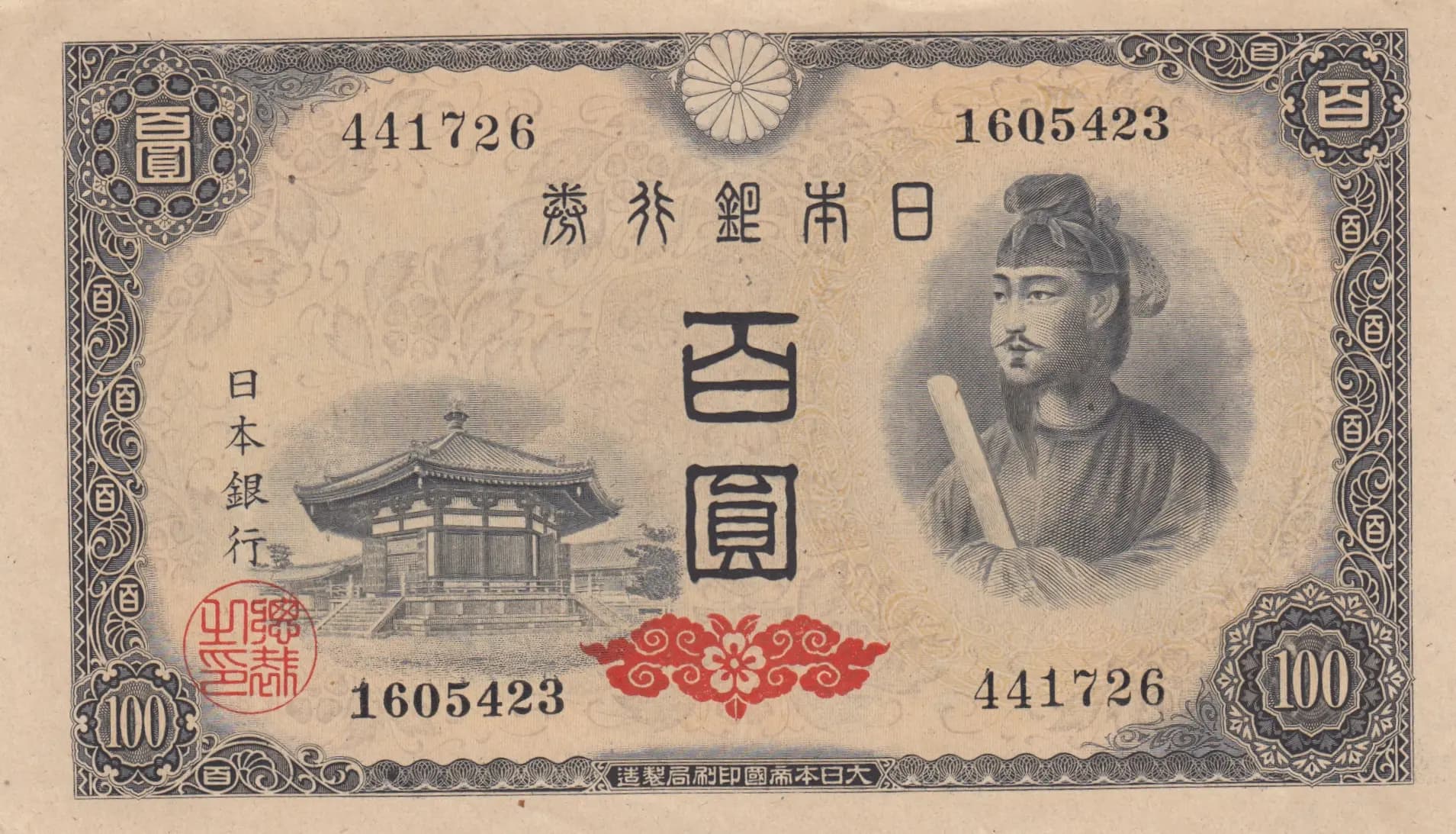
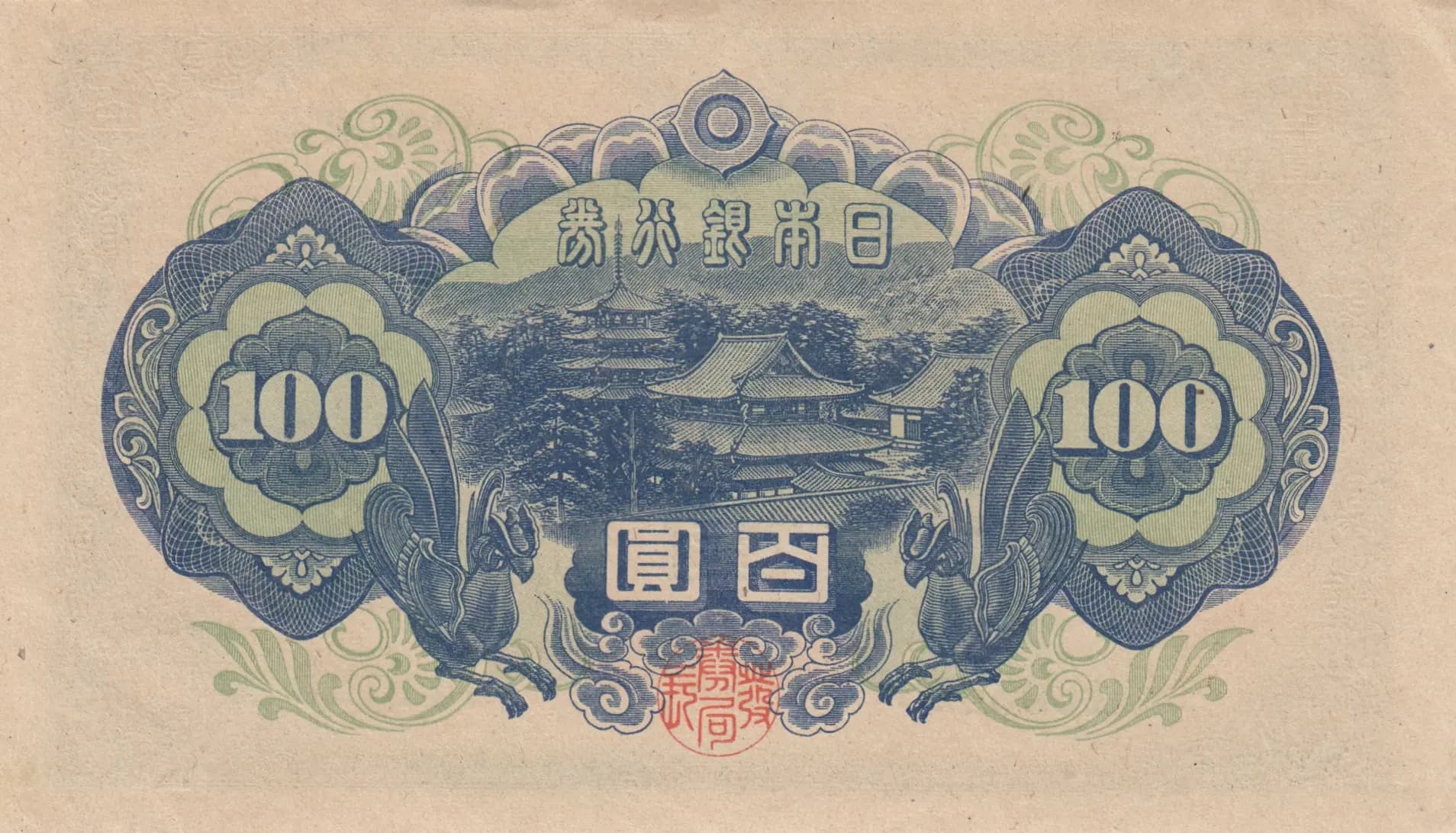
This is a 1946 Japanese 100 Yen note (Pick P-89) in EF condition, featuring a striking design with black ink on lilac underprint depicting the Yumedono Pavilion and a portrait of Prince Shotoku on the obverse, while the reverse displays a blue-toned Horyuji Temple landscape. The note exhibits the characteristics of early post-WWII Japanese currency, with intricate ornamental borders, fine engraving work, and traditional security features including kiri leaf watermarks and control numbers that are clearly visible and well-preserved in this example.
Common. Market data shows consistent eBay sales activity for this note type across multiple condition grades from 2010-2024, with EF examples selling in the $6-$12 range historically (consistent with the observed EF grade here). The 2016 catalog value for EF/VF is listed at $12.50, and recent PMG-graded examples in comparable conditions (PMG 63-66) continue to sell modestly in the $20-$90 range. The note was a regular issue with substantial print runs typical of post-war currency replacement in Japan, making it readily available in the collector market.
Issued in 1946 by the Nippon Ginko (Bank of Japan) during the immediate post-WWII period under Allied occupation, this banknote reflects Japan's cultural heritage through its imagery of Prince Shotoku and the historic Horyuji Temple complex—both significant to Japanese Buddhist and imperial history. The design choice to feature these cultural landmarks on currency during reconstruction demonstrates Japan's continuity of tradition despite the nation's defeat and occupation, presenting culturally resonant symbols of the nation's spiritual and architectural legacy to stabilize the currency and national identity.
The obverse features a portrait of Prince Shotoku (Shotoku-taishi), an important historical and cultural figure in Japanese history, positioned on the right side in traditional dress with characteristic hairstyle and facial hair rendering. The left-center showcases the Yumedono Pavilion (Dream Hall), one of the oldest wooden structures in the world located within the Horyuji Temple complex, depicted with its distinctive curved roof and architectural details. The reverse presents an expansive landscape view of the Horyuji Temple complex set within mountainous terrain with trees and natural scenery, rendered in blue tones characteristic of the period's printing techniques. Both sides are framed by elaborate ornamental borders featuring traditional scrollwork patterns, decorative cloud motifs, floral emblems, and corner cartouches containing the denomination '100'. A circular floral emblem appears at the top center of the obverse, while red rectangular seals/stamps provide official authentication marks.
Front side: '日本銀行券' (Bank of Japan Note), '百円' (100 Yen), '日本銀行' (Bank of Japan), and Arabic numerals '100' identifying the denomination. Serial numbers appear in multiple locations (top corners and bottom corners) as '441726' and '1605423'. Back side: '日本銀行券' (Bank of Japan Note), '百円' (100 Yen), and '100' appearing within ornamental cartouches on both sides of the central landscape design. Additional Japanese characters appear in the central tablet below the landscape scene.
Engraved intaglio printing on both sides, characteristic of Japanese banknote production of the 1940s period. The front employs black ink with lilac underprint on cream-colored paper, while the back utilizes multiple colors (blue, green, red, and black) in a careful multi-pass intaglio process to achieve the landscape and decorative effects. The fine line work, intricate ornamental patterns, and detailed landscape engraving are consistent with traditional intaglio bank note security printing methods employed by the Bank of Japan during this era. The watermark comprises kiri (paulownia) leaves, a standard security feature for Japanese currency of this period.
This example displays serial numbers '441726' and '1605423', consistent with the standard serial number placement (top corners and bottom corners) for P-89 notes. No overprints, date variations, or signature varieties are visible. The kiri leaf watermark is present as standard for this issue. No specific rare varieties are indicated by the serial number prefix or other visible characteristics. Catalog reference notes that similar later notes exist with English and Japanese text on back (P-42), and earlier pre-WWII variants (P-57), but this 1946 issue maintains the design characteristics consistent with the standard P-89 variety.