10 yen 1946
Market Prices
64 salesAbout This Note
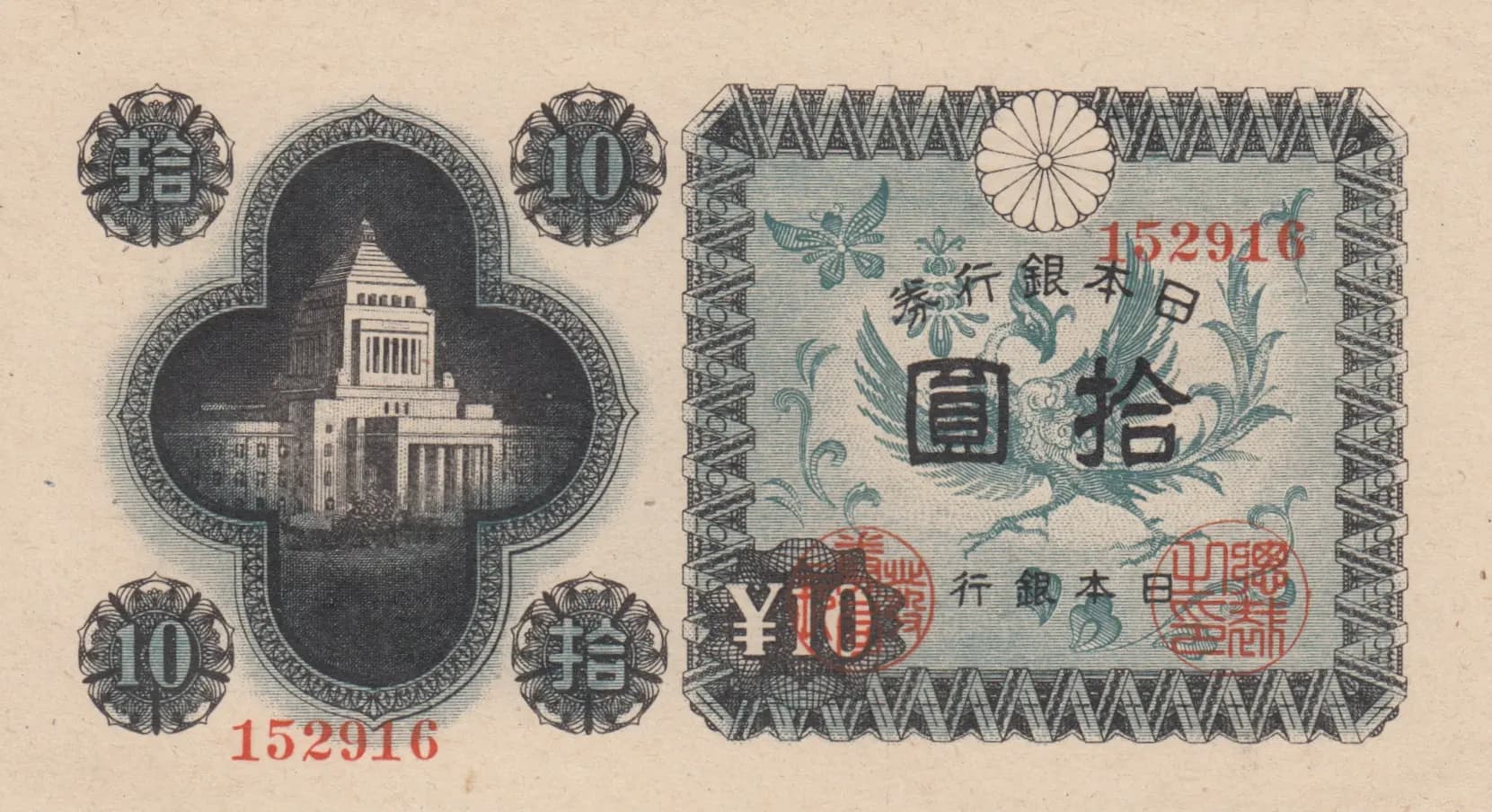
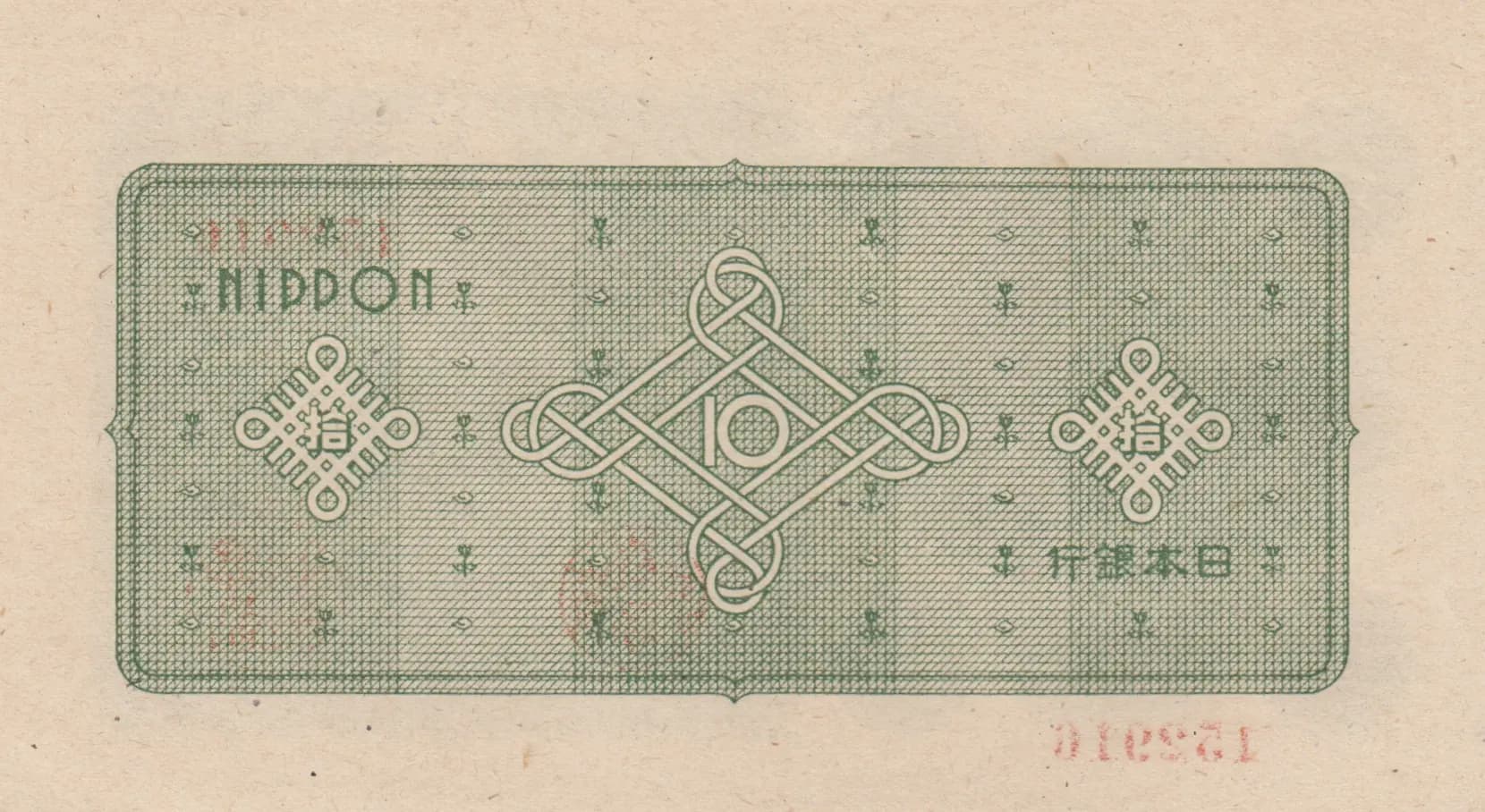
This Japanese 10 Yen note from 1946 features an exceptional example of early postwar Japanese currency design, with a striking central vignette of an ornate government building with a prominent dome rendered in black and gray tones. The note is in AU (Almost Uncirculated) condition with sharp detail throughout, pristine margins, and no visible wear or circulation marks. The reverse displays an elegant green-toned interlaced knot design, and the serial number 152916 is clearly visible in red ink—a hallmark of this denomination and period.
Common. The eBay sales data shows consistent trading activity across all condition grades, with AU/UNC examples typically selling between $3–$9, and even PMG-certified higher grades (65–66) averaging $15–$25. No evidence of a restricted print run, recall, or scarcity premium. This is a regular-issue postwar denomination with substantial survivors in circulation and collections.
Issued by the Bank of Japan (Nippon Ginko) in 1946, this note represents the early reconstruction period following World War II, when Japan was rebuilding its monetary system under Allied occupation. The prominent domed building depicted on the obverse is the Imperial Diet Building (Parliament building, Tokyo), symbolizing Japanese governmental continuity and institutional stability during this transformative historical moment. The design reflects both traditional Japanese artistic conventions and the need to restore confidence in Japanese currency during the transition to postwar governance.
The obverse features a large central oval vignette containing the Imperial Diet Building (Kokkai Gijido), characterized by its distinctive domed tower and columned neoclassical architecture—a symbol of Japanese parliamentary democracy. The vignette is framed by elaborate decorative borders with geometric ornamental patterns. Four corner ornaments display rosette designs containing the denomination '10'. The reverse presents a lighter green-toned design with a central interlaced Celtic-style knot incorporating the numeral 10, flanked by symmetrical corner ornamental emblems with geometric patterning. Both sides utilize fine line background patterns as anti-counterfeiting measures.
Front: Serial number '152916' in Arabic numerals (red ink); Denomination '10' in Arabic numerals (four corner positions). Back: '日本銀行' (Nippon Ginko / Bank of Japan) in Japanese kanji; 'NIPPON' in Latin characters; Denomination '10' in Arabic numerals integrated into central knot design.
Intaglio (copperplate) engraving, the standard security printing method for Japanese banknotes of this era. The fine line patterns visible in the background, the precision of the knot design, and the sharp detail of the architectural vignette are characteristic of intaglio production. The red serial number indicates offset lithography or letterpress application for variable security features.
Serial number 152916 observed. No major varieties are documented for the 1946 10 Yen (P-87) beyond standard serial number variations. This note represents the standard design for the 1946 issue; no known signature varieties, overprints, or significant design modifications distinguish different production batches of this denomination.