10 yen 1944
Market Prices
13 salesAbout This Note
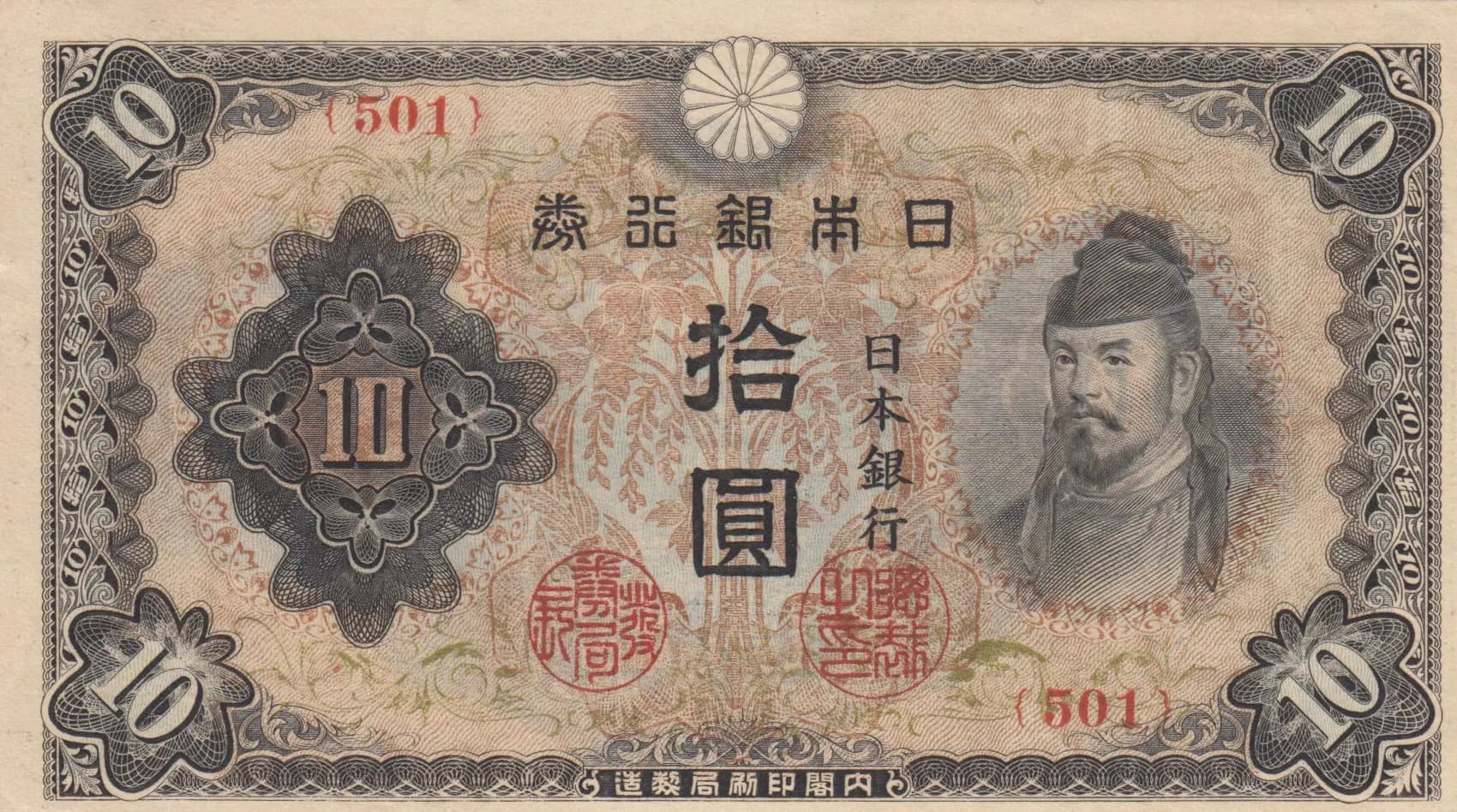
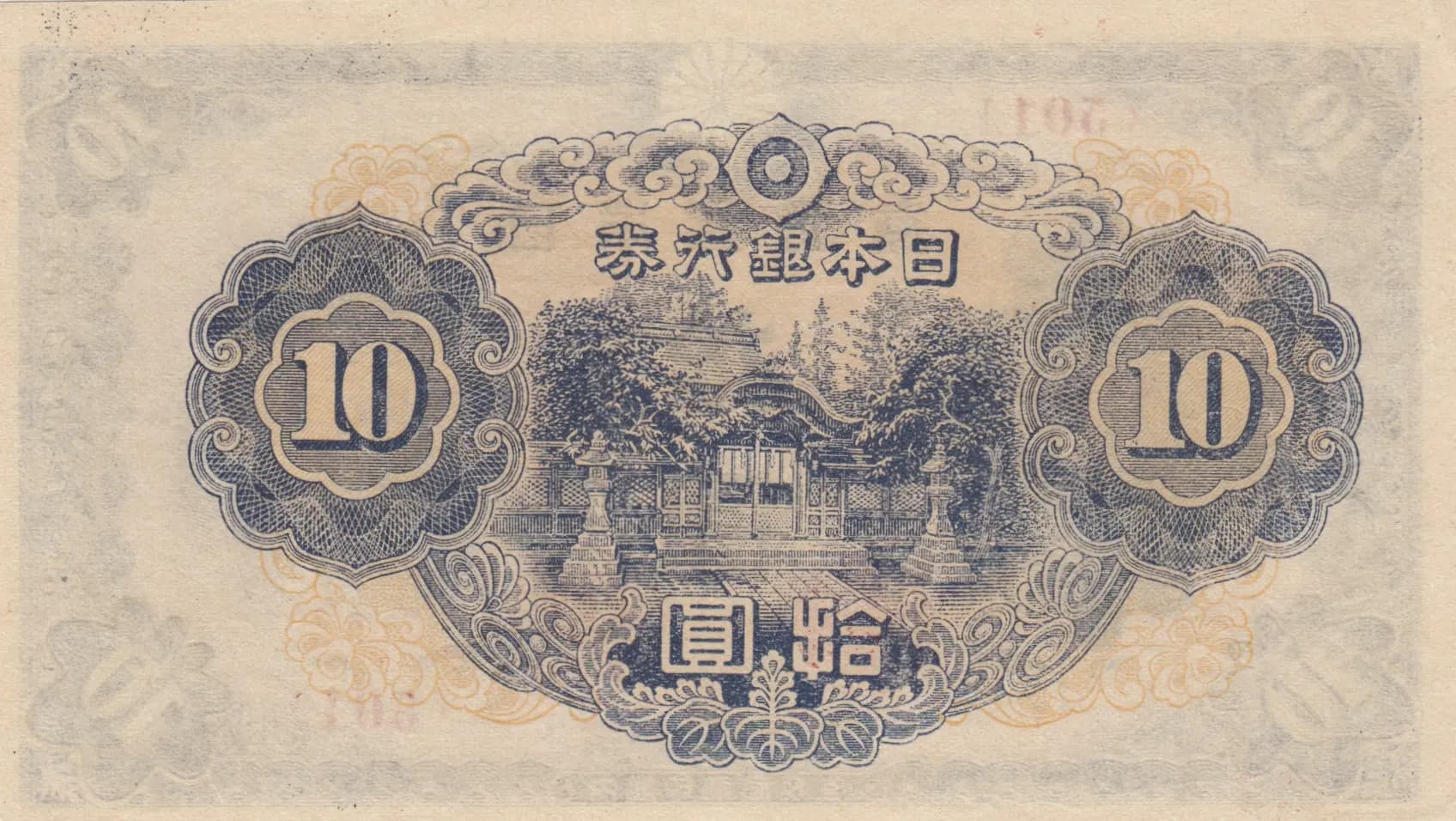
This is a Japanese 10 Yen banknote from 1944 (Pick P-56a) in AU condition, featuring a portrait of Wakeno Kiyomaro on the obverse and a detailed landscape of the Goo Shrine on the reverse. The note displays excellent preservation with minimal wear, vibrant printing in black, red, and blue inks on a beige/tan underprint, and the characteristic red block number identifier visible on the front. The intricate engraving and ornamental borders demonstrate the high-quality production standards of wartime Japanese currency.
Common. Market data from eBay sales spanning 2012-2021 demonstrates consistent and regular availability, with notes in Fine to Very Fine condition selling in the $1.77-$6.00 range, indicating healthy supply. The 2016 catalogue value for VF condition is only $6, and even PMG-graded examples (PMG 65) have sold for approximately $37. The consistent appearance of this note across multiple transactions over a nine-year period confirms it was printed in substantial quantities and remains readily available to collectors.
Issued during 1944-1945 by the Bank of Japan (Nippon Ginko) near the end of World War II, this banknote reflects the Japanese government's continued monetary operations during the final stages of the war. The choice of Wakeno Kiyomaro, an 8th-century Japanese statesman and scholar, on the obverse and the sacred Goo Shrine on the reverse emphasizes cultural and historical continuity even as the nation faced unprecedented military pressures. This denomination and design represent an important transitional period in Japanese numismatic history.
The obverse features a three-quarter portrait of Wakeno Kiyomaro (733-799), a Nara period statesman and imperial advisor, depicted with traditional beard and formal dress on the right side of the note. The left side displays a large ornamental chrysanthemum flower design, a symbol of the Japanese imperial family and longevity. The reverse depicts the Goo Shrine (Goo-jinja), an important Shinto shrine, rendered as a detailed architectural and landscape scene with traditional temple buildings surrounded by trees and formal garden elements, framed by decorative auspicious cloud motifs. Both sides feature elaborate ornamental borders with floral and geometric patterns, corner medallions with denomination numerals, and finely-engraved security patterns throughout.
Front side: '日本銀行券' (Nippon Ginko Ken / Bank of Japan Note), '拾圓' (Ju En / Ten Yen), '內閣印刷局製造' (Naikaku Insatsu Kyoku Seizô / Manufactured by the Cabinet Printing Bureau), and denomination numeral '10'. Back side: '日本銀行券' (Bank of Japan Note), '拾圓' (Ten Yen), and denomination numeral '10'. Red block number visible on front (noted as '1501' in visual analysis).
Intaglio (engraved) printing, characteristic of Japanese currency of this period. The note was manufactured by the Cabinet Printing Bureau (內閣印刷局), as indicated by the imprint on the note. The multi-color printing in black, red, blue, and brown demonstrates the sophisticated color separation and registration techniques employed. The fine line work, ornamental patterns, and portrait engraving are consistent with high-security intaglio production standards.
This note is identified as Pick P-56a, the variant featuring red block number only (without serial numbers on this particular type). The visual analysis indicates a block number of '1501'. According to catalog references, earlier similar notes (P-40) featured both text in Japanese and English on the back, while P-51 featured both block and serial numbers. The P-56a represents a specific wartime production variant with the simplified red block numbering system. The bearded portrait of Wakeno Kiyomaro and the Goo Shrine imagery are consistent across this series.