10 sen 1946
Market Prices
1 saleAbout This Note
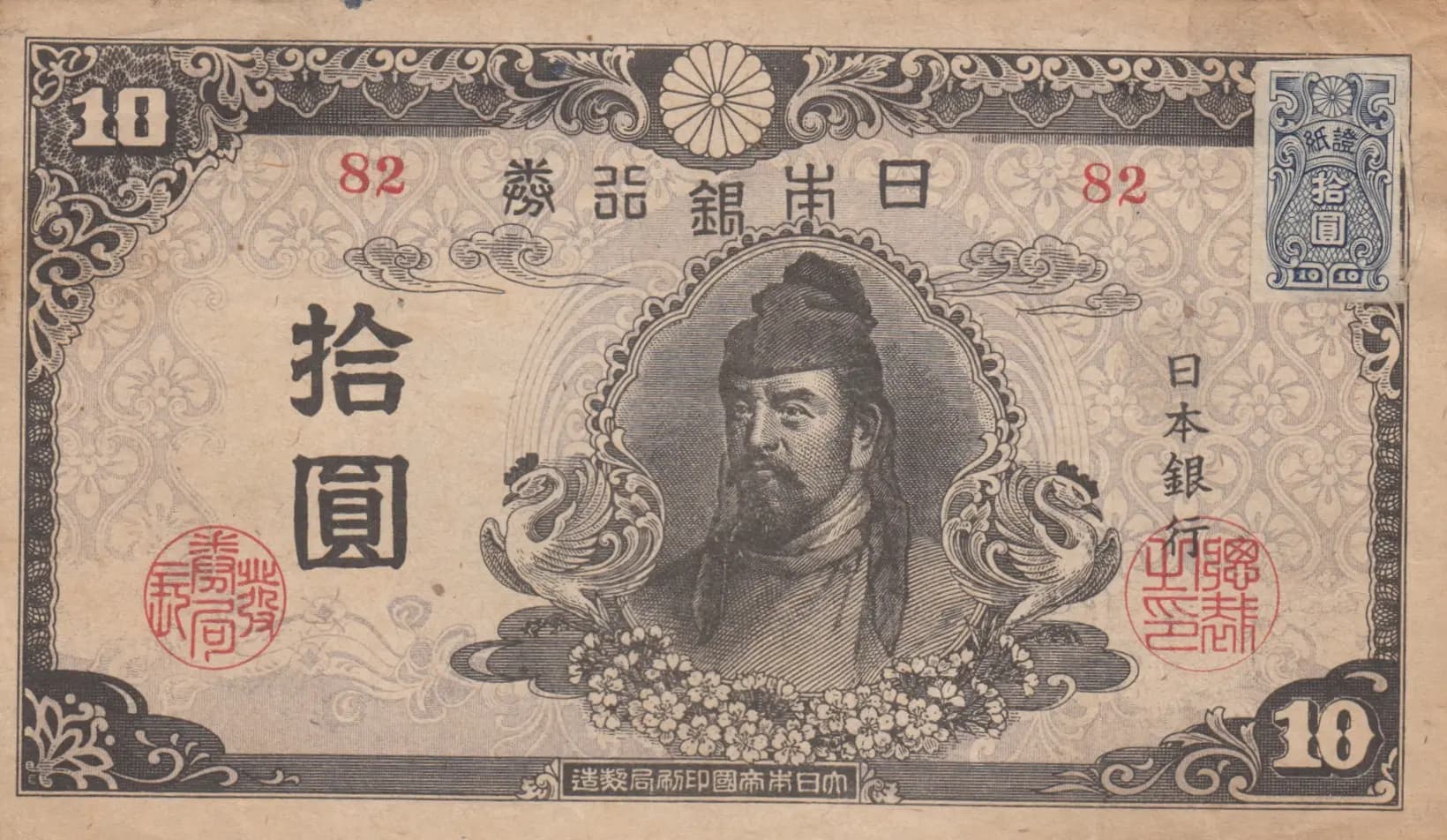
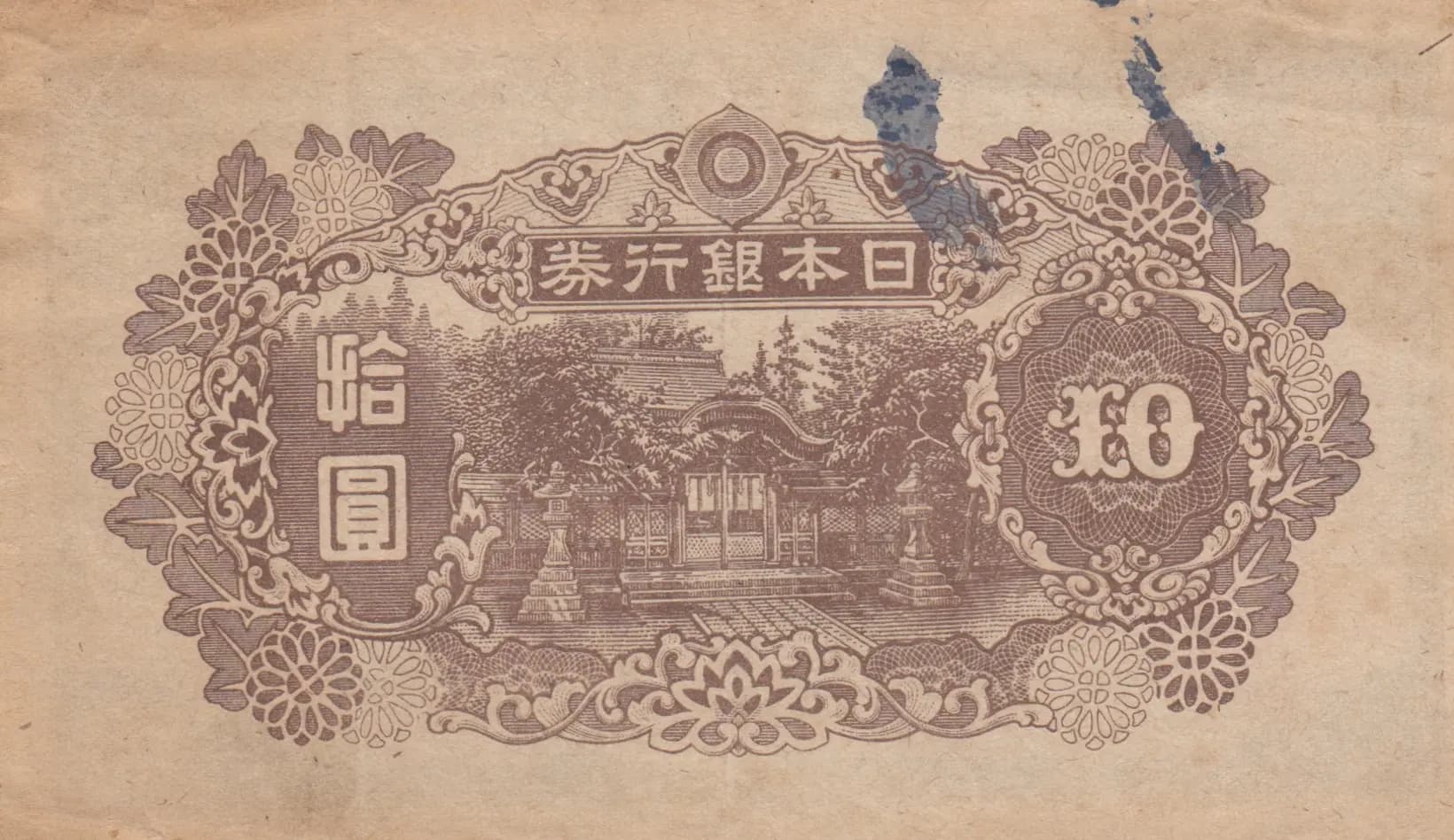
This 1946 Japanese 10 sen banknote (Pick P-79d) presents a well-preserved example of immediate post-war Japanese currency featuring a portrait of Wakeno Kiyomaro on the obverse and an architectural rendering of Goo shrine on the reverse. The note displays characteristic age-related patina and light creasing consistent with VF condition, with fine engraving work clearly visible throughout both sides including ornate decorative borders, floral motifs, and red circular seals that enhance its collector appeal.
Common. The 1946 10 sen note was issued in substantial quantities during the post-war period by the Bank of Japan. Market data from realbanknotes.com shows VF examples catalogued at $75, and recent eBay activity shows comparable notes selling in the $5-10 range, indicating robust supply in the collector market. Pick P-79d is a standard regular issue without known major varieties or restricted print runs that would elevate rarity.
Issued in 1946 by the Bank of Japan during the Allied occupation period following World War II, this banknote represents a transitional moment in Japanese currency design. The selection of Wakeno Kiyomaro, an 8th-century statesman and scholar, reflects Japan's attempt to reconnect with its classical cultural heritage amid post-war reconstruction. The depiction of Goo shrine on the reverse further emphasizes this cultural continuity, featuring traditional East Asian architectural elements that were integral to Japanese national identity during the recovery period.
The obverse features a central oval-framed portrait of Wakeno Kiyomaro (733-799), the Nara-period statesman and scholar, depicted as a bearded man wearing traditional East Asian headwear, with a floral garland of flowering plants positioned beneath. The reverse showcases Goo shrine (Gū Shrine), a significant Shinto shrine complex, rendered in architectural detail with its characteristic peaked ornamental roof, secondary structures, surrounding vegetation, balustrades, and entrance archway within a traditional landscape composition. Both sides are framed by elaborate decorative borders incorporating chrysanthemum flowers, scrollwork, and floral motifs positioned at corners and top center, with red circular seals/stamps serving as additional design elements.
Front side: '10' (Arabic numerals), '拾円' (Ten yen), '82' (Arabic numerals), '日本銀行' (Bank of Japan), '日本' (Japan). Back side: '日本銀行券' (Bank of Japan Note), '10' (Arabic numerals), '円' (Yen), '帝国印刷局製造' (Printed by Imperial Printing Bureau).
Intaglio engraving (steel plate engraving) produced by the Imperial Printing Bureau (帝国印刷局). The fine line engraving technique is evident throughout both sides, creating the complex decorative patterns, portrait detailing, and landscape elements. Red ink was applied separately for the circular seal impressions.
The note is catalogued as Pick P-79d, the fourth identified variety of the 1946 10 sen issue. Varieties within this series are primarily distinguished by minor printing differences and signature variations rather than major design alterations. The serial number '82' visible in the visual analysis may indicate this specimen's place within the production sequence, though without additional comparative examples, specific variety classification beyond P-79d cannot be definitively established from the images alone.