50 centesimi 1870
About This Note
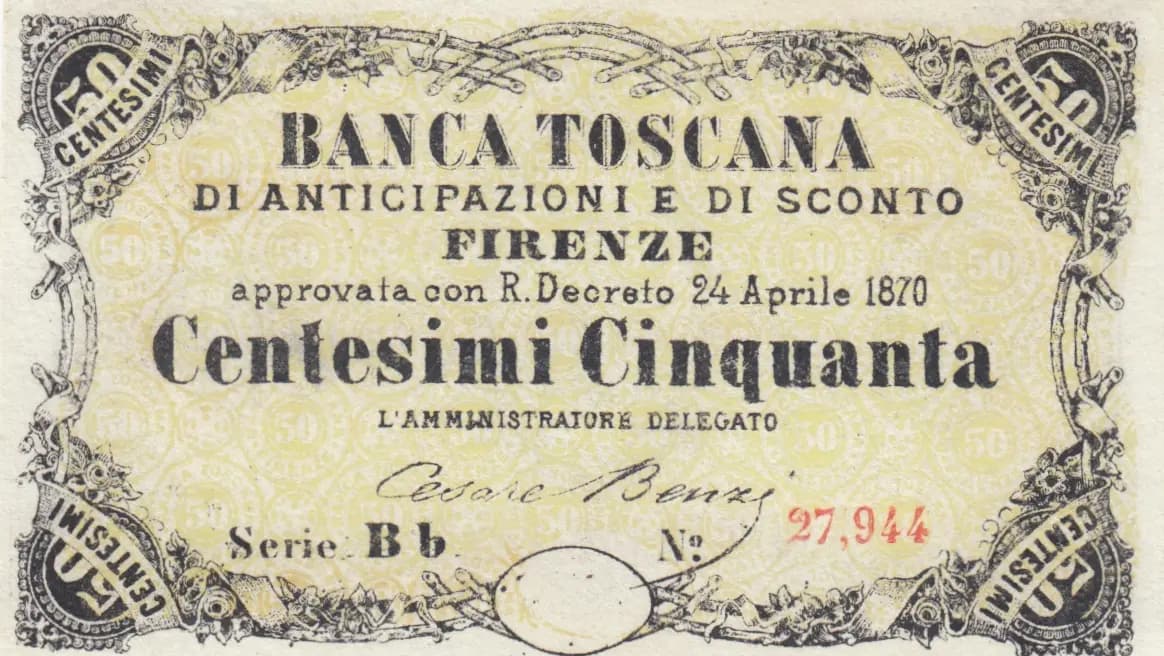
A scarce 50 centesimi banknote issued by Banca Toscana in 1870, approved by Royal Decree on April 24th of that year. The note exhibits the characteristic ornate engraving and classical design elements typical of early Italian regional banking currency, with prominent circular denomination medallions, handwritten signatures, and red serial numbering. Despite showing age-related foxing and discoloration consistent with 19th-century paper stock, the note displays strong detail in its decorative borders and central emblems, representing an important example of Tuscan financial history during the early unified Italian period.
Uncommon to scarce. Banca Toscana operated as a regional bank during Italy's transitional financial period (1870s), prior to the consolidation of note-issuing authority under the Banca d'Italia. Regional bank notes from this era were produced in limited quantities relative to national issues, and survival rates are notably lower due to paper degradation and historical withdrawal from circulation. The specific series designation 'Bb' and serial number '27,944' suggest a moderate print run typical of regional banks of the period. While not exceptionally rare, well-preserved examples of Banca Toscana currency are substantially less common than contemporary central bank issues, making this note of meaningful interest to Italian numismatic specialists and regional banking history collectors.
Banca Toscana (Bank of Tuscany) was established as a regional discount and advance bank headquartered in Florence, operating during the critical period of Italian unification and financial reorganization. The Royal Decree approval date of April 24, 1870, places this note within the early years of the Kingdom of Italy, when regional banks maintained significant note-issuing authority before the Banca d'Italia consolidated monetary control. The bilingual inscriptions in Italian and French reflect Tuscany's historical cultural and commercial ties, particularly the influence of Franco-Italian financial practices in the post-Napoleonic era.
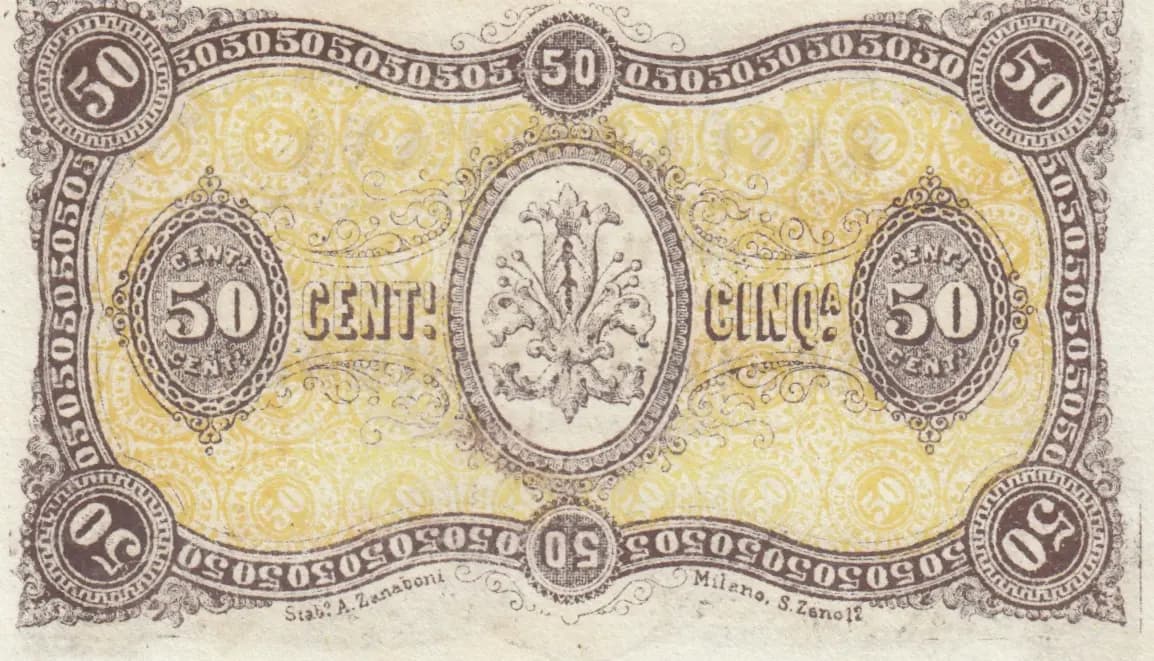
The banknote employs a classical Renaissance Revival aesthetic typical of mid-19th century European bank currency. The front features a cream and black color scheme with ornate scrollwork and floral decorative borders framing the central text area. Circular medallions containing the denomination '50' and 'CENTESIMI' are positioned at the top corners, while a central seal or emblem occupies the lower center position. The delegate administrator's signature (Cesare Benzi) appears prominently in the center-right area, with the series designation 'Bb' and serial number '27,944' marked in red ink—a typical security measure of the period. The reverse presents a more elaborate design with a yellow-cream background and brown-sepia ornamental elements, featuring a prominent central floral medallion (likely an iris or lily, symbolic of Florence) surrounded by repeating geometric patterns and corner medallions. The repeating '50' denomination markers along the top and bottom borders provide visual reinforcement of value. Both sides showcase the sophisticated engraving work characteristic of the A. Zanoletti print house in Milan, one of Italy's premier security printers of the era.
FRONT SIDE: 'BANCA TOSCANA' (Tuscan Bank) / 'DI ANTICIPAZIONI E DI SCONTO' (Of Advances and Discount) / 'FIRENZE' (Florence) / 'approvata con R.Decreto 24 Aprile 1870' (approved by Royal Decree 24 April 1870) / 'Centesimi Cinquanta' (Fifty Centesimi) / 'L'AMMINISTRATORE DELEGATO' (The Delegate Administrator) / 'Cesare Benzi' (Cesare Benzi - signature) / 'Serie Bb' (Series Bb) / '27,944' (serial number). BACK SIDE: '50' and 'CENT.' (Centesimi - abbreviation, repeated in corners) / 'CINQ' (French: Five) / 'Stab. A. Zanoletti' (A. Zanoletti Establishment/Print House) / 'Milano, S.Zenelti' (Milan, S.Zenelti).
Steel plate intaglio engraving (line engraving), the dominant security printing method for banknotes throughout the 19th century. The complex ornamental borders, fine scrollwork, and detailed medallion designs visible in both the visual analysis and the multi-color printing effects indicate classical intaglio production. The note was produced by the A. Zanoletti Establishment (Stabilimento A. Zanoletti) located in Milan, S. Zenelti—a recognized Italian security printer of the period. The consistent, fine line work and the ability to produce sharp detail in the decorative elements throughout the note are hallmarks of steel plate engraving technology.
Series Bb with serial number 27,944 in red ink. The delegate administrator signature 'Cesare Benzi' is present on this example. Varieties of Banca Toscana notes typically include different series designations (Series A, Aa, B, Bb, etc.) and different signature variants corresponding to changes in bank administration. This particular note represents the Series Bb variety with the Benzi administration signature. No overprints or significant printing variants are apparent in the observed example, though other series and administrative signature combinations likely exist.