1000 lire 1971
Market Prices
9 salesAbout This Note
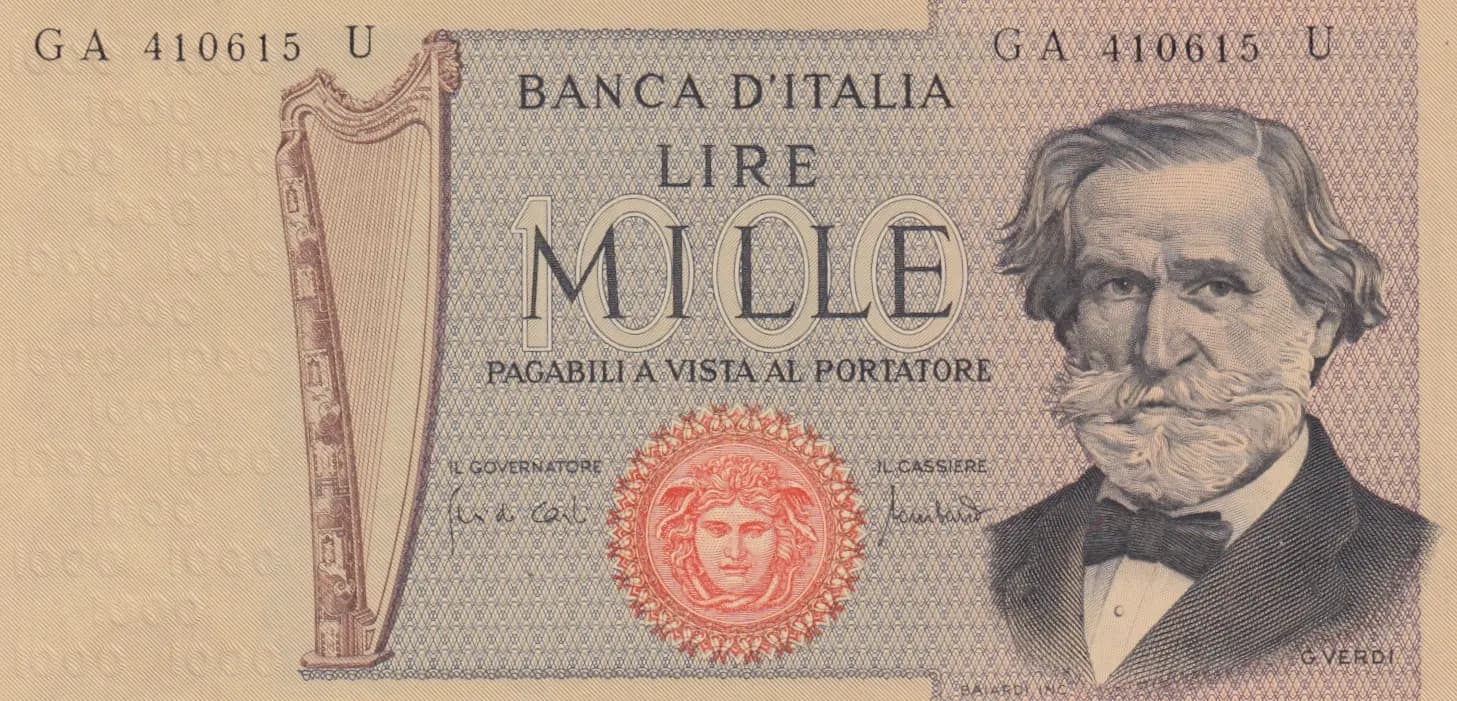
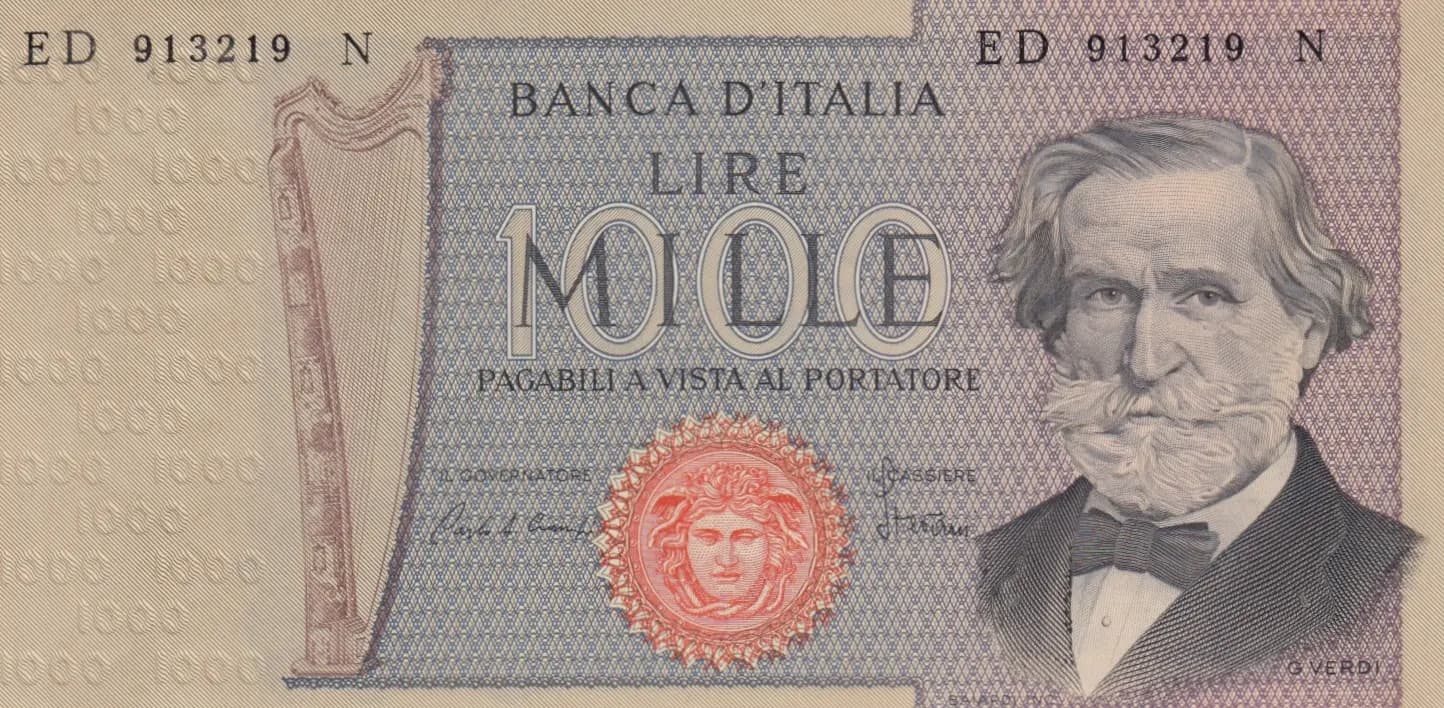
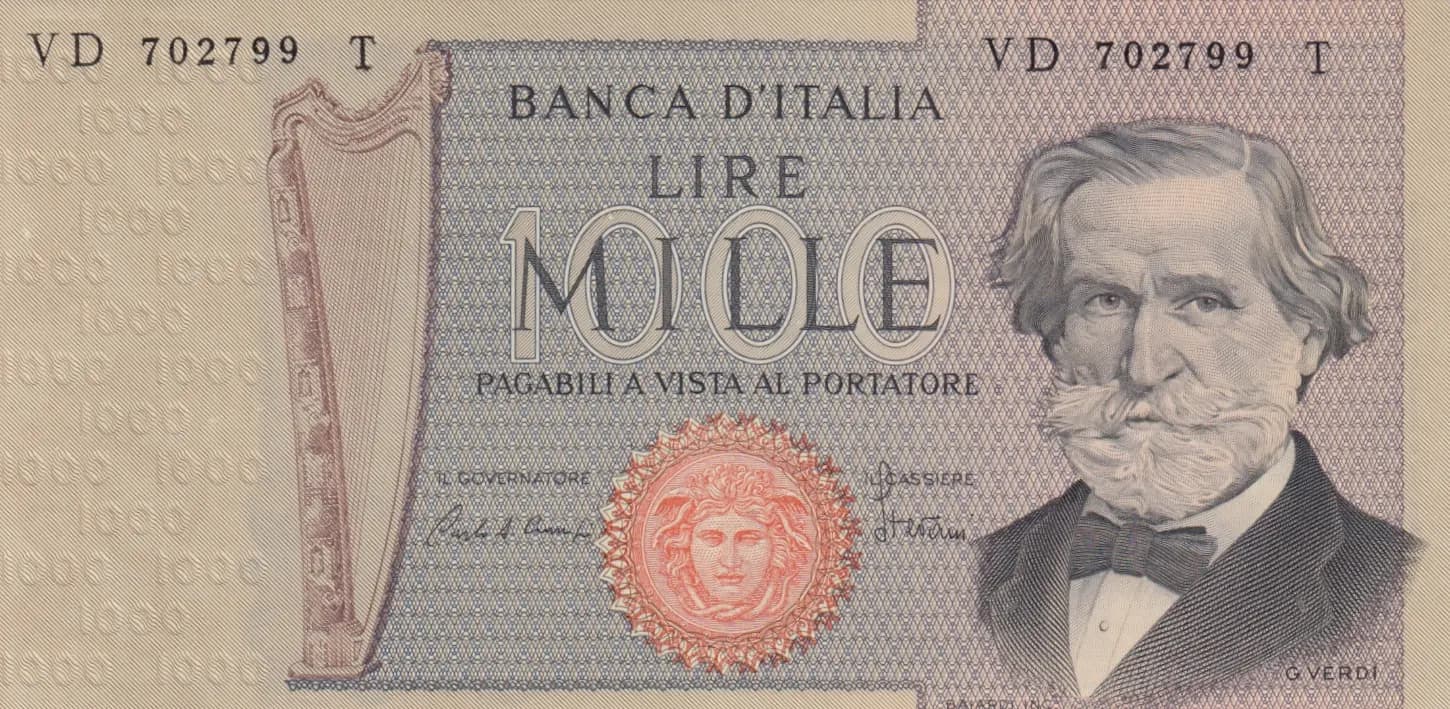
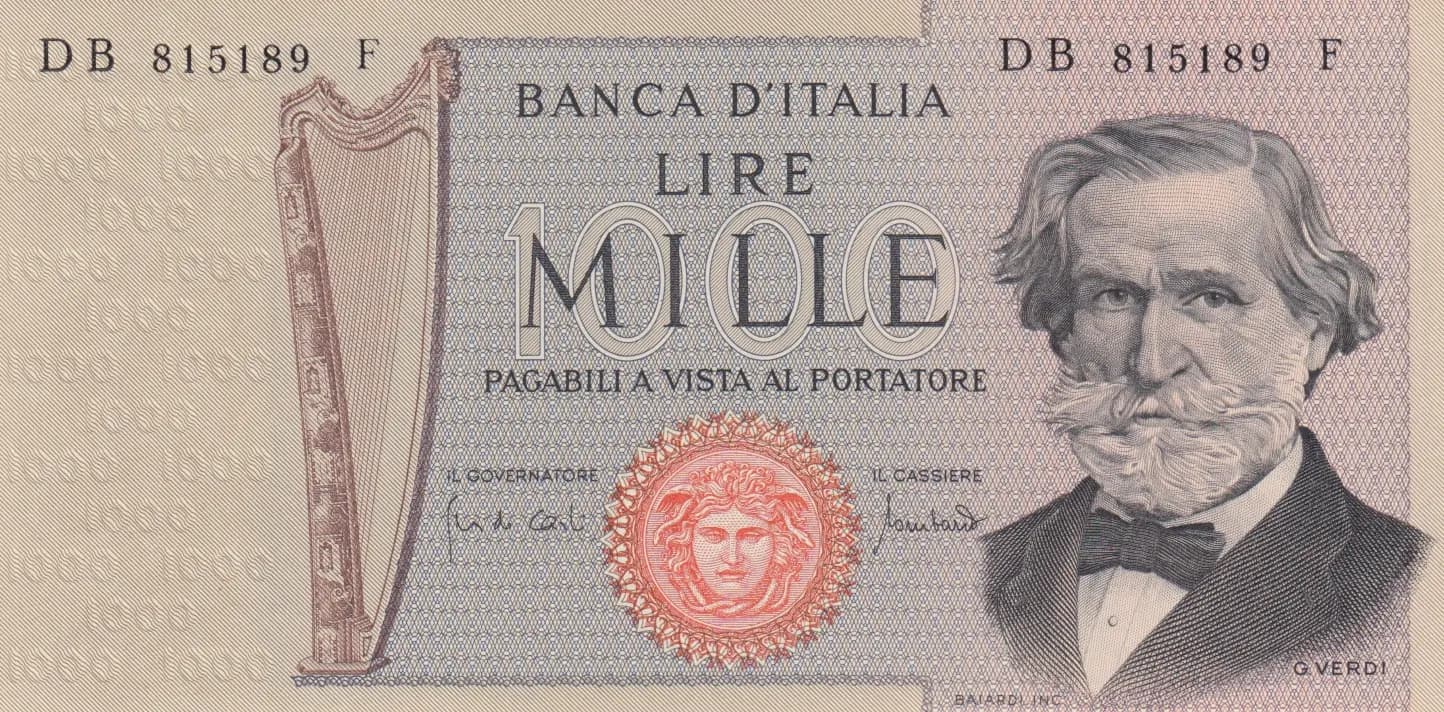
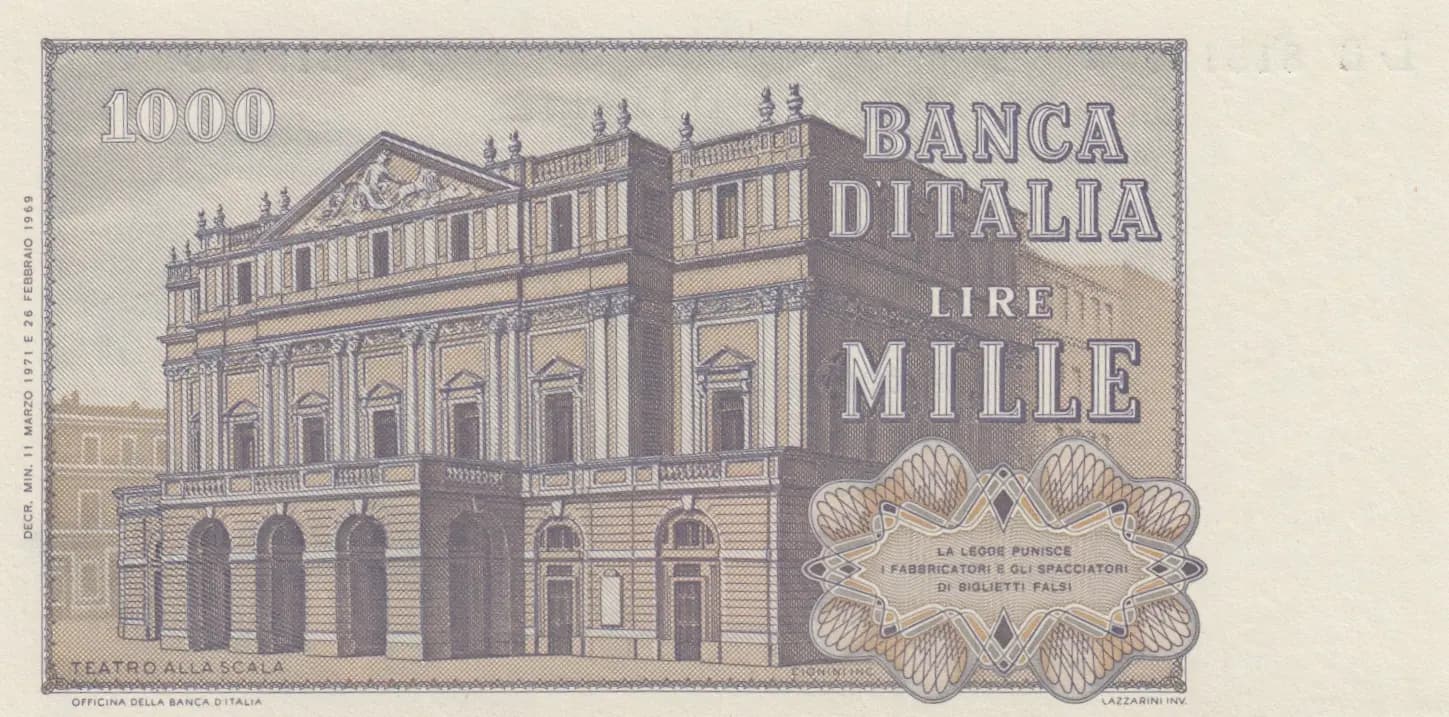
This is an uncirculated 1000 Lire note from Italy's 1971 issue, featuring a striking portrait of Giuseppe Verdi on the obverse and an architectural engraving of Milan's Teatro alla Scala on the reverse. The note displays excellent preservation with no visible wear, creases, or stains, showcasing the fine detail work characteristic of Banca d'Italia's printing during this period. The prominent Medusa head seal and intricate security features reflect the sophisticated engraving techniques employed in mid-20th century Italian currency production.
Common. The 1000 Lire 1971 issue (Pick P-101b) is among the most frequently encountered Italian banknotes in the numismatic market. The eBay price tracking data confirms this assessment, with recent sales ranging from under $1 to $5 for circulated and near-uncirculated specimens, and even professionally graded UNC examples achieving only $11-$45 on the secondary market. The denomination was issued in large quantities over a 12-year period (1969-1981), with millions of pieces produced. This note represents a standard issue from a stable, functioning central bank with no historical recall or production anomalies that would create scarcity.
This 1000 Lire denomination was issued by the Banca d'Italia during the 1969-1981 period, a time of significant economic activity in Italy following the post-war reconstruction era. The choice to honor Giuseppe Verdi, Italy's most celebrated composer, reflects the nation's cultural pride and artistic heritage during the 1970s. The inclusion of the Teatro alla Scala—one of the world's premier opera houses located in Milan—reinforces Italy's position as a center of cultural prestige and artistic excellence in the late 20th century.
The obverse features a formal three-quarter portrait of Giuseppe Verdi (1813-1901), the renowned Italian opera composer, depicted as a bearded gentleman in 19th-century formal attire with a bow tie, positioned on the right side of the note. The background employs a sophisticated color palette of beige, tan, purple, and gray tones with fine line engraving throughout. A prominent circular red seal bearing a classical Medusa head—symbolizing protection and authority—is centrally positioned in the lower portion, flanked by ornamental architectural border elements on the left edge. The reverse showcases a detailed neoclassical architectural engraving of the Teatro alla Scala in Milan, featuring its characteristic ornate facade with columns, arches, mansard roof with decorative balustrades, and elaborate detailing rendered in gray, brown, and beige tones. A winged emblem with text appears in the lower center-right area, and the denomination '1000 LIRE' is prominently displayed in the center-right section.
FRONT SIDE: 'BANCA D'ITALIA' (Bank of Italy), 'MILLE LIRE' (One Thousand Lire), 'PAGABILI A VISTA AL PORTATORE' (Payable on demand to bearer), 'IL GOVERNATORE' (The Governor), 'IL CASSIERE' (The Cashier), 'G.VERDI' (G. Verdi - attribution to the depicted portrait), serial number 'DB 815189 F'. BACK SIDE: 'BANCA D'ITALIA' (Bank of Italy), '1000 LIRE MILLE' (One Thousand Lire), 'TEATRO' (Theater), 'LA LEGGE PUNISCE I FABBRICATORI E GLI SPACCIATORI DI BIGLIETTI FALSI' (The law punishes counterfeiters and distributors of forged notes), 'OFFICINA DELLA BANCA D'ITALIA' (Office of the Bank of Italy/Printing Office), 'LAZZARINI INV.' (Lazzarini Inventor/Designer), printer notation 'DRER SIM IMPRCO INSERI 6/1948' (printing information from 1948 design date).
This note was produced using intaglio (copperplate) engraving combined with letterpress printing, as evidenced by the exceptionally fine line work, complex cross-hatching patterns, and precise detail visible throughout both sides. The Officina della Banca d'Italia in Rome employed multiple color printing with careful registration to achieve the subtle transitions between the beige, tan, purple, gray, brown, and black inks. The fine engraving detail, security thread, and watermark with laureate heads indicate use of advanced security printing techniques standard for Italian currency of this period.
This example represents the Pick P-101b variety, identified by its watermark of vertical rows of laureate heads and the Medusa head seal design. The visual analysis shows serial number prefix 'DB' with the designation 'F', typical of notes from this series. The PMG population report indicates P-101a and P-101d variants also exist with the same laureate head watermark. The design elements (Lazzarini as designer, Officina della Banca d'Italia notation) and printing date notation ('6/1948') are consistent with the standard 1971 issue specifications. No notable overprints, errors, or signature varieties are apparent in this specimen.