1000 lire 1981
Market Prices
11 salesAbout This Note
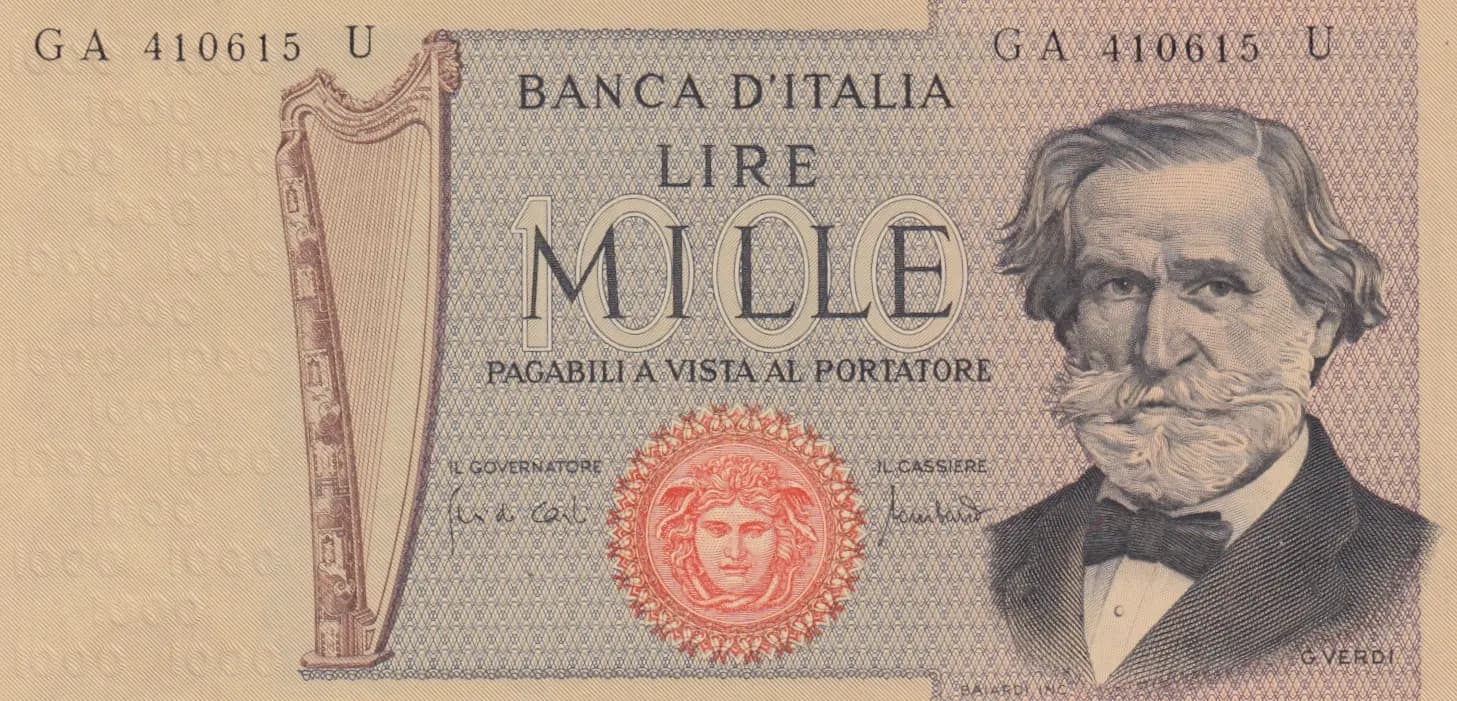
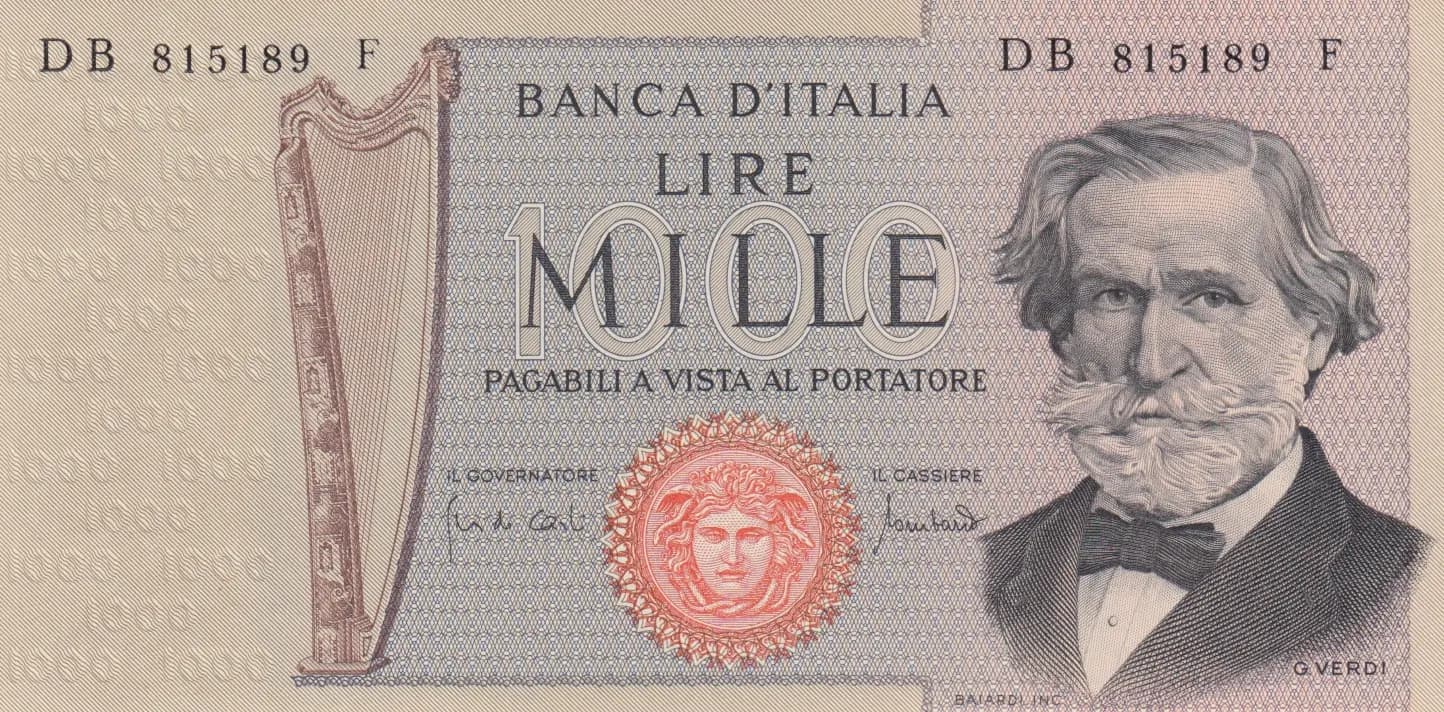
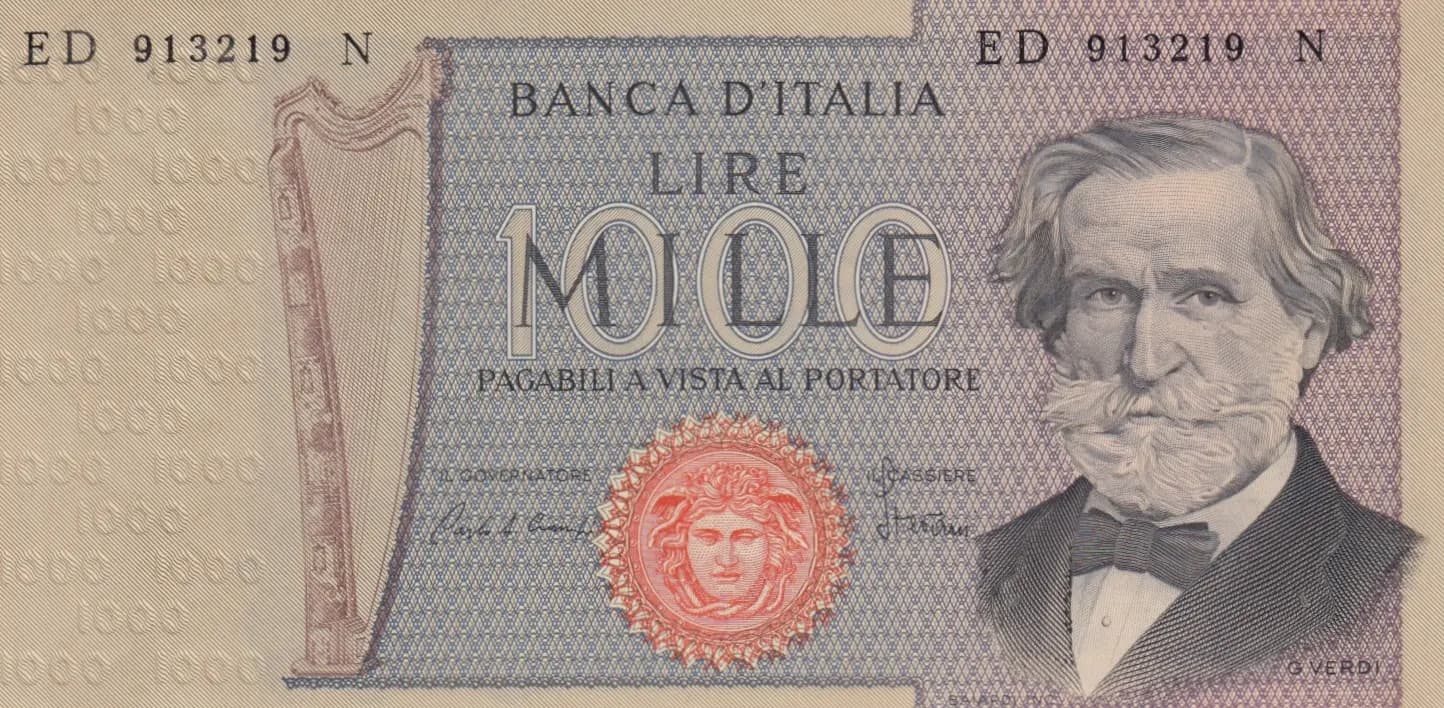
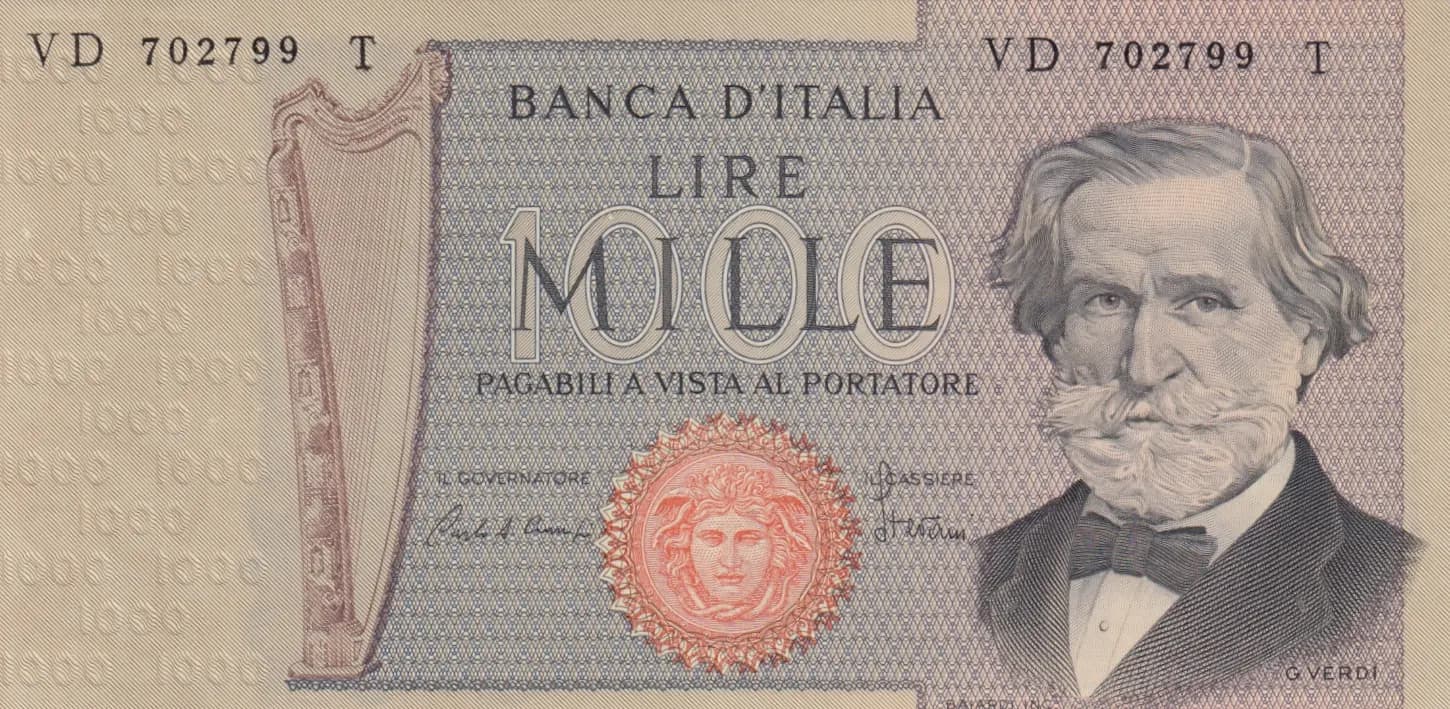
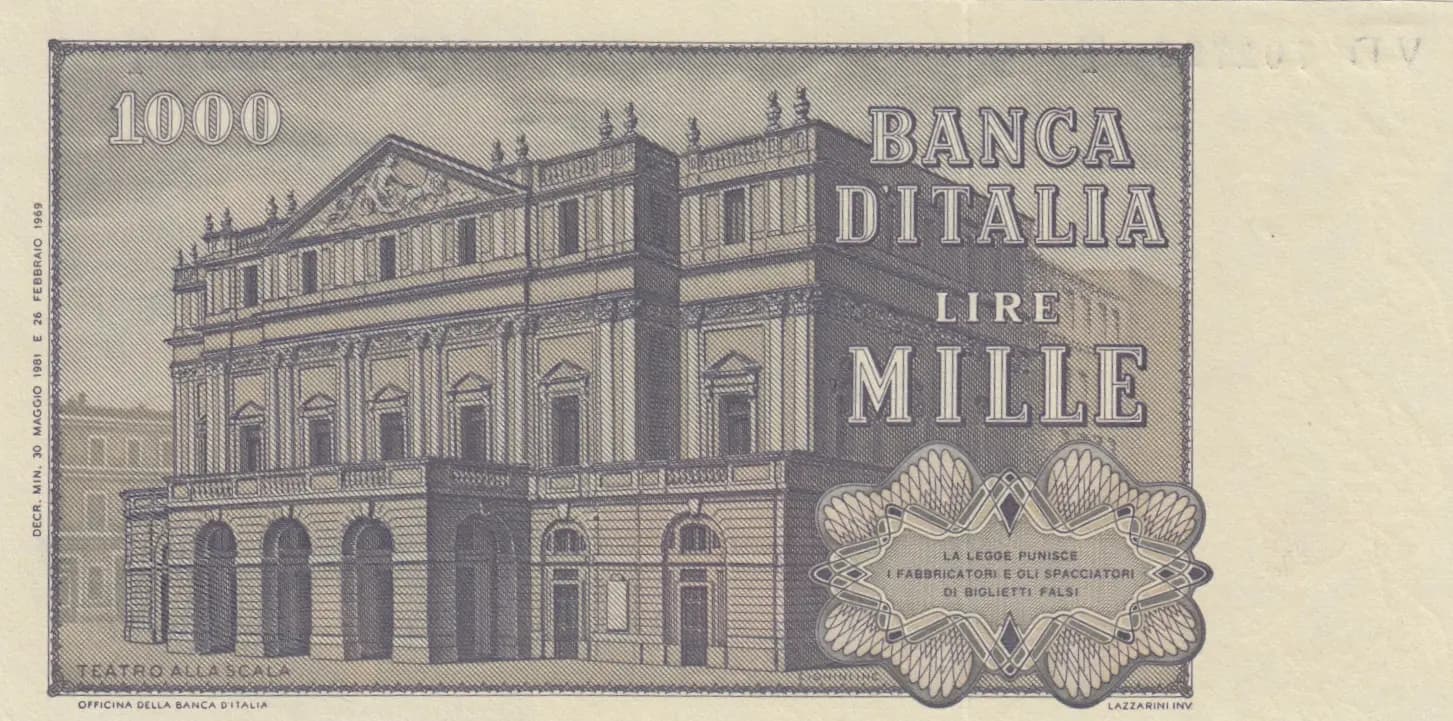
A pristine uncirculated example of Italy's 1000 lire banknote from 1981, featuring the legendary composer Giuseppe Verdi in formal 19th-century attire on the obverse and an exquisitely engraved rendering of Milan's iconic Teatro alla Scala opera house on the reverse. The note exhibits excellent preservation with sharp printing throughout, intricate security features including fine-line patterns and decorative elements, and maintains the characteristic beige, purple, and gray color palette typical of this issue. This is a popular series among Italian banknote collectors, with this specific UNC grade example representing strong collector appeal.
Common. This is a regular issue note from a major currency that was widely circulated throughout Italy during a 12-year period (1969-1981 according to catalog data). The eBay market data provided shows consistent sales at modest valuations, with UNC examples selling in the $8-12 range in recent years, and lower grades commanding only $0.50-$4.25. These price points, combined with the wide circulation period and absence of any special or short-lived status, confirm this is a common banknote despite its artistic merit and historical interest.
Issued during the final decade of the Italian lira's circulation as an independent currency, this 1981 banknote commemorates Giuseppe Verdi, one of Italy's most celebrated cultural figures and a symbol of Italian artistic excellence during the 19th century. The reverse depicts La Scala opera house in Milan, one of Europe's most prestigious cultural institutions and a fitting complement to Verdi's legacy. The ministerial decrees dated May 30, 1981 and February 26, 1982 indicate this note was part of the Bank of Italy's effort to modernize and secure the currency in the pre-euro era.
The obverse features a three-quarter portrait of Giuseppe Verdi (1813-1901), the renowned Italian composer, depicted as a distinguished bearded gentleman in formal 19th-century attire including a bow tie and dark jacket, positioned on the right side of the note. The left-center displays a classical harp, symbolizing music and the arts. A prominent circular medallion featuring a classical female head (Medusa-like figure) in red/pink coloring with an ornate border occupies the lower center, serving as a security and decorative element. The reverse presents a meticulously engraved architectural rendering of Teatro alla Scala (La Scala opera house) in Milan, showcasing its distinctive neoclassical design with multiple stories, columns, arches, and balustrades. An ornamental cartouche with scrollwork, wings, and shield-like design containing the anti-counterfeiting warning text appears in the lower right corner. The watermark consists of a vertical row of laureate heads, complemented by a seal featuring a facing Medusa head for additional security.
FRONT SIDE: 'BANCA D'ITALIA' (Bank of Italy) / '1000 LIRE' (One thousand lire) / 'PAGABILI A VISTA AL PORTATORE' (Payable on demand to the bearer) / 'GOVERNATORE' (Governor) / 'CASSIERE' (Cashier) / 'G.VERDI' (Giuseppe Verdi - signature/attribution) / Serial number 'VD 702799' with letter designation 'T' (appears twice). BACK SIDE: '1000 LIRE MILLE' (One thousand lire) / 'BANCA D'ITALIA' (Bank of Italy) / 'MILLE' (One thousand) / 'LA LEGGE PUNISCE I FABBRICATORI E GLI SPACCIATORI DI BIGLIETTI FALSI' (The law punishes the makers and distributors of counterfeit notes) / 'OFFICINA DELLA BANCA D'ITALIA' (Office/Printing Works of the Bank of Italy) / 'LAZZARINI INV' (Lazzarini - designer/engraver attribution) / 'DECR. MIN. 30 MAGGIO 1981 E 26 FEBBRAIO 1982' (Ministerial Decree of May 30, 1981 and February 26, 1982).
Intaglio engraving (also known as recess printing or copperplate engraving), executed by the Officina della Banca d'Italia (Bank of Italy's Printing Works) in Rome. The visual analysis confirms characteristic intaglio features including fine parallel line patterns creating detailed texture throughout both sides, intricate geometric security patterns, ornate borders with repeated pattern elements, and the exceptionally sharp definition of architectural details and portraiture. This traditional high-security printing method was standard for Italian banknote production during this period and provided excellent anti-counterfeiting protection through the complexity and difficulty of reproducing fine-line engraved details.
Per Pick P-101h designation, this represents one variant of the 1000 lire 1981 issue (PMG has catalogued at least variants P-101a, P-101d, and P-101h for this base number). The specific variety observed here corresponds to Pick P-101h with watermark of laureate heads and Medusa seal. The serial number prefix 'VD' with letter designation 'T' visible on this example provides further identification, though detailed variety classification within the series may depend on signature combinations, date variations on the reverse decree, or serial number prefix sequences. The visual analysis does not reveal any overprints, printing varieties, or error characteristics that would indicate a special or scarce variety within the P-101h classification.