1000 lire 1969
Market Prices
12 salesAbout This Note
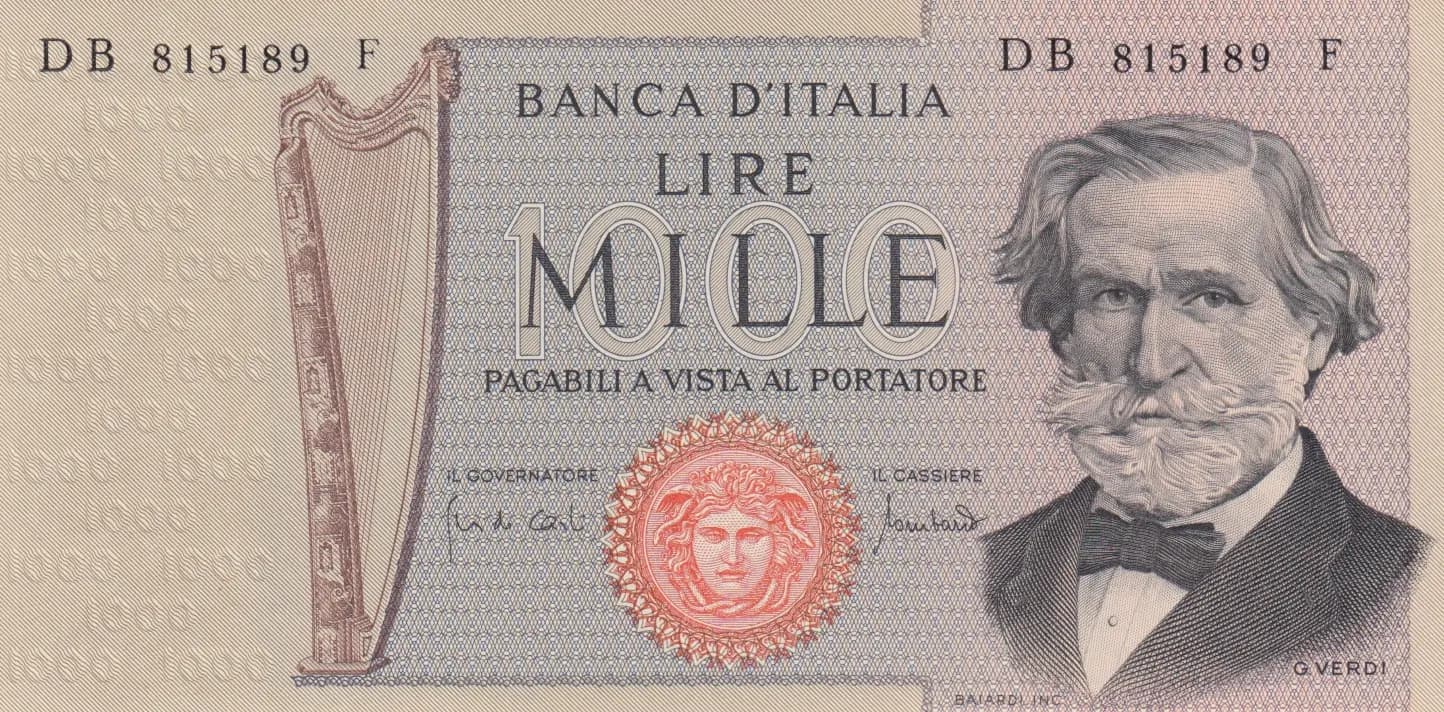
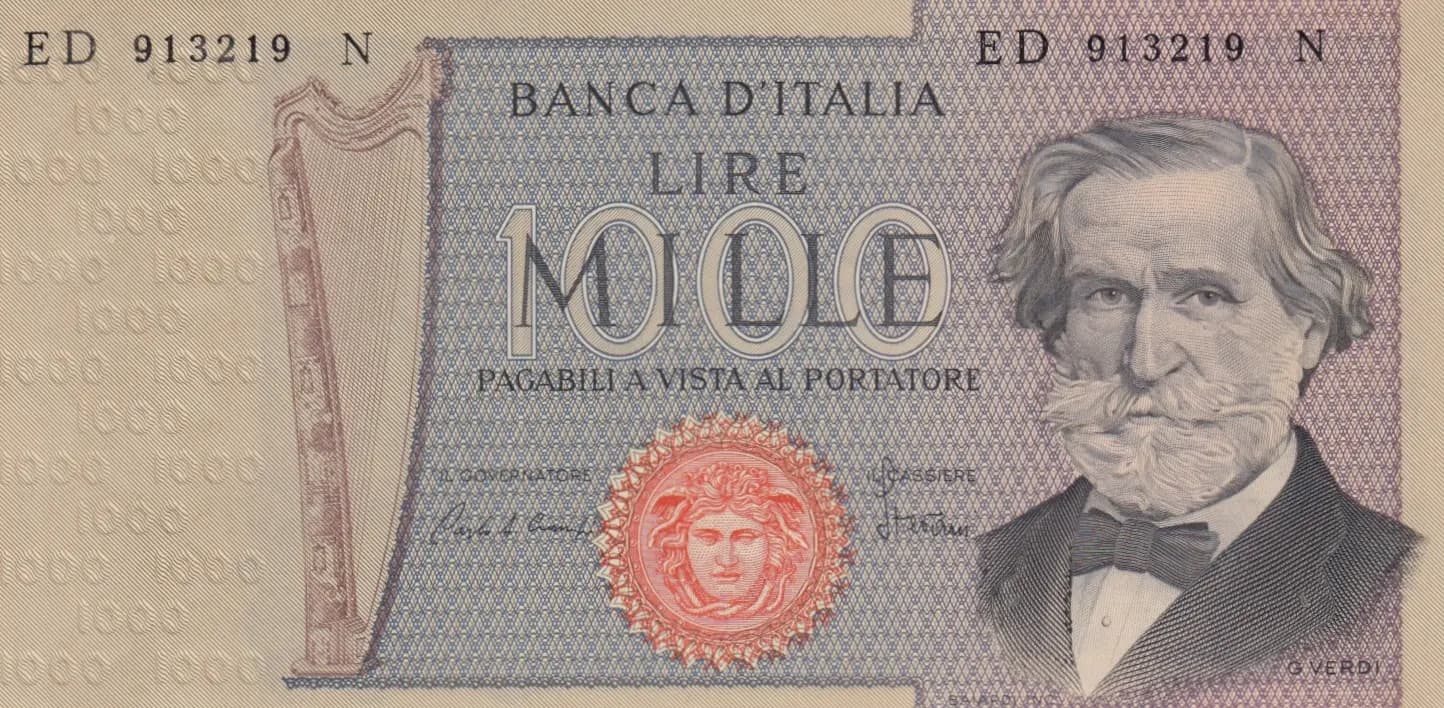
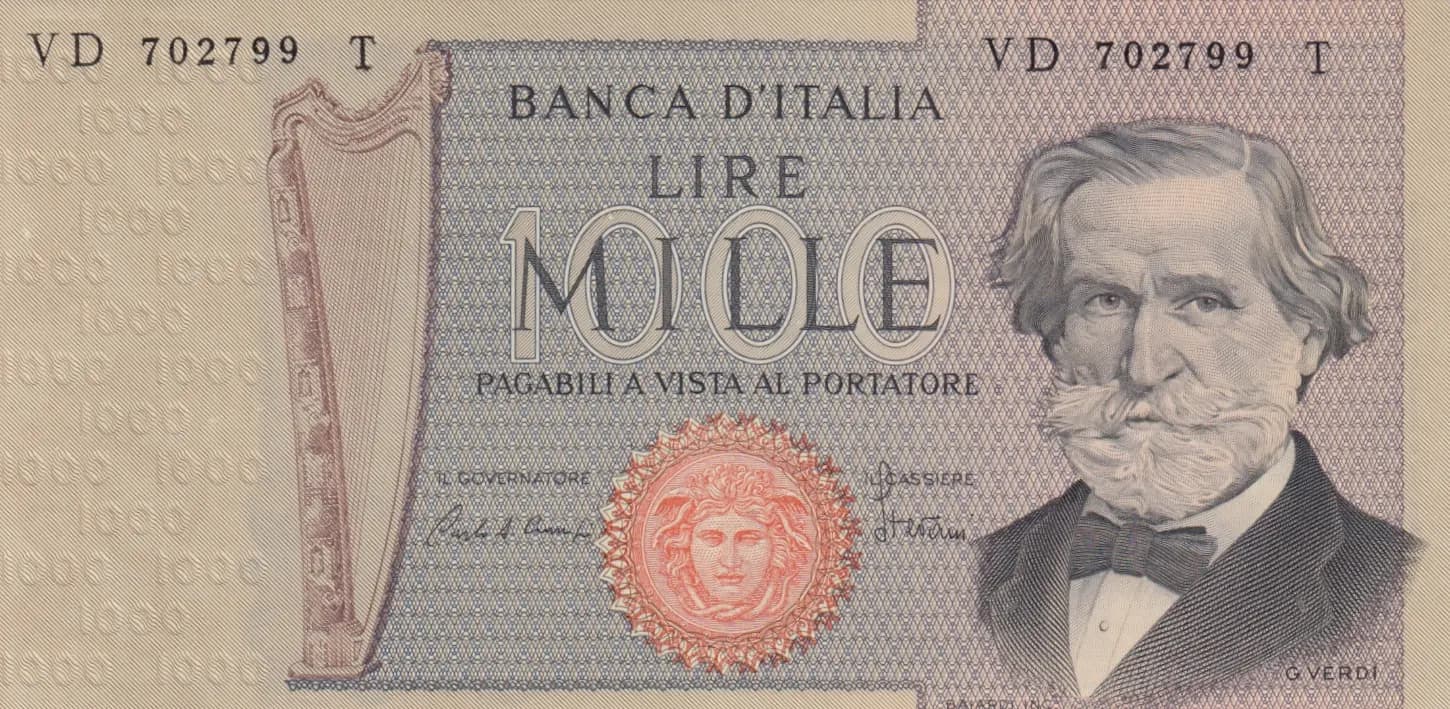
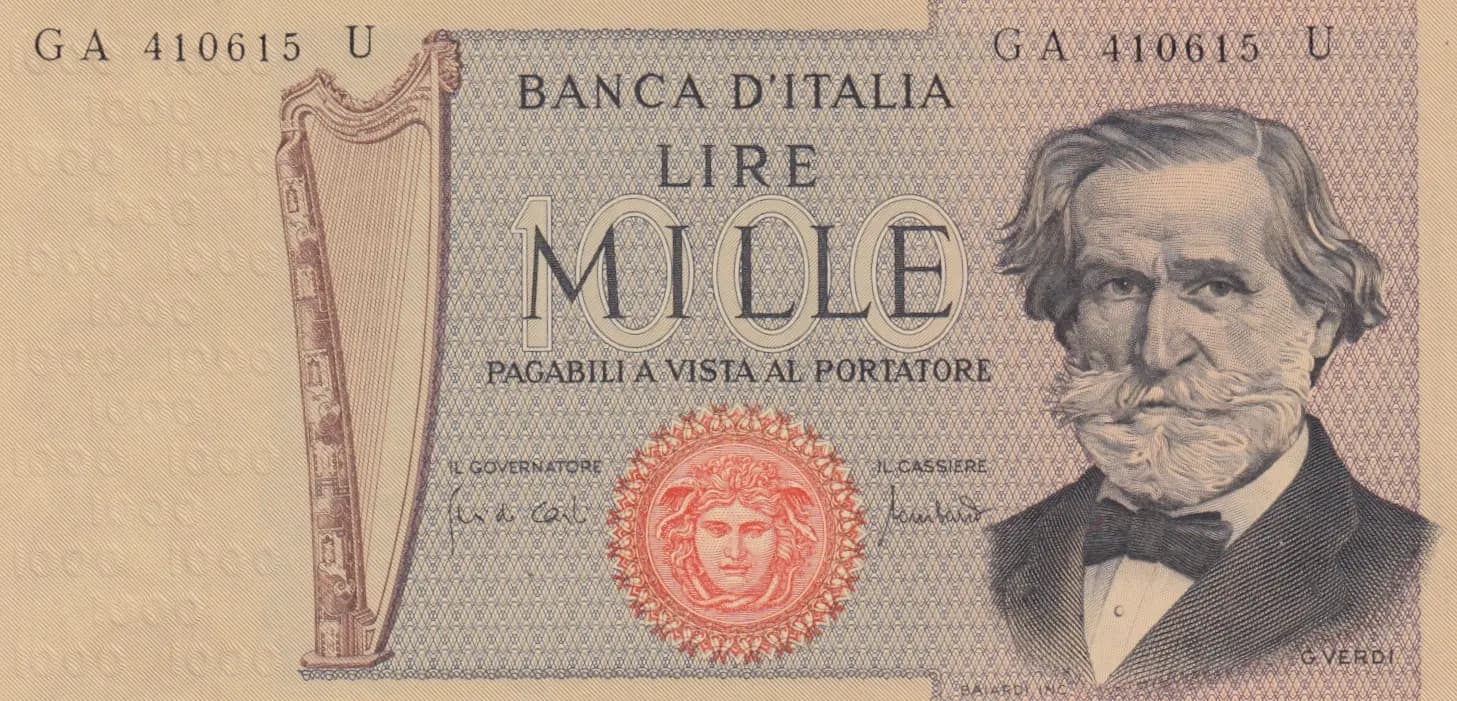
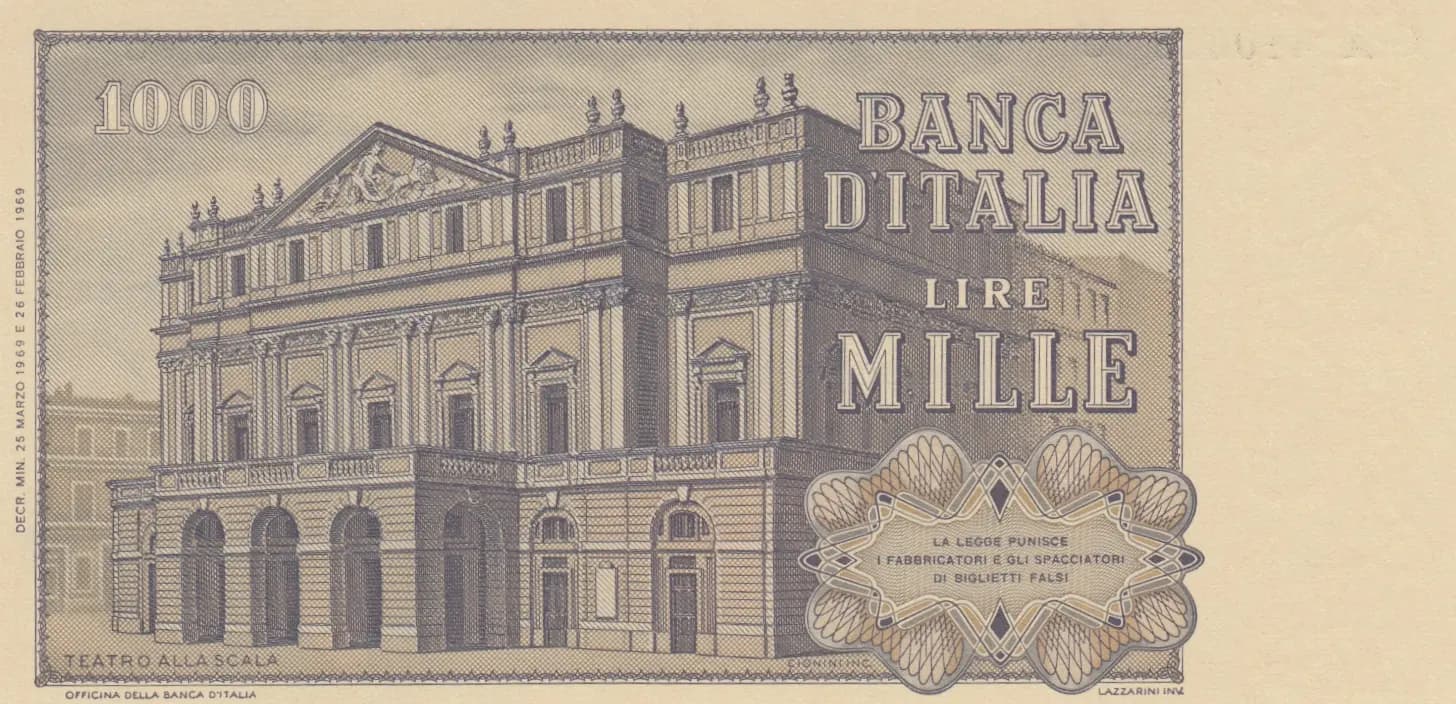
This is an uncirculated 1000 Lire note from 1969, presenting an exceptional example of Italian banknote design during the post-war period. The obverse features a distinguished portrait of Giuseppe Verdi rendered in fine engraving style, complemented by a classical lyre symbol and an elegant red Medusa seal, while the reverse showcases the architectural grandeur of Milan's Teatro alla Scala in detailed black and white engraving. The note exhibits pristine condition with no visible wear, creases, or circulation marks, making it a desirable specimen for collectors of Italian currency or operatic memorabilia.
Common. This is a regular-issue banknote with a substantial print run spanning from 1969 to 1981, as indicated by the catalog date range. The eBay market data provided demonstrates consistent trading at low prices ($0.49–$6.00 for circulated and AUNC specimens, with UNC catalogued at $11.50 in 2019). The note regularly appears in dealer inventories and online auctions, and PMG population reports show it has been professionally graded in multiple variants (P-101a and P-101d), indicating broad availability. No historical evidence of recall, short print runs, or scarcity supports a higher rarity classification.
Issued in 1969 under Decree of December 25, 1969, this banknote celebrates Giuseppe Verdi, Italy's greatest operatic composer, whose legacy was particularly relevant during a period of Italian cultural nationalism and economic recovery. The reverse depicting Teatro alla Scala in Milan emphasizes Italy's prominence as a center of high culture and artistic achievement, reinforcing national pride through the dual symbolism of musical genius (Verdi) and architectural magnificence (the world-renowned opera house). This denomination and design remained in circulation throughout the 1970s and early 1980s, representing a stable period in the Italian lira's history before the transition to the Euro.
The obverse showcases a formal three-quarter bust portrait of Giuseppe Verdi (1813–1901), Italy's preeminent operatic composer, depicted as a distinguished bearded gentleman in formal 19th-century attire with bow tie and dark jacket. The left side features a classical lyre, the ancient symbol of music and Apollo, emphasizing the note's cultural significance. The center-lower area displays a red circular seal bearing the profile of Medusa, a classical security device common to Italian banknotes of this era. The note's color scheme employs beige, brown, gray, and black tones with the distinctive red accent. The reverse presents an elaborate architectural engraving of Teatro alla Scala in Milan, one of the world's most prestigious opera houses, rendered in neoclassical style with multiple stories, columns, arched windows, balustrades, and refined decorative elements. An ornamental shield with winged emblem appears in the lower right corner. The entire design reinforces themes of Italian cultural excellence and artistic heritage.
FRONT SIDE: 'BANCA D'ITALIA' (Bank of Italy) / 'MILLE LIRE' (One thousand lire) / 'PAGABILI A VISTA AL PORTATORE' (Payable at sight to the bearer) / 'IL GOVERNATORE' (The Governor) / 'IL CASSIERE' (The Cashier) / 'VERDI' (Verdi - composer attribution) / Serial number: 'GA 410615 U' (printed twice, top left and right). REVERSE SIDE: 'BANCA D'ITALIA' (Bank of Italy) / '1000 MILLE LIRE' (One thousand lire) / 'TEATRO ALLA SCALA' (Scala Theater) / 'LA LEGGE PUNISCE I FABBRICATORI E GLI SPACCIATORI DI BIGLIETTI FALSI' (The law punishes the manufacturers and distributors of counterfeit banknotes) / 'OFFICINA DELLA BANCA D'ITALIA' (Office of the Bank of Italy) / 'LAZZARINI INC' (Lazzarini Inc., engraver/printer mark) / 'DECR. MM. 25 DICEMBRE 1969' (Decree of December 25, 1969).
Intaglio engraving (line engraving), the traditional security-print method used for banknotes of this era. The visual analysis confirms the characteristic fine line work, cross-hatching, and intricate background pattern work typical of engraved banknote production. Printed by Officina della Banca d'Italia (the Bank of Italy's own printing facility in Rome) with engraving by Lazzarini Inc. The presence of complex architectural detail on the reverse and the refined portraiture on the obverse demonstrate the high level of craftsmanship employed in this production.
This note is catalogued as Pick P-101a, identified by its watermark of vertical rows of laureate heads. The PMG population report indicates at least one other variant (P-101d) exists within the same base Pick number, likely differing in watermark design or minor printing details. The observed serial number 'GA 410615 U' is consistent with standard Italian banknote serialization of the period. The specific date of issue ('DECR. MM. 25 DICEMBRE 1969') and printer attribution ('LAZZARINI INC') are fixed characteristics of this variety. No overprints, emergency issues, or special variants are apparent from the visual evidence.