1 lira 1881
Market Prices
About This Note
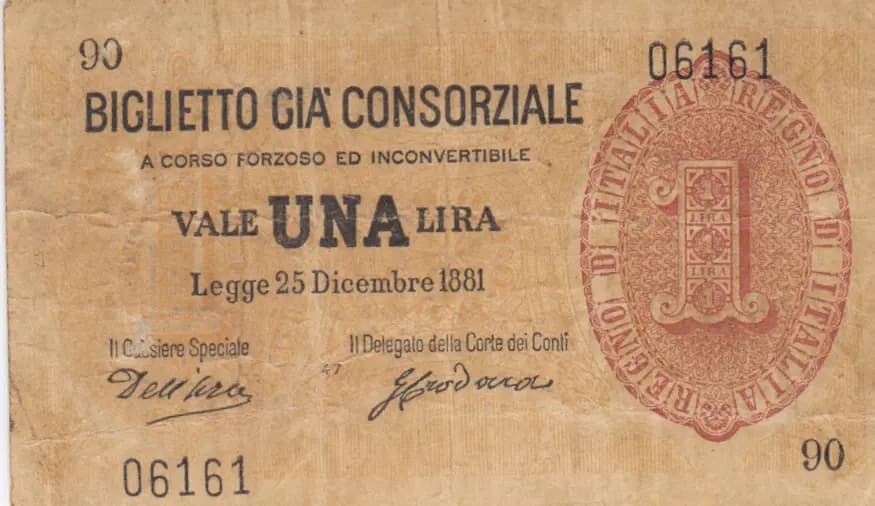
This 1 Lira note from 1881 represents an important transitional piece in Italian monetary history—a former consortium banknote elevated to legal tender status by decree. The note displays classic 19th-century Italian engraving with ornate red-brown borders, allegorical figures, and an elaborate central medallion. Despite clear signs of age-related wear including foxing and creasing, the intricate decorative details remain well-preserved, making this a desirable example for collectors of early Italian currency.
Common. The catalogue value for this note in Fine condition is listed at $20 USD (2016), and eBay market data shows most examples trading between $25–$135 USD depending on grade. These prices, combined with the straightforward legal status of the note and the absence of indicators of limited print runs or recalls, suggest this is a readily available note for collectors of Italian currency. The 'F' condition grade assigned here is typical for circulated examples from this period.
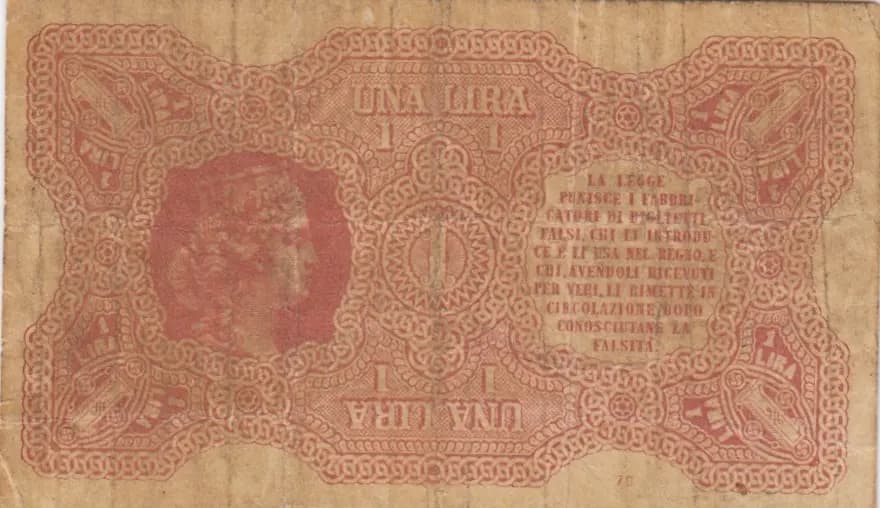
Issued under the Law of December 25, 1881, this banknote marks the formal transition of consortium-issued notes into the Kingdom of Italy's official currency system as inconvertible legal tender. The allegorical figures depicted on the reverse—representing classical authority and the Italian state—reflect the artistic conventions of the Risorgimento period, while the explicit legal language on both sides ('A CORSO FORZOSO ED INCONVERTIBILE') underscores Italy's move toward centralized monetary control during the reign of King Umberto I.
The obverse features a tan/beige paper base with red-brown ornamental printing dominated by an elaborate circular seal with radiating text border positioned on the right side. Official signatures and authority titles occupy the lower portion, with serial numbers (90, 06161) visible in top and bottom left margins. The reverse displays a symmetrical composition with classical allegorical figures in profile flanking a central ornamental medallion, surrounded by intricate filigree scrollwork and decorative borders typical of 19th-century Italian banknote design. The allegorical figures likely represent Italia and complementary virtues associated with the Italian state, rendered in the classical style favored during this period.
FRONT: 'BIGLIETTO GIA CONSORZIALE' (Former Consortium Banknote) / 'A CORSO FORZOSO ED INCONVERTIBILE' (Legal tender and inconvertible) / 'VALE UNA LIRA' (Worth one lira) / 'Legge 25 Dicembre 1881' (Law of December 25, 1881) / 'Il Cassiere Speciale' (The Special Cashier) / 'Il Delegato della Corte dei Conti' (The Delegate of the Court of Accounts) / Signatures: Pellini, Giordana. BACK: 'UNA LIRA' (One lira) / Extended legal text establishing equal conditions of emission and circulation authority within the Kingdom.
Intaglio engraving, the dominant security printing method for Italian banknotes of this era. The complexity of the ornamental borders, filigree patterns, and allegorical figure details are characteristic of steel plate engraving. The precise color registration of red-brown ink on tan paper indicates multi-stage professional printing consistent with state-authorized Italian note production of the 1880s.
This example is identified as P-10, the base Pick catalog number for Italian 1 Lira notes from the 1881 Law. The specific signatures visible (Pellini and Giordana) and serial number prefix (90) may indicate a particular printing run, though detailed variety classification for this early Italian issue requires reference to specialized Italian currency catalogs. No overprints or obvious print variants are observed in the visual analysis.