2 lire 1870
About This Note
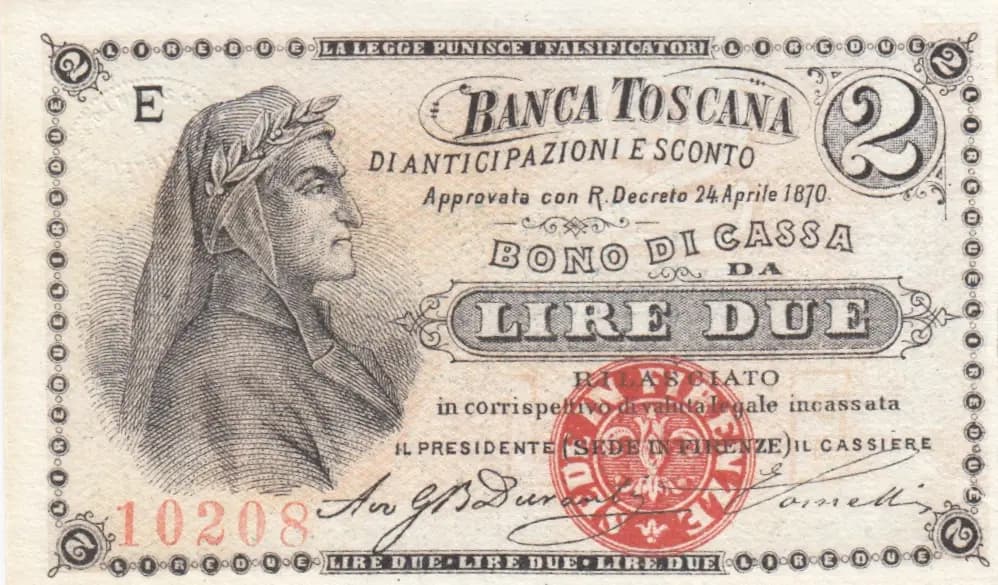
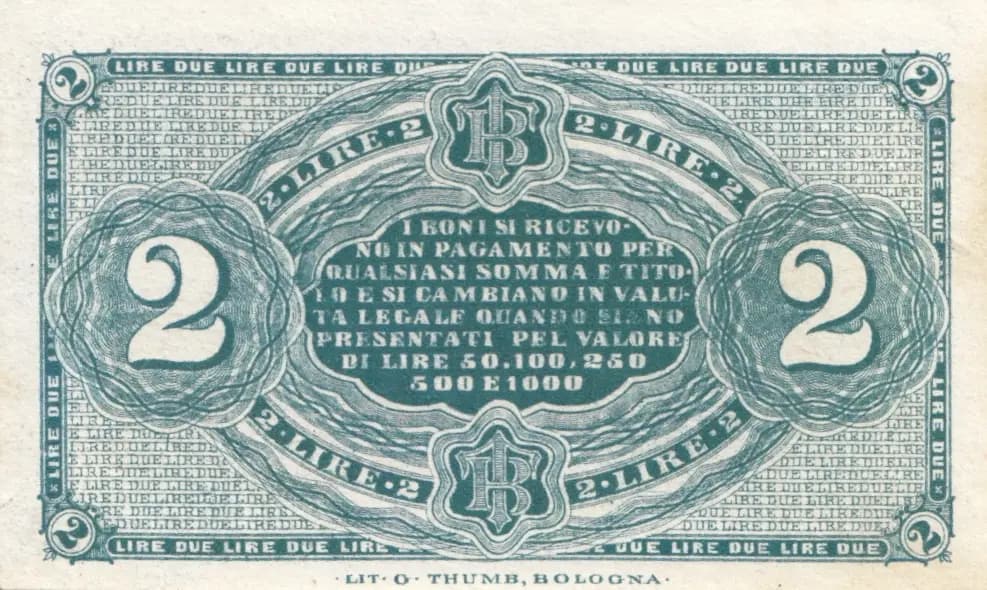
This is an attractive 2 Lire note from Banca Toscana dated 1870, displaying the classical Italian design sensibilities of the early post-unification period. The note features a striking classical portrait with laurel wreath on the obverse and an ornamental coat of arms on the reverse in green, with the red circular seal of the issuing bank prominently displayed. In AU condition, the note shows expected age-related patina with foxing and yellowing consistent with 19th-century paper, making it a desirable example of early Tuscan banking currency for the serious collector.
Common. While Banca Toscana notes from 1870 are not abundant in modern collections, this specific denomination and issuer were part of a legitimate banking operation that operated for several decades. The Pick catalog listing as 'unlisted' suggests incomplete cataloging of regional Italian bank notes rather than extreme scarcity. No evidence indicates an exceptionally small print run, early recall, or short operational period for Banca Toscana. AU condition examples are moderately available to collectors specializing in Italian regional banking currency.
Banca Toscana di Anticipazioni e Sconto was established in Florence following Italian unification, receiving royal approval by decree on April 24, 1870, during the reign of King Victor Emmanuel II. The classical portrait with laurel wreath reflects the neoclassical revival aesthetics popular in post-Risorgimento Italy, while the heraldic lion on the reverse represents Tuscan regional identity. These 'Boni di Cassa' (cash bonds) represent an important transitional banking instrument in the early years of the unified Italian state, before the Banca d'Italia's monopoly on note issuance became complete.
This banknote exemplifies the ornate aesthetic of 1870s Italian banking documents. The obverse features a classical left-facing portrait in profile wearing draped Roman-style clothing and a laurel wreath, representing either a classical historical figure or an allegorical personification of Italy or Commerce. The portrait is set within elaborate circular ornamental frames with geometric border patterns. A large red circular seal bearing heraldic insignia dominates the center-right portion, serving as the official mark of Banca Toscana. The reverse displays a more densely ornamental design in green with the Tuscan coat of arms (heraldic lion) in a central cartouche surrounded by nested geometric frames and repeating 'LIRE DUE' text that serves a dual function as both denomination identifier and anti-counterfeiting measure. Large denomination numerals '2' appear in decorative circles on both left and right margins. The lithographer's imprint 'THUMB, BOLOGNA' indicates production by a Bologna-based firm specializing in security printing.
FRONT SIDE: 'BANCA TOSCANA' (Bank of Tuscany); 'DI ANTICIPAZIONI E SCONTO' (Of Anticipations and Discount); 'Approvata con R.Decreto 24 Aprile 1870' (Approved with Royal Decree 24 April 1870); 'BONO DI CASSA' (Cash Bond); 'LIRE DUE' (Two Lire); Serial number 'E 10208'; 'LE LEGGE PUNISCE I FALSIFICATORI' (The Law Punishes Counterfeiters). BACK SIDE: 'LIRE DUE' (Two Lire) appearing multiple times and in large decorative circles; 'LIT.O. THUMB, BOLOGNA' (Lithography by Thumb, Bologna); Terms regarding redemption: 'I BONI SI RICEVO NON IN PAGAMENTO PER RUSSIANE E SOMME POSTE E SI CAMBIANO IN VALUTA LEGALE QUANDO SI NO PRESENTATI PEL VALORE DI LIRE 50.100.280 S.00.1000' (The bonds are received not in payment for Russian [transactions] and sums placed and are exchanged in legal currency when presented for values of 50, 100, 280 Lire, 00.1000).
Lithography (indicated by 'LIT.O.' notation and artist signature 'THUMB, BOLOGNA'). The multiple colors (black and red on obverse, green on reverse) and fine ornamental detail are characteristic of chromolithographic production, the primary security printing method for banknotes during the 1870s. The repeating text pattern background and complex geometric ornaments were designed to deter counterfeiting through visual complexity impossible to reproduce with period hand-engraving or simple printing methods.
Serial number prefix 'E 10208' is visible on the obverse. Banca Toscana notes may exist with different serial prefixes and numbering sequences indicating different print runs or series. The specific lithographic edition by Thumb of Bologna may represent a distinct variety. Without access to comprehensive census data for this institution's currency, specific variety classifications cannot be definitively established, but collectors should note serial ranges and any variations in the coat of arms design or seal impressions across examples.