1 lira 1871
About This Note
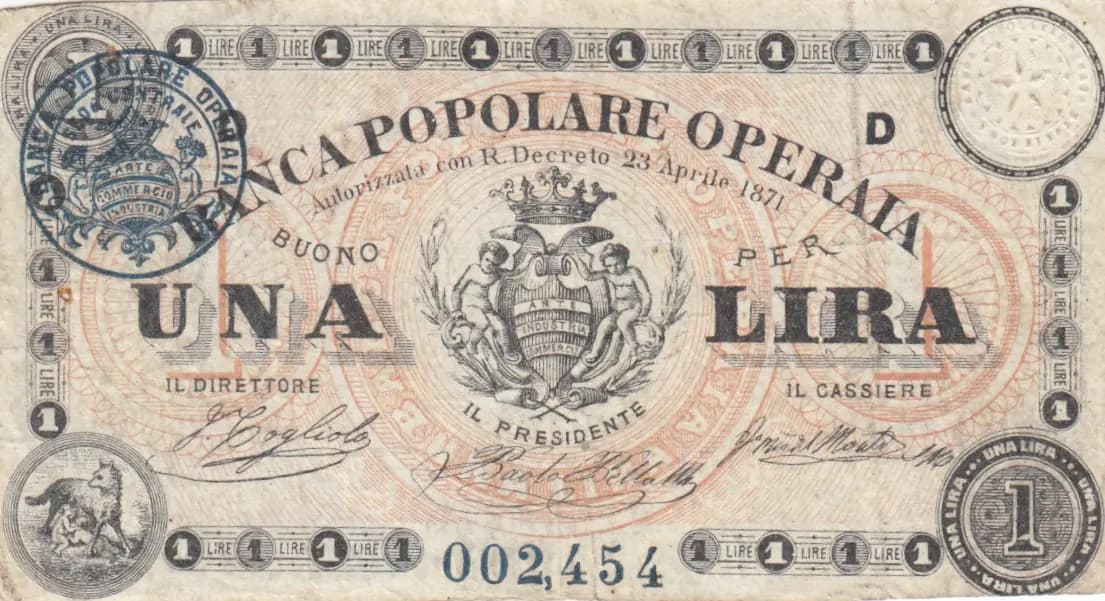
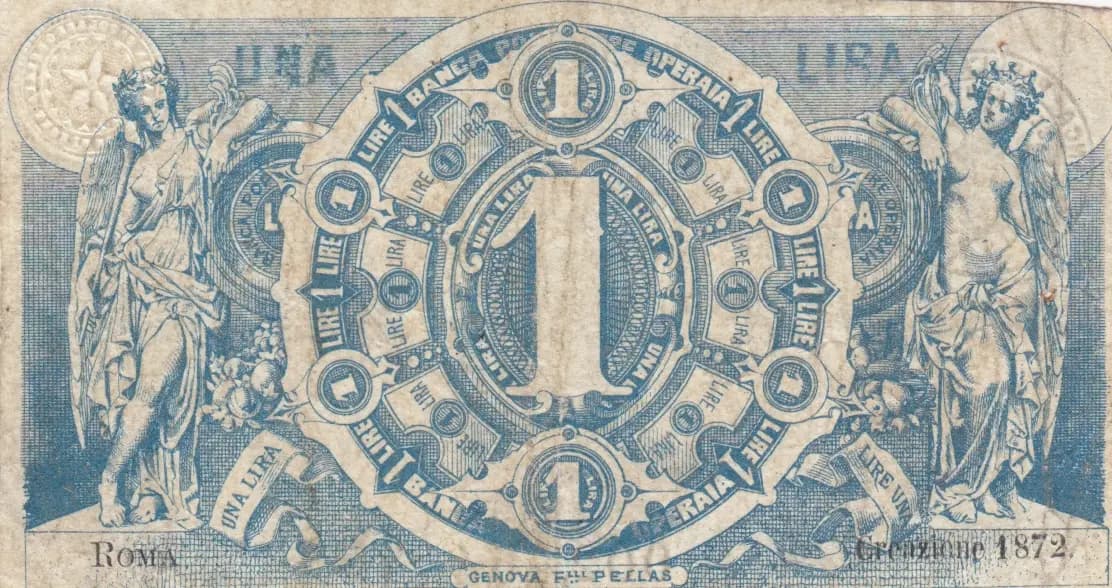
A historically significant 1 lira note issued by the Banca Popolare Operaia (Popular Workers Bank) in 1871, authorized by Royal Decree just days before this note's creation. The front features an elaborate Italian coat of arms with crown and shield in cream and brown tones, while the reverse displays allegorical female figures in classical dress flanking a large central denomination '1', rendered in blue ink. In Fair condition, this note exhibits expected age-related wear including foxing, creasing, and ink fading, yet remains readable with visible handwritten signatures from the bank's officers.
Common. While this is an unlisted Pick number indicating it may not appear in all standard catalogs, the Banca Popolare Operaia was an authorized royal institution with regular note circulation. The visible serial number (002,454) and circulation wear suggest this was part of a standard production run. The Fair condition grade and lack of any exceptional printing characteristics or overprints do not indicate scarcity. Early Italian regional banknotes of this type, while desirable to collectors, typically remain relatively common in the secondary market.
This note represents an early example of Italian regional banking currency during the immediate post-unification period, issued just one year after Italy's formal consolidation as a kingdom. The royal authorization dated April 23, 1871, and the presence of Rome (Roma) on the reverse underscore the nascent Italian state's effort to centralize banking and monetary authority through authorized regional institutions. The classical allegorical imagery and heraldic symbolism reflect 19th-century Italian nationalism and the cultural aspirations of the newly unified nation.
The front displays the coat of arms of Italy or the Banca Popolare Operaia itself, centered with crown and shield, surrounded by a wreath and flanked by winged heraldic supporters. Four circular medallions occupy the corners, with a lion figure prominently featured in the lower left. Denomination indicators 'UNA' and 'LIRA' appear on either side of the central heraldic design. Handwritten signature lines for three authorized officials (Director, Cashier, President) occupy the lower portion. The back is dominated by a large numeral '1' encircled by an ornate border containing repeated 'LIRE' inscriptions. Female allegorical figures in classical Greek or Roman dress appear on both left and right, likely representing virtues such as Justice, Liberty, or Commerce. Circular portrait medallions in the top corners contain profile portraits of historical or contemporary figures. The note credits the Pellas Brothers (F.LI PELLAS) as the engraver/printer, with Roma and Genova locations noted, indicating this was printed by the well-known Pellas Brothers printing house in these Italian cities.
FRONT: 'CASSA POPOLARE OPERAIA' (Popular Workers Bank) / 'Autorizzata con R. Decreto 23 Aprile 1871' (Authorized with Royal Decree 23 April 1871) / 'BUONO' (Good/Valid) / 'UNA LIRA' (One Lira) / 'PER IL DIRETTORE' (For The Director) / 'IL CASSIERE' (The Cashier) / 'IL PRESIDENTE' (The President) / Serial number '002,454' / Decorative border with repeated 'LIRE' (Lire). BACK: 'ROMA' (Rome) / 'GENOVA' (Genoa) / 'F.LI PELLAS' (Pellas Brothers - printer) / '1872' (Year) / Repeated 'LIRE' in decorative circular border / Large denomination '1'.
Intaglio engraving with multiple color printing. The front is rendered primarily in black and brown inks on cream paper, while the reverse employs blue ink, suggesting a multi-plate engraving process typical of high-security currency production of the 1870s. The detailed portraiture, fine line work in decorative borders, and intricate heraldic designs are characteristic of steel plate engraving. The Pellas Brothers were renowned security printers specializing in banknote and official document production, employing state-of-the-art engraving and lithographic techniques.
Serial number variant 002,454 observed. Year printed (1872 on reverse) differs from authorization year (1871 on front), a known characteristic of this series printed after authorization. Handwritten signature variety present; three signature lines visible but specific individual signatures not clearly legible in image. This appears to be a standard circulation note from the initial production run rather than a special or limited variety.