1 lira 1870
About This Note
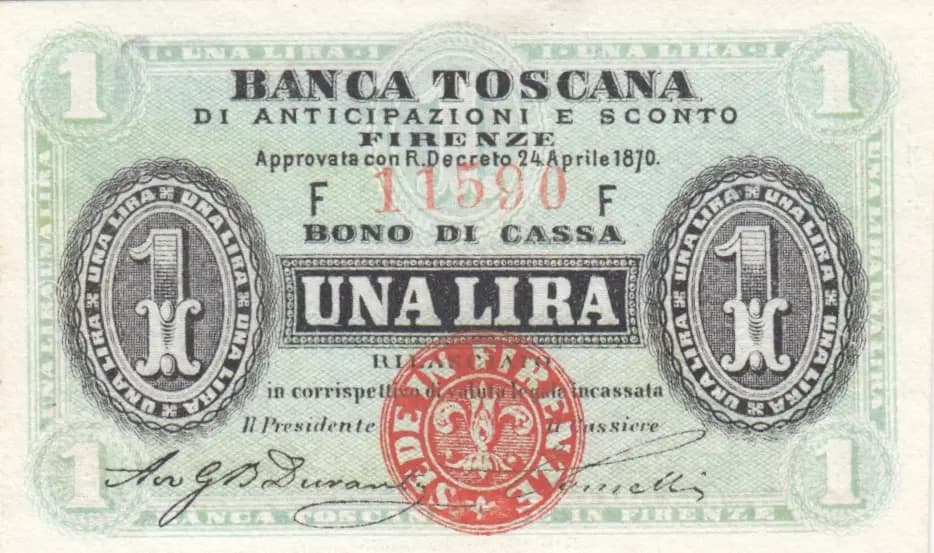
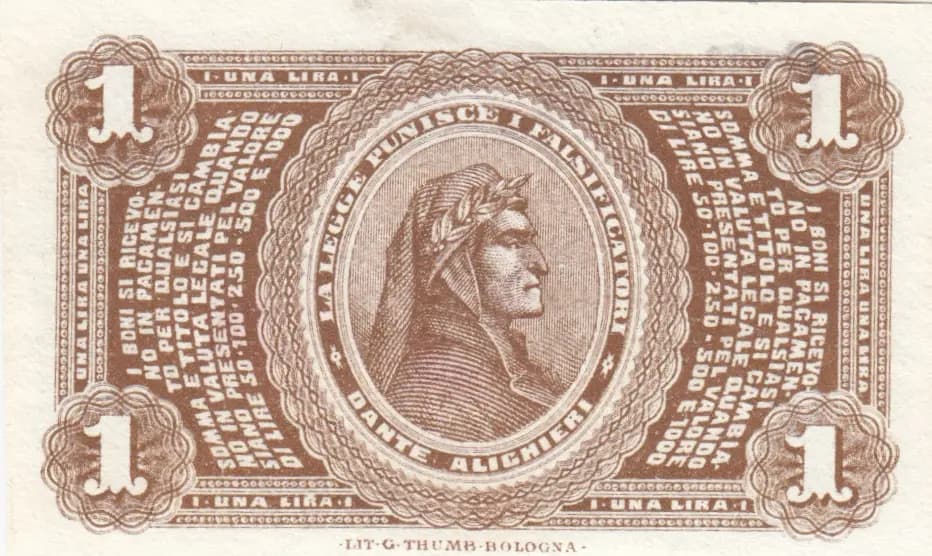
A scarce 1 lira banknote issued by Banca Toscana (Tuscan Bank) in Florence, approved by Royal Decree on 24 April 1870, presented in UNC condition. The obverse features a distinctive light green background with ornamental corner designs and a prominent red wax seal impression bearing heraldic symbolism, while the reverse displays a classical male portrait in profile within an elaborate oval medallion set against warm brown/tan tones. This early Italian regional bank issue represents an important transitional piece from the pre-unified banking era, with exceptional preservation evident in the crisp printing and minimal wear despite its 150+ year age.
Scarce. Banca Toscana was a regional Italian bank of limited geographic scope operating during the transitional period of Italian monetary unification. The specific 1870 Royal Decree issue would have had a relatively modest print run compared to notes from major national banks. The Pick unlisted status suggests this note falls outside the primary Pick catalog focus on major international and national issues, which typically reflects either regional bank issues or notes with very limited circulation. UNC examples are particularly scarce, as most surviving specimens show significant handling wear consistent with their use as actual circulating currency during the late 19th century.
Banca Toscana di Anticipazioni e Sconto was a Florence-based financial institution operating in Tuscany during the early years of Italian unification. The 1870 approval date places this note in the period immediately following the 1866 monetary reforms that standardized Italian currency, when regional banks still issued their own notes backed by the emerging Kingdom of Italy. The classical male portrait on the reverse, labeled as representing 'La Repubblica Fiorentina' (The Florentine Republic), reflects the historical pride in Florence's republican heritage, a common design motif for Tuscan financial institutions of this era.
The obverse presents a formal banking document layout with Banca Toscana's full title and approval authority prominently displayed. Two identical circular medallions flanking the central text contain fleur-de-lis symbols—the heraldic emblem of Florence and Tuscany—within ornamental frames. The centerpiece is a red wax seal impression displaying a coat of arms, a security feature common to Italian regional bank notes of this period. The light green background provides contrast to black text and red accents. The reverse displays a classical male portrait, likely representing a historical Florentine figure or allegorical representation of the city-state, rendered in fine profile view with period drapery and possibly a laurel wreath. The figure is enclosed within an elaborate oval medallion with decorative border work. All four corners feature ornamental frames containing the numeral '1'. The brown/tan color scheme and repeating background text pattern provide visual security against counterfeiting through complexity of design.
FRONT SIDE: 'BANCA TOSCANA' (Tuscan Bank); 'DI ANTICIPAZIONI E SCONTO' (Of Anticipations and Discount); 'FIRENZE' (Florence); 'Approvata con R.Decreto 24 Aprile 1870' (Approved by Royal Decree 24 April 1870); 'BONO DI CASSA' (Cash Bond); 'UNA LIRA' (One Lira); 'F 11590 F' (Serial Number); 'in corrispettivo della incassata' (in correspondence with the cashed); 'Il Presidente' (The President); 'il Cassiere' (the Cashier); signature of 'Ang G S Pivarani' (likely 'Angelo G.S. Pivarani'). BACK SIDE: '1' and 'LIRA' (denomination markers in all four corners); 'LIT.G.THUMB-BOLOGNA' (Lithography by G. Thumb of Bologna); 'LA REPUBLICA FIORENTINA' (The Florentine Republic).
This note was produced using lithographic printing, as confirmed by the 'LIT.G.THUMB-BOLOGNA' credit on the reverse, indicating the lithographic workshop of G. Thumb in Bologna. The fine line work, cross-hatching visible in the portrait rendering, ornamental borders, and the ability to reproduce the red wax seal impression all demonstrate skilled lithographic execution. The multi-color printing (green, brown, red, black, and cream) typical of mid-19th century Italian bank note lithography is evident throughout.
Serial number F 11590 F identifies this as a specific production batch. The signature of Ang G S Pivarani (likely Angelo G.S. Pivarani) as cashier is documented on this specimen. No known overprints or major varieties are visible in this example. The lithographic printer credit (G. Thumb, Bologna) appears consistent across the issue, though signature varieties among different cashiers and presidents may exist within the series.