1 lira
About This Note
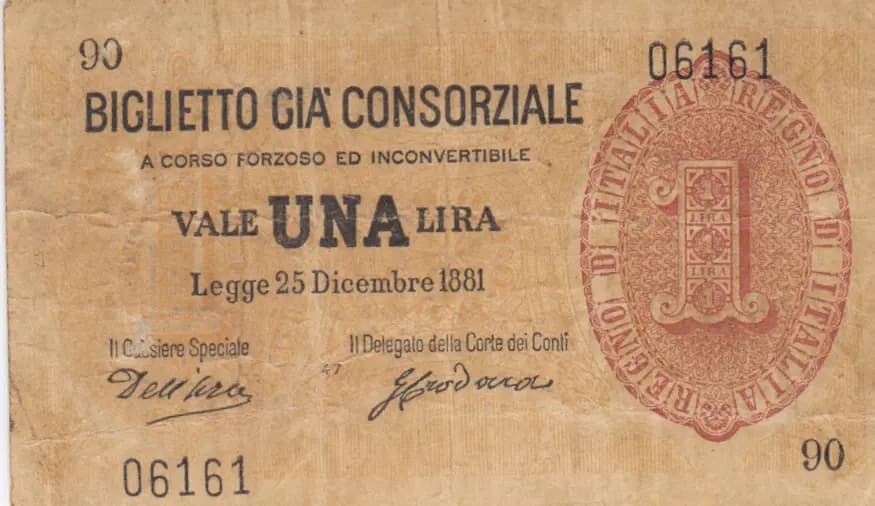
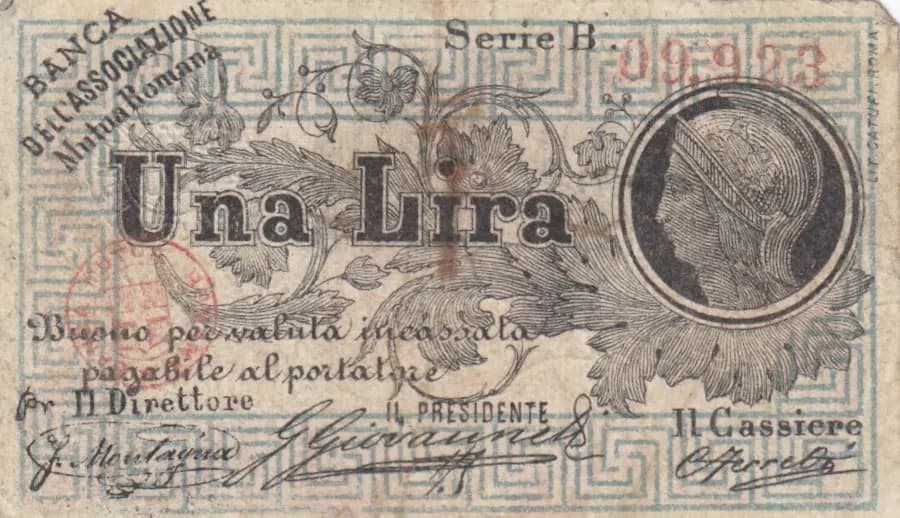
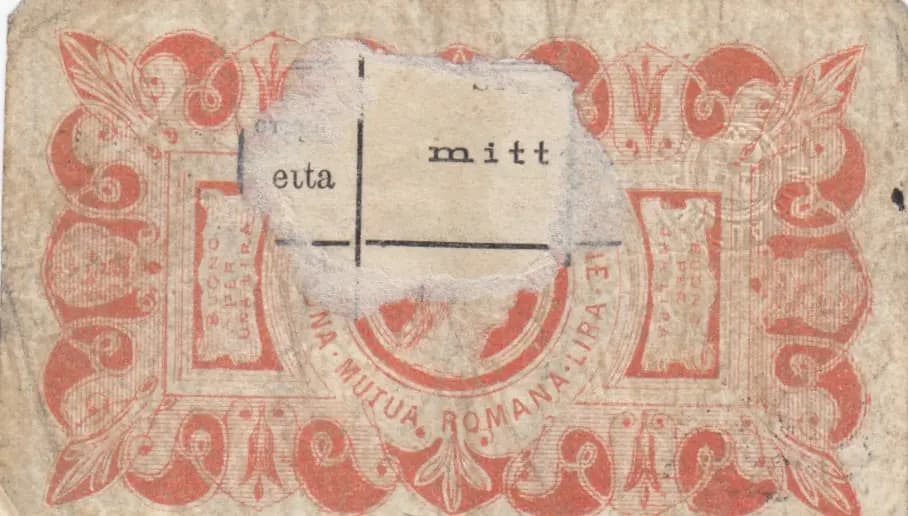
This is a 1 lira banknote issued by Banca dell'Associazione Mutua Romana, a private Italian bank operating during the 19th century. The note features ornate neoclassical design with elaborate floral borders, portrait medallions, and baroque scrollwork in red/coral and black on cream paper. In Fair condition, the note shows extensive wear including creases, foxing, staining, edge damage, and a significant white damaged area on the reverse, reflecting heavy circulation and age.
Common. While this is an unlisted Pick number indicating a private regional bank issue, Italian private bank notes from this period are generally not scarce. The extensive circulation wear visible on this specific specimen (Fair condition with major damage) and the fact that the bank operated during a lengthy period of private banking in Italy suggests adequate print runs. The poor condition and damage further reduces collector demand, supporting a common classification.
This banknote was issued during Italy's early banking period when numerous private and regional banks issued their own currency before centralization under the Banca d'Italia. The Banca dell'Associazione Mutua Romana was a Roman mutual banking institution that participated in Italy's diverse financial system of the 1800s. The promise 'Una lira pagabile in oro alla portatore' (One lira payable in gold to bearer) reflects the gold standard era when private banks guaranteed convertibility, a common practice before modern central banking became established in Italy.
The obverse features a classical design with a left-facing profile portrait in a circular medallion on the right side, surrounded by ornate geometric and floral borders. Large botanical flowers and decorative elements dominate the central field, with winged ornamental designs above the denomination text. The reverse displays baroque-style symmetrical ornamentation in red/coral with acanthus leaf scrollwork, corner medallions containing additional profile portraits, and a central architectural or measurement mark with horizontal lines. The dual portrait medallions and classical imagery reflect 19th-century Italian banking aesthetics emphasizing respectability and classical authority.
FRONT: 'Una Lira' (One Lira), 'Serre B' (Series B), 'BANCA NAZIONALE' (National Bank - likely a designation), 'Una lira pagabile in oro alla portatore' (One lira payable in gold to the bearer), 'fr. Direttore' (Director), 'Il PRESIDENTE' (The President), 'Il Cassiere' (The Cashier), 'Governo' (Government). BACK: 'MUTUA ROMANA MUTUAE' (Roman Mutual - partial/fragmentary due to damage), partial text 'etta' and 'mitt' visible but incomplete due to deterioration.
Intaglio (engraved) printing, evidenced by the fine detailed line work in the ornate borders, portrait medallions, and baroque scrollwork. The layered decorative elements and precise geometric patterns are characteristic of steel or copper plate engraving. Handwritten signatures from officials (President, Director, Cashier) were added after printing, a standard practice for private bank notes of this period.
Series B designation visible on obverse. The note shows handwritten signatures and annotations from multiple officials (President, Director, Cashier positions), which would vary by individual notes depending on who held these positions at time of issue. No date visible in the analyzed images, but the style suggests mid-to-late 1800s Italian banking. Specific variety identification would require access to the serial number (not clearly legible in images) and comparison with other known examples of this bank's issues.