50 lirot 1968
Market Prices
53 salesAbout This Note
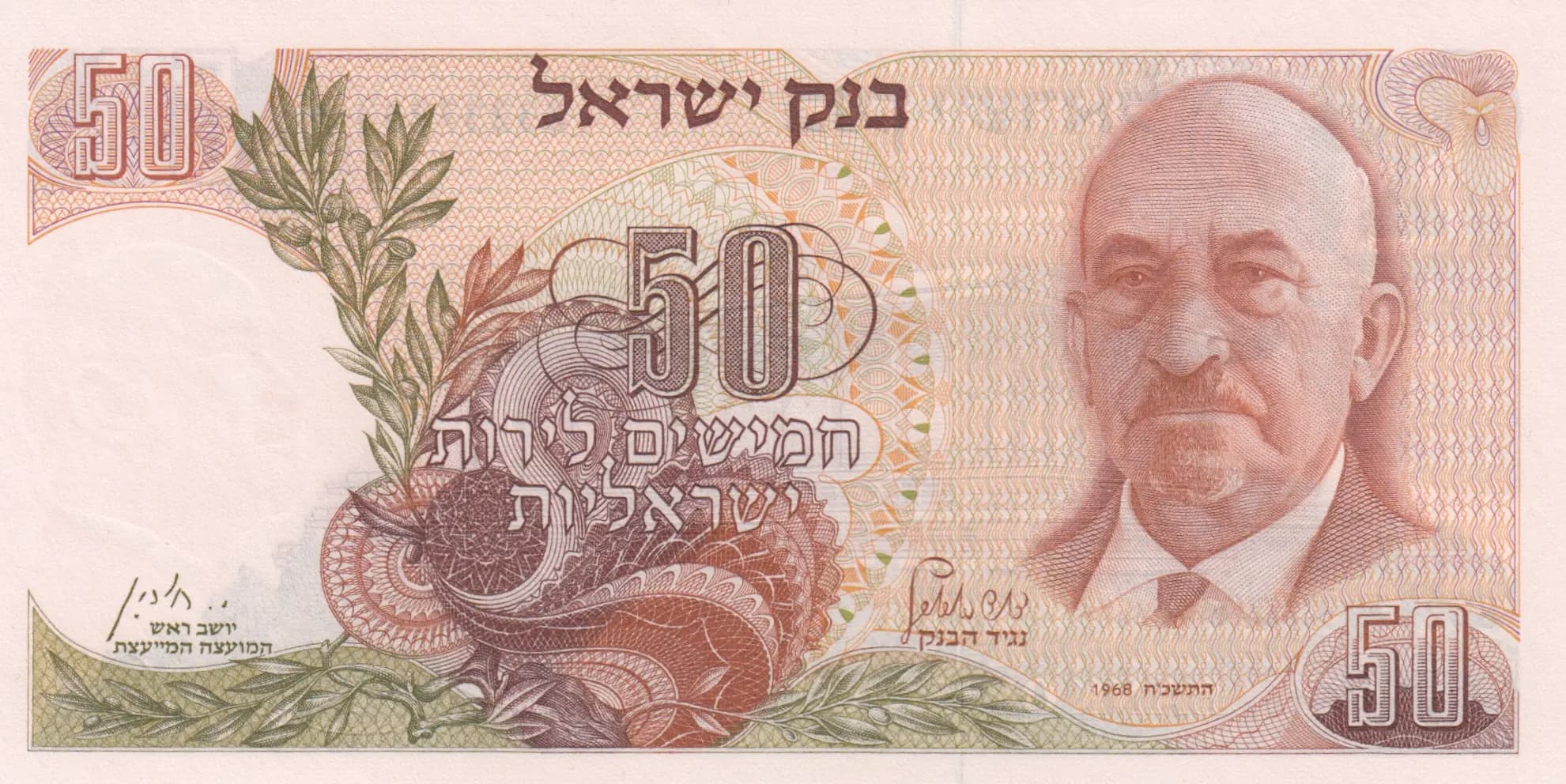
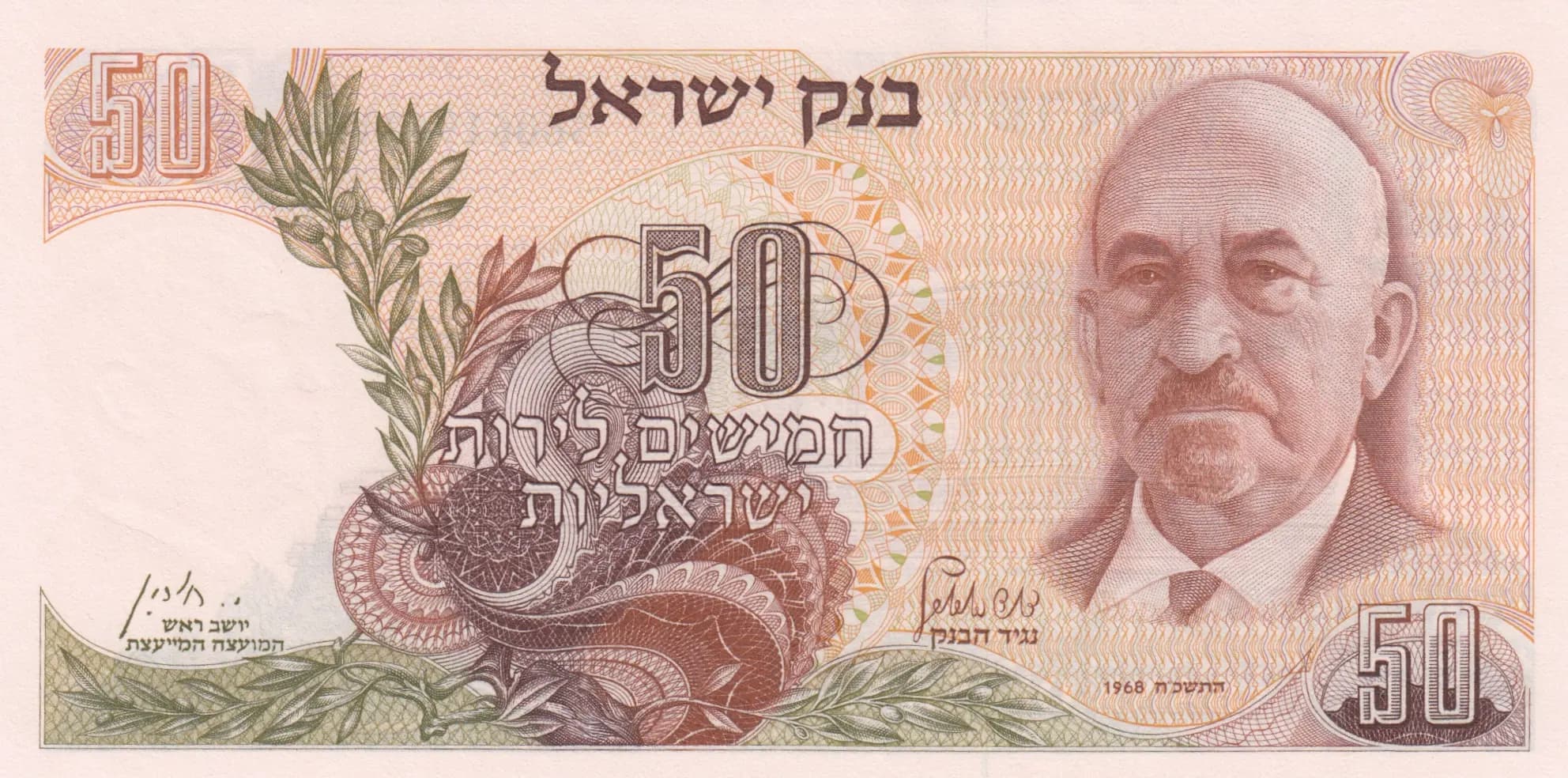
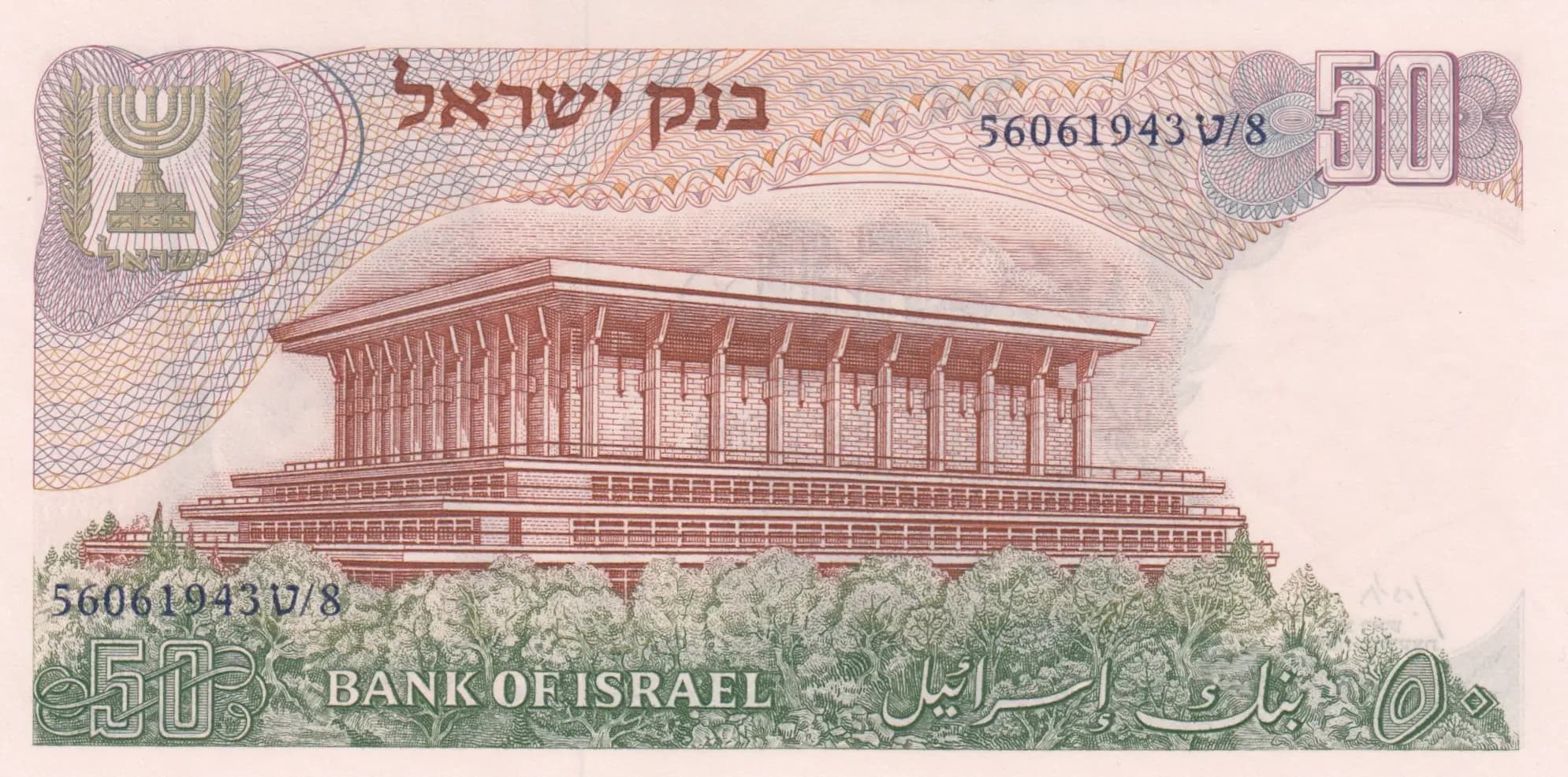
This 1968 Bank of Israel 50 lirot note (Pick-36b) presents in uncirculated condition with exceptional clarity and sharp detail throughout. The obverse features a distinguished portrait of Chaim Weizmann, Israel's first president, rendered in fine intaglio engraving alongside symbolic olive branches and pomegranate imagery. The reverse displays the iconic Knesset building in Jerusalem with a menorah symbol, representing the seat of Israeli government during this formative period of the nation's history.
Common. The eBay price data shows UNC specimens selling between $55-$156.60 in 2015-2016, with 2019 catalog values of $7 for UNC condition. More recently, comparable uncirculated examples have sold for significantly less ($2-$11 for typical EF-UNC grades), indicating stable but modest collector demand. With an estimated print run in the millions during Israel's early currency period, this note remains readily available in the numismatic market despite its historical significance.
Issued in 1968, this note commemorates a pivotal moment in Israel's early statehood, following the 1967 Six-Day War. The prominent imagery of Chaim Weizmann honors the founding father and first president who died in 1952, while the Knesset building symbolizes the democratic institutions central to the newly established nation. The olive branches and menorah reinforce Israeli cultural and religious heritage during a period of nation-building and territorial consolidation.
The obverse features Chaim Weizmann, Israel's first president (1874-1952), portrayed in formal business attire in three-quarter profile facing right. The design incorporates symbolic olive branches with detailed foliage and a pomegranate in the center-left, representing Israeli agricultural heritage and biblical symbolism. The reverse depicts the Knesset building, Jerusalem's modernist parliamentary structure characterized by distinctive columned architecture and horizontal emphasis, surrounded by landscaped grounds with trees. A seven-branched menorah appears in the upper left corner of the reverse, symbolizing Jewish heritage and Israeli sovereignty. The composition uses multiple security printing layers with intricate guilloche patterns and geometric designs throughout.
Front: 'בנק ישראל' (Bank of Israel), '50' (denomination), 'החמישים לירות ישראליות' (Fifty Israeli lirot), '1968' (issue year), 'יושב ראש הממלכת' (Head of State). Back: 'בנק ישראל' (Bank of Israel), '50' (denomination), 'BANK OF ISRAEL' (English), Serial number '56061943 ח/8' (alphanumeric combination with Hebrew letter).
Intaglio (recess) printing on multi-colored underprint, utilizing fine line engraving for portrait and architectural detail. The security features include complex guilloche patterns, geometric background elements, and multiple printing layers visible in varying pattern density. Printer identified as JEZ (Jewish Engraving and Printing Company) per PMG catalog records for Pick-36b variant.
This is specifically identified as Pick-36b, one of three cataloged variants (P-36a, P-36b, P-36s) all printed by JEZ. The variety distinction likely relates to signature variations, serial number prefixes, or subtle printing differences typical of mid-20th century Israeli currency production. The observed serial number '56061943 ח/8' with Hebrew letter designation is consistent with Israeli numbering conventions of this period. No overprints or significant anomalies are apparent in the visual analysis.