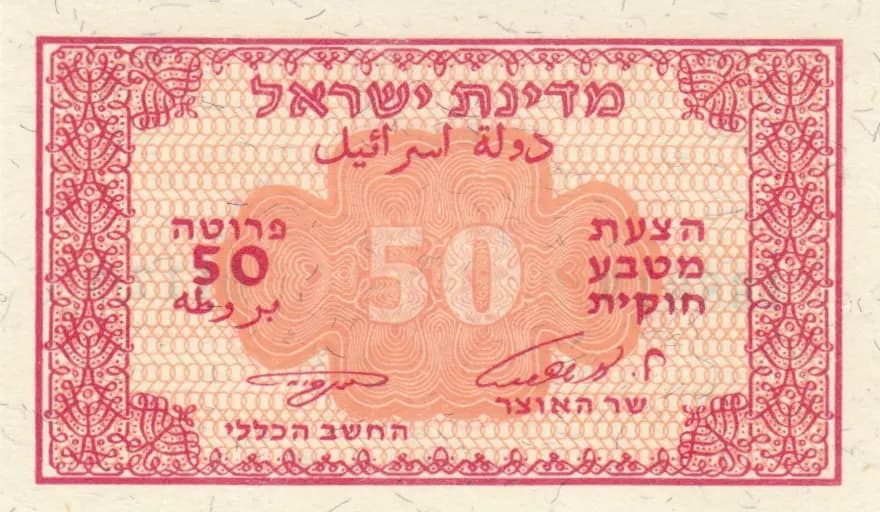
50 pruta 1952
Market Prices
26 salesAbout This Note
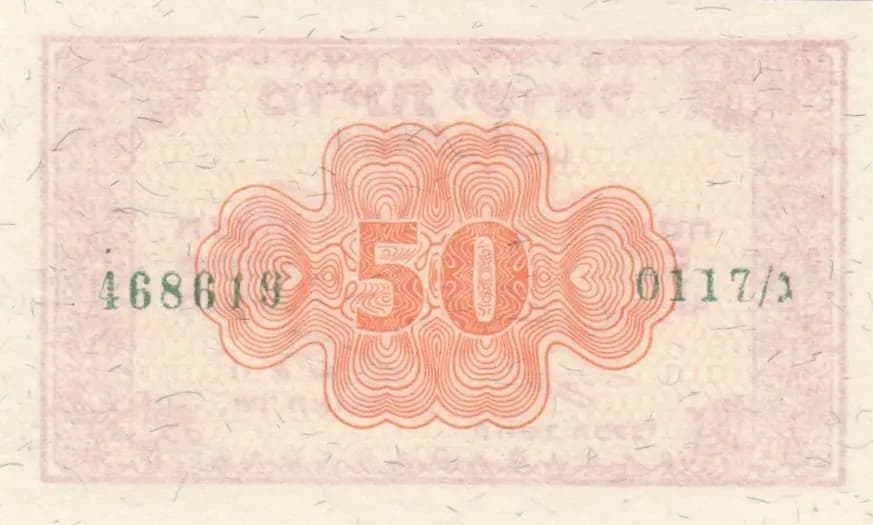
This is an outstanding example of Israel's early currency from 1952, the 50 Pruta note (Pick 10c) in uncirculated condition. The note displays crisp, vibrant red and pink tones on the obverse with a distinctive purple/lavender reverse featuring a red concentric oval medallion design. The excellent preservation, sharp printing detail, and complete absence of wear make this an attractive example for collectors of early Israeli numismatic material.
Common. Despite its age (1952), the 50 Pruta note is widely available in the numismatic market. eBay auction data shows consistent sales across all condition grades, with UNC examples regularly selling between $18–$33 (with occasional outliers reaching $60–$100+ when graded higher by professional services like PMG). The catalogue value for UNC examples is listed at $7.50 (2016), and the sustained volume of sales indicates healthy supply. This is typical for early-period Israeli notes that saw substantial circulation before being superseded by later designs.
Issued during Israel's formative years as a new nation (1952), this note represents the early period of the Israeli currency system before decimalization. The bilingual inscriptions in Hebrew and Arabic reflect the complex multilingual context of the young state, while the emphasis on the State of Israel's sovereignty through 'מדינת ישראל' (Medinat Yisrael) and legal tender declarations underscore the nation's establishment of monetary authority.
The 50 Pruta note (P-10c) features a classical design centered on ornamental geometric and architectural motifs rather than portraiture. The obverse displays an elaborate decorative framework with corner ornaments featuring floral and geometric patterns in red and pink against a cream background, with a large concentric circular medallion in the center containing the denomination '50'. The reverse maintains the same central oval medallion design but rendered in red/coral against a purple/lavender background, with serial numbers printed in green flanking the central device. The repeating geometric background pattern and intricate guilloche work on the reverse (specifically noted as red guilloche in the P-10c variant, distinguishing it from the gray guilloche of P-9) serve as security features. The bilingual Hebrew and Arabic inscriptions reflect the official multilingual character of early Israeli government documents.
OBVERSE: מדינת ישראל (Medinat Yisrael - State of Israel) | 50 (denomination in numerals) | פרוטה (Pruta - currency unit) | שרותה (Pruta, variant spelling) | מטבע חקיקויות (Legal tender/lawful money) | החזקה כללית (General holding/widespread use) | שר האוצר (Minister of Finance) | הממשלה הכללית (General Government). REVERSE: 50 (denomination in numerals) | Serial numbers in Hebrew numerals and Arabic numerals (visible as 0117/א and 468610), printed in green ink.
Intaglio/engraving process, evidenced by the crisp, deeply detailed guilloche patterns, fine-line ornamental borders, and precise concentric circular designs visible in both the central medallion and background repeating patterns. The vibrant color registration and the distinct color separation between obverse (red/pink on cream) and reverse (red/purple) indicate professional security printing of the period. The specific red guilloche on the reverse (characteristic of P-10c) was produced using traditional intaglio security printing techniques standard for central bank currency of the 1950s.
This note is catalogued as P-10c, one of three distinct variants listed under the base Pick number 10. The P-10c variant is specifically distinguished by the red guilloche pattern on the reverse, as noted in the catalog reference, which differentiates it from P-9 (gray guilloche). The visual analysis confirms the red/coral concentric circular medallion on the reverse consistent with P-10c. The serial number visible (0117/א and 468610) represents a standard issue serial number format for this variant. No rare serial number combinations or notable overprints are evident that would elevate this to a premium variety.