1 lira 1958

Market Prices
18 salesAbout This Note
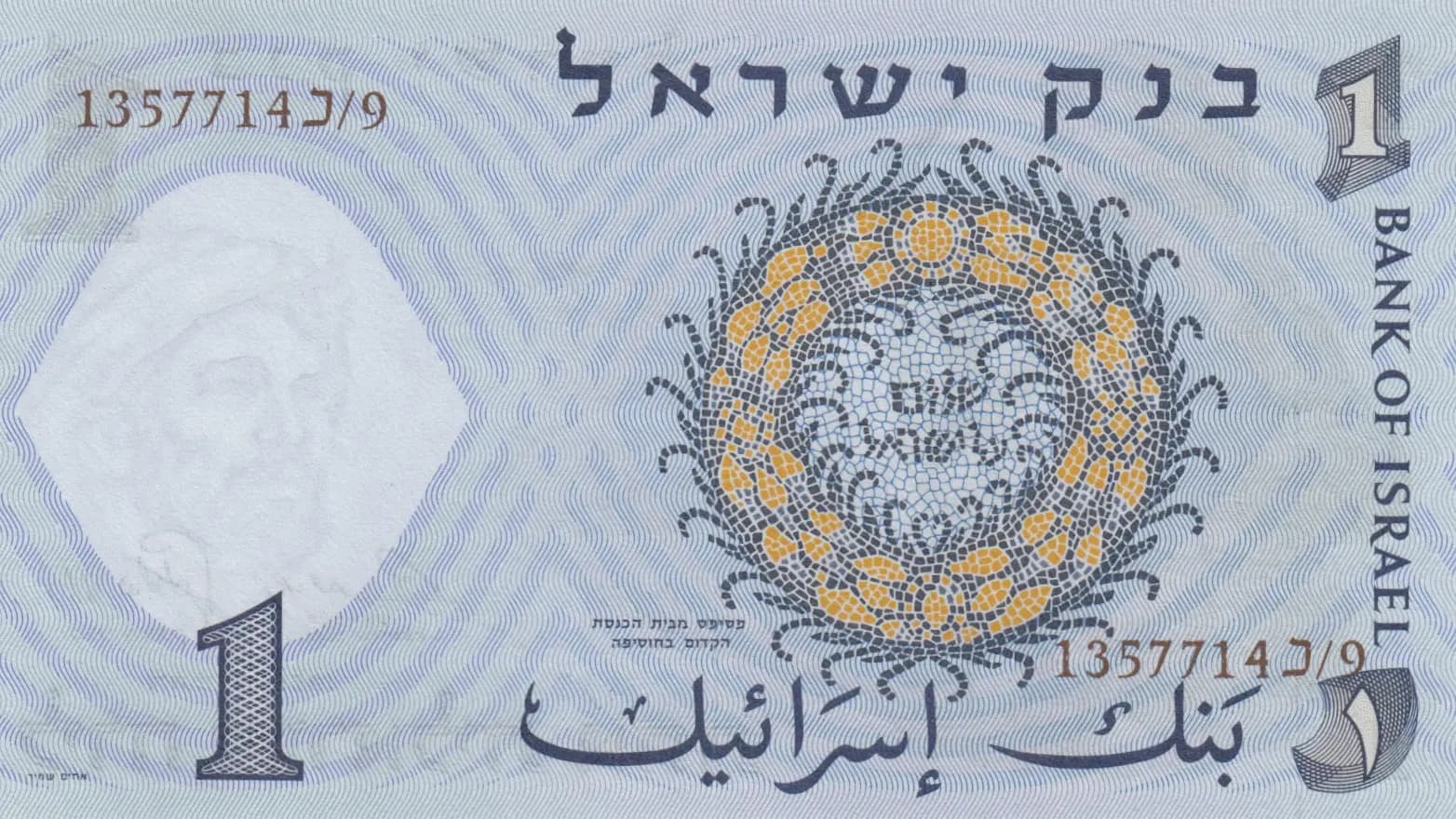
This is an uncirculated 1958 Israeli 1 Lira note (Pick P-30a) featuring the iconic Bank of Israel design with a prominent ornate circular medallion displaying intricate geometric mosaic patterns in blue, golden-yellow, and white. The note exhibits pristine condition with sharp, clear printing throughout and no signs of wear, creasing, or circulation. The design reflects Israel's early numismatic identity with trilingual inscriptions in Hebrew, English, and Arabic, making it a notable example of the nation's foundational currency issues.
Common. The 1958 1 Lira (Pick P-30a) is a common date and denomination from Israel's early currency period. eBay auction data shows UNC specimens selling consistently in the $1-$4 range across multiple transactions from 2011-2020, with only professionally graded specimens (PMG 64-66) commanding premiums above $10-$20. The large print run of this foundational issue and ongoing availability in the market confirm common status.
Issued in 1958 during Israel's early years as a state, this 1 Lira note represents the Bank of Israel's first series of currency designs. The ornate circular medallion featuring a mosaic pattern is based on the ancient synagogue of Issafiya on Mt. Carmel, connecting the contemporary currency to Israel's ancient Jewish heritage and archaeological significance. The trilingual presentation (Hebrew, English, Arabic) reflects the complex linguistic and political landscape of the newly established nation in the Levant.
The obverse features a light blue-grey wavy background pattern covering the entire note surface, which serves both aesthetic and security purposes. The central design element is a large ornate circular medallion containing detailed geometric and mosaic-like patterns rendered in dark blue, white, and golden-yellow, representing the ancient mosaic from the Issafiya synagogue on Mt. Carmel. The medallion is framed by decorative ornamental flourishes. The left side shows a faint portrait area (consistent with catalog descriptions of the fisherman motif, though appearing subdued in this specimen). Denomination numeral '1' appears symmetrically positioned on both left and right edges. The note employs trilingual text reflecting the official languages of early Israel.
Front side inscriptions: 'בנק ישראל' (Hebrew: 'Bank of Israel'), 'BANK OF ISRAEL' (English: 'Bank of Israel'), 'شيقل إسرائيلي' (Arabic: 'Israeli Shekel'), denomination '1' appearing on left and right margins. Serial numbers: 'I3577149/9' (upper left) and 'I3677144/0/9' (lower right) printed in brown. The dual serial number format and Hebrew calendar notation (5718) appear standard for this issue.
This note was produced by JEZ (Joh. Enschedé Zonen), the renowned Dutch security printer, utilizing offset lithography combined with intaglio line work for the fine geometric patterns and security features. The continuous wavy background pattern, intricate mosaic detailing within the medallion, and sharp line work throughout indicate high-quality security printing techniques typical of Enschedé's operations during the 1950s. The fine detail reproduction and color registration are characteristic of professional-grade banknote production.
This specimen represents the P-30a variety as catalogued by Pick, produced by printer JEZ (Joh. Enschedé Zonen). The PMG population report identifies four catalogued variants for the 1 Lira 1958: P-30a, P-30b, P-30c (with brown serial numbers), and P-30s (specimen). The serial number formatting (I3577149/9 and I3677144/0/9) and black serial number color are consistent with the standard P-30a variety. No overprints, date variations, or signature varieties are apparent in this specimen.