100 pruta 1952
Market Prices
29 salesAbout This Note
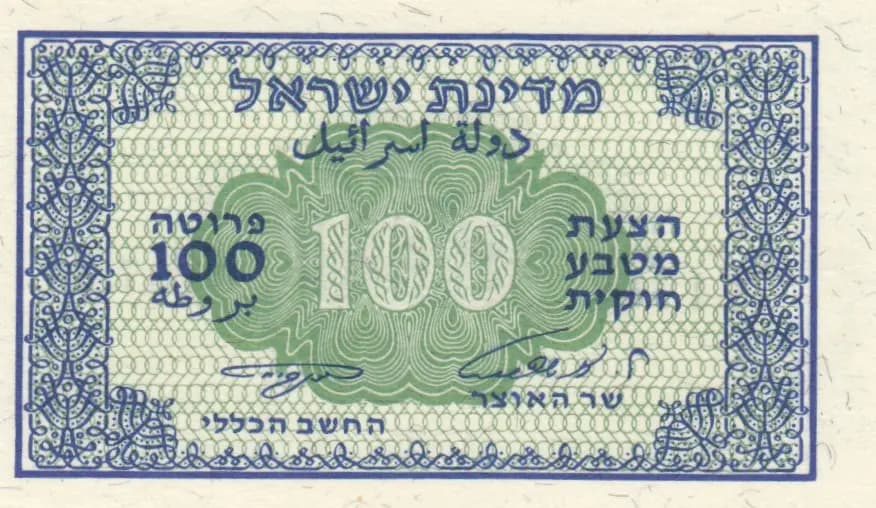
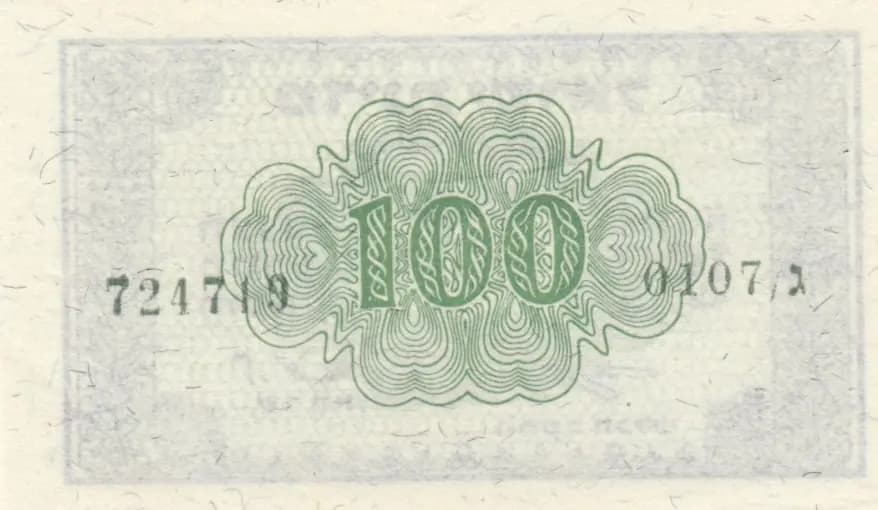
This is a pristine UNC example of Israel's 100 Pruta banknote from 1952, featuring an elegant design with blue ornamental borders on the obverse and a green guilloche pattern characteristic of the P-12c variety. The note displays exceptional condition with minimal wear, light age-appropriate foxing, and vibrant color retention across the blue-green palette. The intricate concentric line patterns in the central medallion and fine mesh security background demonstrate the sophisticated engraving techniques employed by Israel's early post-independence currency.
Common. The eBay price data shows consistent circulation in the market with numerous sales across multiple grades (PMG 63-66, EF, AUNC, UNC) spanning from 2009 to 2026, with UNC examples selling in the $20-33 range historically and more recently at $26. The 2016 catalog value of $7.50 for UNC and the high volume of transactions indicate this is a standard issue with adequate supply. The existence of four cataloged varieties (P-12a through P-12d) further suggests this was a sizeable printing run. This note presents no scarcity premium.
Issued in 1952 by the newly established State of Israel, this 100 Pruta note reflects the country's transition from the British Mandate's Palestine Pound to its own currency system. The bilingual Hebrew and Arabic inscriptions, combined with references to both 'State of Israel' (מדינת ישראל) and the historical 'Palestine pound' (דולר ארץ ישראל), document this pivotal period in Israeli monetary history when the Pruta served as the primary currency unit before decimalization.
The obverse features a formal, symmetrical design dominated by an ornate green oval medallion containing the denomination '100' at center, surrounded by radiating concentric line patterns. Decorative blue floral and botanical border designs frame the left and right margins, with a fine mesh guilloche pattern serving as the background security feature. The reverse presents a simplified composition with the same green medallion design centrally positioned, the denomination repeated, and bilateral black serial numbers. The color scheme—blue on green underprint for the obverse and solid green for the reverse—matches the catalog reference for P-12c variety. No portraits or landmarks are depicted; instead, the design relies on geometric ornamentation and security patterns characteristic of 1950s currency production.
FRONT: 'מדינת ישראל' (State of Israel), 'דולר ארץ ישראל' (Palestine pound), '100' (denomination), 'מטבע' (currency), 'חזק' (legal tender), 'שר האוצר' (Minister of Finance), 'הבנק לאומי לישראל' (Bank Leumi for Israel). BACK: '100' (denomination in central medallion), Serial number segments '7247' (left) and '207,א' (right) printed in black.
Intaglio engraving (recess printing) is evident from the fine, crisp detail visible in the concentric line patterns, the complex guilloche mesh background, and the sharp serif typography throughout. The multi-color printing—requiring separate plates for blue and green elements—combined with the precision of the security patterns indicates production by a specialized security printer. For Israeli currency of this era, Bank Leumi worked with international security printers; the technical quality suggests professional currency-grade production standards.
This note is identified as Pick P-12c, which is cataloged as a distinct variety within the 100 Pruta 1952 issue. Per the external reference, P-12c is distinguished by having a green guilloche pattern on the back, contrasting with P-11 notes which feature a gray guilloche. Four total varieties are known for the base 100 Pruta denomination (P-12a, P-12b, P-12c, P-12d), with P-12d additionally identified as carrying signature variant #3. The variety differentiation likely reflects changes in design elements, security features, or signature authorities during the printing run. No overprints or date variations are evident on this specimen.