50 lirot 1968
Market Prices
61 salesAbout This Note
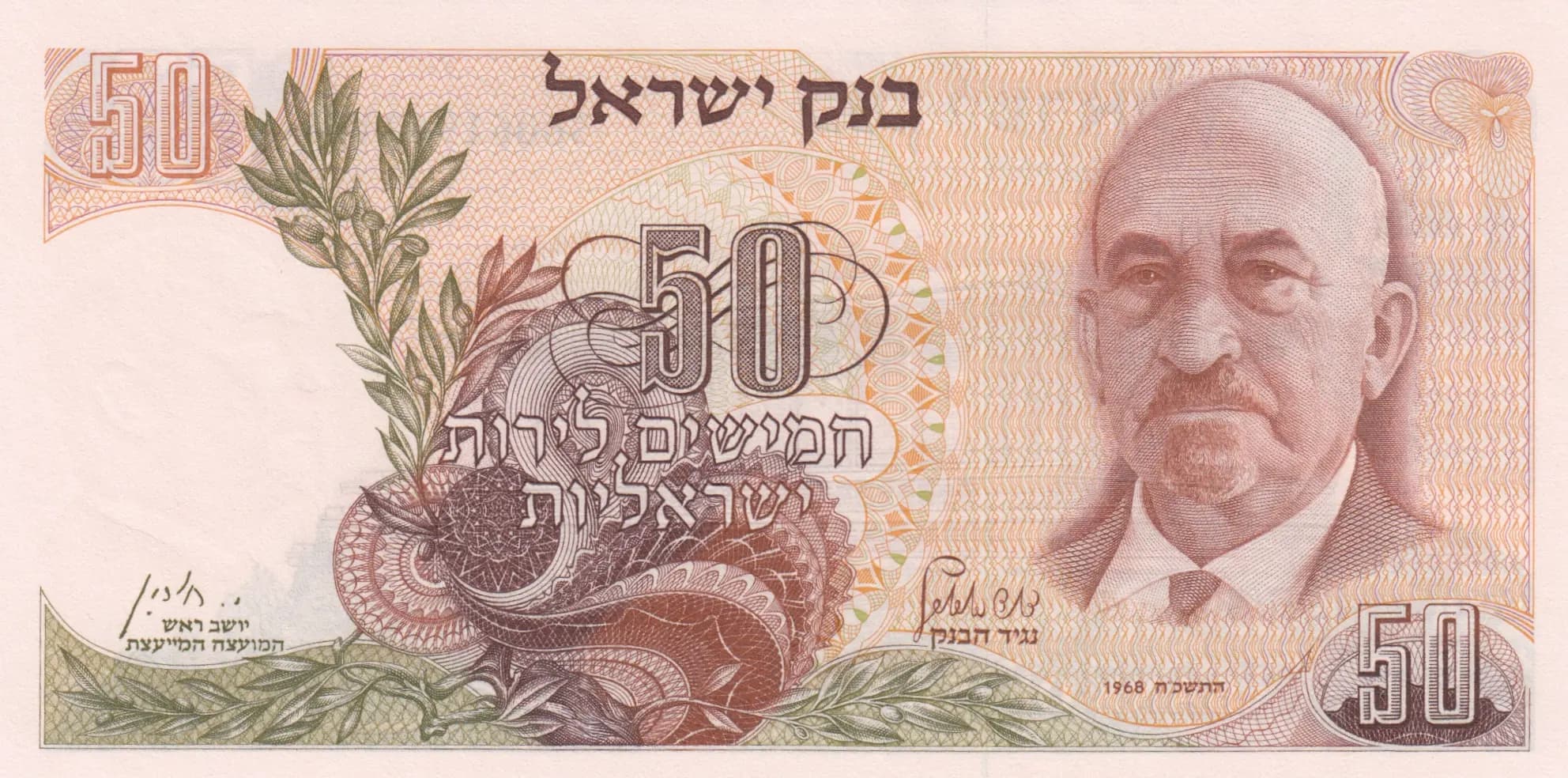
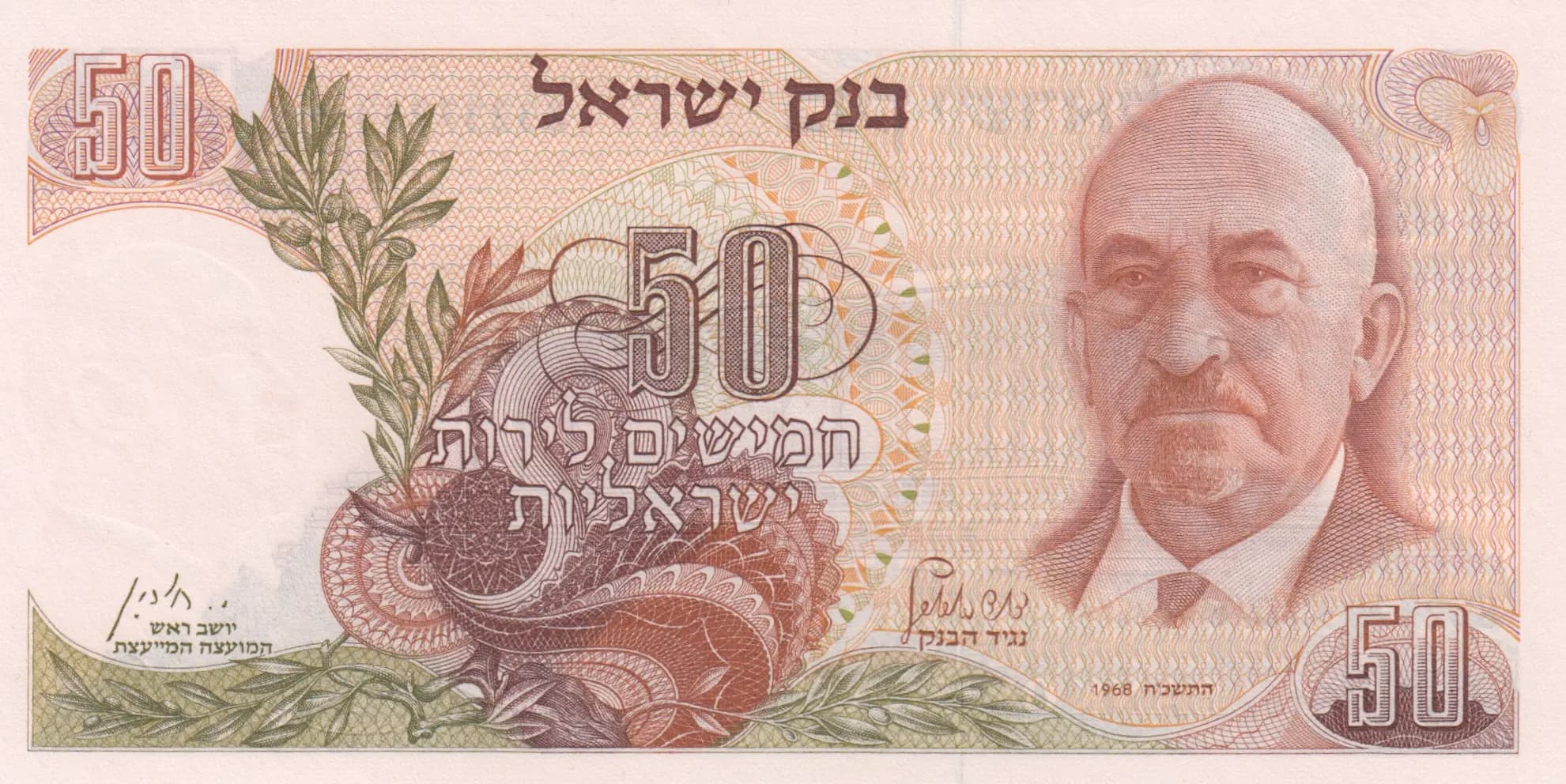
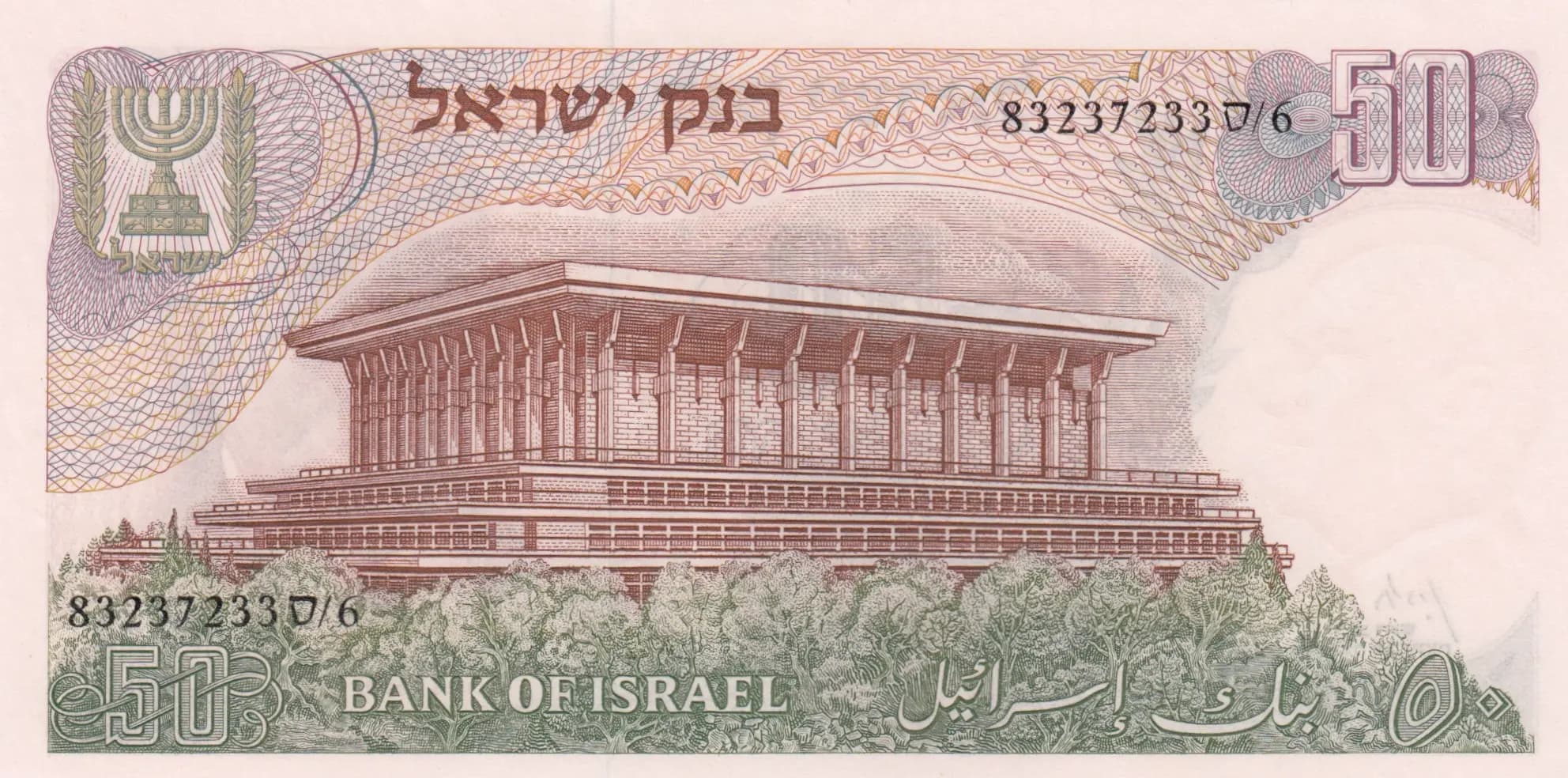
This is an uncirculated 1968 Israeli 50 Lirot note (Pick P-36a) featuring President Chaim Weizmann in formal portrait on the obverse and the Knesset building on the reverse. The note displays exceptional condition with no visible wear, creasing, or damage, presenting crisp, fresh characteristics typical of newly issued currency. The design combines classical engraving techniques with symbolic Israeli imagery including olive branches, pomegranates, and the menorah, making it an attractive example of mid-20th century Israeli currency design.
Common. This note exhibits characteristics typical of commonly circulated denominations from a stable, well-established issuer with substantial print runs. The eBay price history demonstrates consistent market activity with UNC examples regularly selling between $7-$35 over the past decade, with most sales in the $10-$15 range for uncirculated examples. PMG-graded specimens command premiums ($22-$113 range for high grades), but the abundance of sales data and consistent availability indicate robust supply. The 1968 issue date and standard Pick number designation P-36a (with variants P-36b and P-36s existing) suggest this was a regular, high-volume production rather than a limited or commemorative issue.
Issued in 1968 (5728 in the Hebrew calendar), this banknote was produced during the post-1967 Six-Day War period, a pivotal moment in Israeli history. The choice of Chaim Weizmann, Israel's first president (1949-1952), honored the nation's founding figure, while the Knesset building depicted on the reverse represented the democratic institutions central to the young state. The incorporation of traditional Jewish symbols—the menorah, olive branches, and pomegranates—reflected Israel's cultural identity during a period of national consolidation and pride.
The obverse features a right-facing portrait of Chaim Weizmann, Israel's first president, rendered in detailed engraved line work with realistic facial features and formal attire (suit and tie). The left side displays ornamental botanical elements—olive branches with leaves and pomegranate fruits—representing traditional Israeli agricultural and cultural symbols. The reverse depicts the Knesset building (Israeli Parliament) as an imposing modernist structure with a columned portico, horizontal architectural lines, and stepped foundation, positioned above a stylized landscape with coniferous and deciduous trees. A menorah (seven-branched candelabrum), the national emblem of Israel, appears on the left side of the reverse. The color scheme throughout employs pink/mauve as the dominant background color with green accents in foliage elements, brown in architectural details, and cream tones creating depth and visual hierarchy.
Front side: 'בנק ישראל' (Bank of Israel) appears at top center; '50' (Fifty) appears in upper left and lower right corners. Back side: 'בנק ישראל' (Bank of Israel) in Hebrew appears at bottom center; 'BANK OF ISRAEL' in English appears at bottom; '50' (Fifty) appears in upper right and lower left corners; Serial number '8323723380/6' is printed in black.
Intaglio (engraved) printing process, evidenced by the fine line patterns throughout the background, detailed portrait rendering with precise line work, intricate geometric patterns in security cartouches, and the crisp definition of architectural and botanical elements. The printer for P-36a is JEZ (Joh. Enschedé en Zonen, Dutch security printer), a firm renowned for high-quality banknote production. Multiple color printing layers were applied to create the multicolored effect described in the catalog reference.
This note is cataloged as Pick P-36a, with two known variants existing: P-36b and P-36s, all printed by JEZ. Variants likely differ in signature combinations, date variations within the 1968 issue year, or minor design details typical of banknote production across multiple printings. The specific serial number visible in the images (8323723380/6) identifies this particular specimen but does not constitute a catalogable variety. The Hebrew date 5728 corresponds to 1968 in the Gregorian calendar and may appear on some or all examples of this issue.