1 dinar 1934
Market Prices
2 salesAbout This Note
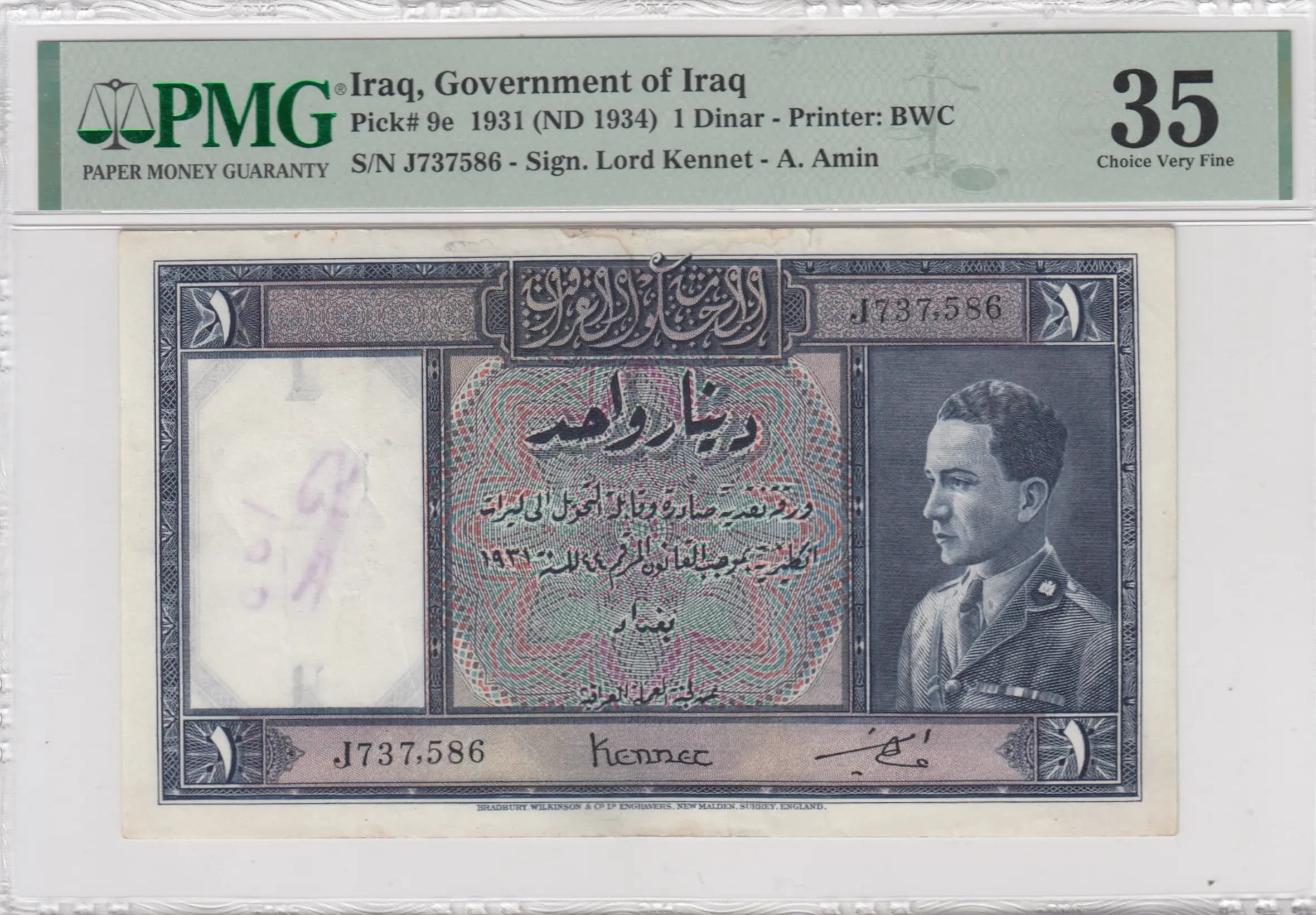
This 1934 Iraqi Government 1 Dinar note (Pick-9e, PMG 35) features a striking portrait of King Ghazi in military uniform on the obverse, rendered in blue on multicolor underprint with ornamental guilloche work characteristic of Bradbury Wilkinson's prestige security printing. The note displays period-appropriate aging with foxing and brown/purple staining particularly visible on the left panel, consistent with its nearly 90-year history, and represents an early and historically significant issue from Iraq's formative years as an independent nation.
Common. While this is an early issue from Iraq's independent monetary period (1934), eBay market data shows F-graded examples selling for $720 (2015) and G-graded examples for $152.50 (2016), with 2016 catalogue values of $175 (G) and $475 (F). These moderate price points and regular market appearance indicate reasonable circulation and availability. The PMG population report lists P-9e as one of ten catalogued variants for this base Pick number, suggesting no exceptional scarcity. This grade (PMG 35) falls below the F and EF specimens tracked, so it represents a more common condition state for the issue.
Issued under Law No. 44 of 1931 (dated 1934), this note commemorates King Ghazi's reign during Iraq's transition to monarchy and sovereign currency. The formal military portrait reflects Iraq's post-Ottoman institutional modernization, while the note's sterling convertibility clause demonstrates the currency's anchoring to British monetary systems during the British mandate period. This series represents Iraq's first national currency under its own government rather than Ottoman or occupier control.
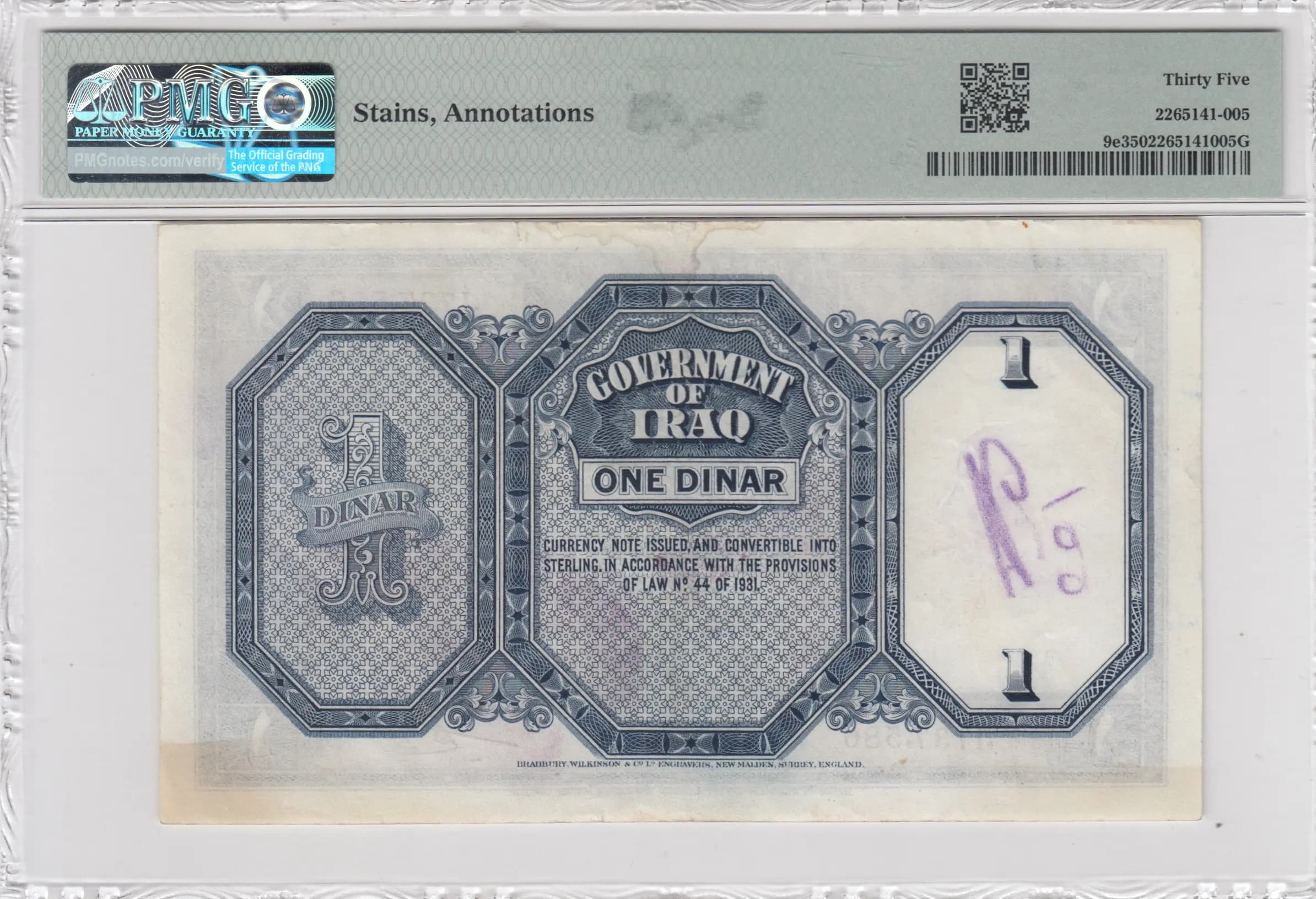
The obverse presents King Ghazi in profile facing left, dressed in formal military uniform with insignia, positioned at the right of the note. The central design employs a decorative panel with fine red and blue ornamental patterns, flanked by blank space on the left (typical of the era for signature/annotation space) and a geometric border with crescent moon corner ornaments characteristic of Iraqi heraldic design. The reverse features three shield-shaped or octagonal cartouches in a horizontal arrangement, with the left and right panels bearing the numeral '1,' the central panel containing the bilingual currency designation and legal provenance text, and ornamental corners throughout. The overall aesthetic reflects early 20th-century British security printing standards applied to an emerging Middle Eastern nation's currency.
FRONT: Arabic text 'واقعة الدولة العراقية' (Government of Iraq/Iraqi State); English signatures of 'Kennet' (Lord Kennet) and 'A. Amin'; denomination '1' and serial number 'J737586'. BACK: 'DINAR' and 'ONE DINAR' in English; 'GOVERNMENT OF IRAQ'; full legal text: 'CURRENCY NOTE ISSUED, AND CONVERTIBLE INTO STERLING, IN ACCORDANCE WITH THE PROVISIONS OF LAW NO 44 OF 1931'; printer credit: 'BRADBURY WILKINSON & CO LTD ENGRAVERS, NEW MALDEN, SURREY, ENGLAND'; denomination markers '1' on left and right cartouches.
Intaglio engraving by Bradbury Wilkinson & Co Ltd (BWC), New Malden, Surrey, England. The fine line work visible throughout the note, ornamental guilloche patterns in the central panels, and detailed security engraving on both obverse and reverse are characteristic of high-security banknote production. The multicolor underprint visible on the blue-dominant obverse reflects the advanced printing capabilities of this prestigious British security printer during the interwar period.
Identified as Pick-9e variant, specifically printed by BWC (Bradbury Wilkinson & Co). The PMG population report confirms P-9a, P-9b, and P-9e as distinct varieties, all printed by BWC. The serial number observed (J737586) and signatures of Kennet and A. Amin are consistent with this issue. No overprints or special markings are evident in the visual analysis, indicating this is a standard regular-issue variety from the 1931 Law No. 44 series.