1/4 dinar 1942
Market Prices
10 salesAbout This Note
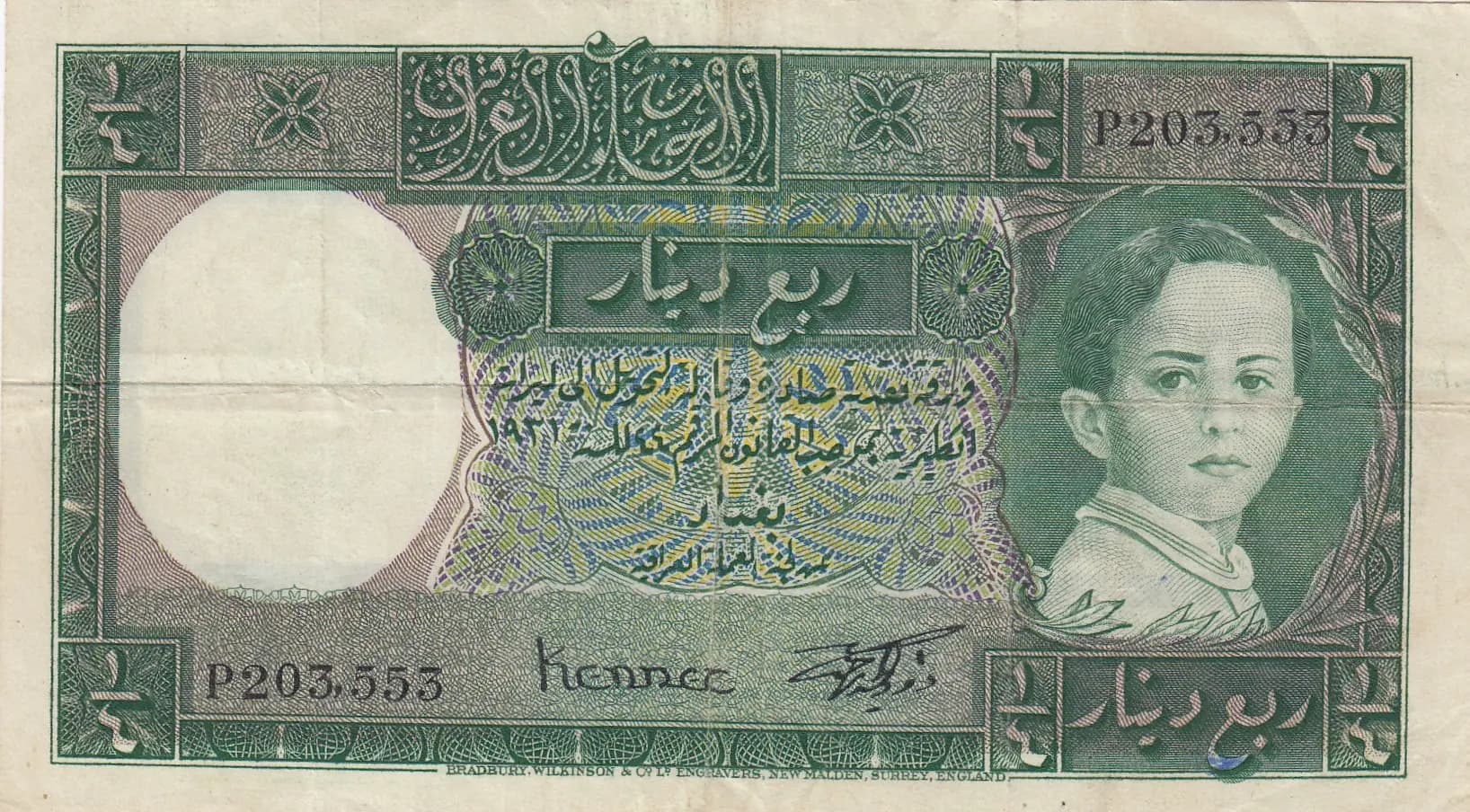
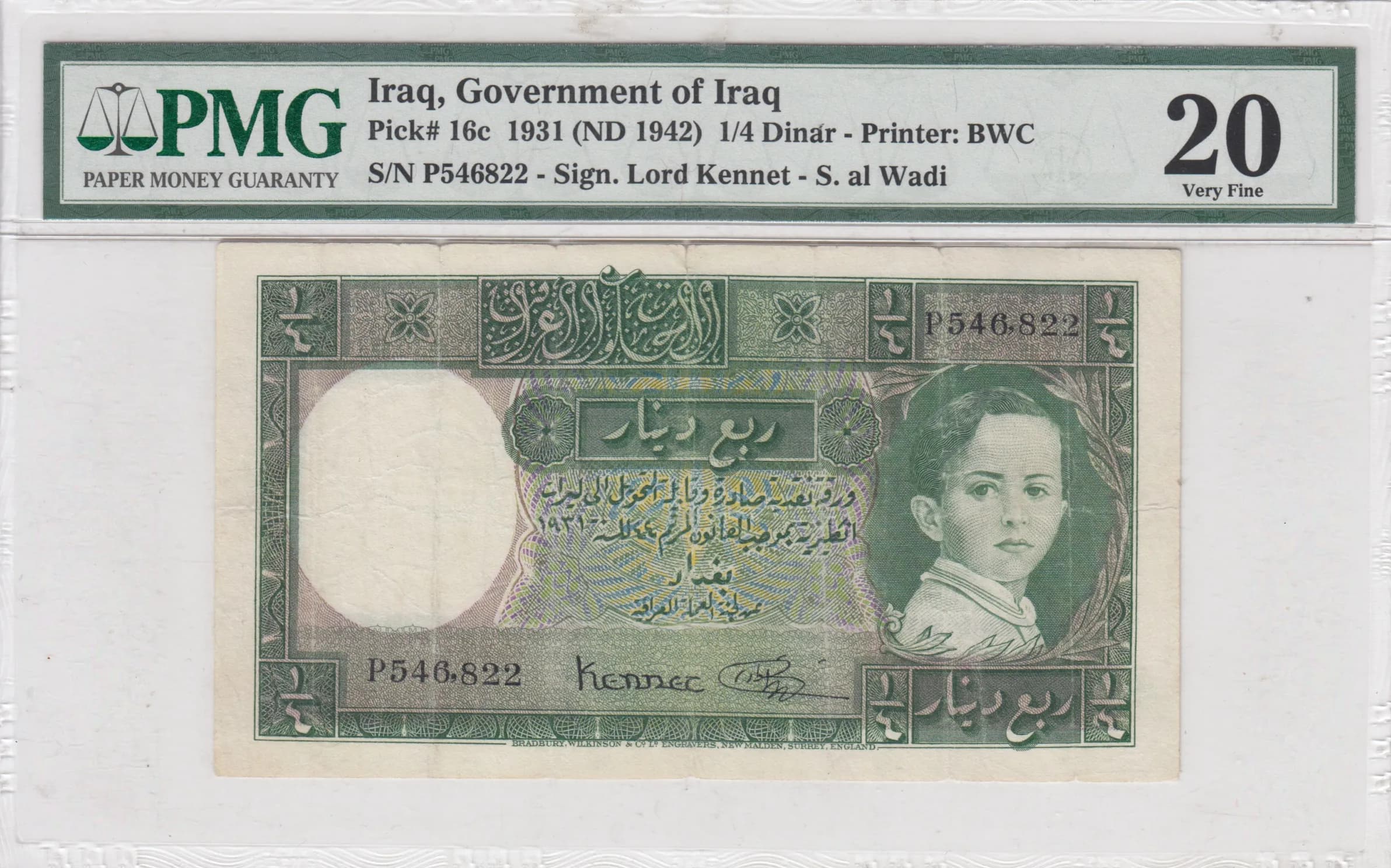
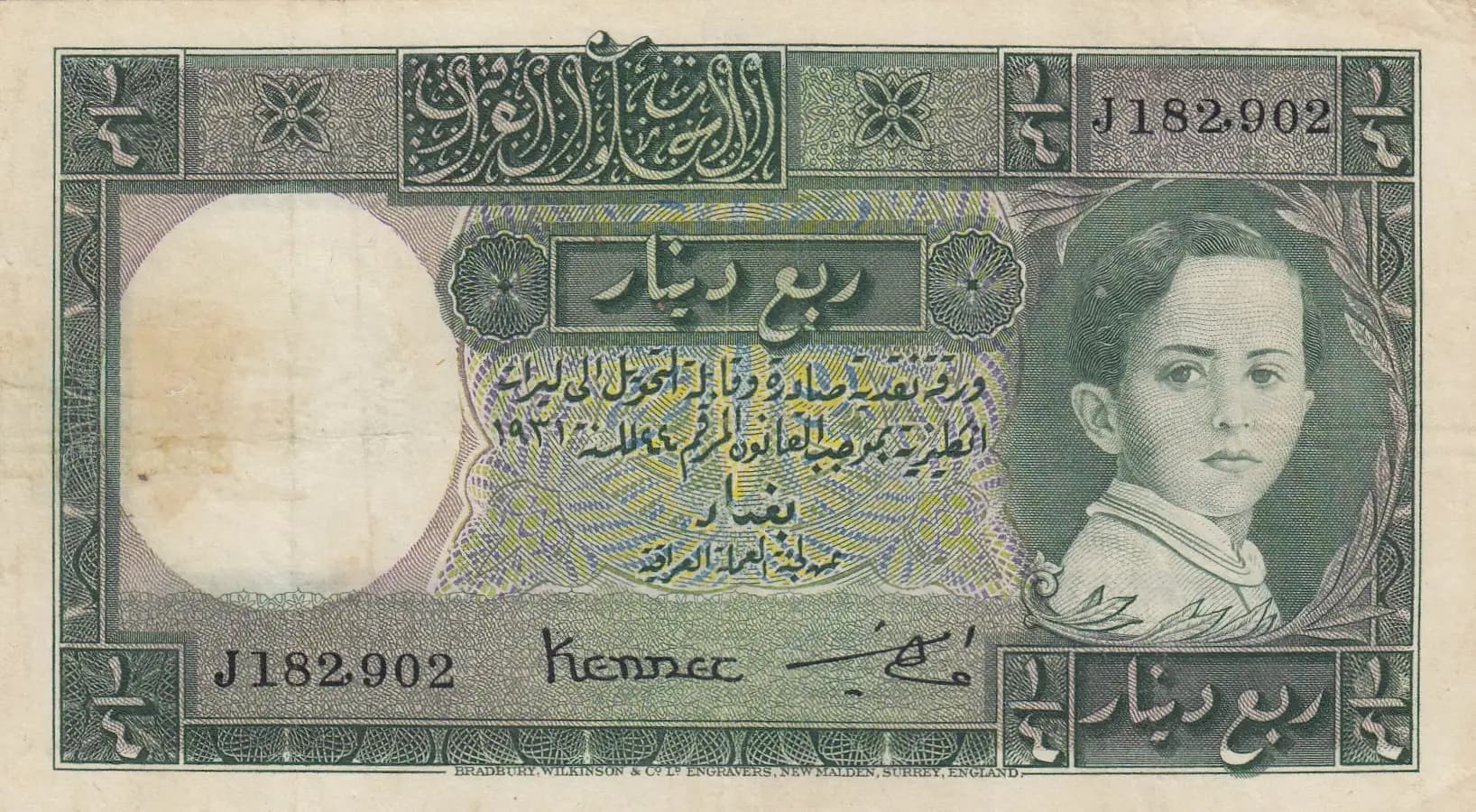
This 1/4 Dinar note from 1942 represents an early issue of Iraqi currency during the reign of King Faisal II, featuring a striking portrait of the young monarch on the obverse and ornate Islamic geometric design elements throughout. The note displays significant aging characteristics including foxing, browning, and yellowing consistent with an 80+ year-old banknote, placing it in VF condition with visible patina that collectors of early Middle Eastern currency find appealing. The Bradbury Wilkinson printing and sterling convertibility clause reflect Iraq's post-WWI relationship with British monetary authority, making this note historically significant beyond its face value.
Common. While this note is now historically interesting and over 80 years old, the eBay market data shows consistent sales activity with VF examples selling in the $160-$235 range (2009-2024), indicating reasonable supply in the collector market. The catalog values (2016) of $250 for F and $500 for EF grades reflect typical pricing for abundant early banknotes rather than scarce issues. PMG population reports show the note exists in multiple variants, further indicating substantial production runs. The denomination (1/4 Dinar) was a smaller unit likely produced in higher quantities for everyday circulation.
Issued under Law No. 44 of 1931, this note reflects Iraq's early period of monetary independence following the Ottoman era and British Mandate administration. King Faisal II, depicted as a child on the obverse, was a symbolic figurehead during this formative period of Iraqi statehood, and his portrait on currency represented the legitimacy of the nascent Iraqi government. The sterling convertibility clause indicates Iraq's monetary integration with the British imperial economic system, a defining characteristic of Middle Eastern finance in the interwar period.
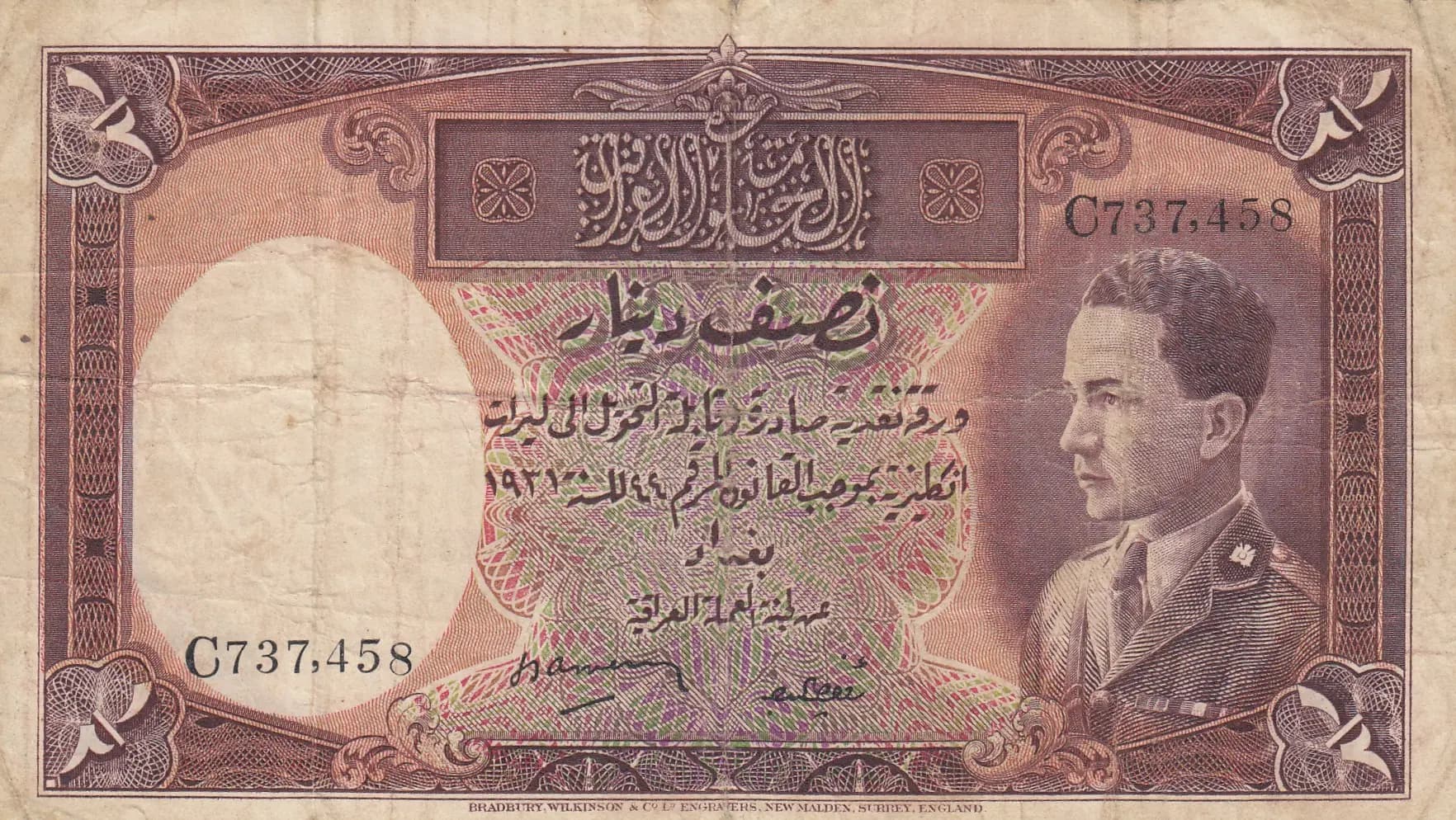
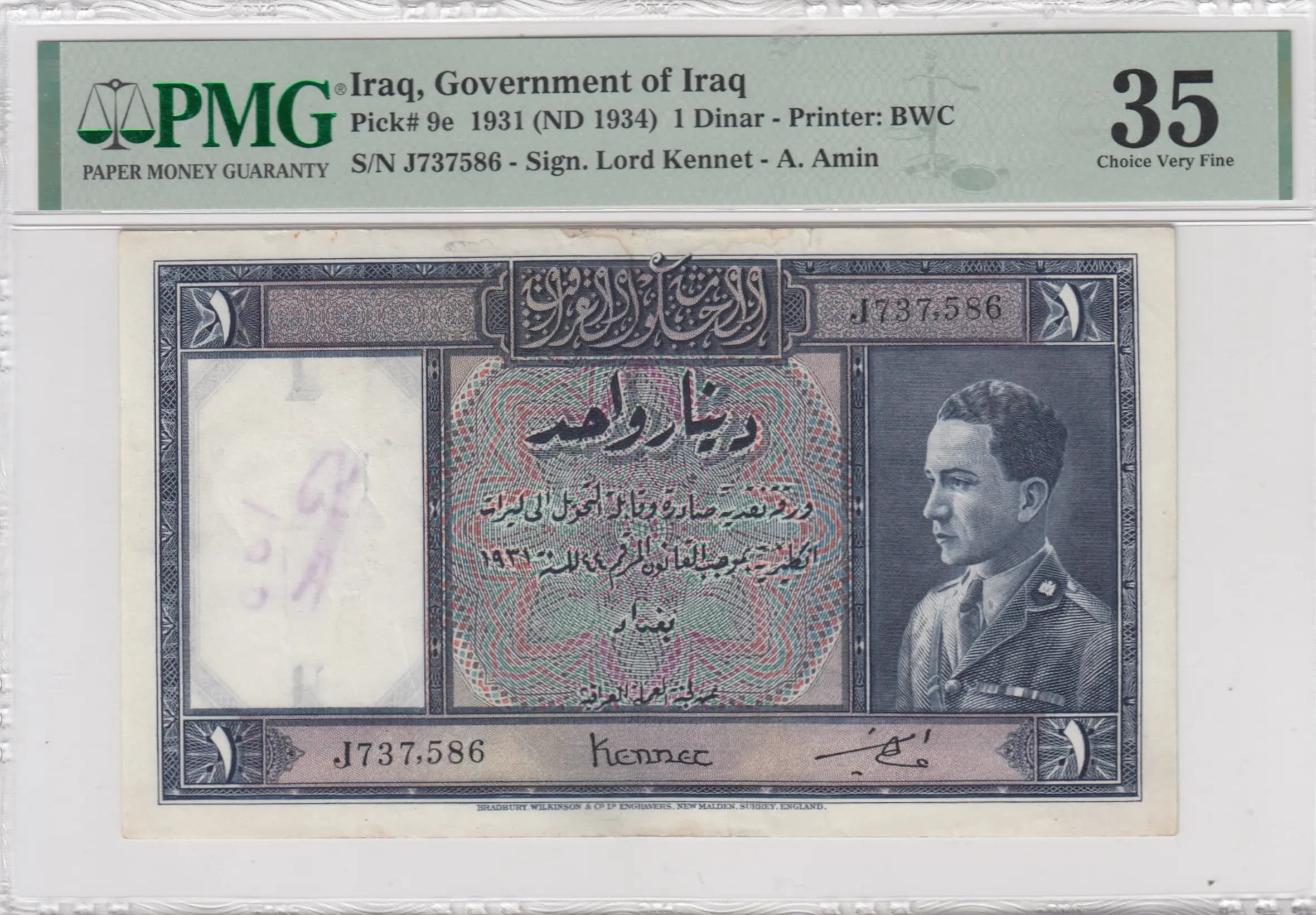
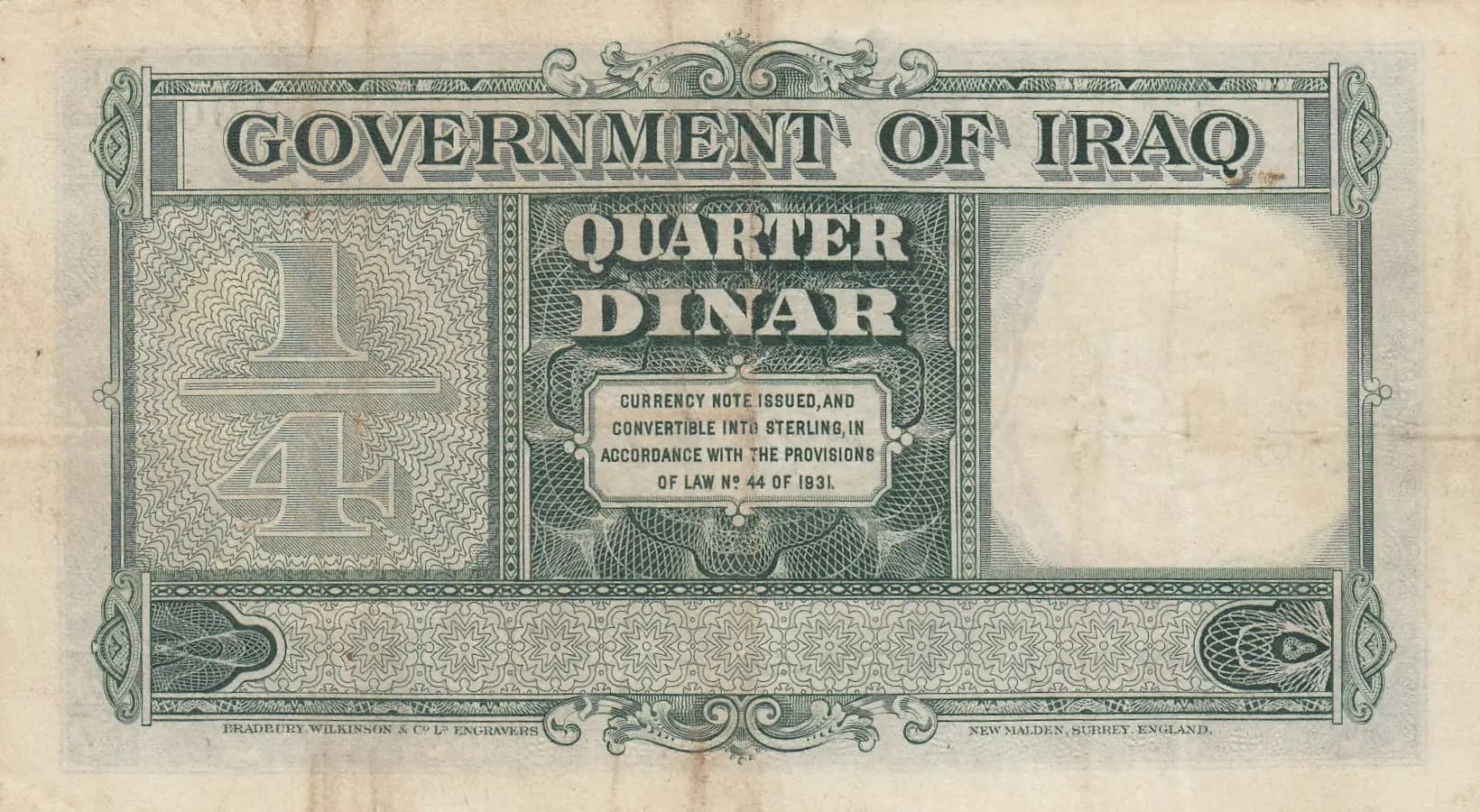
The obverse features a formal portrait of King Faisal II positioned in three-quarter profile view on the right side of the note, rendered with fine intaglio line work typical of British security printers. The portrait is framed within an ornate cartouche with Islamic geometric star patterns and floral rosette designs flanking the central Arabic denomination text 'ربع دينار' (Quarter Dinar). The reverse displays primarily text-based design with a prominent numeral '1' contained within an ornate geometric frame, surrounded by decorative scrollwork in the border corners and Islamic-style geometric patterns. The entire note employs a green and cream color scheme with black intaglio printing, typical of early 20th-century British Commonwealth currency design. The watermark reportedly features King Faisal's portrait, consistent with contemporary security practices.
FRONT SIDE: Arabic: 'ربع دينار' (Quarter Dinar); Serial numbers: J182902 (bottom left), 7182902 (top right); Signature: 'henner' (engraver attribution); Printer mark: 'BRADBURY WILKINSON & CO LTD ENGRAVERS NEW MALDEN SURREY ENGLAND'; Constitutional authority: 'اللجنة الدستورية العراقية الدراقة الاولى للأسكندرية بغداد' (Iraqi Constitutional Committee, First Edition for Alexandria, Baghdad). BACK SIDE: 'GOVERNMENT OF IRAQ'; Denomination: 'QUARTER DINAR'; Legal basis: 'CURRENCY NOTE ISSUED, AND CONVERTIBLE INTO STERLING, IN ACCORDANCE WITH THE PROVISIONS OF LAW No 44 OF 1931'; Printer: 'BRADBURY WILKINSON & CO LTD ENGRAVERS NEW MALDEN SURREY ENGLAND'.
Intaglio engraving and printing by Bradbury Wilkinson & Co. Ltd. (BWC), a renowned British security printer located in New Malden, Surrey. The visual analysis confirms the characteristic fine line work, detailed geometric pattern fills, and ornate border engraving typical of intaglio currency production. The multi-color underprint visible in the VF example reflects the sophisticated security printing capabilities of BWC during the early 20th century.
This specimen is identified as Pick P-16a, produced by Bradbury Wilkinson & Co. (BWC). The PMG population report indicates at least three catalogued variants: P-16a and P-16b (both BWC printer), and P-16s (unspecified printer). The serial numbers visible on this example (J182902 and 7182902 with matching digits) are consistent with the known issue. The signature 'henner' appears to be the engraver attribution. Without access to comprehensive printer variant documentation, the P-16a classification with BWC printer attribution appears definitive based on catalog data provided.