1/2 dinar 1959
About This Note
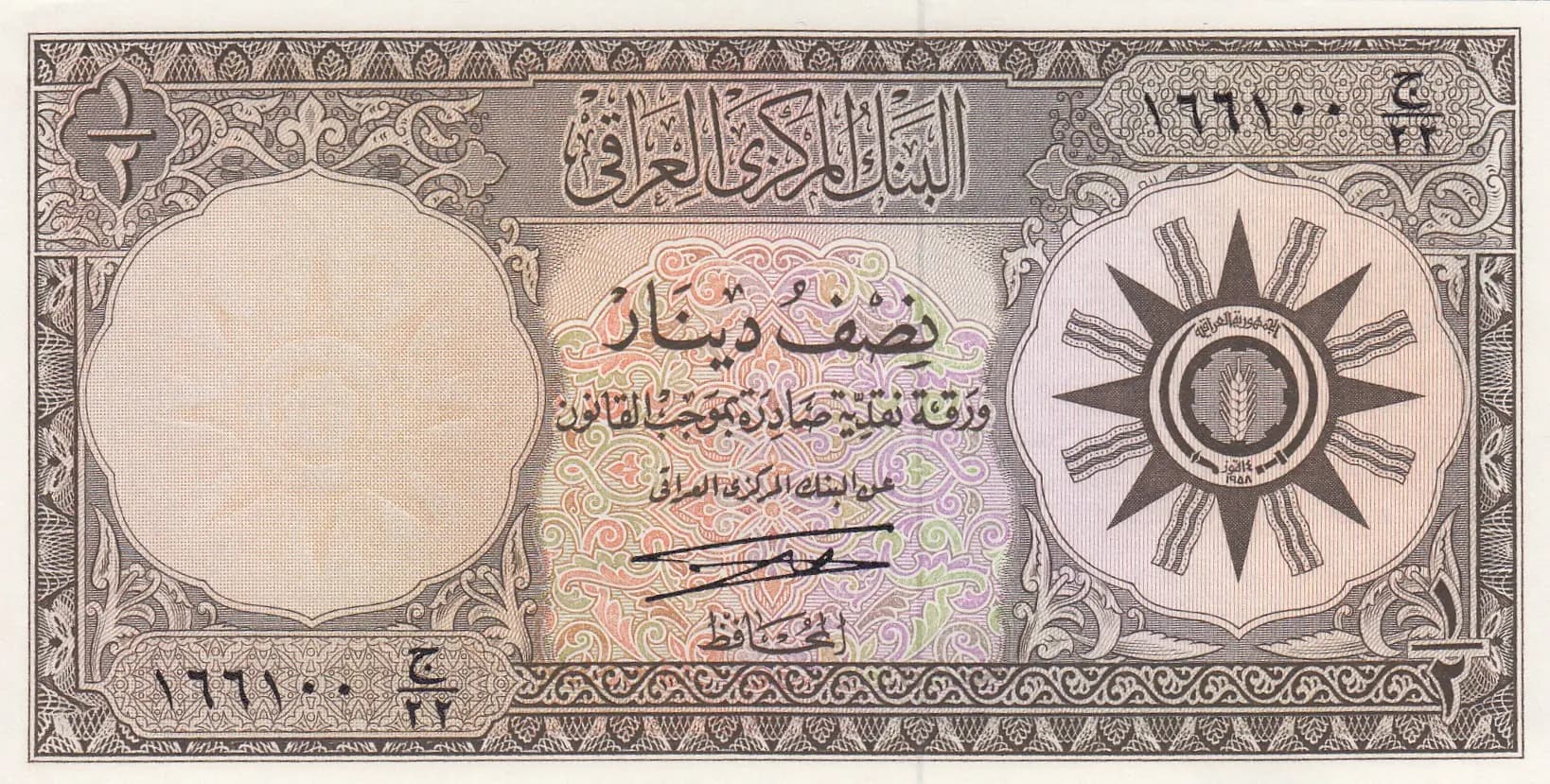
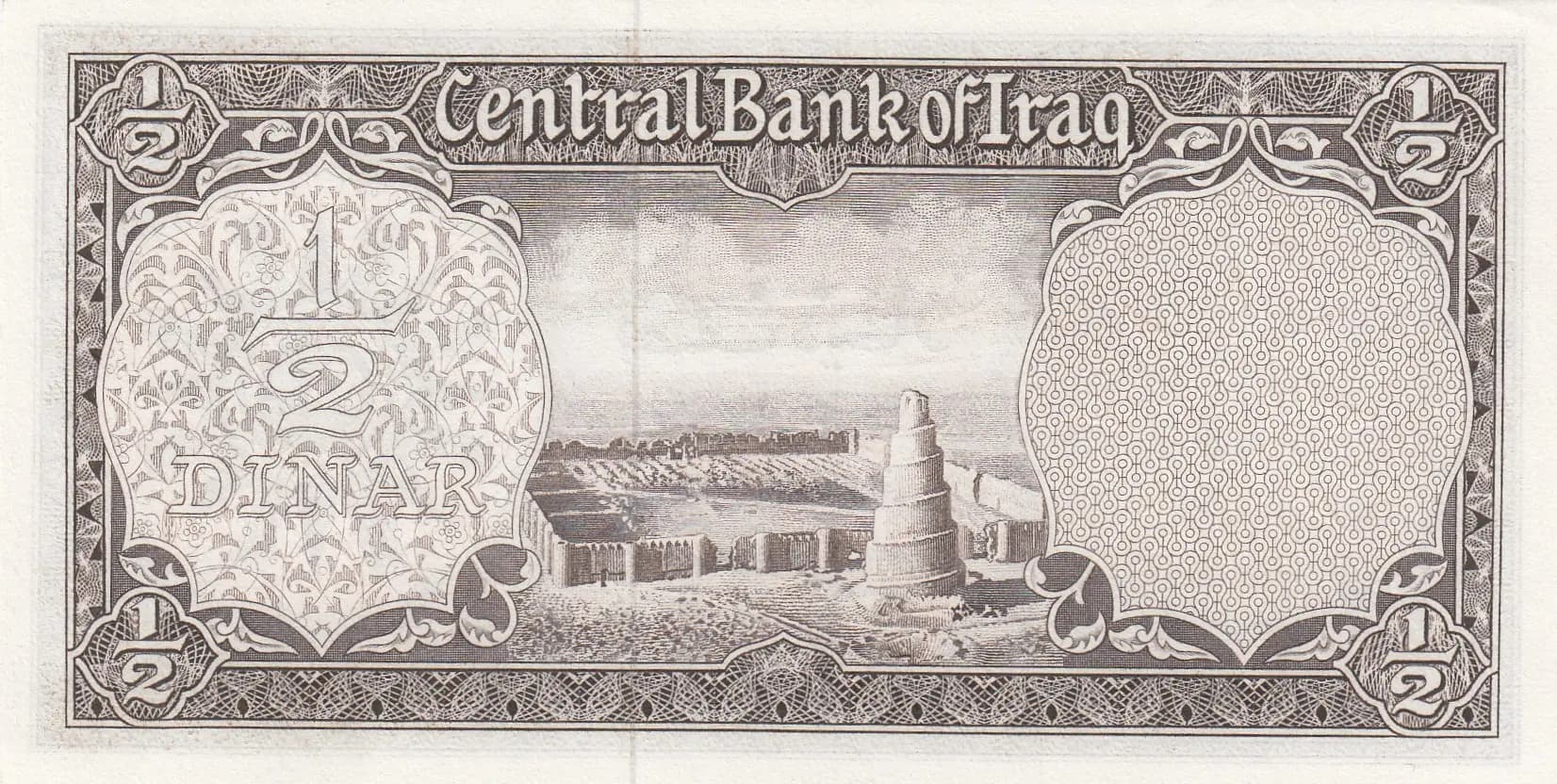
This is an exceptional uncirculated example of Iraq's 1959 half-dinar banknote, featuring stunning ornate Islamic geometric and floral design work characteristic of early post-independence Iraqi currency. The front displays a prominent sunburst emblem with radiating pointed star design surrounding a wheat/grain medallion—symbolic of Iraq's agricultural heritage—while the reverse depicts the historically significant spiral minaret at Samarra (Al-Malwiya) amid architectural ruins, rendered in fine engraved detail. The pristine condition with sharp, clean impressions throughout makes this an excellent specimen for collectors of Middle Eastern numismatics or Iraqi historical currency.
Common. This 1/2 dinar from 1959 (Pick-52b) was part of the Central Bank of Iraq's standard circulation issue and experienced a substantial print run. No evidence suggests this note was recalled, had a limited production run, or was from a short-lived issuing authority. The denomination and early date do not confer significant scarcity in the collector market. Examples in various grades are regularly available through numismatic dealers and auction houses at modest valuations.
This banknote was issued in 1959 by the newly independent Central Bank of Iraq, during a formative period in Iraqi monetary sovereignty following the 1958 revolution. The agricultural symbolism (wheat imagery on the front) reflects Iraq's economic foundation during this era, while the reverse's depiction of Samarra's famous spiral minaret—one of Iraq's most recognizable historical monuments—emphasizes the nation's rich cultural and architectural heritage. The bilingual presentation (Arabic on obverse, English on reverse) reflects Iraq's position as a modern nation-state engaging with Western financial systems while maintaining strong ties to Islamic and Arab identity.
The obverse features an elaborate ornamental design centered on Iraq's national coat of arms—a sunburst emblem with radiating pointed star design surrounding a central circular medallion containing wheat or grain imagery, symbolizing Iraq's agricultural resources and prosperity. The design is framed by intricate geometric and floral patterns in ornate decorative cartouches and borders rendered in brown, tan, pink, purple, and green. The reverse depicts the Al-Malwiya minaret at Samarra, an iconic ninth-century spiral mosque tower, shown amid surrounding architectural ruins and desert landscape. The minaret, with its distinctive helical structure, dominates the center of the composition and is rendered in fine engraved line work. Both sides employ elaborate corner medallions and geometric pattern cartouches in a color palette of brown, black, beige, and gray, reflecting the classical engraving aesthetic of mid-20th-century currency design.
Front side: 'البنك المركزي العراقي' (Central Bank of Iraq) and 'نصف دينار' (Half dinar). Back side: 'Central Bank of Iraq' (English header), '2' (denomination numeral), and 'DINAR' (denomination in English). Note: The back denomination marking shows '2' with 'DINAR,' which appears to represent the value in the context of half-dinar note (i.e., 2 half-dinars = 1 dinar), though the Pick catalog identifies this as the 1/2 dinar denomination.
Intaglio (engraved) printing, the standard security printing method for banknotes of this era. The fine line detail work visible throughout the borders, the intricate geometric security patterns in the cartouches, and the detailed architectural rendering of the Samarra minaret all demonstrate the characteristic depth and precision of intaglio engraving. For Iraqi banknotes of the 1959 series, the Central Bank of Iraq contracted with established international security printers; the specific printer for this Pick number is not definitively identified from the visual analysis, but British American Bank Note Company (BABNC) and De La Rue were common contractors for Middle Eastern currency during this period.
The Pick catalog notation 'P-52b(2)' indicates this is a specific variety within the 1959 half-dinar series. The '(2)' designation typically refers to a secondary variety, which may relate to signature varieties, serial number ranges, or minor design elements. Without access to the specific note's serial number prefix or signature panel details in the provided images, the exact variety differentiation cannot be confirmed from the visual analysis alone. Collectors should consult detailed Iraqi banknote references or the Pick Standard catalog for a complete variety breakdown of the 1959 series.