50 pengö 1944
Market Prices
18 salesAbout This Note
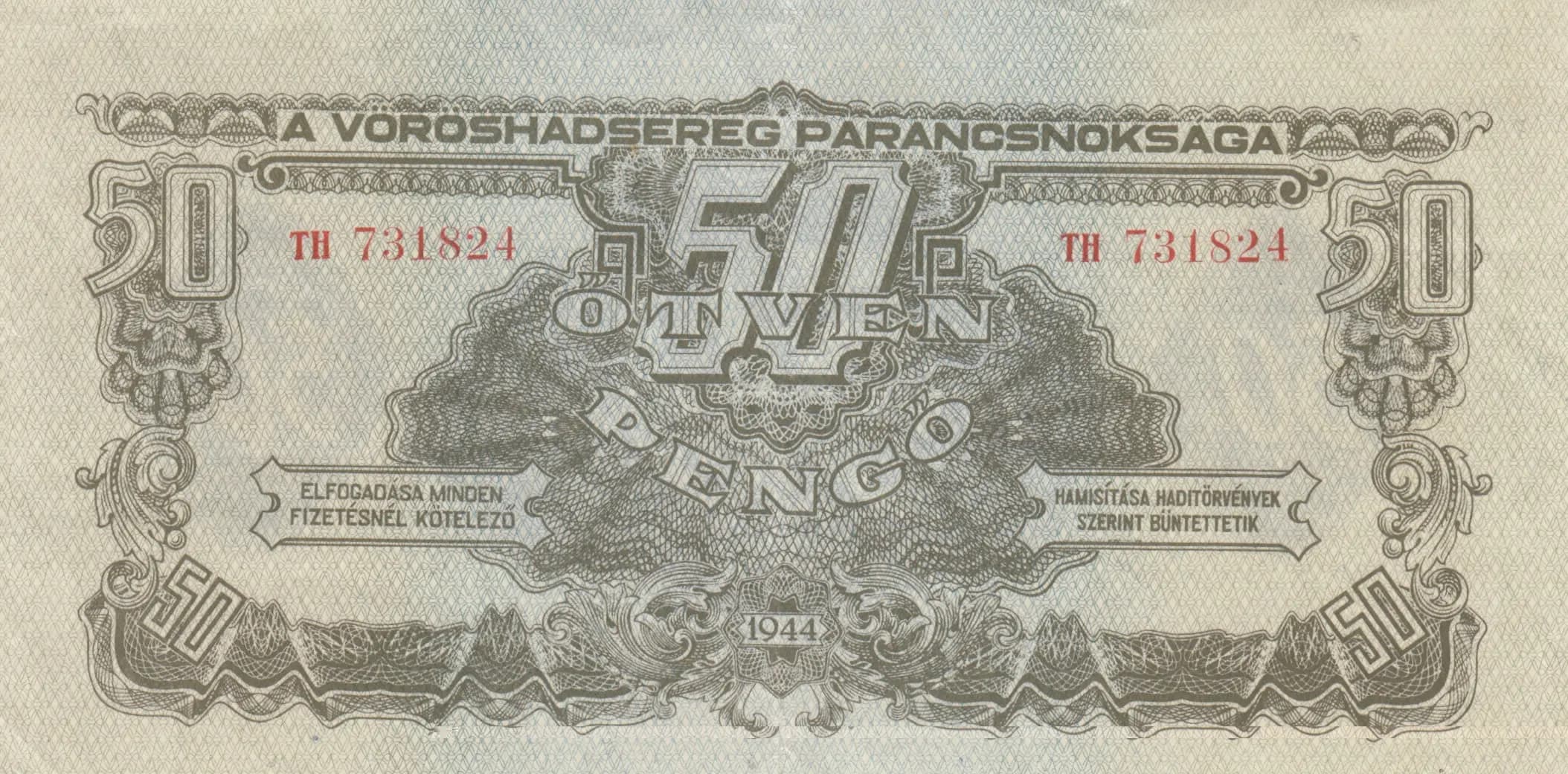
This 1944 Hungarian 50 pengö military payment note presents in exceptional condition, displaying pristine paper with no visible wear, creasing, or circulation marks. The note features an ornate Art Deco design with elaborate baroque-style flourishes, gray-green ink on a cream/beige background, and bears the inscription 'A Vöröshadsereg Parancsnoksága' (To the Commander-in-Chief of the Red Army), marking it as currency issued for use by Soviet forces during their occupation of Hungary. The specimen exhibits the fine detailed engraving characteristic of this issue, with serial number TH 731824 visible on the obverse.
Common. eBay market data shows consistent sales across multiple years ranging from $1.29 to $20.50, with most VF-graded examples selling between $2-$6.50 in recent years. The 2008 catalogue value for VF is only $1.50. This note was issued in significant quantities for Soviet military operations and remains readily available in the collector market, indicating substantial surviving circulation. The price range and frequency of sales confirm this is a commonly encountered military payment note rather than a scarce issue.
This military payment note was issued in 1944 by the Soviet Red Army command during the final phase of World War II and the Soviet advance into Hungary. The inscription 'A Vöröshadsereg Parancsnoksága' and the double-headed eagle coat of arms reflect the Soviet military administration's authority over occupied Hungarian territory. The mandatory acceptance clause and counterfeiting penalties inscribed in Hungarian demonstrate the occupying force's attempt to establish legitimacy and control over the local economy during this transitional period.
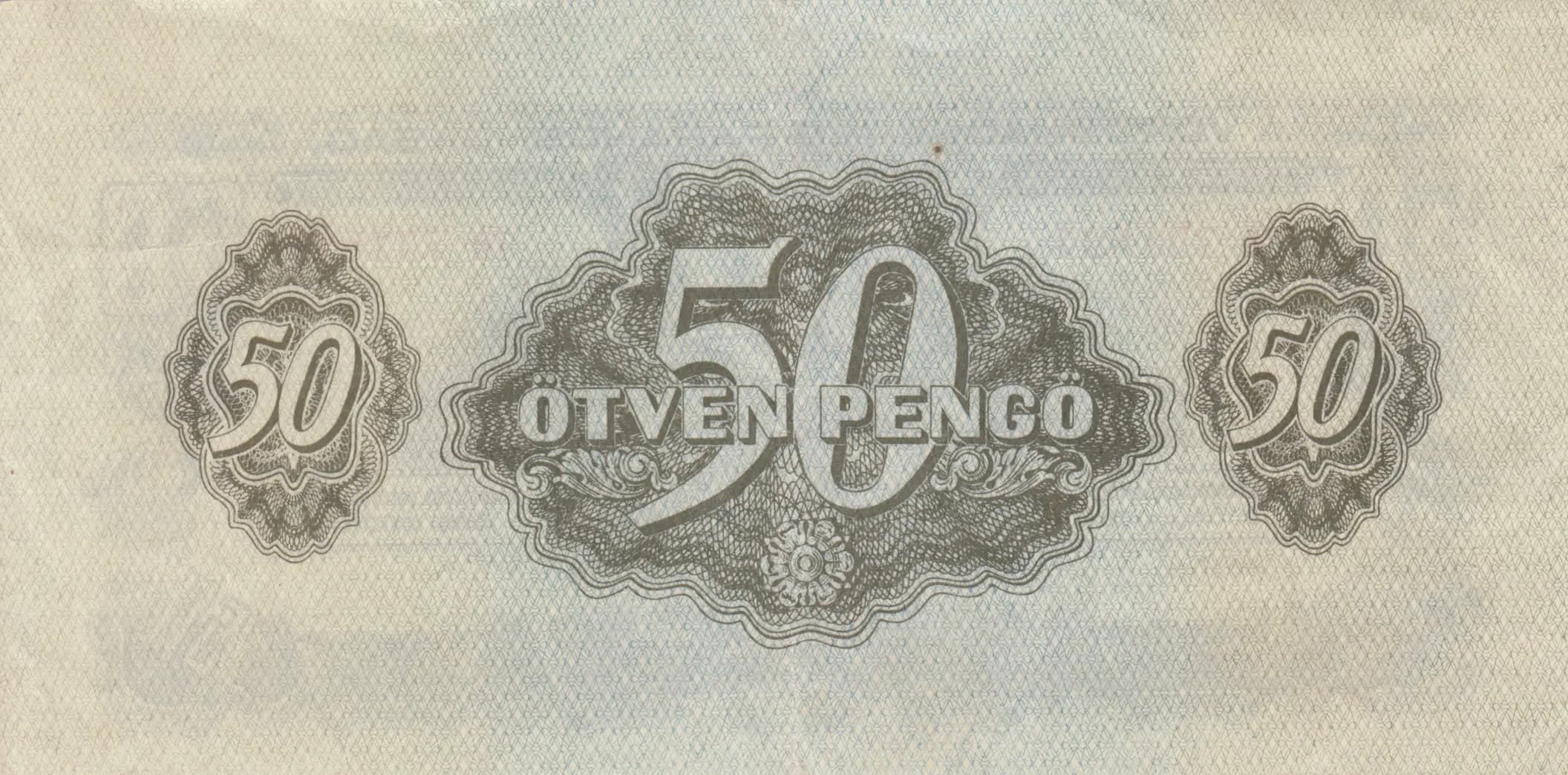
The obverse features a symmetrical Art Deco composition with an ornate border of geometric and baroque-style flourishes occupying all four corners. The denomination '50' is prominently displayed in the center and corners. The Hungarian coat of arms—a double-headed eagle with shield—is positioned at the center-bottom, serving as the primary heraldic symbol. The reverse presents a simpler design emphasizing the denomination through three ornamental cartouches containing the numeral '50' and text 'ÖTVEN PENGÖ,' with decorative guilloche patterns providing visual depth. No portraits are depicted; instead, the design relies on elaborate ornamental engraving typical of military currency of the period.
OBVERSE: 'A Vöröshadsereg Parancsnoksága' = 'To the Commander-in-Chief of the Red Army'; '50' = Fifty; 'ÖTVEN' = Fifty; 'ELFOGEADÁSA MINDEN FIZETÉSNÉL KÖTELEZÕ' = 'Acceptance mandatory for all payments'; 'HAMISITÁSA HADITÖRVÉNYEK SZERINT BÜNTETTETIK' = 'Counterfeiting is punishable under military law'; '1944' = Year of issue; Serial number: 'TH 731824'. REVERSE: '50' = Fifty (appears in three locations); 'ÖTVEN PENGÖ' = 'Fifty Pengö'.
The note was produced using intaglio (line engraving) printing, evidenced by the fine detailed engraving visible throughout both sides, intricate guilloche patterns in the background, and the precise line work characteristic of high-security currency production. The detailed cartouche designs and elaborate border work are consistent with traditional bank note engraving techniques. The specific printer for Pick M7 is consistent with Hungarian state printing facilities under Soviet military administration.
Serial number TH 731824 observed on this specimen. The catalog reference notes two serial number varieties exist for this issue. This note appears to be one of the standard circulation varieties. No overprints, color variations, or printing errors are evident from the visual analysis. The Pick catalog designation P-M7 confirms this is the standard issue type for the 50 pengö denomination from the Red Army Command in 1944.