20 kronen 1916
About This Note
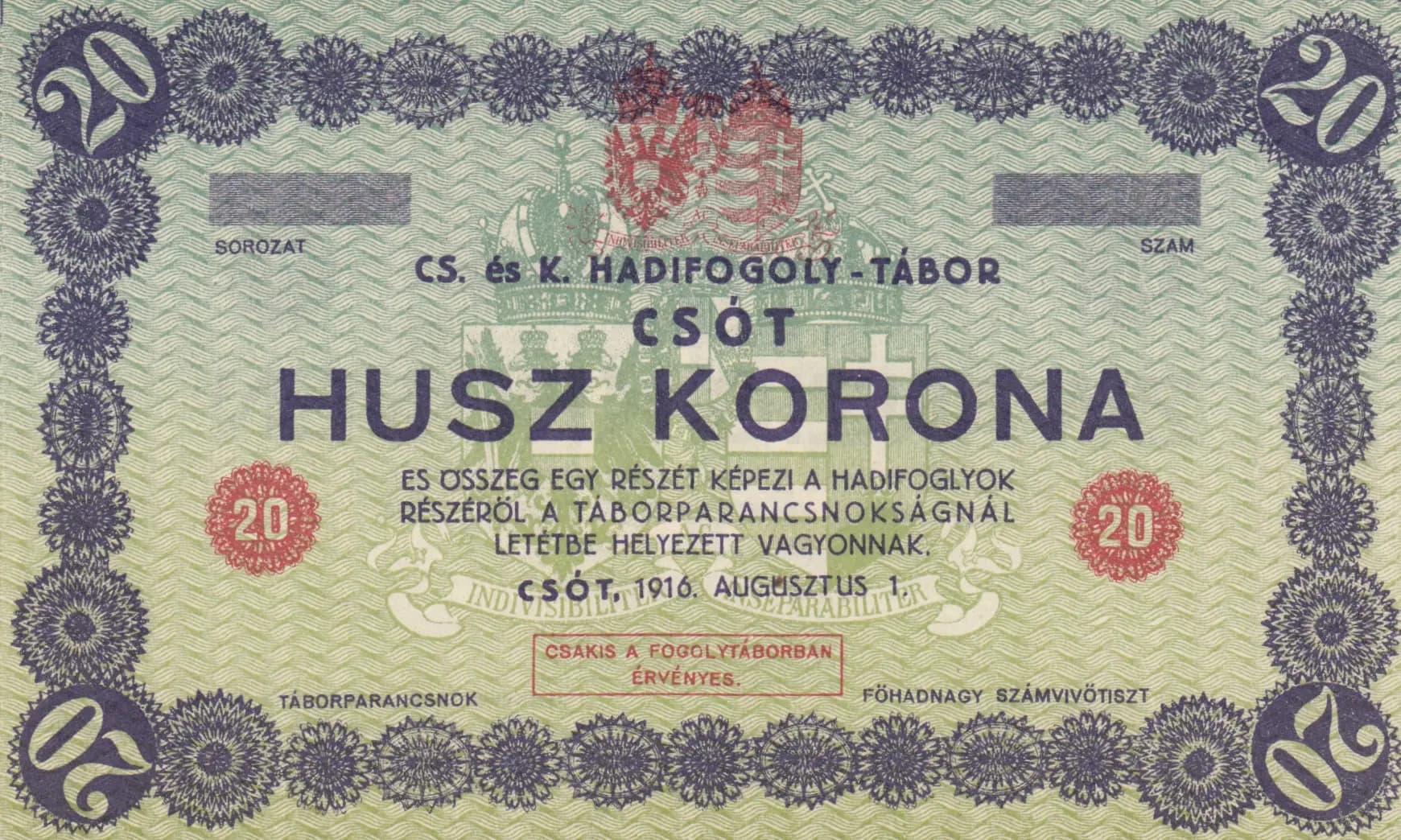
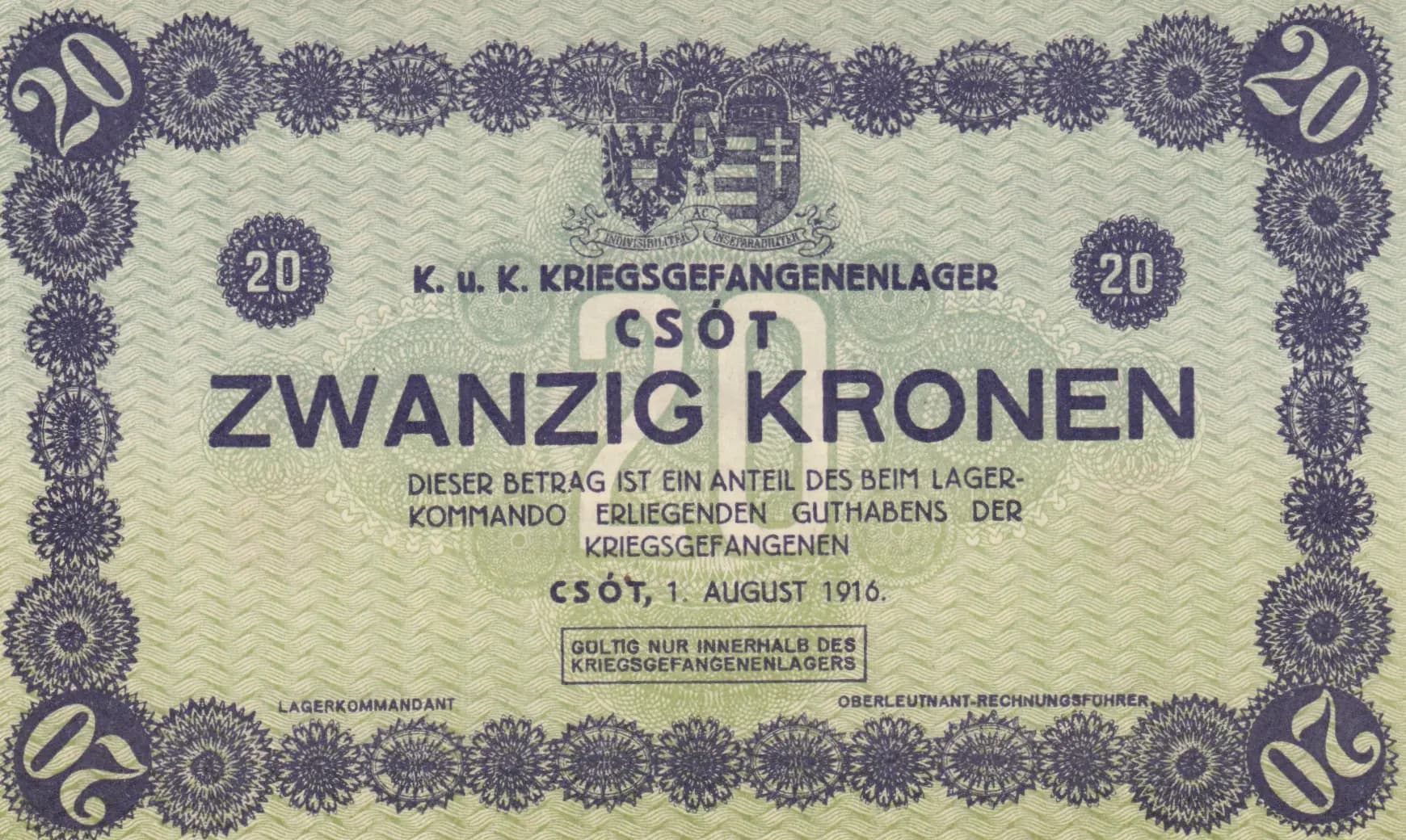
An exceptional 1916 Austro-Hungarian prisoner-of-war camp scrip note issued by the Hadifogoly Tabor (CSÓT) in denominations of 20 kronen. This bilingual (Hungarian/German) note is printed in light green with ornate purple and dark blue rosette borders, and features imperial heraldic symbolism including a double-headed eagle and crowned Hungarian shield. The example exhibits AU condition with pristine, uncirculated surfaces showing no wear, creases, or foxing—a remarkable state of preservation for this specialized camp currency.
Common. While this is an unlisted Pick number reflecting its specialized prisoner-of-war camp scrip classification, such camp currency was issued in significant quantities for administrative and accounting purposes throughout the war years. The survival of this particular note in AU condition is noteworthy, but the denomination itself was not produced in limited runs and examples regularly appear in collections of World War I military scrip and Austro-Hungarian ephemera. The lack of Pick catalog listing reflects specialized collecting interest rather than extreme scarcity.
This note represents a fascinating artifact of World War I military administration, issued during the Austro-Hungarian Empire's management of prisoner-of-war camps. The bilingual Hungarian-German text and imperial coat of arms reflect the dual Austro-Hungarian monarchy's official structures, while the August 1, 1916 date places it during the war's height. Rather than cash, this scrip functioned as a receipt for prisoner deposits held by camp command, serving both as a security measure and a practical accounting tool within the camp economy.
The design presents a symmetrical, bilaterally identical layout on both front and back, emphasizing the dual-language administrative nature of the Austro-Hungarian Empire. The dominant visual elements are the ornate borders composed of repeated rosette (flower) patterns in purple and dark blue intaglio work against a light green background. Central to each side is the imperial coat of arms—a double-headed eagle surmounted by a crown and displaying a red heraldic shield featuring the Hungarian crown and shield symbols. The denomination '20' appears in large numerals in all four corners. The Hungarian side emphasizes the military prisoner camp administration (HADIFOGOLY-TÁBOR), while the German side uses the official imperial designation (K. u. K. KRIEGSGEFANGENENLAGER). Both sides prominently state that this scrip is 'valid only within the prisoner of war camp,' reinforcing its limited circulation purpose. The design eschews portraiture in favor of heraldic and institutional symbolism, reflecting the note's status as camp scrip rather than circulation currency.
FRONT SIDE: '20' (denomination numerals) | 'HUSZ KORONA' (Twenty Crowns) | 'CS. és K. HADIFOGOLY-TÁBOR CSÓT' (Imperial and Royal Military Prisoner Camp CSÓT) | 'SOROZAT' (Series) | 'SZÁM' (Number) | 'ES OSSZEG EGY RESZET KEPEZI A HADIFOGLYLOK RESZÉRÖL A TABORPARANCSNOKSÁGNÁL LETÉTBE HELYEZETT VAGYONNAK.' (This amount represents a share of the property deposited with the camp command on behalf of the prisoners of war) | 'CSÓT, 1916. AUGUSZTUS 1.' (CSÓT, August 1, 1916) | 'ILLETVE A FOGOLYTÁBORBAN ÉRVÉNYES.' (Valid in the prisoner of war camp) | 'TABORPARANCSNOK' (Camp Commander) | 'FÖHADNAGY SZÁMVIVÖTISZT' (Senior Lieutenant Paymaster Officer). BACK SIDE: '20' (denomination numerals) | 'ZWANZIG KRONEN' (Twenty Crowns) | 'K. u. K. KRIEGSGEFANGENENLAGER CSÓT' (Imperial and Royal Prisoner of War Camp CSÓT) | 'DIESER BETRAG IST EIN ANTEIL DES BEIM LAGER-KOMMANDO ERLIEGENDEN GUTHABENS DER KRIEGSGEFANGENEN' (This amount is a share of the credit held by the prisoner of war camp command) | 'CSÓT, 1 AUGUST 1916.' (CSÓT, August 1, 1916) | 'GÜLTIG NUR INNERHALB DES KRIEGSGEFANGENENLAGERS' (Valid only within the prisoner of war camp) | 'LAGERKOMMANDANT' (Camp Commander) | 'OBERLEUTNANT-RECHNUNGSFÜHRER' (First Lieutenant Accounts Officer).
Intaglio printing (engraved plate printing), evidenced by the complex, fine-line ornamental details visible in the rosette border patterns and the depth of the heraldic symbols. The bilateral symmetry and precise alignment of decorative elements indicate careful registration typical of high-security engraved printing. No specific printer or security printer attribution is documented for this unlisted Pick number, but the technical sophistication suggests production by an established Austro-Hungarian state printing facility or authorized security printer, likely the Austro-Hungarian state printing works (K.u.K. Staatsdruckerei).
This note is dated 1 AUGUST 1916 (AUGUSZTUS 1 in Hungarian), which is the signature date variety for the 1916 issuance. The camp designation 'CSÓT' appears as a consistent identifier. Varieties may exist in the signatures of the Camp Commander (TABORPARANCSNOK/LAGERKOMMANDANT) and Paymaster Officer (FÖHADNAGY SZÁMVIVÖTISZT/OBERLEUTNANT-RECHNUNGSFÜHRER), though specific documented varieties are not established in standard catalogs. The bilateral Hungarian-German text arrangement is standard for this issue. Serial number/series information would be present but is not legible in the visual analysis provided. No overprints or secondary varieties are apparent on this example.