1 pengö 1938
Market Prices
2 salesAbout This Note
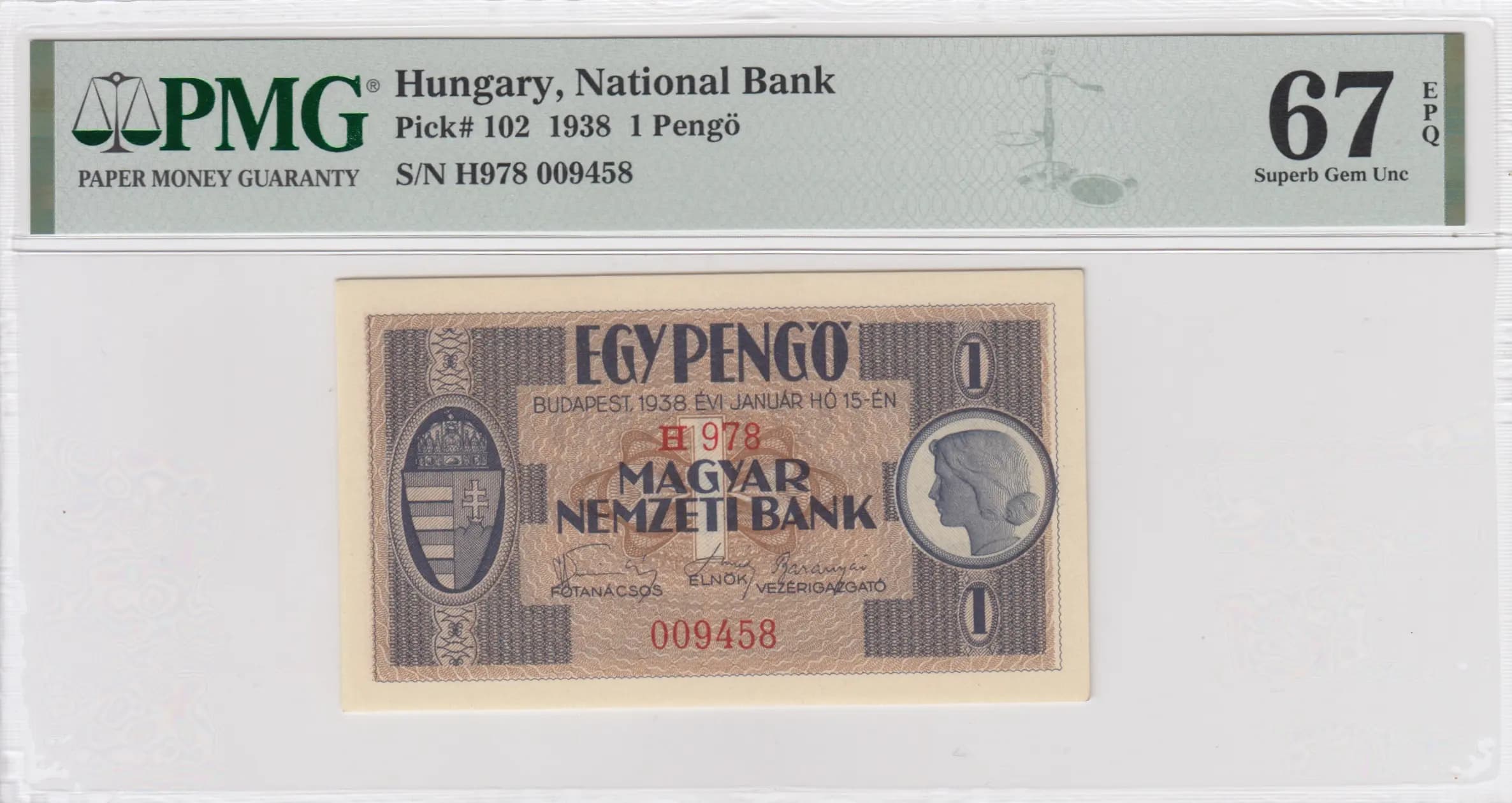
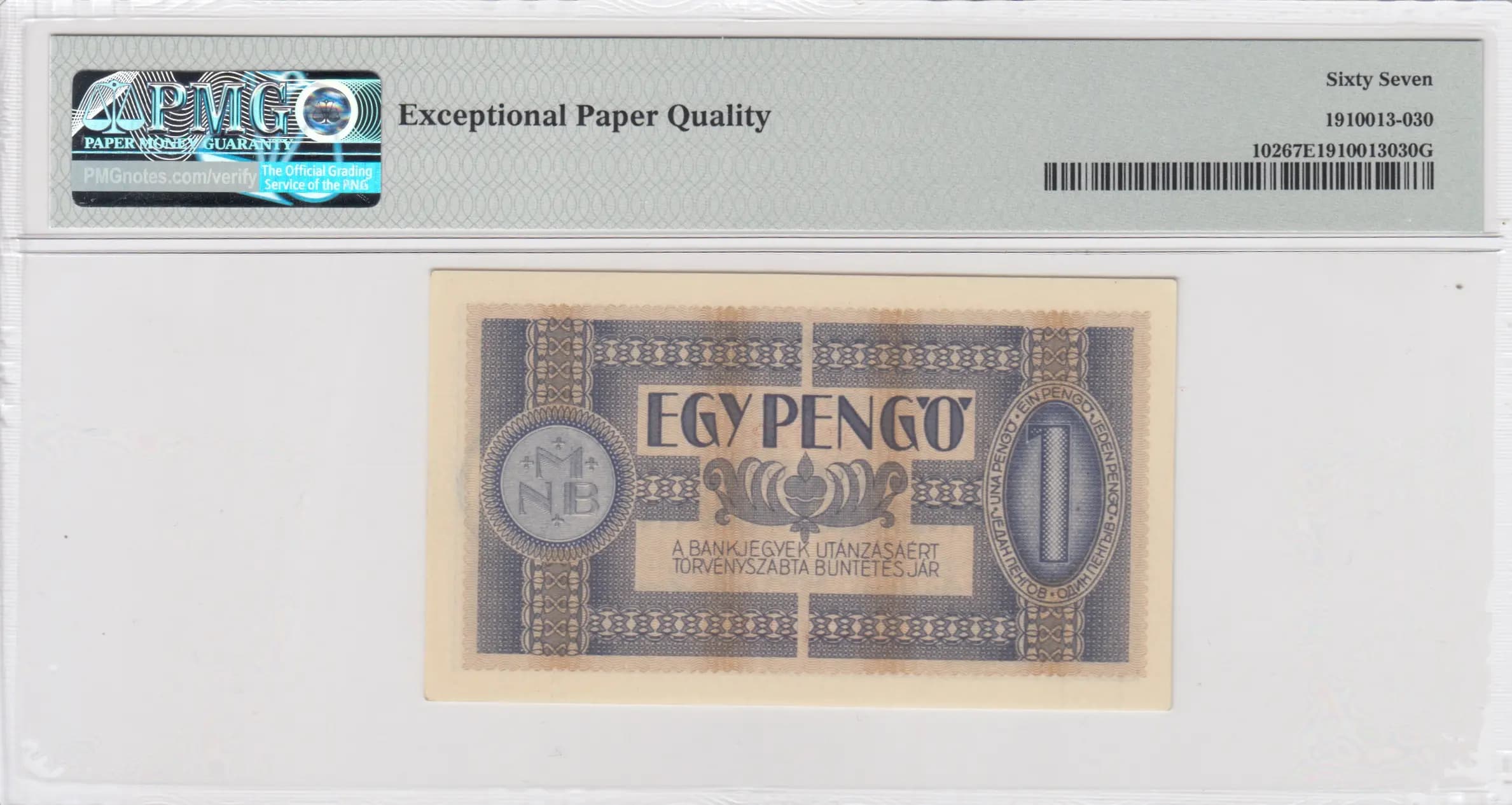
This is an exceptionally well-preserved Hungarian 1 Pengö note from 1938, graded PMG 67 EPQ, representing the regular issue from the Magyar Nemzeti Bank dated January 15, 1938. The note displays crisp printing with minimal wear, featuring a striking design of a female profile medallion paired with the Hungarian coat of arms, complemented by intricate geometric border work on the reverse. The excellent condition, combined with this note's historical significance as a pre-WWII Hungarian currency issue, makes it an attractive example for collectors of Central European numismatics.
Common. This is a regular-issue 1938 pengö from a large print run by the Magyar Nemzeti Bank during a period of stable currency circulation. Secondary market data confirms common status: eBay sales from 2019–2021 in AUNC condition averaged $50–$67, while catalog values from 2016 list UNC examples at only $10. The note experiences steady collector interest but no scarcity premium. PMG has catalogued only one variant for Pick-102, and the lack of any asterisk or special marking indicates this is the standard variety without the distinction of starred notes (P-114) issued under different circumstances.
Issued during the Horthy era of Hungary (1920-1944), this 1938 pengö represents a period of relative economic stability in the interwar years, though the nation was increasingly drawn into the political currents of Nazi-influenced Central Europe. The note bears the official imprint of Budapest dated January 15, 1938, reflecting the Magyar Nemzeti Bank's authority during the regency of Miklós Horthy. The imagery—featuring a classical female profile and the Hungarian heraldic arms with characteristic horizontal stripes and cross—reinforces national identity during a transitional and ultimately turbulent decade in Hungarian history.
The obverse features a classical female profile portrait in a circular medallion positioned on the right side of the note, rendered in the neoclassical style typical of 1930s European banknote design. On the left is the Hungarian coat of arms displayed within an oval shield, featuring the characteristic horizontal stripes (representing the historic regions of Hungary) and the patriarchal cross—a symbol of Hungarian heraldry dating back to medieval times. The center bears the issuer name and date information with signature lines for three officials (President, Chief Counselor, and Director General). The reverse showcases a symmetrical ornamental design with geometric border patterns framing the denomination in large central text, flanked by circular emblems on either side—the National Bank monogram on the left and a wreathed numeral '1' on the right. The overall composition employs fine line engraving and geometric precision characteristic of high-security banknote production of the era.
OBVERSE: 'EGY PENGŐ' = One Pengö (denomination); 'BUDAPEST, 1938. ÉVI JANUÁR HÓ 15-ÉN' = Budapest, January 15, 1938 (issue date); 'MAGYAR NEMZETI BANK' = Hungarian National Bank (issuer); 'H 978' = Block/series identifier; '009458' = Serial number; 'ELNÖK' = President; 'FŐTANÁCSOS' = Chief Counselor; 'VEZÉRIGAZGATÓ' = Director General. REVERSE: 'EGY PENGŐ' = One Pengö (denomination); 'A BANKJEGYEK UTÁNZÁSÁÉRT TÖRVÉNYSZABTA BÜNTETÉS JÁR' = Counterfeiting banknotes is punishable by law (anti-counterfeiting warning).
This note was produced using intaglio (engraved line) printing, evidenced by the crisp, fine line work visible throughout both sides, the sharp serif typography, and the precise geometric patterns forming security borders. The multicolor printing—combining dark blue, brown, tan, gray, and red inks—was achieved through successive passes in the intaglio process. Magyar Nemzeti Bank notes of this period were typically produced by the Hungarian State Printing Works (Magyar Államnyomda) or contracted European security printers; the technical quality suggests institutional security printing standards of the 1930s.
This note is the standard variety (P-102) without an asterisk prefix to the block number. The visual analysis confirms the absence of an asterisk before 'H 978,' distinguishing it from the starred variety catalogued as Pick-114, which was issued under the Horthy Government with modified authorization. The block identifier 'H 978' and serial number '009458' are consistent with the regular 1938 issue. No overprints, replacement marks, or emergency variants are evident.