10 kronen 1916
About This Note
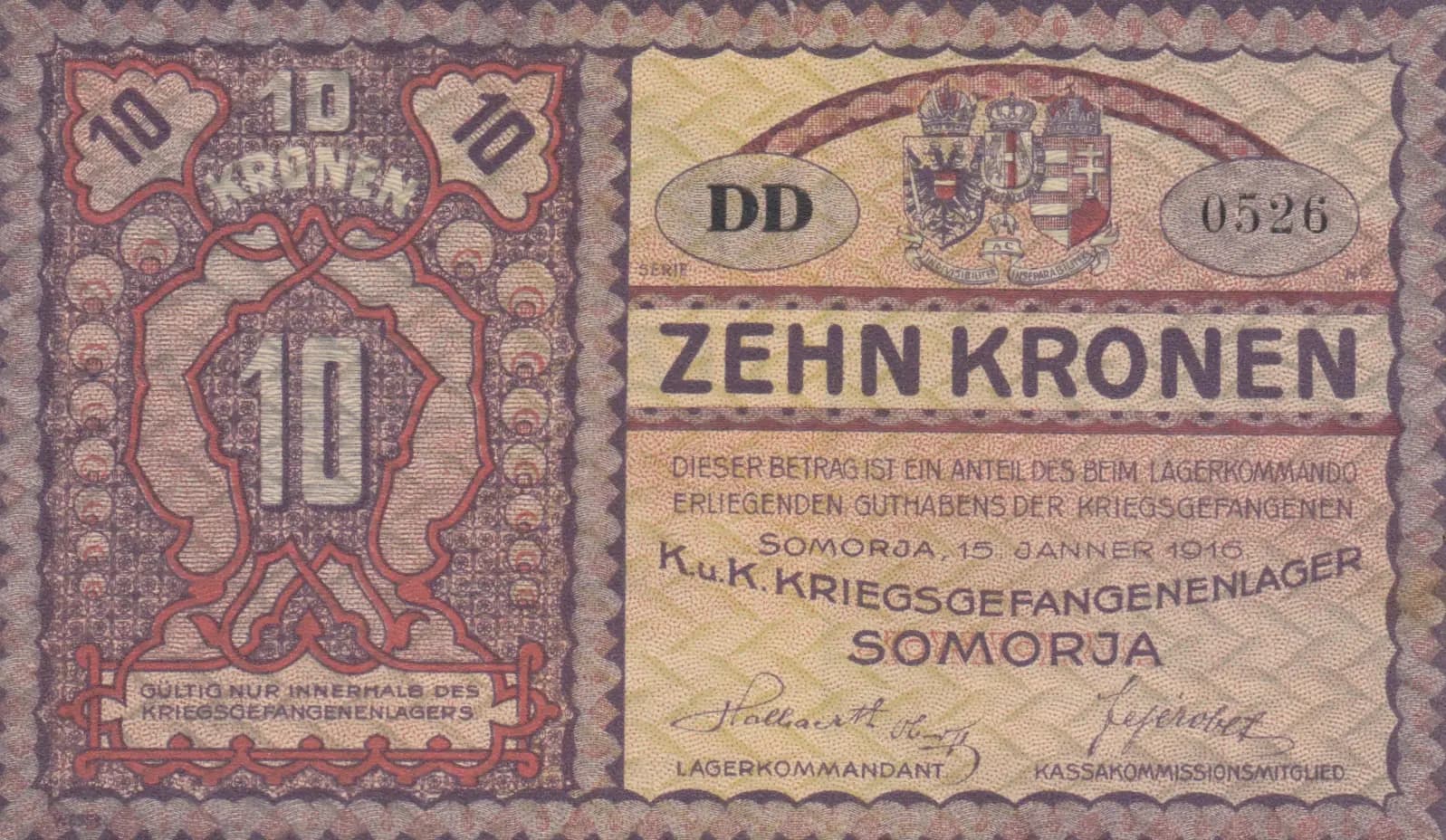
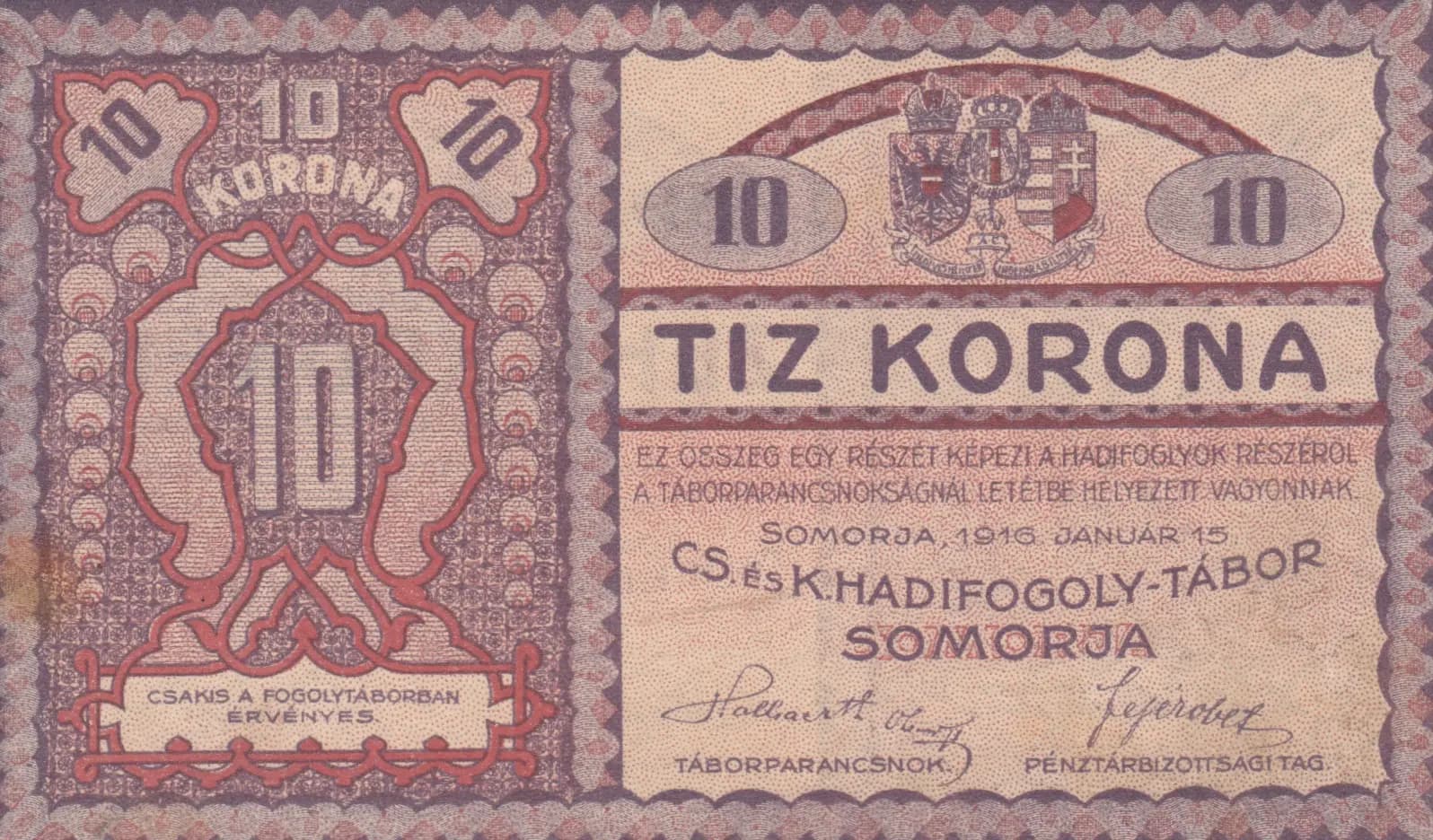
This is a 10 Kronen banknote issued by the Kriegsgefangenenlager (Prisoner of War Camp) Somorja on January 15, 1916, during Austria-Hungary's World War I internment operations. The note features bilingual (German and Hungarian) inscriptions reflecting the dual-language administration of the Austro-Hungarian Empire, with ornate red and brown decorative borders framing imperial heraldic symbols on both sides. Despite visible wear consistent with age and circulation within the camp, the note remains in UNC condition with legible inscriptions, making it a notable example of wartime camp currency with significant historical and numismatic interest.
Uncommon. Kriegsgefangenenlager (prisoner of war camp) currency represents a specialized category of emergency wartime scrip with limited original circulation, as these notes were issued only within specific camps and for a circumscribed population. The Somorja camp operated throughout WWI but closed after 1918, and surviving examples are scarce due to the temporary nature of the currency and destruction of many documents post-war. The unlistedness in Pick catalog (P-unlisted) suggests this particular denomination and issuer combination lacks comprehensive cataloging, which typically indicates limited collector awareness and moderate market availability. UNC condition examples are particularly scarce, as most surviving specimens show heavy wear from camp circulation.
Somorja (present-day Šomorja, Slovakia) operated as a major Austro-Hungarian prisoner of war camp during World War I, housing captured Allied soldiers. Camp currency like this note was essential for internal camp commerce, allowing prisoners to purchase goods from the canteen while maintaining secure accounting of their funds through the camp command. The dual German-Hungarian inscriptions and K.u.K (Kaiserlich und Königlich/Imperial and Royal) designation reflect the bicephalous structure of the Austro-Hungarian Empire and its administrative complexity during the war.
The banknote displays a symmetrical layout with ornamental borders in red and brown on both sides, containing the denomination '10' in each upper and lower corner. The left portion of each side features elaborate scrollwork and decorative flourishes characteristic of early 20th-century printing design. The central right section presents heraldic imagery: the double-headed imperial coat of arms of Austria-Hungary, featuring crowns above each head and quartered shields representing the constituent lands of the empire. The heraldic crest includes a crown and ornate shield division typical of K.u.K official documentation. The bilingual text (German on the obverse, Hungarian on the reverse) reflects the empire's dual administrative structure. No individual portraits appear on the note; instead, the heraldic symbols serve as the primary anti-counterfeiting and authenticating device.
FRONT SIDE (German): 'ZEHN KRONEN' (Ten Crowns) / 'DIESER BETRAG IST EIN ANTEIL DES BEIM LAGERKOMMANDO ERLIIGENDEN GUTHABENS DER KRIEGSGEFANGENEN' (This amount is a portion of the credit held by the prisoner of war camp command) / 'K.u.K KRIEGSGEFANGENENLAGER SOMORJA' (K.u.K Prisoner of War Camp Somorja) / 'SOMORJA 15 JÄNNER 1916' (Somorja 15 January 1916) / 'LAGERKOMMANDANT' (Camp Commandant) / 'KASSAKOMMISSIONSMITGLIED' (Cash Commission Member) / Serial marking: '0526' / 'DD' (designation abbreviation). BACK SIDE (Hungarian): 'TIZ KORONA' (Ten Crowns) / 'EZ ÖSSZEG EGY RÉSZÉT KÉPEZI A HADIFOGLYOK RÉSZÉRŐL A TÁBOR PARANCSNOKSÁGNÁL HELYEZETT VAGYONÁNAK' (This amount is a portion of the prisoners' funds held at the camp command) / 'CS. és K. HADIFOGOLY-TABOR SOMORJA' (Imperial and Royal Prisoner of War Camp Somorja) / 'SOMORJA, 1916 JANUAR 15' (Somorja, January 15, 1916) / 'TABORPARANCSNOK' (Camp Commandant) / 'PENZTARBIZOTTSAGI TAG' (Cash Commission Member) / 'CSAK A FOGOLYTABORBAN ÉRVÉNYES' (Valid only in the prisoner of war camp).
The note exhibits characteristics of letterpress printing combined with multicolor lithography, evidenced by the precise fine-line work in decorative borders, the sharp registration of text elements, and the distinct color separation between red, brown, tan, and cream inks. The intricate ornamental patterns and heraldic details suggest skilled engraving work typical of official Austro-Hungarian security printing. The visible aging, foxing, and yellowing in the observed condition are consistent with period-appropriate paper stock and inks. The specific printer for Somorja camp notes is not documented in standard Pick catalogs; these were likely produced by a regional Austro-Hungarian government printing facility or military administrative printer.
The observed serial number '0526' and the signature designations 'DD' (likely referencing Lagerkommandant and Kassakommissionsmitglied names) may indicate a specific print variety. The note is dated '15 JÄNNER 1916' (January 15, 1916) on both sides, suggesting this was an early issue from the camp's operation. Bilingual editions (German/Hungarian) exist; the front shows German language prominence while the reverse shows Hungarian language prominence, which may represent different printings or editions. The 'K.u.K' designation and location 'SOMORJA' appear to be consistent across known examples, but variations in signature blocks and serial number ranges may exist among collector examples.