10 pengö 1936
Market Prices
112 salesAbout This Note
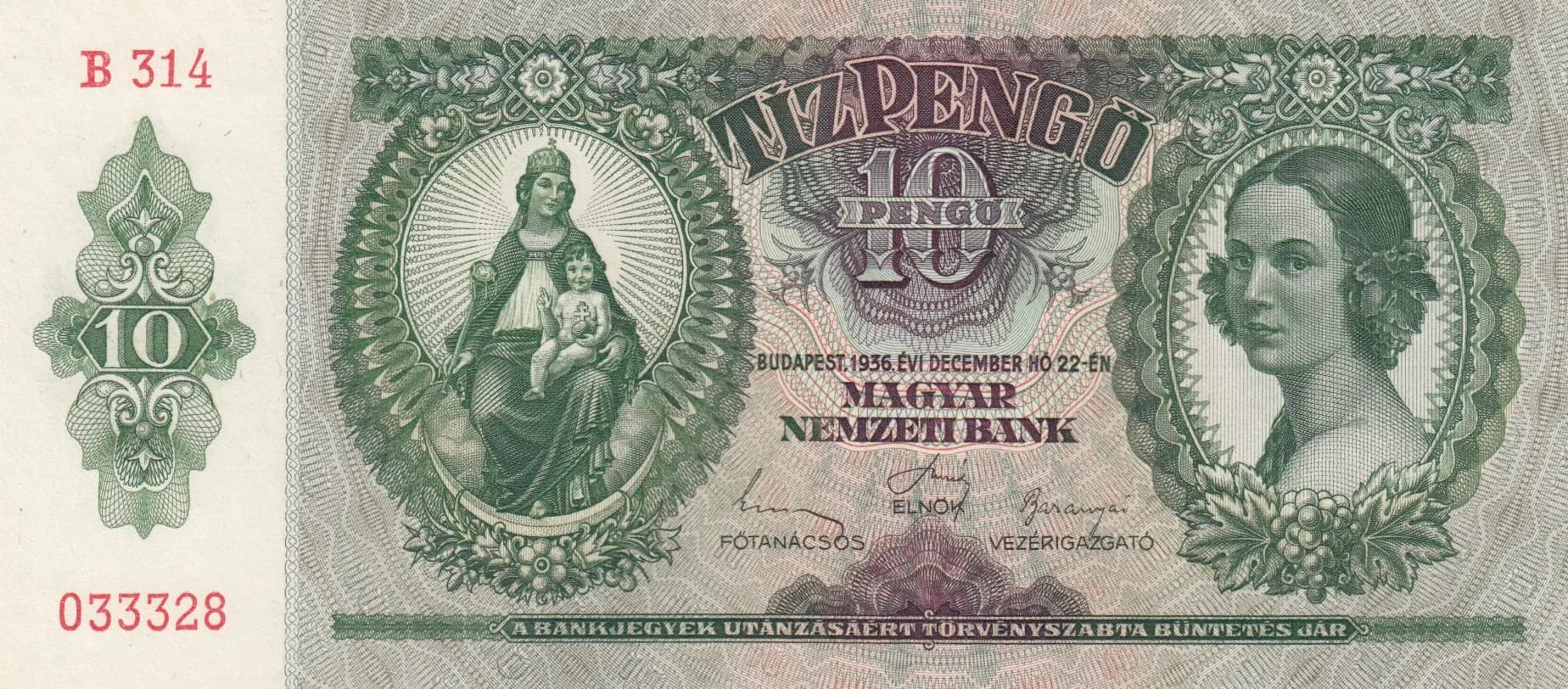
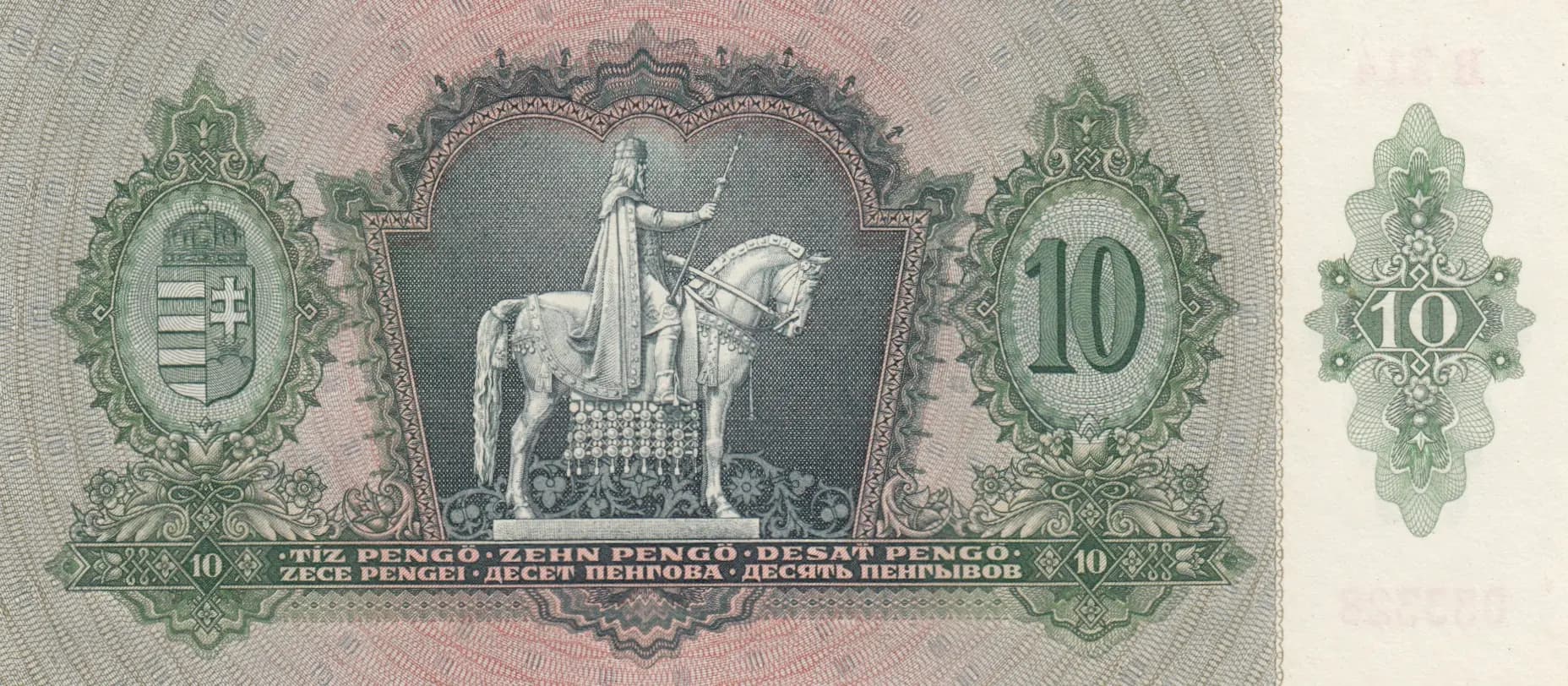
This is an exceptionally well-preserved Hungarian 10 pengö banknote from 1936, graded AU (About Uncirculated), issued by Magyar Nemzeti Bank on December 22, 1936. The note displays crisp, clean appearance with vibrant green and pink/mauve coloring throughout, featuring the iconic Patrona Hungariae (Madonna and Child) vignette on the obverse and a classical equestrian figure representing St. Stephen on the reverse. This is a regular issue without asterisk designation, representing a significant piece of Hungarian interwar currency.
Common. This is a regular-issue note from a substantial print run in 1936. eBay market data shows consistent sales across all condition grades, with VF examples regularly selling for $2-7 USD and even AU/UNC specimens typically fetching $20-50. The denomination 10 pengö was heavily circulated during the period, and many examples survive. The lack of asterisk (*) designation indicates this is from the regular Magyar Nemzeti Bank issue, not from the scarce World War II-era Szálasi government overprints (which would be marked as P-113). No evidence of scarcity in this grade.
This note was issued during a pivotal period in Hungarian history, just four years before the outbreak of World War II. The Patrona Hungariae imagery—the Madonna and Child—reflects Hungary's deep Catholic heritage and historical role as a Christian kingdom, symbolizing divine protection over the nation. The reverse depicts an equestrian statue of St. Stephen, Hungary's first king and patron saint, reinforcing national identity and continuity with the Hungarian crown during a period of significant political and economic uncertainty in the 1930s.
The obverse features a prominent portrait of a woman in profile facing left on the right side of the note, alongside the central allegorical vignette of Patrona Hungariae—the Madonna and Child—depicted in classical religious iconographic style within an elaborate oval frame with flourishing border designs. The left side displays ornate heraldic emblems and the Hungarian coat of arms. The reverse showcases a classical equestrian statue of St. Stephen (Patrona Hungariae's male counterpart in Hungarian national symbolism), depicted as a woman on horseback riding to the right and holding a staff or scepter—a romanticized allegorical representation rather than a literal historical portrait. Both sides are surrounded by intricate decorative borders, oval medallions with heraldic designs, and crown motifs. The color scheme emphasizes green with pink/mauve accents throughout, creating a distinctive and memorable aesthetic.
FRONT: 'MAGYAR NEMZETI BANK' (Hungarian National Bank) | 'BUDAPEST, 1936.EVI DECEMBER HÓ 22-EN' (Budapest, December 22, 1936) | 'TÍZENPENGO' (Ten pengö) | 'ELNOÖK' (President) | 'FOTANÁCSOS' (Privy Councillor) | 'VEZÉRIGAZGATÓ' (General Manager) | 'A BANKJEGYEK UTÁNZÁSÁÉRT TÖRVÉNYSZABTA BÜNTETÉS JÁR' (Counterfeiting banknotes is punishable by law) | Serial designation 'B 314 033328'. BACK: '10 PENGÖ TÍZENPENGO DESZ.PENGÖ DESAZTI PENGÖ' (10 pengö / Ten pengö) | 'ZECE PENGEI DECET PENGOVA ДЕСЯТЬ ПЕНГЫВОВ' (Ten pengö in Romanian and Russian). The multi-language denominations reflect Hungary's multi-ethnic population and regional linguistic diversity.
This note was produced using intaglio engraving (line engraving), the standard security printing method for Hungarian banknotes of this era. The visual analysis confirms fine line engraving patterns, intricate cross-hatching, detailed border work, and complex hatching patterns characteristic of intaglio production. The security features include ornamental design patterns with fine detail work that would be difficult to replicate without specialized equipment. Magyar Nemzeti Bank contracted with established European security printers for production; notes from this period typically bear the marks of firms such as the Hungarian State Printing Office or international security printers.
This note exhibits the standard 1936 regular issue without asterisk prefix, indicating it was issued by Magyar Nemzeti Bank rather than the later Szálasi government during the 1944-1945 period. The serial number 'B 314 033328' uses the block letter 'B' prefix without asterisk designation. The date of issue is confirmed as December 22, 1936, matching the Budapest printing date visible on the obverse. The visual characteristics (green coloring, Madonna and Child vignette, equestrian St. Stephen reverse) are consistent with the standard P-100 type throughout the 1936-1944 circulation period before reissue overprints.