20 kronen 1916
About This Note
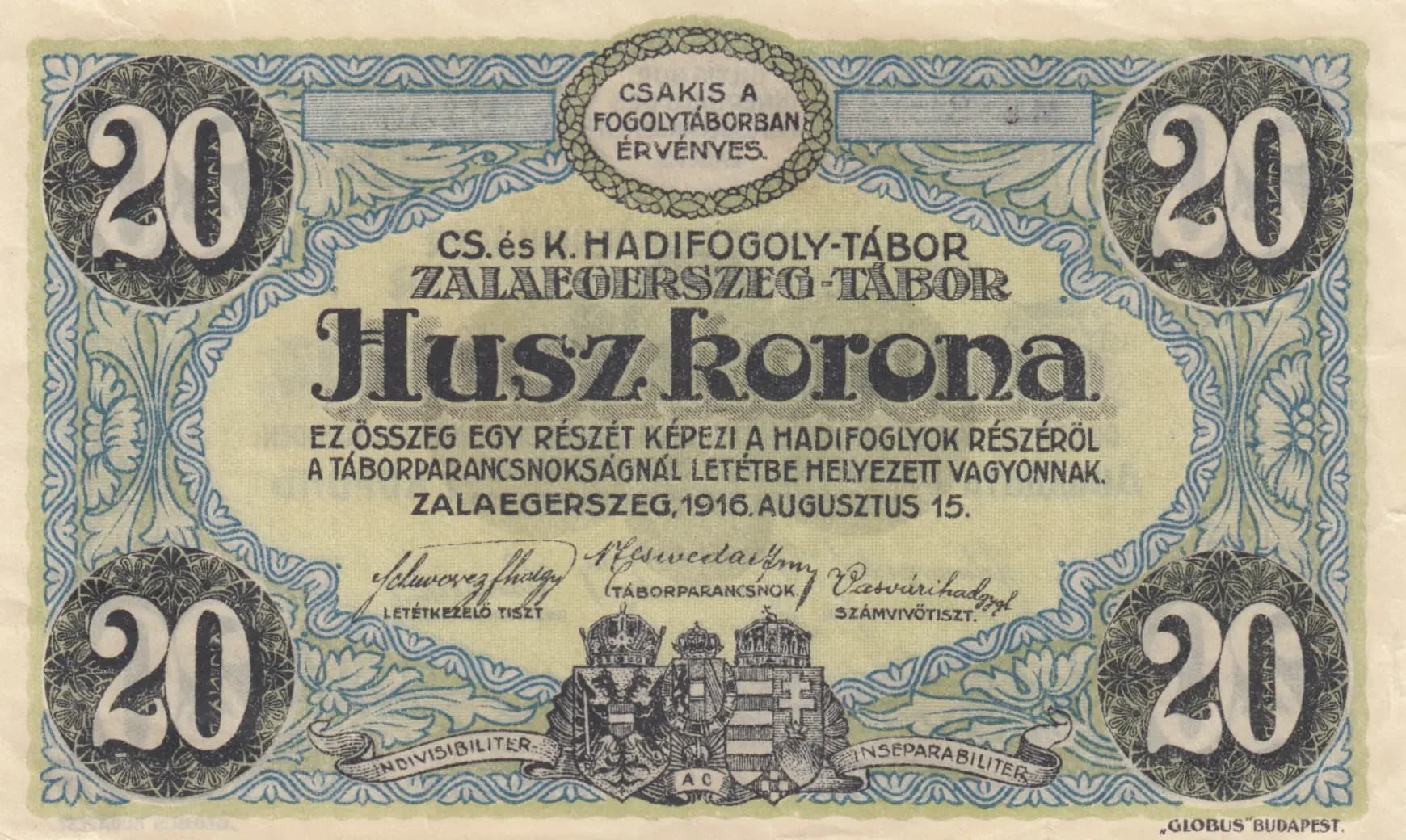
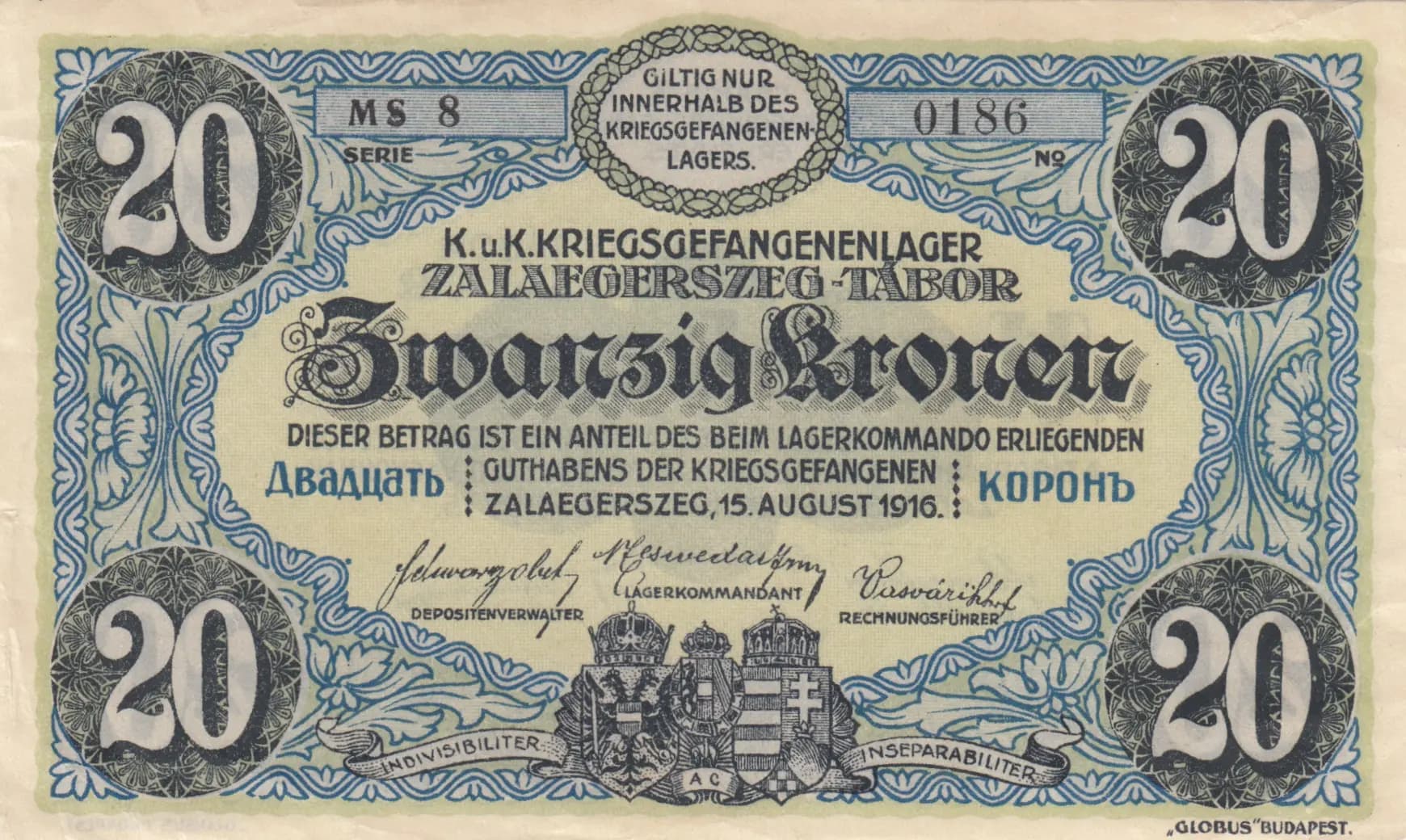
This is a 20 kronen prisoner of war camp currency note issued by the Austro-Hungarian military at Zalaegerszeg camp on August 15, 1916. The note displays crisp cream-colored paper with elegant blue and black ornamental borders featuring floral and geometric patterns, along with a prominent heraldic coat of arms at the center bottom of both sides. In VF condition, the note shows minimal wear with clearly legible inscriptions in Hungarian, German, and Russian, making it a well-preserved example of this specialized military scrip currency.
scarce
This note represents a unique category of Austro-Hungarian currency used specifically within prisoner of war camps during World War I. The multilingual inscriptions (Hungarian, German, Russian, and Latin phrases 'Indivisibiliter' and 'Inseparabiliter') reflect the diverse composition of captives held at Zalaegerszeg, including Russian prisoners. The note functioned as a deposit receipt for prisoner belongings held in trust by the camp command, serving both as currency within the camp and as documentation of held assets—a practice designed to maintain order and prevent disputes among the camp population.
This camp scrip note features a symmetrical design with no portraits or landmarks, instead emphasizing heraldic and administrative authority through its central coat of arms displaying multiple shields representing the Austro-Hungarian dual monarchy. The design employs ornamental circular frames in all four corners, each containing the denomination '20,' utilizing a classical aesthetic appropriate to official Austro-Hungarian financial documents. The heraldic coat of arms at the bottom center of both sides serves as the primary identifying symbol, conveying legitimacy and official sanction. The bilingual (and trilingual on reverse) inscription layout—with Hungarian on the front and German on the back, supplemented by Russian text on the reverse—reflects the practical necessity of communicating with a multinational prisoner population. The ornamental border consists of intricate blue linear and geometric patterns combined with black text elements on a cream-colored paper stock, creating a professional appearance suitable for a document representing held prisoner assets. The presence of three signature lines for different camp officials (deposit custodian, camp commander, and accounting officer) emphasizes the formal accountability structure governing the note's issue.
FRONT SIDE: '20' (denomination in numeric form); 'SZAKIS A FOGOLYTÁBORBAN ÉRVENYES' (Valid in the prisoner of war camp); 'CS.és K. HADIFOGOLY-TÁBOR ZALAEGERSZEG-TÁBOR' (Austro-Hungarian Military Prisoner of War Camp Zalaegerszeg Camp); 'Husz Korona' (Twenty Crown); 'EZ ÖSSZEG EGY RÉSZÉT KÉPEZI A HADIFOGLYOK RÉSZÉRŐL A TÁBORPARANCSNOKSÁGNÁL LETÉTBE HELYEZETT VAGYONNAK' (This amount is part of the property deposited by prisoners of war with the camp command); 'ZALAEGERSZEG,1916.AUGUSZTUS 15' (Zalaegerszeg, August 15, 1916); Official titles: 'LETÉTKEZELŐ TISZTI' (Deposit custodian officer), 'TÁBORPARANCSNOK' (Camp commander), 'SZÁMVIVŐTISZT' (Accounting officer); 'INDIVISIBILITER' (Indivisibly - Latin); 'INSEPARABILITER' (Inseparably - Latin); 'GLOBUS BUDAPEST' (printer). BACK SIDE: '20' (denomination); 'MS 8' and '0186' (series and sequential number designations); 'GÜLTIG NUR INNERHALB DES KRIEGSGEFANGENENLAGERS' (Valid only within the prisoner of war camp); 'K.u.K.KRIEGSGEFANGENENLAGER ZALAEGERSZEG-TÁBOR' (Austro-Hungarian Prisoner of War Camp Zalaegerszeg Camp); 'Swarzig Kronen' (Twenty Crown in German); 'DIESER BETRAG IST EIN ANTEIL DES BEIM LAGERKOMMANDO ERLIEGENDEN GUTHABENS DER KRIEGSGEFANGENEN' (This amount is a share of the balance held by the camp command on behalf of the prisoners of war); 'ZALAEGERSZEG, 15.AUGUST 1916' (Zalaegerszeg, August 15, 1916); Russian text: 'Авадцать КОРОН' (Twenty Crown); German official titles: 'DEPOSITENVERWALTER' (Deposit manager), 'LAGERKOMMANDANT' (Camp commander), 'RECHNUNGSFÜHRER' (Accounting officer); Latin phrases repeated; 'GLOBUS BUDAPEST' (printer).
The note was produced using letterpress printing with color separation, as evidenced by the crisp, well-defined ornamental borders in blue and the sharp black text characteristic of early 20th-century letterpress work. The printer 'GLOBUS BUDAPEST' was a respected Hungarian printing house capable of security printing. The consistent color application across both sides and the precision of the fine ornamental details indicate careful registration during the multi-pass printing process. The decorative borders and framing elements show the characteristic sharp edges and consistent ink density typical of mechanical letterpress printing rather than later photographic processes.
This specific note is identified by the series designation 'MS 8' with sequential number '0186,' representing the eighth series of Zalaegerszeg camp currency. The date of August 15, 1916 is fixed for this issue. Variations may exist in other series numbers (MS 1 through MS 7 or potentially higher), though catalog data is limited. The multilingual reverse (German primary with Russian supplementary) may represent a specific printing intended for camps with significant Russian prisoner populations. Signature varieties may exist depending on which officers signed individual notes, as the three signature lines suggest potential for variant combinations of camp officials.