100 pengö 1945
Market Prices
5 salesAbout This Note
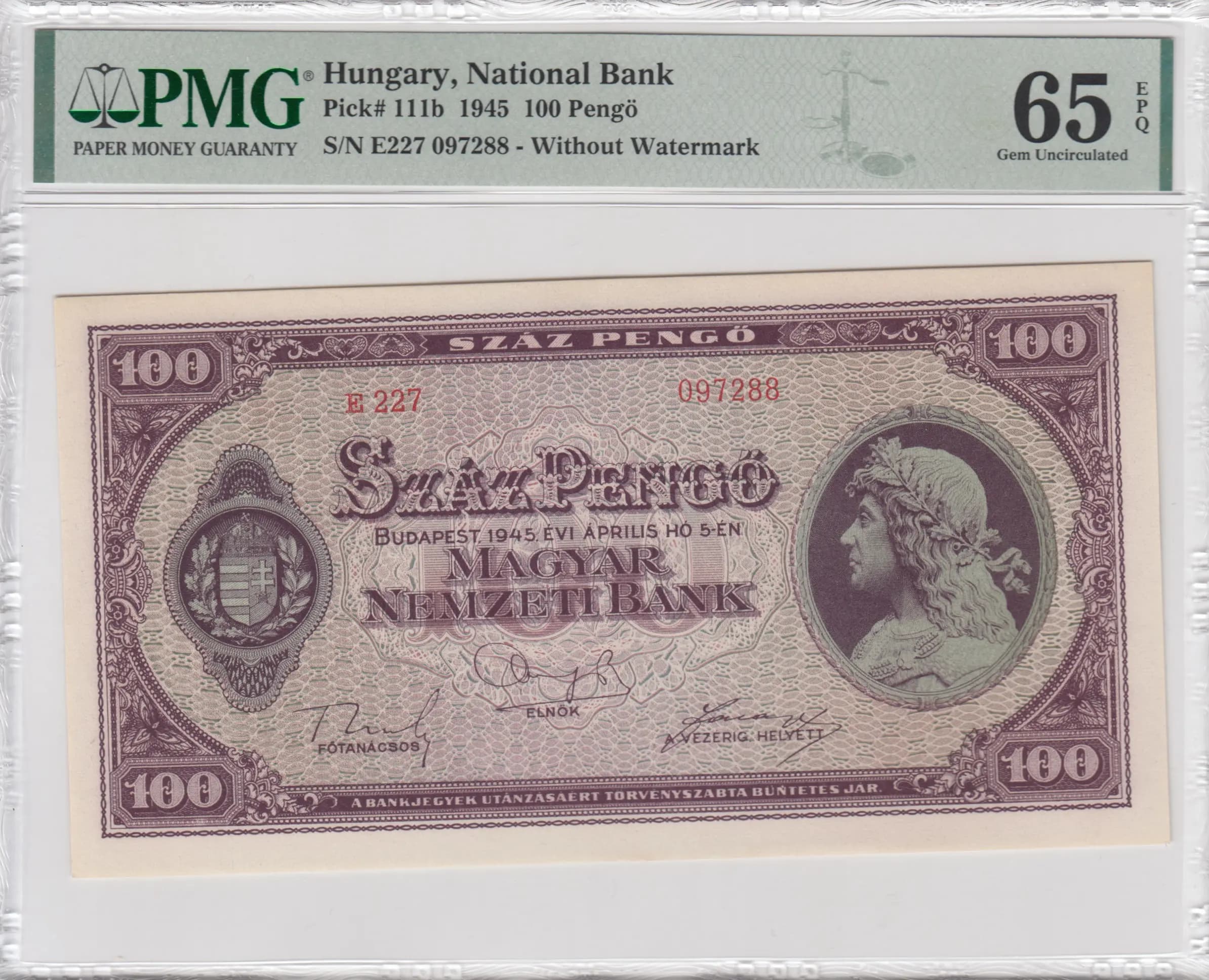
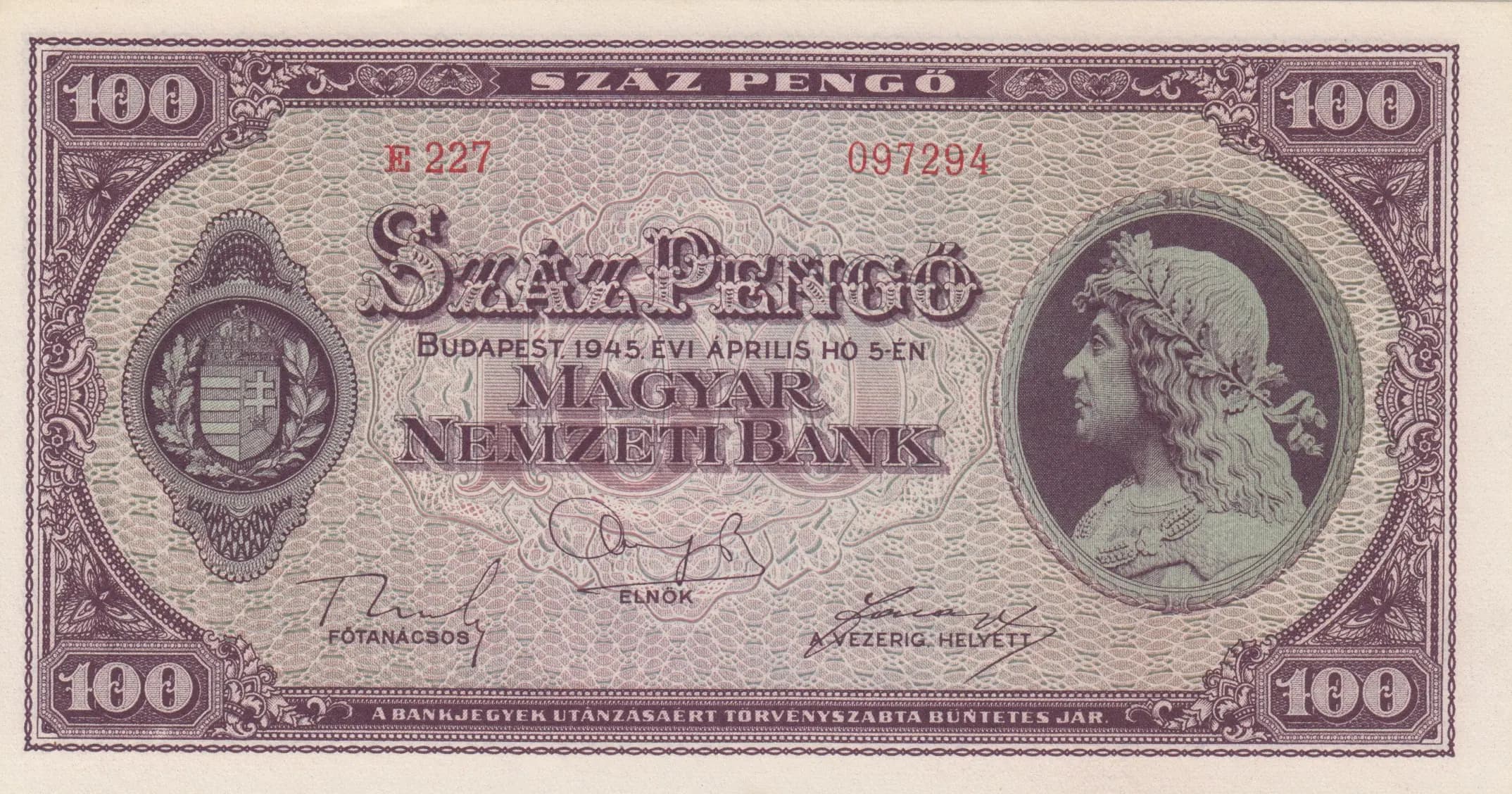
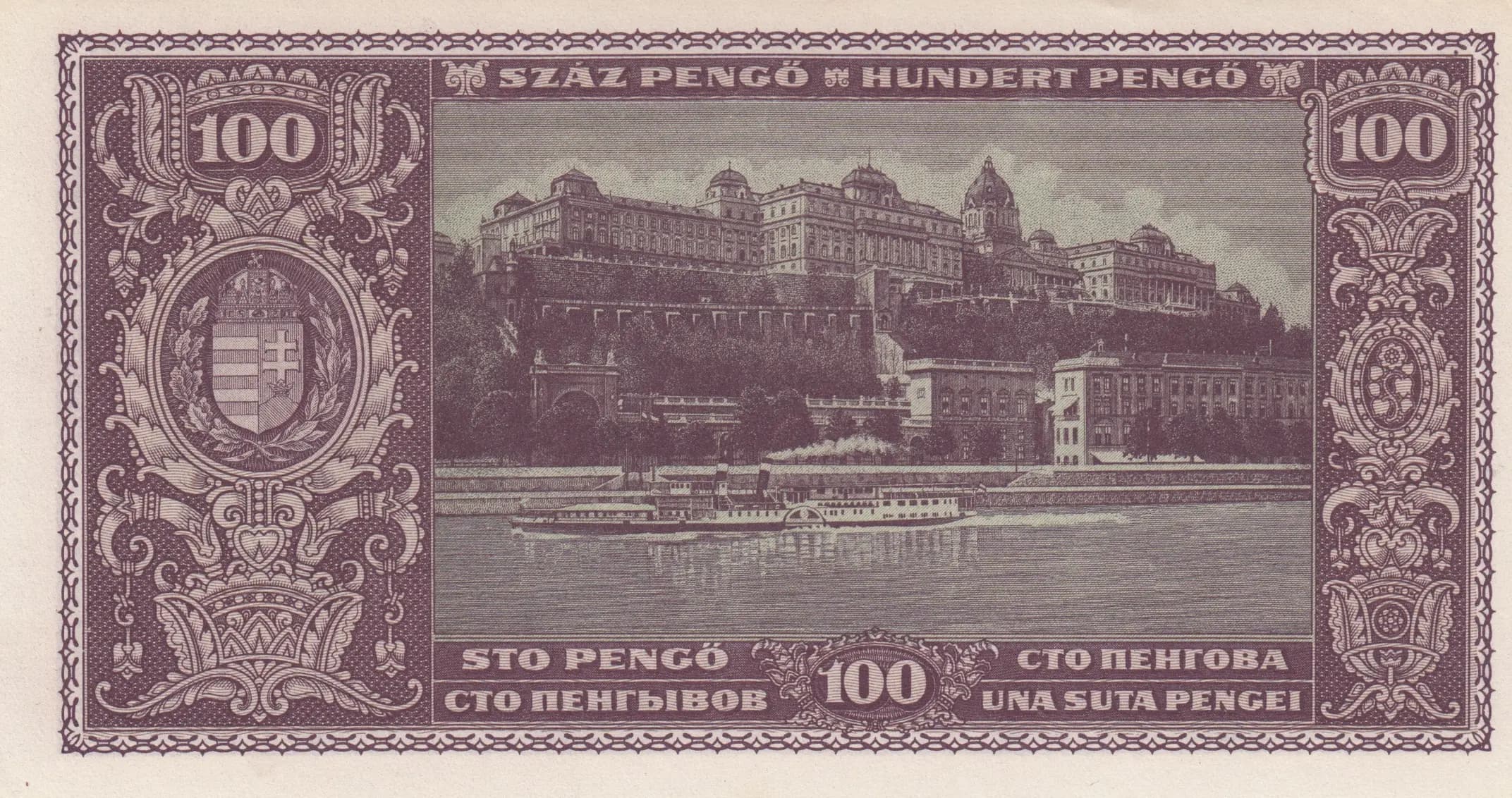
This is a pristine example of Hungary's 100 Pengö note from April 5, 1945, issued by the Magyar Nemzeti Bank in the final months of World War II. The note exhibits AU condition with sharp, clear printing throughout, no visible wear, creases, or foxing, and displays the characteristic purple and mauve color scheme with ornate decorative borders. The obverse features a portrait of King Matthias I in profile within an oval frame, while the reverse showcases Budapest's iconic Royal Palace complex along the Danube with a period steamboat, making this both a historically significant and visually striking example of late-wartime Hungarian currency.
Common. The 100 Pengö P-111 is a regularly issued denomination from the final year of the Hungarian pengö era. Market data from realbanknotes.com shows eBay transaction prices ranging from $1.35 to $3.25 for various grades (F to EF) between 2012-2013, with 2016 catalog values of $1-$8 depending on condition. The note was produced in substantial quantities sufficient to meet civilian circulation needs, and many examples survive today. While the 1945 date carries historical significance as the note of Hungary's final days before Soviet occupation, the denomination and issuing authority were not short-lived or recall-limited. The AU condition shown here is desirable but does not significantly elevate the rarity assessment, as examples in similar condition are regularly available to collectors at modest prices.
This note was issued on April 5, 1945, mere days before Germany's surrender and the Soviet occupation of Hungary, representing one of the final regular-issue banknotes from the Hungarian National Bank during the interwar and WWII periods. The imagery deliberately references Hungary's royal and architectural heritage—King Matthias I (1458-1490) was one of Hungary's greatest Renaissance monarchs, while the Royal Palace of Budapest represents the seat of Hungarian power and dignity. The multilingual denominations on the reverse (Hungarian, German, Czech, Russian, and Romanian) reflect the ethnically diverse and contested territories of the Austro-Hungarian sphere during this turbulent era.
The obverse features a left-facing profile portrait of King Matthias I (Mátyás Hunyadi), the legendary 15th-century Renaissance monarch who expanded Hungarian power and cultural influence. The portrait is rendered in green and sepia tones within an ornate oval frame, positioned on the right side of the note. The left side displays the Hungarian coat of arms—a shield design with heraldic elements—contained within an ornate oval medallion with decorative scrollwork. The reverse depicts Budapest's Royal Palace (Budai Vár) situated on the elevated Buda hills overlooking the Danube River, rendered as a detailed architectural scene with multiple domed and spired buildings, fortified walls, and ramparts. A period steamboat is depicted on the river below, adding temporal context to the scene. Both sides are heavily ornamented with intricate floral and scrollwork border patterns in purple and mauve tones. The denomination '100' appears in all four corners of the obverse and both upper corners of the reverse.
FRONT: 'SZÁZ PENGŐ' (One Hundred Pengö) / 'BUDAPEST 1945 ÉVI ÁPRILIS HÓ 5-ÉN' (Budapest, April 5th, 1945) / 'MAGYAR NEMZETI BANK' (Hungarian National Bank) / 'A BANKNOTE UTÁNZÁSÁÉRT FENYEGETTSÉG SZABTÁ BÜNTETIK' (Counterfeiting this banknote is punishable by law) / 'FŐTANÁCSOS' (Chief Advisor) / 'ELNÖK' (President) / 'VEZETC. HELYETT' (Deputy Director [abbreviated]) / Series designation 'E 227' and serial number '097294'. BACK: 'SZÁZ PENGŐ' (Hungarian: One Hundred Pengö) / 'HUNDERT PENGŐ' (German: One Hundred Pengö) / 'STO PENGÓ' (Czech: One Hundred Pengö) / 'СТО ПЕНГЫВОВ' (Russian: One Hundred Pengö) / 'UNA SUTA PENGEI' (Romanian: One Hundred Pengö).
This note was produced using intaglio (engraved line) printing, a security-conscious technique evident from the fine-line engraved background patterns, the sharp detail in the portrait and architectural rendering, and the complex decorative border work. The intricate multi-layered design with fine hairline details and the precise registration of the purple and mauve color separations are characteristic of high-security banknote intaglio production. The Hungarian National Bank commissioned work from established security printers of the era; this specific note was likely produced by Pénzjegynyomda (Hungarian Banknote Printing Works) or a contracted European security printer capable of producing such refined work during wartime constraints.
The observed specimen appears to be P-111b (the primary regular issue variety) based on the design characteristics. The PMG population report indicates two cataloged variants (P-111b and P-111s), with P-111s likely representing a specimen note with specimen overprints or perforations. The series designation 'E 227' and serial number '097294' are consistent with the standard circulation variety. No overprints, perforations, or other modifications are visible on this example. This is a straightforward example of the regular circulation issue P-111b.