20 korona 1916
About This Note
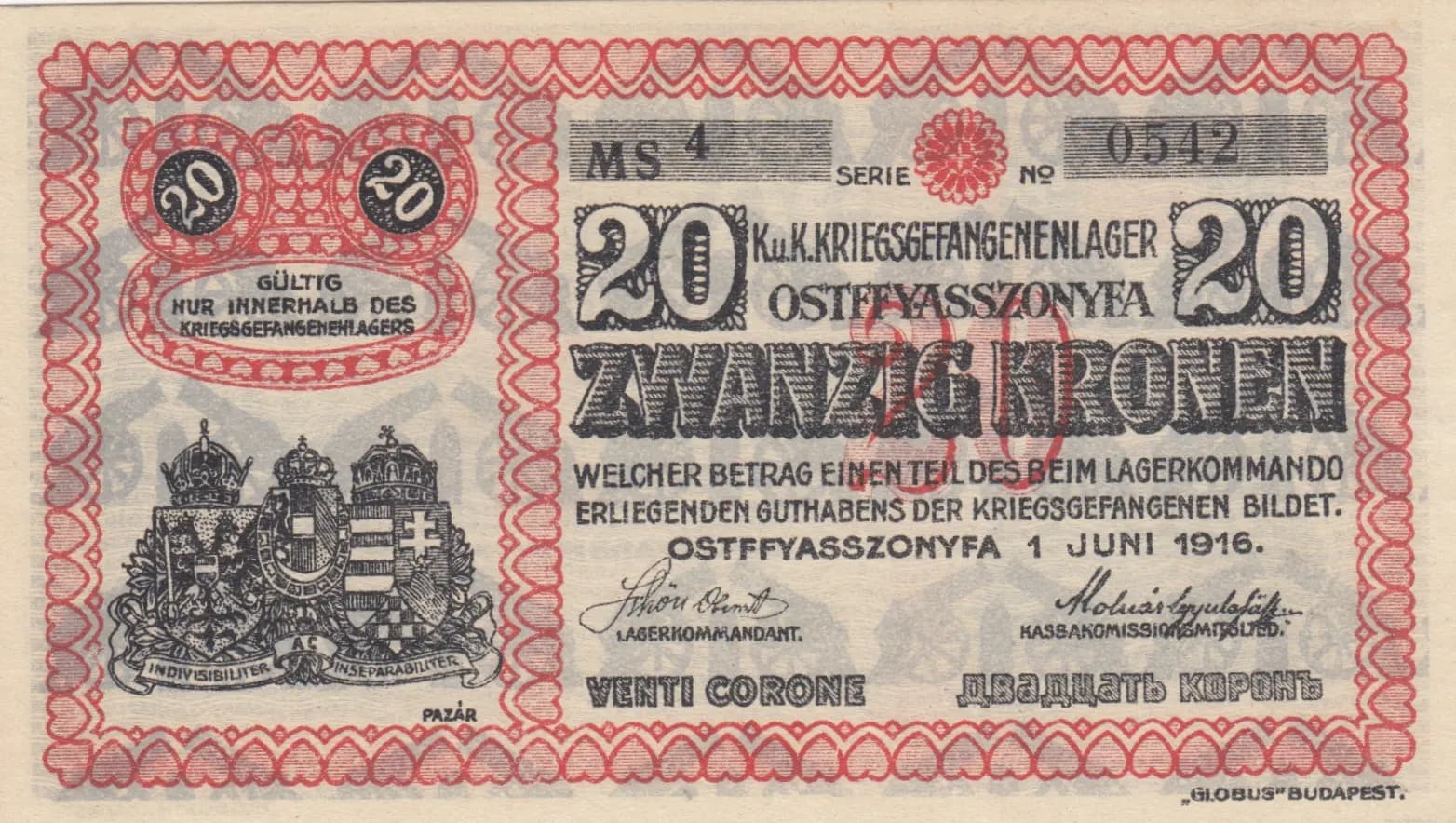
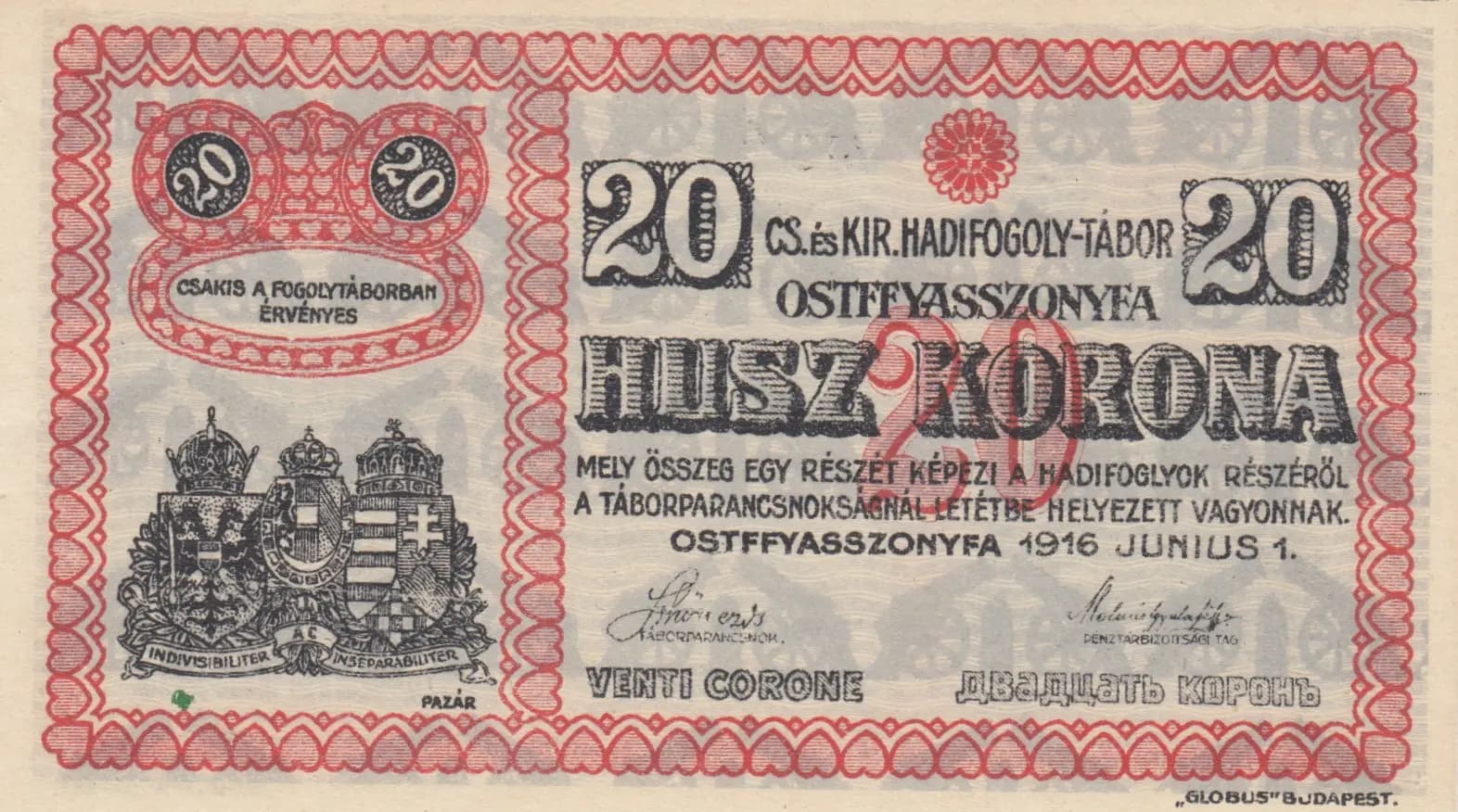
This is a 20 korona prisoner-of-war camp note issued by the Kir. Hadifogoly Tabor (Royal Military Prisoner Camp) at Ostffyasszonyfa in 1916, representing a fascinating numismatic artifact from the Austro-Hungarian Empire during World War I. The note features an ornate design with red and white scalloped heart borders, a double-headed eagle coat of arms with three crowns, and shield emblems, printed in red, black, and cream. In UNC condition, this example shows only minor aging with visible creasing and foxing, preserving the sharp detail of the complex engraving and multilingual inscriptions (German, Hungarian, Italian, and Russian).
Common. While these prisoner-of-war camp notes are historically significant and represent an unusual category of Austro-Hungarian financial instruments, they were issued in substantial quantities across multiple camps and denominations during 1916-1918. The Ostffyasszonyfa camp issued various denominations including 10, 20, and 50 korona notes in multiple series. The Pick unlisted status reflects their non-standard classification rather than extreme rarity; such notes are regularly encountered by specialist collectors of Austro-Hungarian and WWI-era currency. The UNC grade adds modest premium value but does not change the fundamental commonality of this series.
This note was issued as a form of internal currency specifically for prisoners of war held at the Ostffyasszonyfa camp, where detainees' earnings and allowances were managed by the camp command rather than paid in standard currency. The multilingual inscriptions—German, Hungarian, Italian, and Russian—reflect the diverse nationalities of prisoners held in Austro-Hungarian camps during the First World War. The deliberate restriction stated on both sides ('Valid only within the prisoner of war camp') ensured these notes functioned as a closed-loop ledger system, with all amounts representing portions of prisoners' balances held in custody by camp authorities.
This camp currency note features a symmetrical layout on both obverse and reverse with identical decorative elements. The central circular design contains two shield emblems flanking the denomination '20' in the upper portion, with an elaborate heraldic coat of arms below featuring the double-headed eagle of the Austro-Hungarian Empire adorned with three crowns—representing the Hungarian crown, the Bohemian crown, and the crown of other lands. A distinctive red and white scalloped heart-shaped border frames the entire design, creating an ornate frame typical of Austro-Hungarian official documents. The typography alternates between German and Hungarian on the respective sides, with supplementary text in Italian and Russian, reflecting the multinational composition of the prisoner population. Serial designation 'MS 4' with number '0542' appears on the front. The printer's mark 'GLOBUS BUDAPEST' identifies the production source. No portraits are featured, as this was an institutional financial instrument rather than a commemorative or circulating currency note.
FRONT: '20' (denomination); 'GÜLTIG NUR INNERHALB DES KRIEGSGEFANGENENLAGERS' (Valid only within the prisoner of war camp); 'MS 4' (series designation); 'SERIE' (Series); '0542' (serial number); '20 Ku.K.KRIEGSGEFANGENENLAGER 20' (20 Austro-Hungarian prisoner of war camp 20); 'OSTFFYASSZONYFA' (camp location); 'ZWANZIGKRONEN' (Twenty crowns); 'WELCHER BETRAG EINEN TEIL DES BEIM LAGERKOMMANDO ERLIEGENDEN GUTHABENS DER KRIEGSGEFANGENEN BILDET' (Which amount forms part of the balance held by the camp command for the prisoners of war); 'OSTFFYASSZONYFA 1 JUNI 1916' (Ostffyasszonyfa June 1, 1916); 'LAGERKOMMANDANT' (Camp commandant); 'HASSAKOMMISSAR MITGLIED' (Hay commissar member); 'VENTI CORONE' (Twenty crowns in Italian); 'ДВАДЦАТЬ КОРОН' (Twenty crowns in Russian); 'PAZÁR' (Market); 'GLOBUS BUDAPEST' (printer); BACK: 'CSAK A FOGOLYTÁBORBAN ÉRVÉNYES' (Valid only in the prisoner of war camp); '20 Cs.s KIR.HADIFOGOLY-TABOR 20' (20 Royal Military Prisoner Camp 20); 'OSTFFYASSZONYFA' (camp location); 'HÚSZ KORONA' (Twenty crowns); 'MELY ÖSSZEG EGY RÉSZÉT KÉPEZI A HADIFOGLYEK RÉSZERŐL A TÁBORPARANCSNOKSÁGNÁL LEVÉTELBE HELYEZETT VAGYONNAK' (Which sum forms part of the assets of the prisoners of war held in custody by the camp command); 'OSTFFYASSZONYFA 1916 JÚLIUS 1' (Ostffyasszonyfa July 1, 1916); 'A TÁBORPARANCSNOK' (The camp commandant); 'FENT TÁBORBIZTOSÍ TAG' (Camp security officer); 'VENTI CORONE' (Twenty crowns in Italian); 'ДВАДЦАТЬ КОРОН' (Twenty crowns in Russian); 'PAZÁR' (Market); 'GLOBUS BUDAPEST' (printer).
Multicolor letterpress/relief printing using red and black inks on cream/white paper stock. The complexity of the heraldic engraving, ornate border work, and precise typography indicates production by skilled security printers—confirmed by the 'GLOBUS BUDAPEST' printer's mark visible on the note. The sharp impression and fine detail preservation in the UNC example demonstrates the high quality of the original plates and printing execution, typical of official Austro-Hungarian government financial documents from this period.
This example is identified as MS 4 series, number 0542, dated 1916 July 1 (verso). The front is dated June 1, 1916, while the back is dated July 1, 1916, suggesting these represent separate printings or authorization dates. Known varieties of Ostffyasszonyfa camp notes include different series designations (MS 1, MS 2, MS 3, MS 4 documented), various serial number ranges within each series, and the multilingual text layouts (German-primary on front, Hungarian-primary on back). The June/July date discrepancy between sides warrants documentation as a potential printing variety.