100 pengö 1945
Market Prices
32 salesAbout This Note
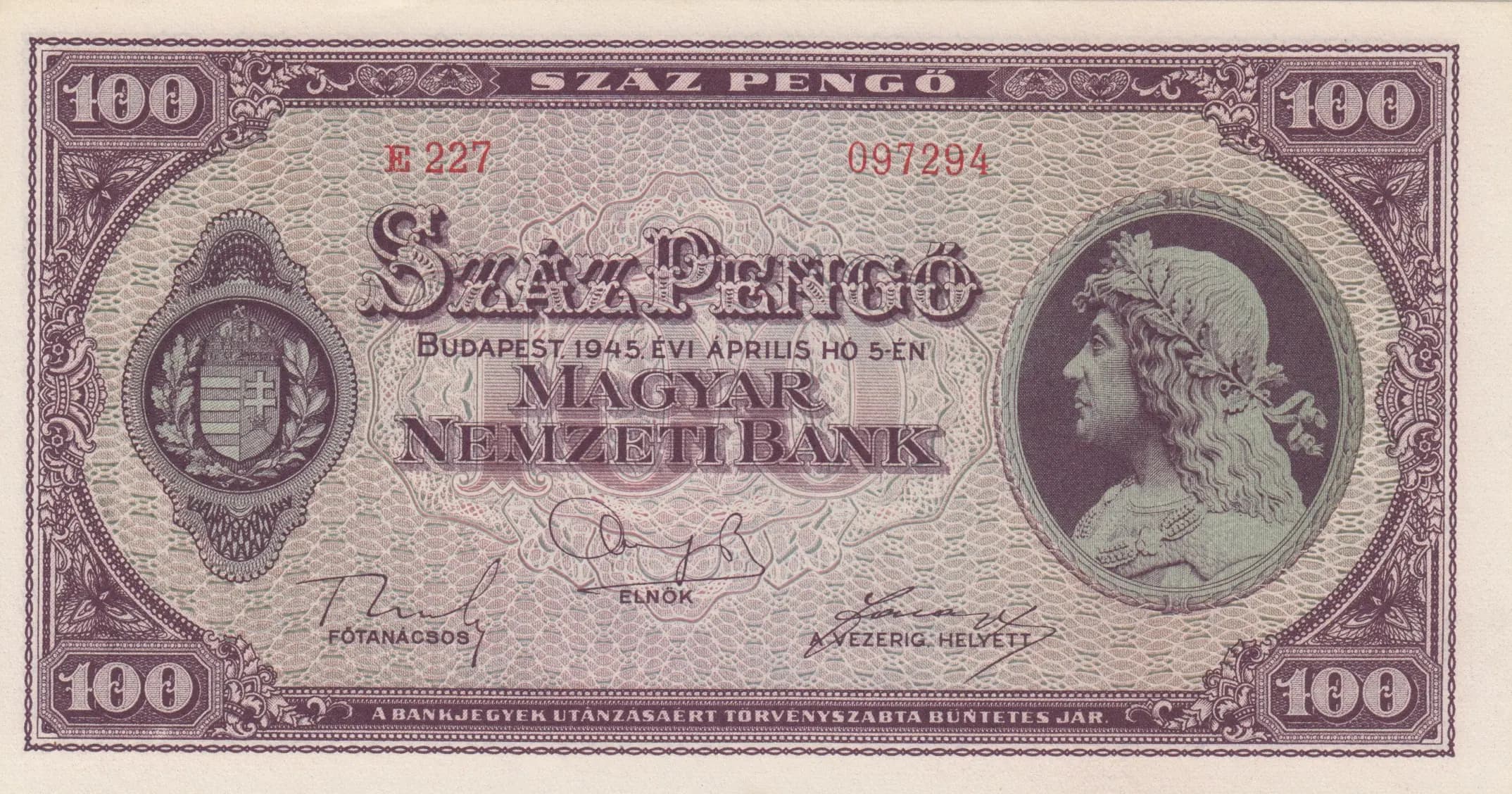
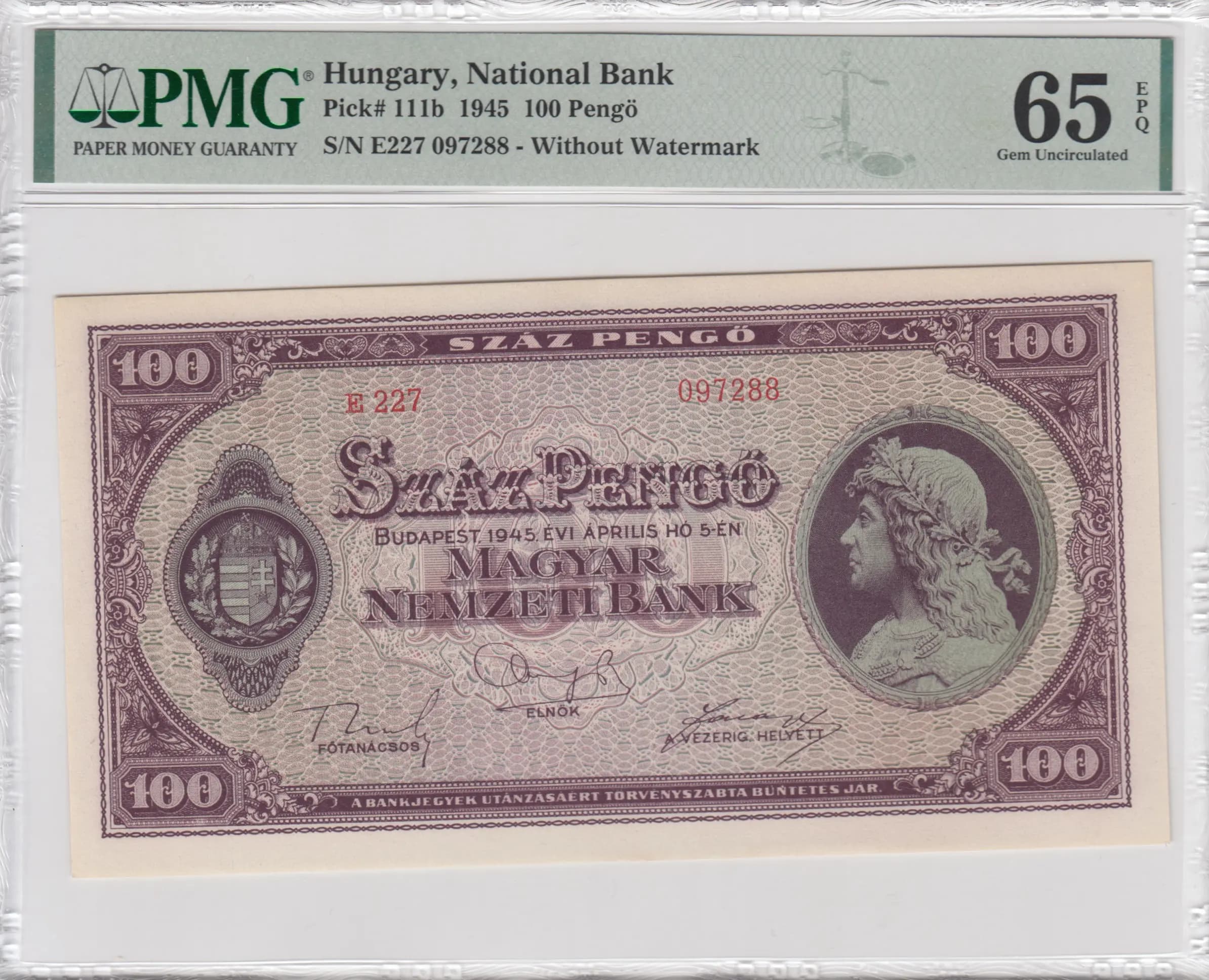
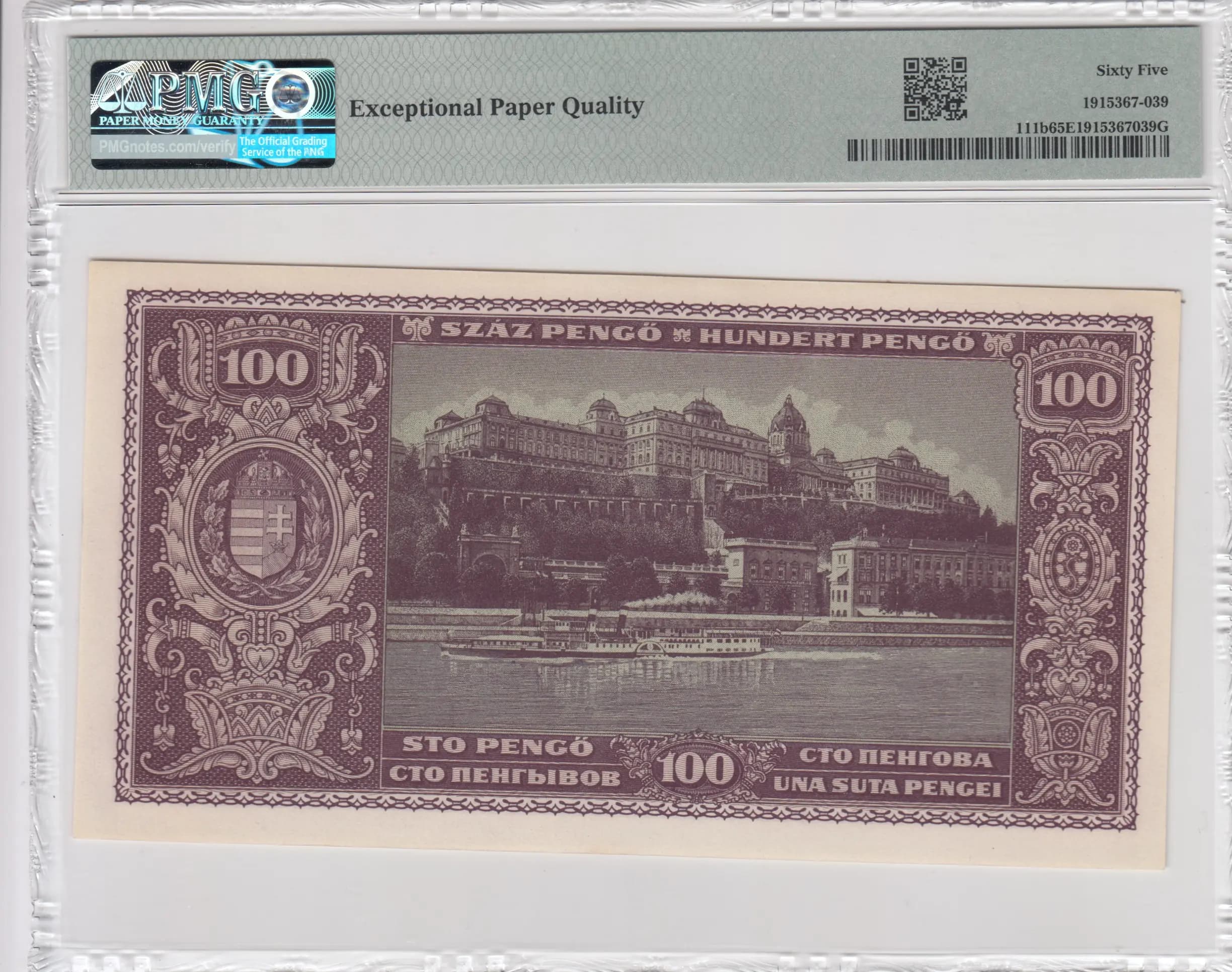
A gem uncirculated example of Hungary's 100 Pengö note from April 5, 1945, graded PMG 65 EPQ with exceptional paper quality. The note features an elegant purple and maroon color scheme with a classical profile portrait on the obverse and a striking engraving of Budapest's Royal Palace overlooking the Danube River on the reverse. This late-war Hungarian currency represents the final months of the Pengö's use before post-WWII monetary reforms, making it an historically significant piece of Central European numismatics.
Common. While this is a wartime-issued banknote from the final weeks of WWII in Europe, the 100 Pengö 1945 remains readily available to collectors in all grades. eBay market data shows consistent sales activity with PMG 65 examples selling in the $60-70 range and lower grades (F-VF) trading for under $10, indicating robust collector supply. Print runs for this denomination were substantial, and survival rates are good. The only significant rarity would be exceptional specimens graded PMG 66 or higher, but the PMG 65 grade observed here is a fairly common condition level for this actively traded note.
Issued by the Magyar Nemzeti Bank on April 5, 1945—just one month before Hungary's surrender in World War II—this banknote reflects the nation's wartime economy and the Hungarian state's attempt to maintain financial stability in its final weeks of Nazi occupation. The Royal Palace depicted on the reverse symbolized Hungarian sovereignty and institutional continuity, while the multilingual denominations (Hungarian, German, Russian, and Romanian) reflect the complex territorial and political circumstances of a Hungary contested by multiple regional powers. This note represents the Pengö currency at the very end of its circulation period, as post-war monetary reforms and Soviet occupation would lead to significant currency changes and hyperinflation within months.
The obverse features a classical profile portrait of King Matthias (Mátyás) I, the 15th-century Renaissance monarch of Hungary, rendered in profile facing right within an ornate oval frame. This choice of historical rather than contemporary leadership symbolized institutional continuity during wartime. The left side displays the ornate Hungarian coat of arms featuring the shield and heraldic wreath. The reverse depicts Budapest's Royal Palace (Buda Castle), the historic seat of Hungarian governance, positioned majestically on a hillside overlooking the Danube River, with a period steamboat visible on the water below—a romantic iconographic representation of Hungary's historical grandeur. Both sides employ elaborate decorative borders with floral and geometric Art Deco-influenced ornamentation, characteristic of 1940s Central European banknote design. The denomination appears in all four corners and is rendered in five languages reflecting the region's multilingual character.
FRONT: SZÁZ PENGŐ (One Hundred Pengö) | BUDAPEST, 1945. ÉVI ÁPRILIS HÓ 5-ÉN (Budapest, April 5, 1945) | MAGYAR NEMZETI BANK (Hungarian National Bank) | Serial designation: E 227 | Serial number: 097288 | ELNÖK (President) | FŐTANÁCSOS (Chief Advisor) | A VEZETIG: HELYETT (For the Leadership) | BACK: SZÁZ PENGŐ & HUNDERT PENGŐ (One Hundred Pengö in Hungarian and German) | STO PENGŐ (100 Pengö) | СТО ПЕНГИВОВ (One Hundred Pengö in Russian Cyrillic) | UNA SUTA PENGEI (One Hundred Pengö in Romanian)
Intaglio engraving on fine quality paper, utilizing the traditional high-security banknote printing method with finely detailed line work and cross-hatching visible in the portrait and landscape elements. The multiple color plates create the purple and maroon color scheme through careful registration of engraved dies. No watermark was employed on this issue, making the fine engraved detail and paper quality the primary security features. This represents typical Central European banknote production standards of the 1940s era.
This note is cataloged as Pick 111b, with a variant Pick 111s also recorded by PMG. The observed example displays the serial designation 'E 227' with serial number 097288, which represents a standard example of the regular issuance. The note shows no evidence of overprints, date varieties, or signature variants beyond normal production authorization marks (ELNÖK, FŐTANÁCSOS). The lack of watermark is consistent with the standard specification for this issue (P-111b).