50 pengö 1932
Market Prices
119 salesAbout This Note
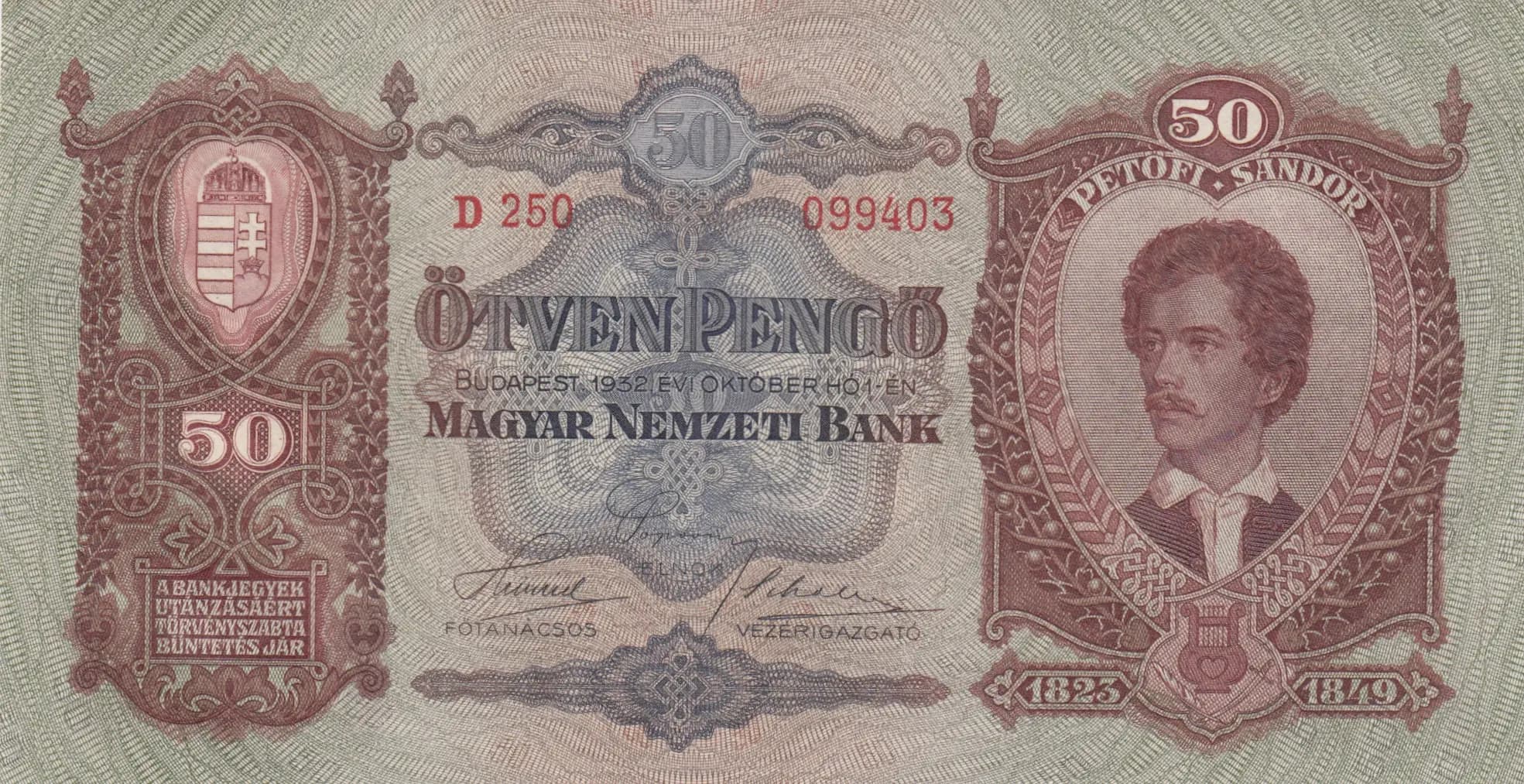
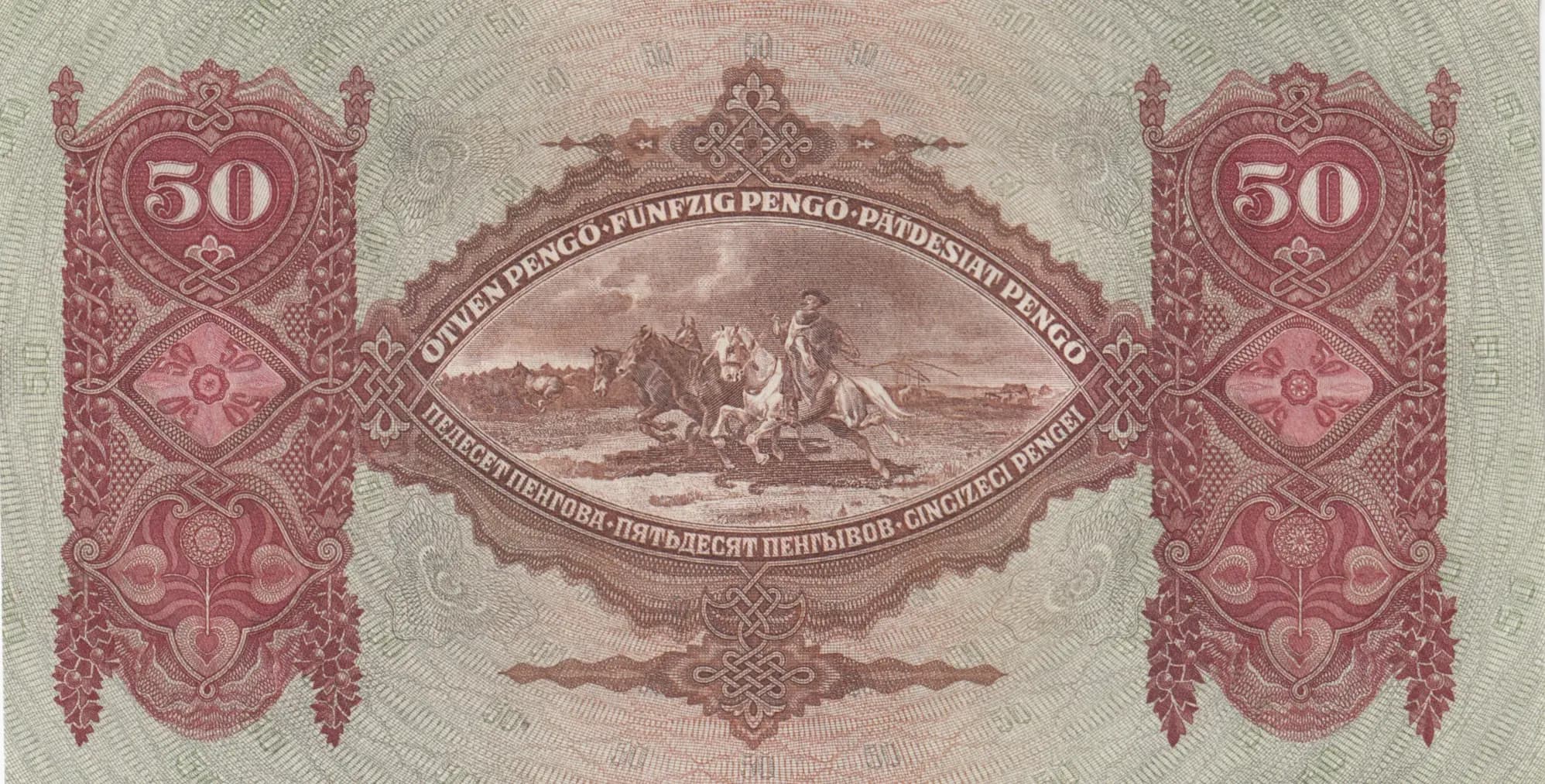
This is an AU-graded 50 Pengö from Hungary's 1932 issue, displaying pristine condition with crisp printing and no visible wear, creases, or damage. The note features an elegant design with burgundy and cream tones, showcasing Sándor Petőfi's portrait on the obverse and János Visky's iconic 'Horse Driving in Hortobágy' vignette on the reverse. As one of Hungary's classic interwar banknotes, this example represents quality printing from the Magyar Nemzeti Bank during a pivotal period of the Hungarian economy.
Common. eBay auction data shows consistent sales across all grades, with hundreds of documented sales from 2010 to 2026. Raw notes in circulated grades (VF, EF) regularly sell for $1-5, while ungraded UNC examples sell for $3-12. PMG-graded examples command premiums ($20-140 depending on grade), but the sheer volume of sales indicates this was a substantial print run. The denomination and years of circulation before modern collection practices began suggest very wide distribution.
Issued on October 2, 1932, this banknote reflects Hungary's economic conditions during the Great Depression, when the Magyar Nemzeti Bank maintained the pengö currency system. The inclusion of Sándor Petőfi, Hungary's most celebrated 19th-century poet and revolutionary, honored nationalist sentiment during the interwar period. The pastoral scene of horse-driven carts in the Hortobágy region on the reverse evoked Hungary's rural heritage and agrarian identity during a time of economic and political transformation.
The obverse features an ornate burgundy and cream design with the Hungarian coat of arms (crowned shield with horizontal stripes) prominently placed on the left side. The central focus is a finely engraved profile portrait of Sándor Petőfi (1823-1849), Hungary's national poet, shown in period dress with wavy hair facing left within an ornate oval frame on the right side. The reverse displays a large detailed landscape vignette by János Visky depicting traditional horse-drawn carts in the Hortobágy plains, a UNESCO-protected region in eastern Hungary known for its pastoral traditions. Ornamental frames containing the denomination '50' appear symmetrically on both sides of the reverse. The multi-language inscriptions (Hungarian, German, Russian, Romanian) served both as a currency indicator for international trade and as an anti-counterfeiting measure.
FRONT: 'ÖTVENPENGO' (Fifty pengö); 'BUDAPEST 1932 EVI OKTOBER HAVI-ENT' (Budapest, October 1932); 'MAGYAR NEMZETI BANK' (Hungarian National Bank); 'A BANKIEGYEK UTAN VEZETOSEGETT TURVENYSZABTA BUNTETES JAR' (Violation of banking regulations subject to penalties prescribed by law); 'FOTANACSOS' (Chief accountant); 'VEZETIGAZGATO' (Managing director); Serial number 'D 250 099403'. BACK: 'ÖTVEN PENGO FÜNFZIG PENGO PATDESIAT PENGO CINCUZECI PENGO' (Fifty pengö in Hungarian, German, Russian, and Romanian languages).
Fine line intaglio (engraving) printing, characteristic of high-security banknote production of the interwar period. The intricate geometric border patterns, detailed portrait work, and complex landscape vignette were all created using traditional engraved plates. The printer was likely the Hungarian State Printing Office (Magyar Államnyomda) or a contracted security printer, though the specific printer attribution is not evident in the inscriptions visible in the images.
The observed specimen carries serial number prefix 'D 250' with serial number 099403. This note represents the standard 1932 issue (Pick P-99) with no visible overprints or exceptional features. The October 1932 date is the standard issue date for this Pick number. No significant varieties are noted for P-99 beyond standard serial number variations. The note appears to be from the regular circulation issue rather than a special presentation or government distribution variant.