50 000 adopengö 1946
Market Prices
10 salesAbout This Note
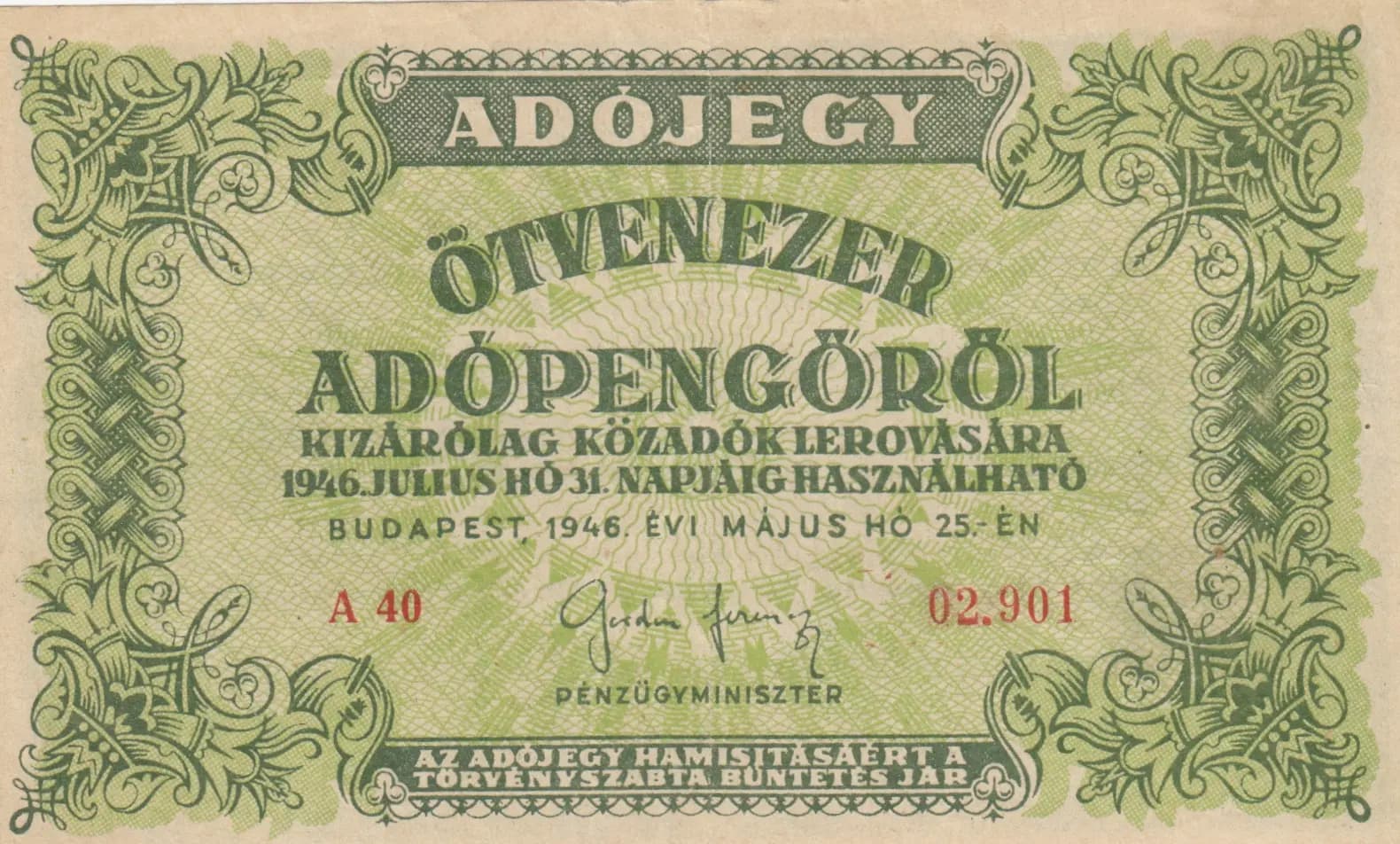
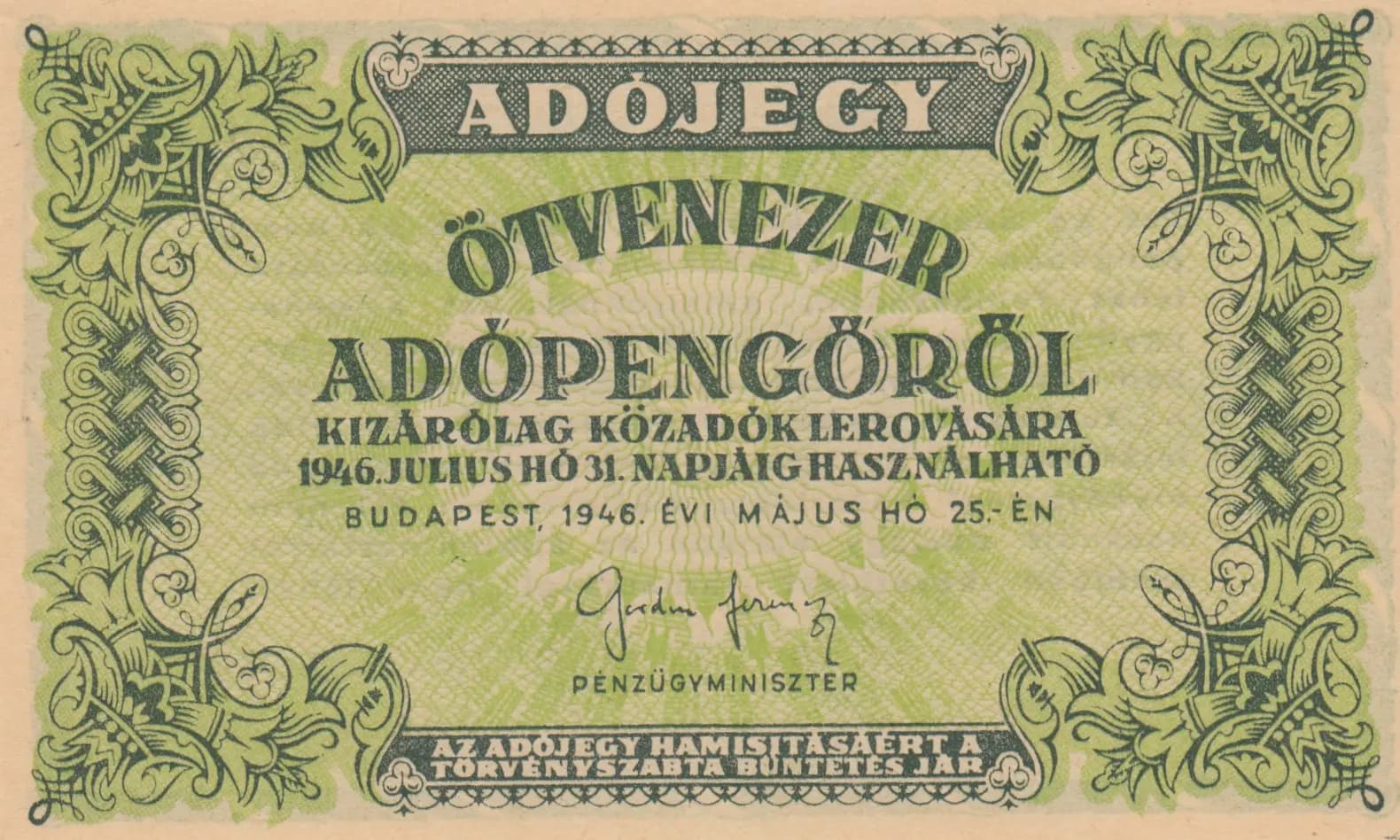
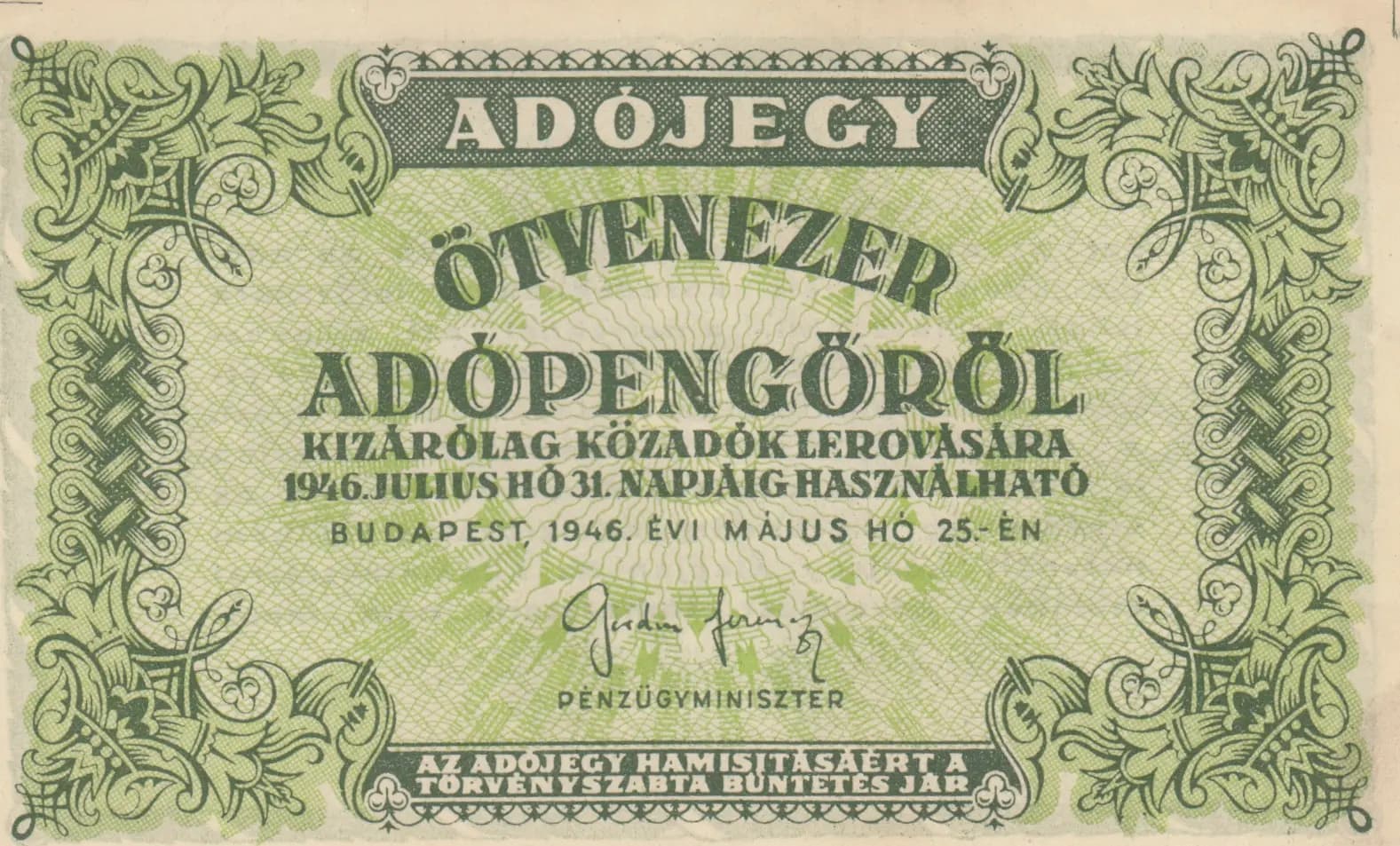
This Hungarian 50,000 Adópengő tax voucher from May 25, 1946, is presented in AU condition with crisp, well-preserved green and cream printing throughout. The note features elaborate ornate decorative borders, fine-line security patterns, and clear legible inscriptions characteristic of official financial documents from the immediate post-WWII period. The excellent state of preservation and the historical significance of this hyperinflation-era tax instrument make it an interesting example of Hungary's monetary crisis during 1946.
Common. Secondary market data from eBay shows consistent sales activity with recent comparable specimens (PMG 63 condition) selling for approximately $17.50, while lower grades (VF, EF) typically realize $1-$4. Catalog values are modest ($1-$7 depending on condition). The 50,000 Adópengő was part of regular issue production during the 1946 hyperinflation crisis and appears to have maintained reasonable survival rates. Print runs for these tax vouchers were substantial given their function as temporary fiscal instruments, and multiple examples continue to appear on the secondary market.
This tax voucher (adójegy) was issued by the Hungarian Ministry of Finance as an emergency fiscal measure during the catastrophic hyperinflation of 1946, one of the worst monetary collapses in history. The note's restriction to tax payments only and its expiration date of July 31, 1946, reflect the desperate measures employed by the Hungarian government to stabilize the collapsing pengő currency. The official government seal and ministerial authorization demonstrate the legitimacy of this emergency currency substitute, which functioned primarily as a tax payment instrument rather than general circulation currency.
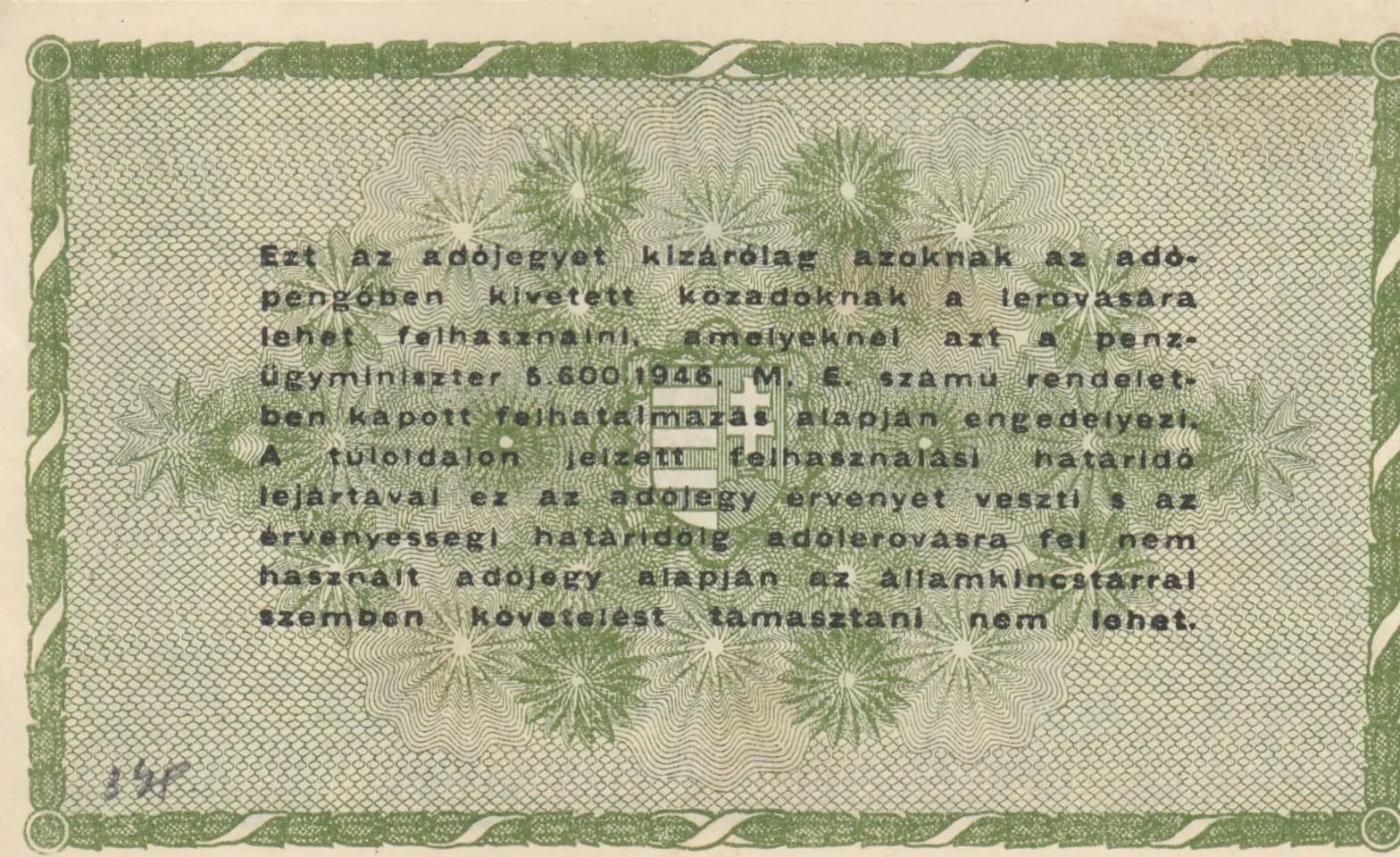
The 50,000 Adópengő features a symmetrical design with prominent ornate decorative borders incorporating elaborate scrollwork and floral vine patterns in green ink. The front displays a formal layout with a decorative banner reading 'ADÓJEGY' at the top center, surrounded by geometric diamond-shaped ornamental elements. The background employs a fine-line network pattern as an anti-counterfeiting security measure. The reverse side showcases an intricate repeating pattern of ornamental fan or sunburst designs covering the entire background in green, with matching linear geometric border patterns and corner circular ornaments. The light cream/beige paper stock with white spacing provides high contrast for the green-printed text and decorative elements. No portraits or landmarks appear on this fiscal instrument, which was designed to function as an official tax payment document rather than circulating currency.
FRONT SIDE: 'ADÓJEGY' (Tax Voucher); 'ÖTVENEZER ADÓPENGŐRŐL' (Fifty Thousand Tax Pengo); 'KIZÁRÓLAG KÖZADÓK LEROVÁSÁSÁRA' (Exclusively for Payment of Public Taxes); '1946.JÚLIUS HÓ 31.NAPJÁIG HASZNÁLHATÓ' (Usable until July 31, 1946); 'BUDAPEST 1946.ÉVI MÁJUS HÓ 25.ÉN' (Budapest, May 25, 1946); 'PÉNZÜGYMINISZTER' (Minister of Finance); 'AZ ADÓJEGY HAMÍSÍTÁSA ÉRT A TÖRVÉNYSZABTA BÜNTETÉS JÁR' (Counterfeiting this tax voucher is punished as prescribed by law). BACK SIDE: Extended legal text authorizing use exclusively for payment of public taxes imposed in tax pengo under ministerial decree 6,800/1946 M.E., with terms that the voucher loses validity after the expiration date and unused vouchers create no claims against the state treasury.
This note was produced using intaglio engraving (line engraving), evidenced by the fine detail work visible in the ornate borders, the intricate repeating fan pattern on the reverse, and the complex fine-line security network covering the background. The consistent, sharp printing quality and the detailed decorative scrollwork are characteristic of professional security printing from the Hungarian government's printing facilities during 1946. The precision of the ornamental designs and the anti-counterfeiting line patterns indicate professional engraved plates were used.
This note is cataloged as Pick P-138c, representing one of at least two known variants in this denomination (P-138b and P-138c variants are documented in PMG population records). The specific variety designation suggests variations exist among 50,000 Adópengő examples, though the visual analysis does not reveal distinguishing marks such as serial numbers (this type typically issued without serial numbers), signature varieties, or overprints. AU condition examples of P-138c represent well-preserved examples of the mid-range varieties in this issue.