50 000 adopengö 1946
Market Prices
23 salesAbout This Note
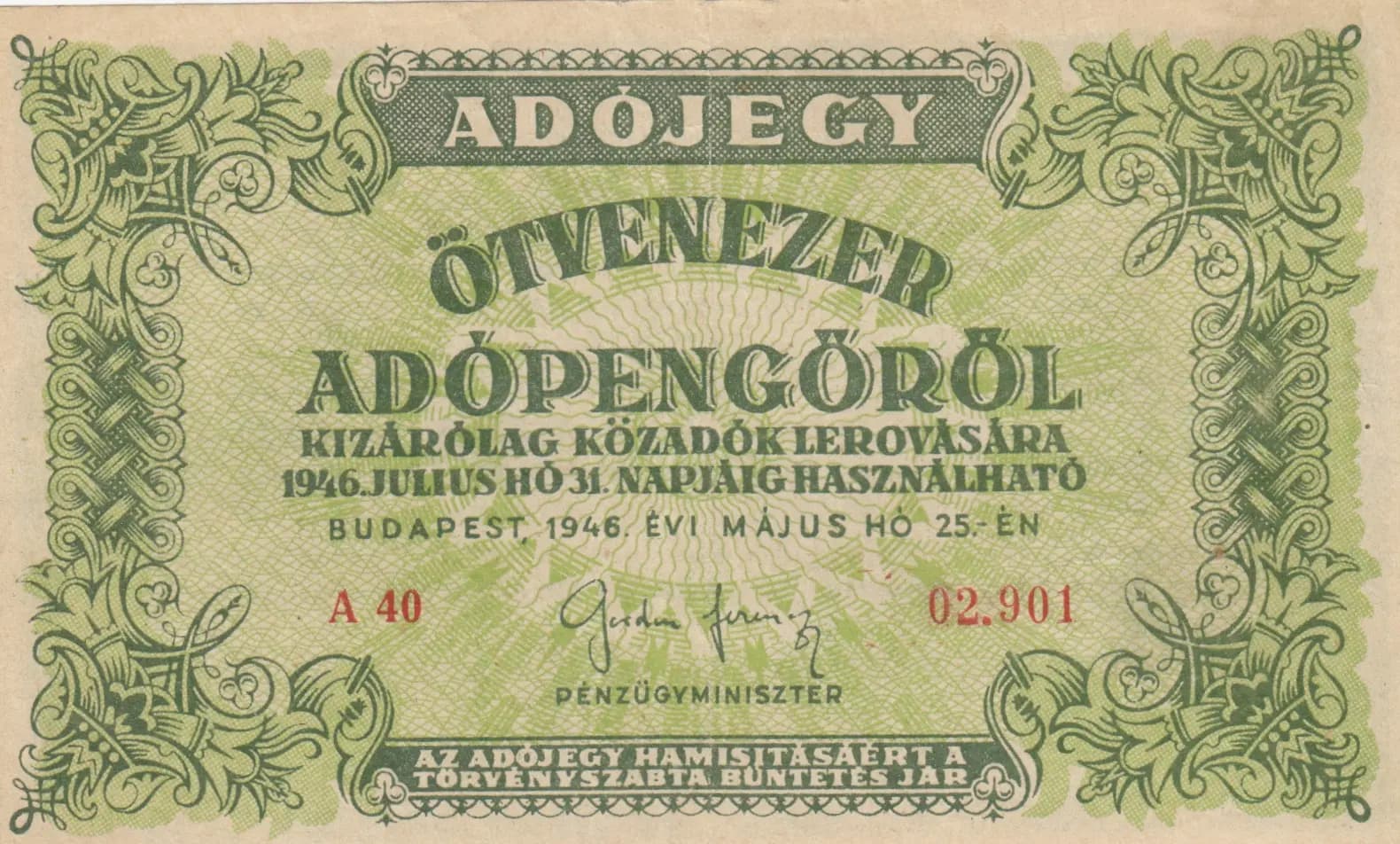
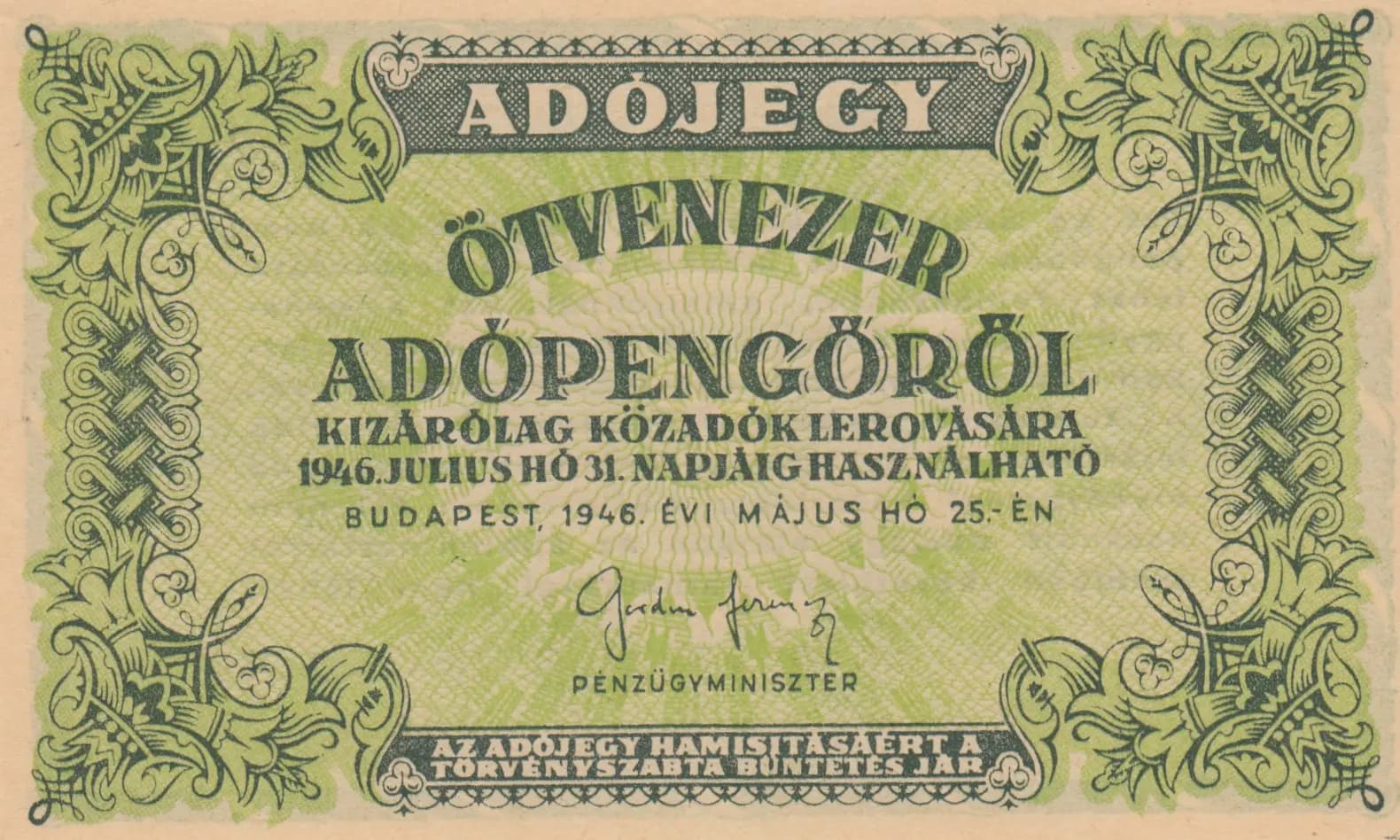
This is a striking Hungarian 50,000 Adópengő tax stamp from May 25, 1946, presented in uncirculated condition with vibrant green and beige Art Nouveau-style ornamental borders and intricate geometric patterns throughout. The note features a handwritten ministerial signature and clearly legible Hungarian text specifying its exclusive use for tax payments, with a validity period ending July 31, 1946. The exceptional condition and elaborate decorative security features make this a visually appealing example of Hungary's post-WWII hyperinflation-era fiscal instruments.
Common. This note is abundant in the collector market, as evidenced by consistent eBay sales activity spanning from 2015 to 2024, with comparable grades regularly achieving prices between $1.35 and $7.00 USD. The catalog value for UNC examples is listed at $7, and recent market activity shows UNC and EF grades selling for $2-6 range, indicating plentiful supply. As a fiscal instrument issued in presumably large quantities across Hungary's tax system in May-July 1946, and given its temporary nature with a three-month validity window, substantial numbers likely survived, making it readily available to collectors.
This tax stamp was issued during Hungary's catastrophic hyperinflation period following World War II, when the Pénzügyminiszterium (Finance Ministry) issued high-denomination pengő notes as emergency fiscal instruments. The note's specific designation as an 'adójegy' (tax stamp) and restriction to public tax payments reflect the desperate measures taken to stabilize the currency and collect revenue during the economic chaos of 1946. The July 31, 1946 expiration date indicates this was a temporary measure, part of the transition that ultimately led to the pengő's complete collapse and replacement by the forint in August 1946.
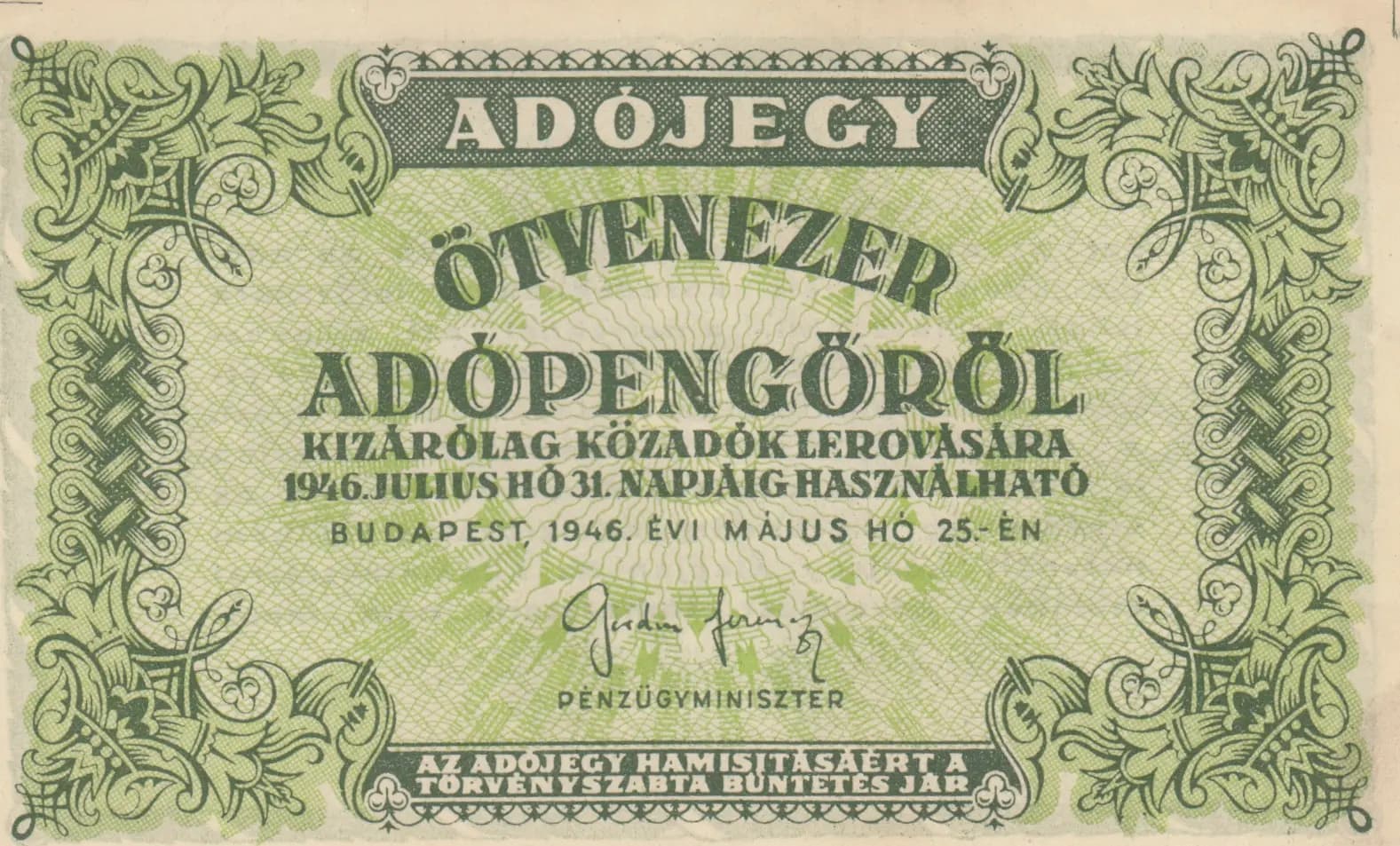
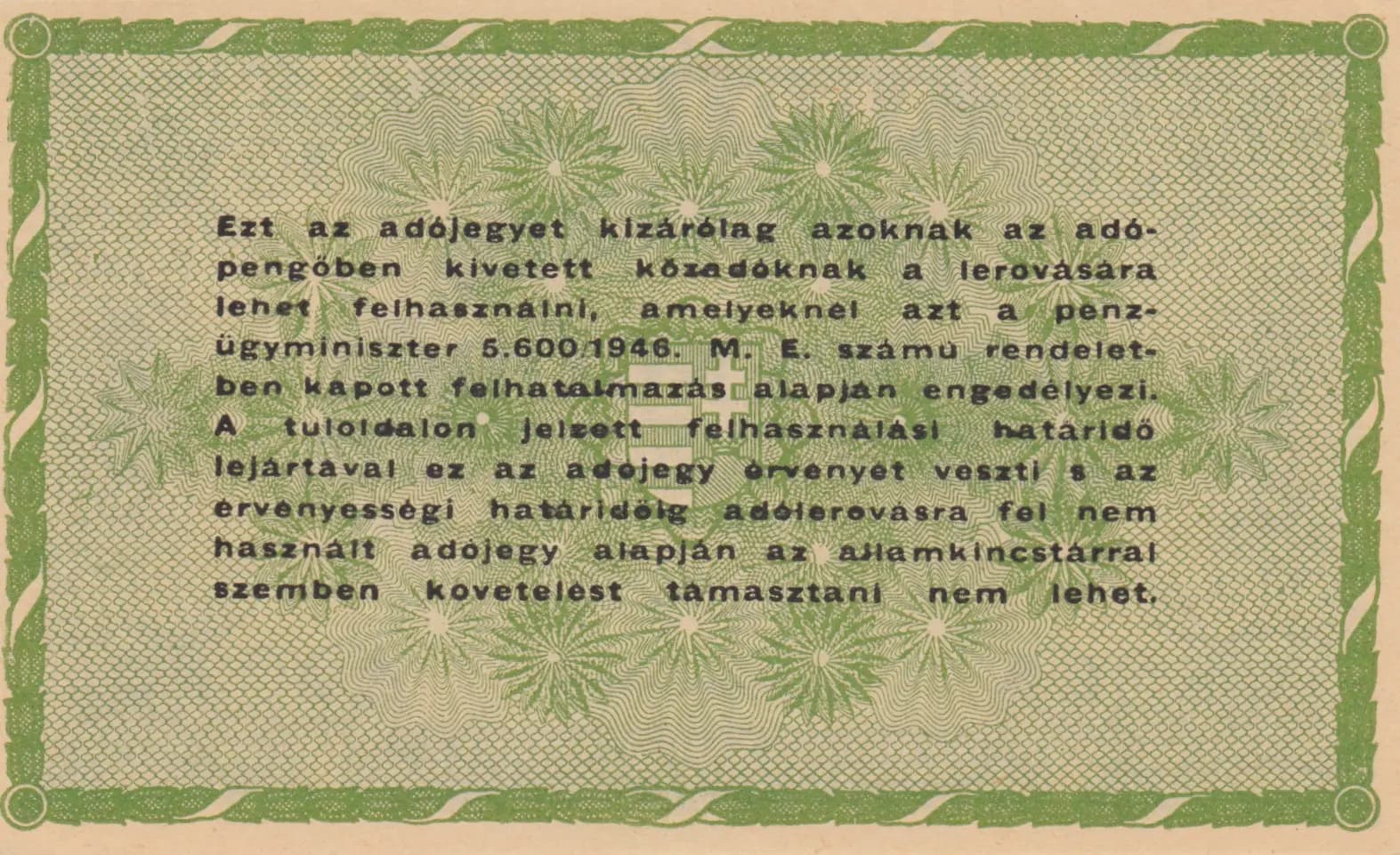
This is a decorative fiscal instrument featuring elaborate Art Nouveau-style ornamentation consistent with early 20th-century Hungarian design traditions. The front displays an ornate green and beige border with interlocking geometric knot designs in the corners, complemented by fine crosshatching and floral motifs throughout. The central area contains multiple lines of Hungarian text in a formal arrangement, with a handwritten signature in blue or black ink from the Finance Minister. The back features a dense block of regulatory text in black ink, surrounded by the same ornamental border style, with a fine wavy line pattern background in light green creating visual texture. No portraits or landmarks are depicted; instead, the security design relies entirely on intricate ornamental patterns, fine line work, and the complexity of the decorative borders as anti-counterfeiting measures.
FRONT SIDE: 'ADÓJEGY' (Tax Stamp); 'ÖTVENEZER' (Fifty Thousand); 'KIZÁRÓLAG KÖZADÓK LEROVASÁSÁRA' (Exclusively for payment of public taxes); '1946.JÚLIUS HÓ 31. NAPJAIGHASZÁLHATÓ' (Usable until July 31, 1946); 'BUDAPEST, 1946. ÉVI MÁJUS HÓ 25.-ÉN' (Budapest, May 25, 1946); 'PÉNZÜGYMINISZTER' (Finance Minister); 'ADÓJEGY HAMISÍTASÁÉRT A TÖRVÉNYSZABTA BÜNTETÉS JÁR' (Counterfeiting this tax stamp carries statutory penalties). BACK SIDE: Lengthy text stating 'This tax stamp may be used exclusively for public taxes collected in pengő as permitted by the Finance Minister under authorization in decree no. 5,600 from 1946. After the expiration date indicated on the reverse side, this tax stamp must be returned before the validity date expires, and no claims against the state treasury may be made for unused tax stamps beyond the established deadline.'
The note exhibits characteristics of intaglio or steel-plate engraving, evident from the fine line work, elaborate crosshatching, and precision of the geometric and floral patterns throughout. The clear distinction between text and decorative elements, combined with the sharp detail visible in the fine wavy background patterns and ornamental borders, indicates professional engraved plate production typical of 1940s Hungarian security printing. The multi-color printing (green, beige/cream base with black text and brown/dark green accents) suggests separate passes, consistent with security printing practices of the era by Hungary's state printing authority.
This note is catalogued as Pick P-138b, with a known variant P-138c also documented in the PMG population records. The specific variety designation (P-138b) likely refers to variations in signature, date variations, or printer's marks, though the catalog data indicates both variants share the same 50,000 Adópengő denomination and 1946 issue date. The May 25, 1946 issue date is consistent with the catalog reference. No serial numbers are present on this note, which is typical for tax stamps of this era. The handwritten signature of the Finance Minister represents the authentication mark for this specific variety.