50 000 adopengö 1946
Market Prices
14 salesAbout This Note
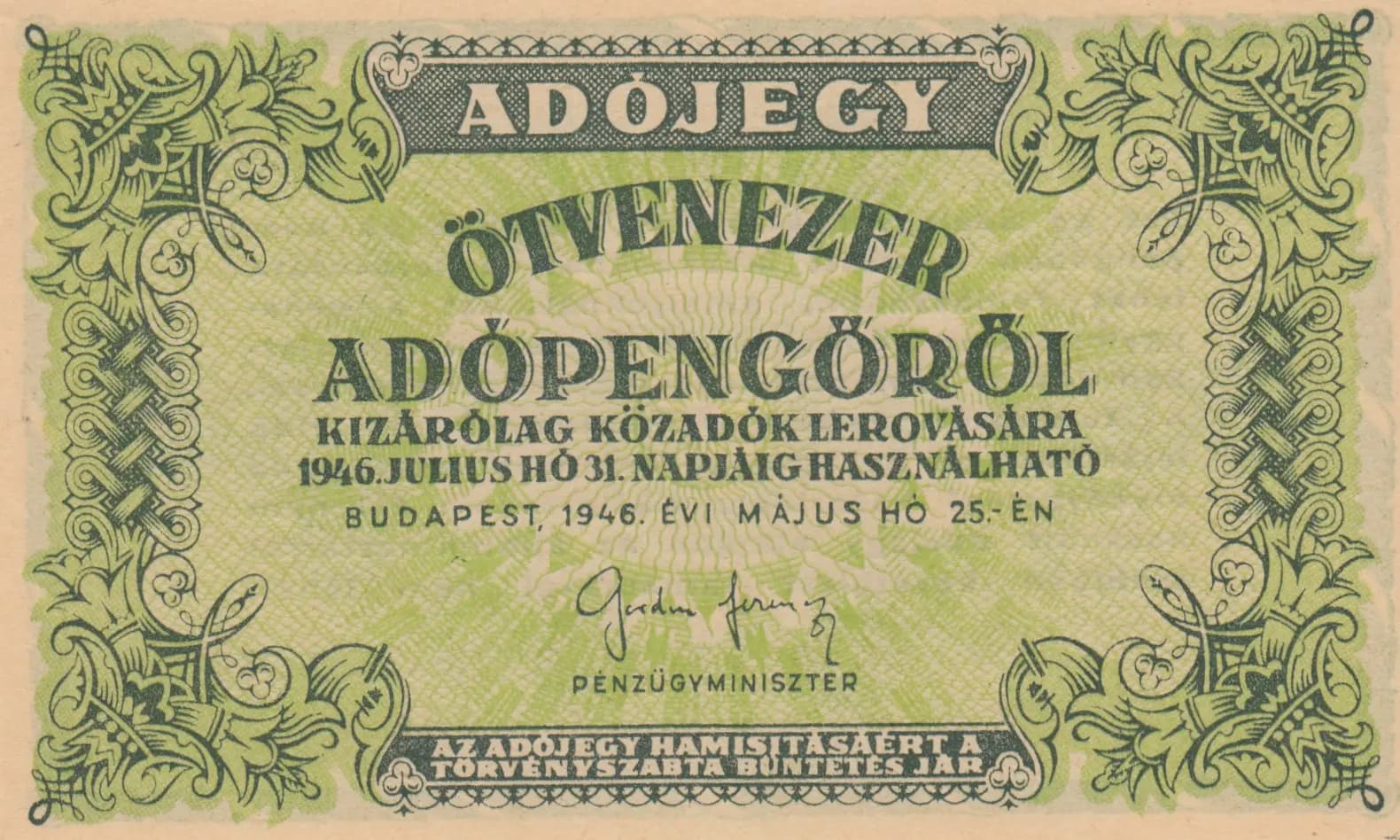
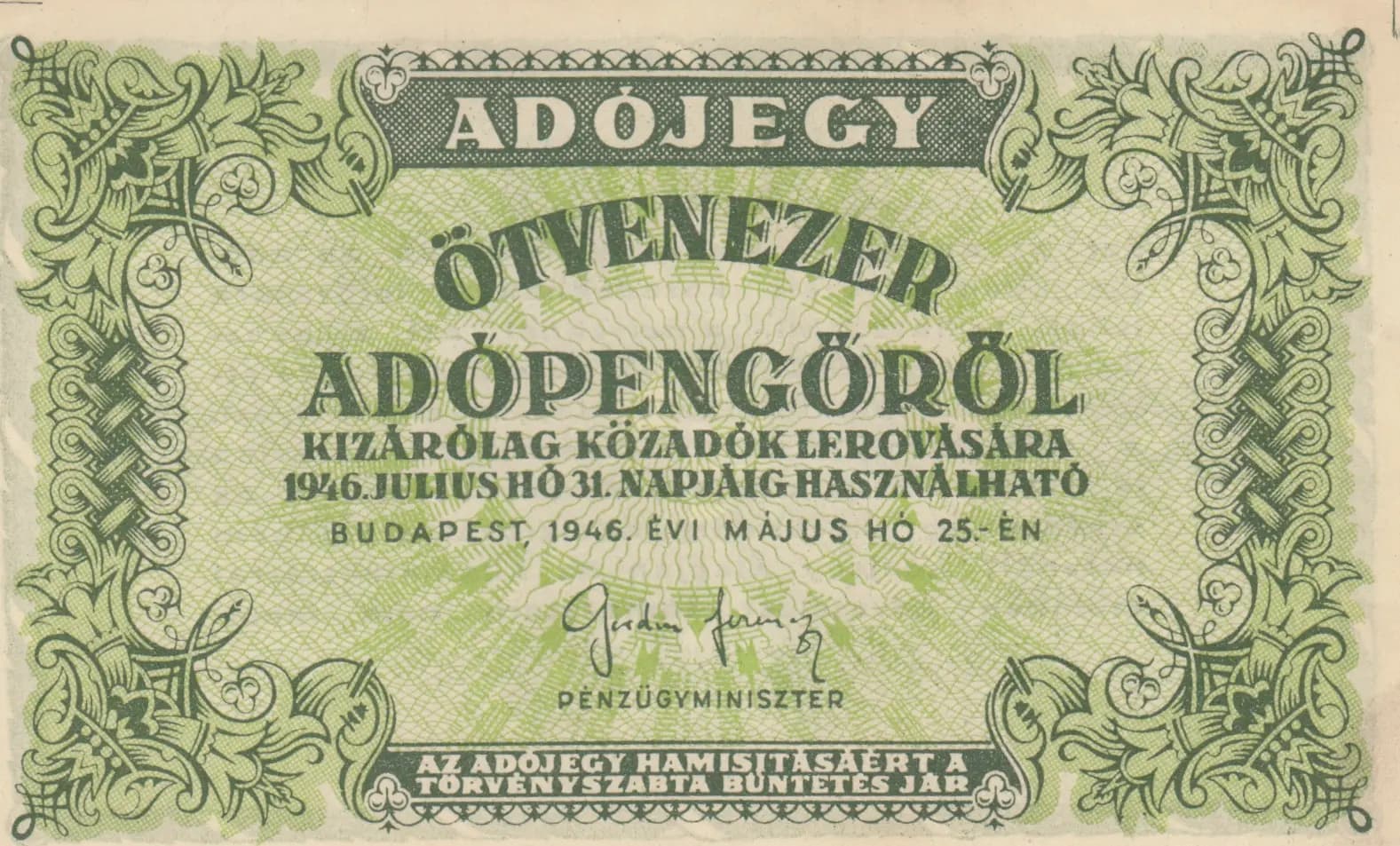
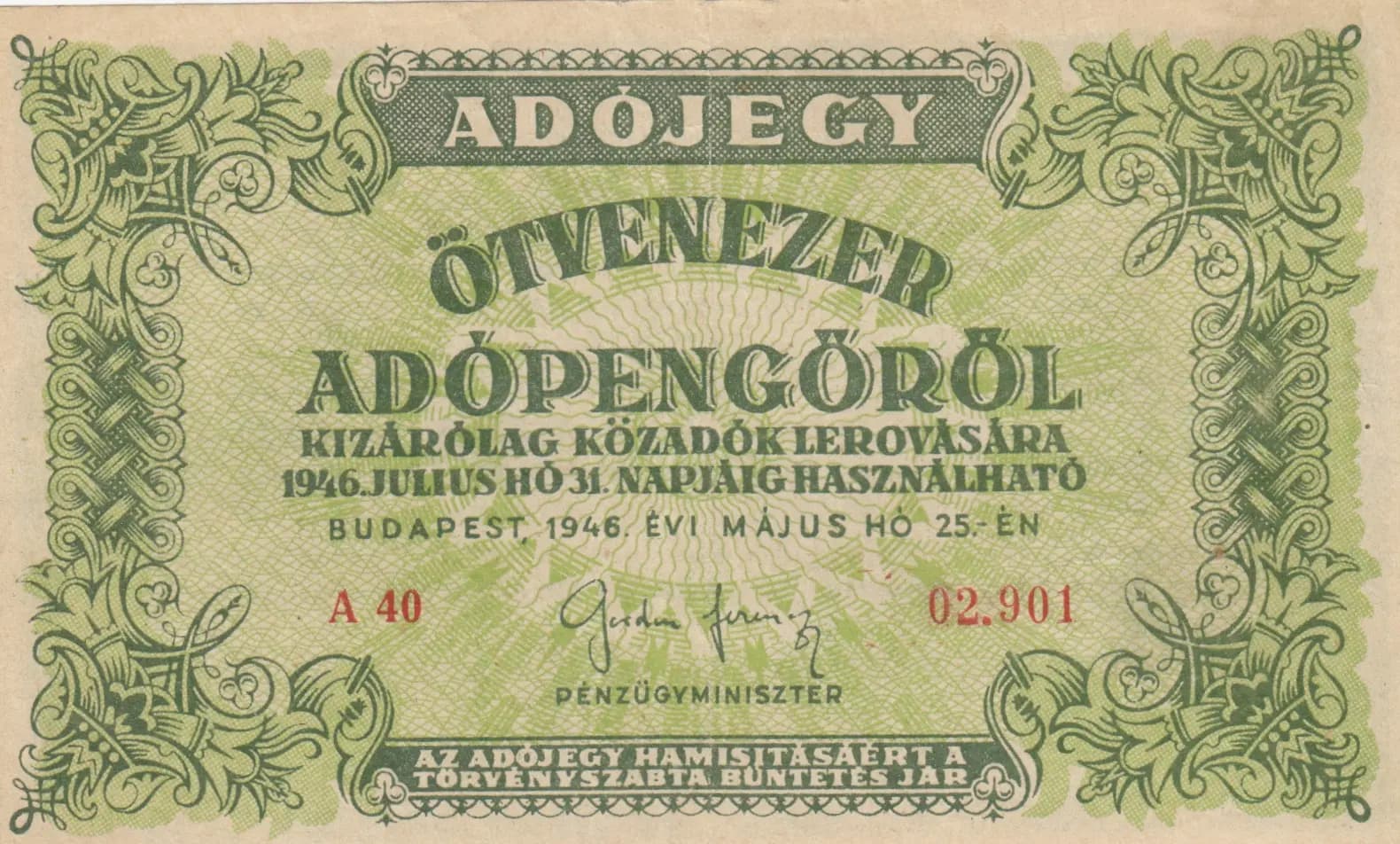
This Hungarian 50,000 Adópengö tax stamp from May 25, 1946 is a well-preserved example of post-WWII Hungarian fiscal currency in VF condition. The note features striking green ornamental borders with Art Nouveau-style decorative patterns on cream-colored paper, and importantly, it explicitly states it was usable only until July 31, 1946, making it a short-lived emergency financial instrument. The red serial number (A 40 02.901) and comprehensive legal text on the reverse confirm its authenticity as a restricted-use tax payment voucher.
Common. eBay market data shows consistent sales across multiple condition grades from 2012 to 2025, with VF examples regularly selling in the $1-$5.50 range (averaging around $2-$3), and even AUNC specimens reaching only $3.25. The 2016 catalog valuation of $3 for VF grade aligns with actual market transactions. This widespread availability and modest pricing indicate a substantial original print run. The three-month validity window (May 25 - July 31, 1946) likely resulted in most issued notes being redeemed or retained in official records rather than circulated into collector hands, but enough examples survive to make this a readily available note for collectors of Hungarian emergency currency.
Issued during Hungary's chaotic post-World War II monetary crisis, this Adópengö (tax pengö) represents the government's attempt to stabilize public finances when the regular pengö currency was experiencing hyperinflation. The May 25, 1946 issue date and three-month expiration window reflect the desperate fiscal conditions of the Hungarian Pénzügyminiszterium (Ministry of Finance), which created these tax-restricted notes as emergency revenue instruments authorized under decree 5.600/1946 M.E. The note's design prioritizes legal text and administrative restrictions over artistic portraiture, emphasizing its functional role as a governmental tax collection tool rather than general circulating currency.
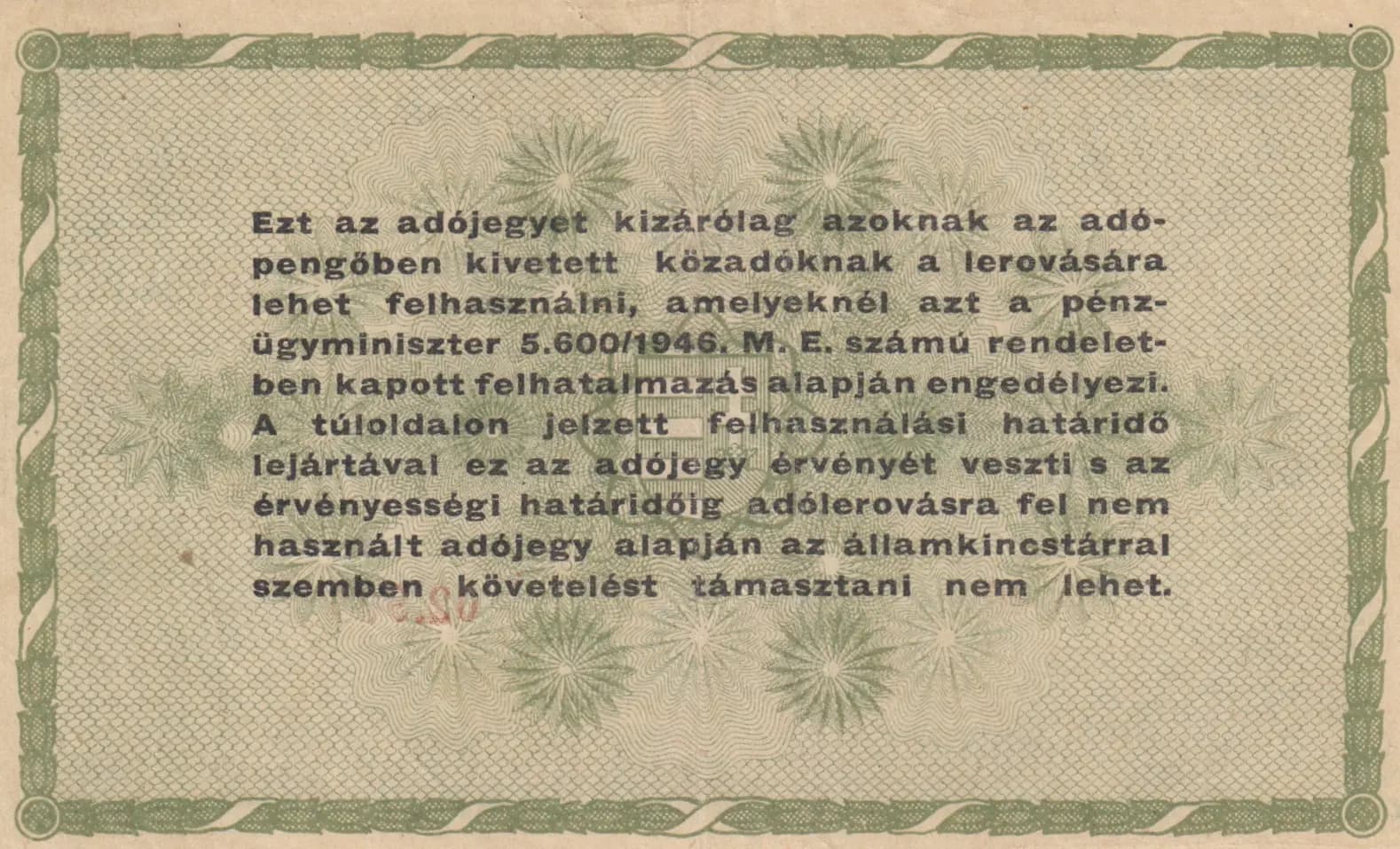
The note displays a purely functional fiscal design typical of emergency wartime and immediate post-war currency. Rather than portraits or landmarks, the obverse features elaborate Art Nouveau-style ornamental borders in green with intricate scrollwork and floral patterns framing the outer edges. The central area contains the denomination (50,000) and restrictive use instructions in multiple horizontal text bands, with the signature of the Minister of Finance positioned in the middle-right. The red-printed serial number (A 40 series with individual serial 02.901) appears on both left and right margins. The reverse is dominated by dense legal text explaining the tax stamp's restrictions and the government decree authorizing its issue, surrounded by matching green decorative borders with radiating line patterns and subtle floral motifs in the background. No heraldic arms or national symbols are prominently featured on the obverse despite the catalog reference to arms in the underprint; the design prioritizes administrative clarity and legal authority over nationalist iconography.
FRONT SIDE: 'ADÓJEGY' (Tax Stamp) — 'ÖTTVENEZZER ADÓPENGÖROL' (Fifty Thousand Tax Pengő) — 'KIZÁRÓLAG KÖZADÓK LEROVÁSÁSÁRA' (Exclusively for Payment of Public Taxes) — '1946.JÚLIUS HÓ 31. NAPJAIG HASZNÁLHATÓ' (Usable until July 31, 1946) — 'BUDAPEST, 1946. ÉVI MÁJUS HÓ 25-ÉN' (Budapest, May 25, 1946) — 'PÉNZÜGYMINISZTER' (Minister of Finance) — 'AZ ADÓJEGY HAMISÍTÁSA ÉRT A TÖRVÉNYSZÉKI ELJÁRÁSBAN' (Counterfeiting this Tax Stamp is Prosecuted in Court Proceedings) — Series: 'A 40' — Serial Number: '02.901' REVERSE SIDE: 'Ezt az adójegyet kizárólag azoknak az adó-pengöben kivetett közadóknak a lerovására lehet felhasználni, amelyeknél azt a pénzügyminiszter 5.600/1946. M.E. számú rendeletben kapott felhatalmazás alapján engedélyezi. A túloldaion jegyzett felhasználási határidő lejártával ez az adójegy érvényét veszti s az érvényességi határidőig adólerovasára fel nem használt adójegy alapján az államkincstárral szemben követelést támasztani nem lehet.' (This tax stamp may be used exclusively for payment of public taxes levied in tax pengő, which the Minister of Finance has authorized in decree 5.600/1946 M.E. Upon expiration of the validity period noted on the obverse, this tax stamp loses its validity, and no claim can be made against the state treasury for any unused tax stamp after the validity period expires.)
Intaglio letterpress printing on security paper, evidenced by the fine detailed line work visible in the background patterns, the crisp clarity of the small legal text on the reverse, and the precision of the ornamental border designs. The dual-color printing (green borders and design elements with red serial numbers on a cream/beige security paper base) suggests multi-pass printing typical of high-security government fiscal documents of the 1940s. The complex background pattern of radiating lines and floral motifs visible behind the reverse text indicates fine engraved plates. The paper itself appears to contain watermarking as noted in market descriptions, a standard security feature for Hungarian government currency of this period.
This specimen corresponds to Pick catalog P-138a based on the visual characteristics and catalog designation. The PMG population report indicates at least two additional varieties exist (P-138b and P-138c) for the 50,000 Adópengö denomination from 1946, likely representing different printer variants, signature variants, or serial number prefix variations. The observed specimen bears the series designation 'A 40' with serial number '02.901', which may help distinguish it from other documented varieties. Without access to comparative images of P-138b and P-138c, the specific distinguishing characteristics between variants cannot be determined from this analysis alone, though variations likely involve different printer marks, signature authorities, or serial number ranges typical of Hungarian fiscal currency of this period.