5 forint 1848
Market Prices
1 saleAbout This Note
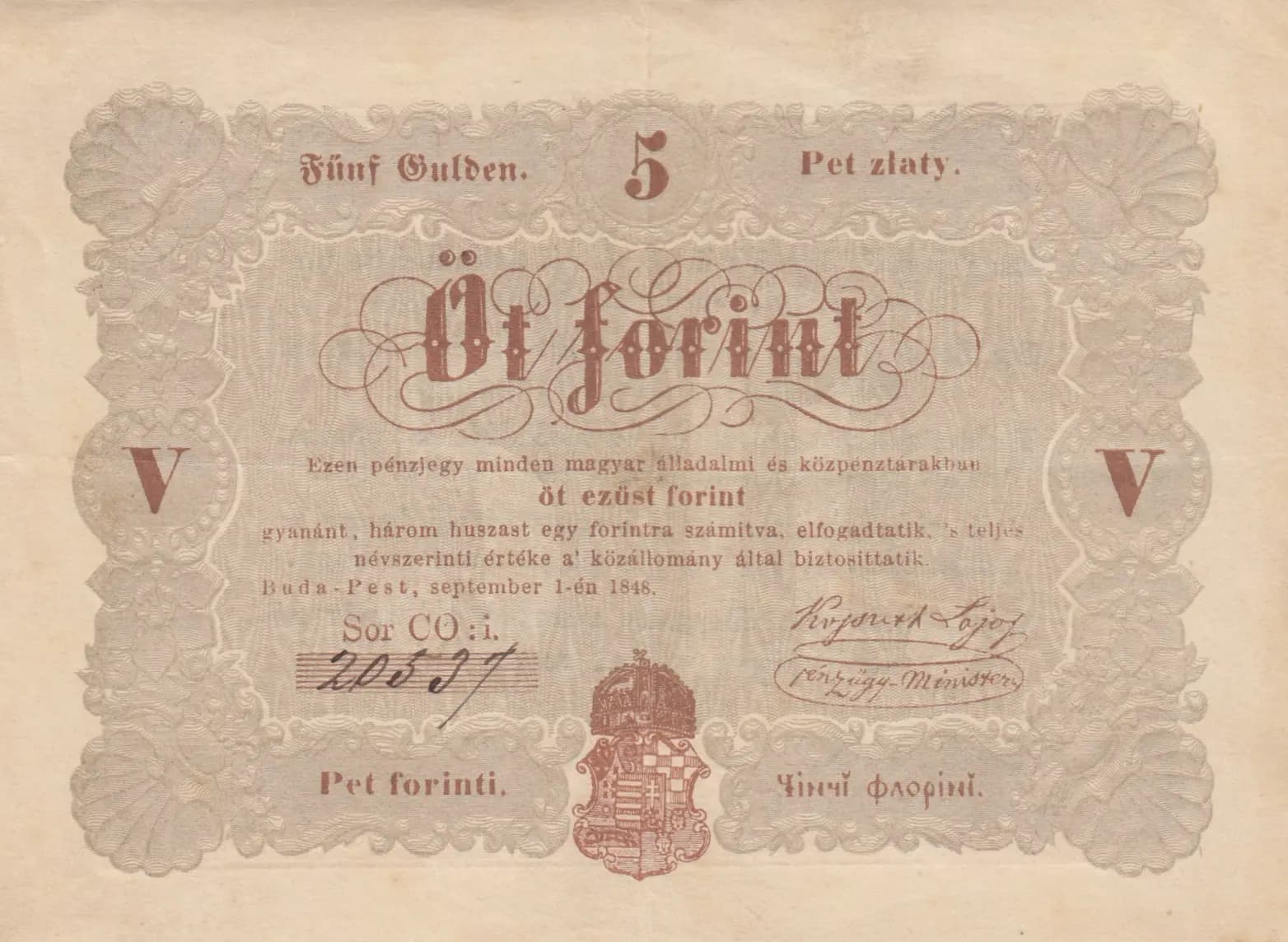
This 5 forint note from 1848 represents an important emergency currency issued during Hungary's revolutionary period. The note displays characteristic period design with ornamental borders, cream/beige background with burgundy text, and the Hungarian coat of arms with crown at center bottom. Despite visible age-related foxing and creasing consistent with its 176-year history, the note remains in VF condition with legible text and no major tears, making it a historically significant example of Hungarian revolutionary finances.
Common. The eBay price tracking data showing a VF example selling for $13.50 in January 2025 indicates this is a readily available note in the collector market. While historically significant as a revolutionary-period emission, the Hungarian 5 forint 1848 was issued in substantial quantities during the revolution and survives in moderate numbers today. The recent modest sale price ($13.50) reflects common market availability rather than scarcity. These notes are regularly encountered in collections of 1848 revolutionary currencies and Habsburg-era paper money.
Issued September 1, 1848, by Hungary's Ministry of Finance during the Hungarian Revolution against Austrian Habsburg rule, this note represents an attempt by the revolutionary government to establish independent Hungarian monetary authority. The multilingual text—Hungarian, German, Slovak, Serbo-Croatian, and Cyrillic—reflects the diverse ethnic composition of the Hungarian Kingdom and the note's intended circulation across multiple language regions of the Habsburg realm. The printed signature of Lajos Kossuth as Finance Minister directly connects this currency to the revolutionary leadership.
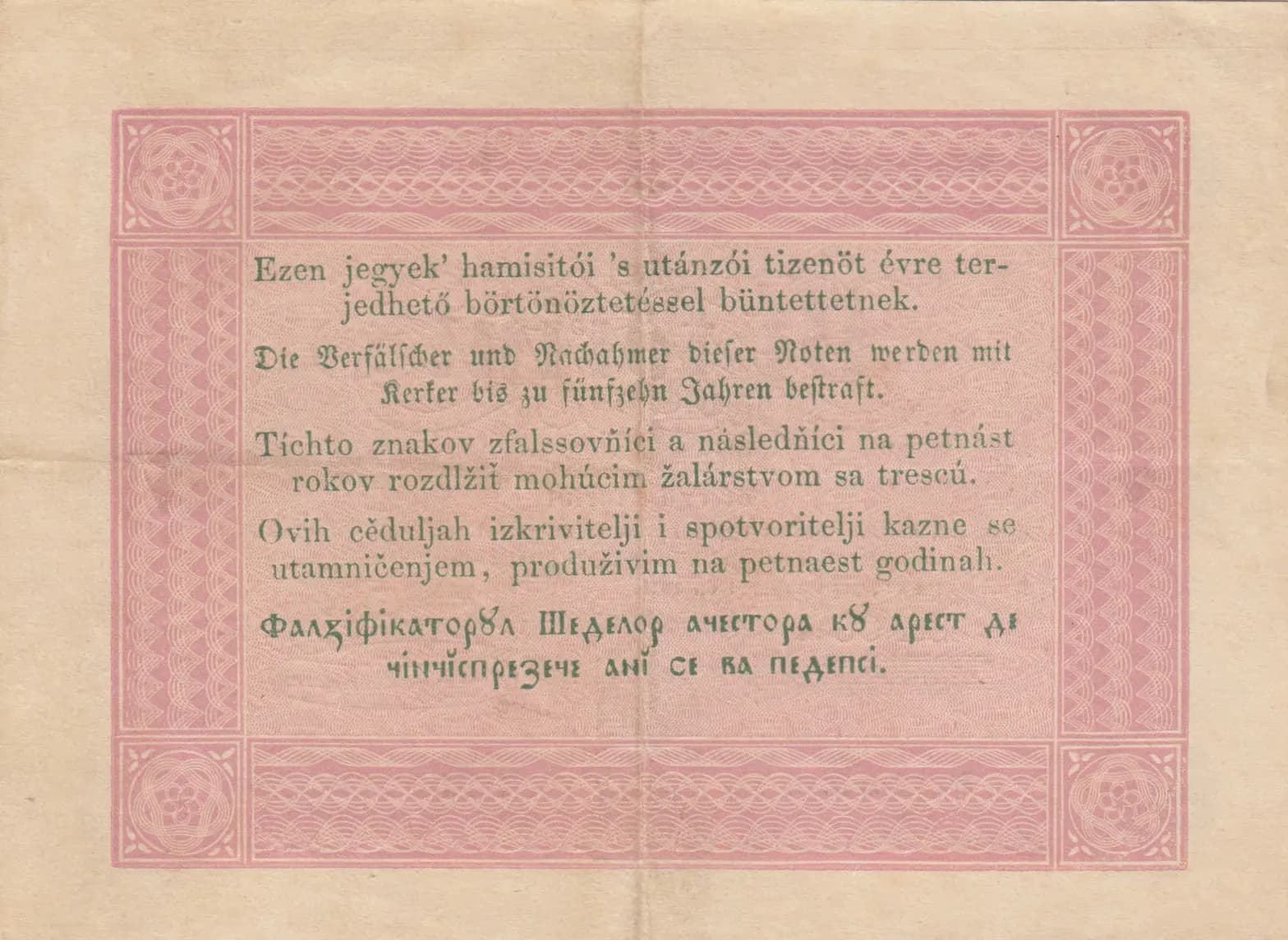
The obverse features a classical ornamental design with decorative scrollwork borders framing all edges and circular ornamental elements in the corners. The central design prominently displays the denomination in large ornamental text. The Hungarian royal coat of arms with crowned shield occupies the center-bottom position, serving as a primary authentication symbol. The note employs a cream/beige background with burgundy/maroon text and design elements. Handwritten signatures and serial number markings appear in designated areas. The reverse presents a simpler aesthetic with pink/rose-colored ornamental borders and geometric corner patterns, containing multilingual anti-counterfeiting warnings in green text. No portraits are depicted; instead, the heraldic coat of arms serves as the primary identifying symbol of state authority.
FRONT: Denomination text in three languages: 'Fünf Gulden' (German), 'Pet zlaty' (Slovak), and 'Öt forint' (Hungarian). Main text: 'This banknote is accepted in all Hungarian state and public treasuries as silver forint; with three twenties counted as one forint, and its full face value is guaranteed by the commonwealth.' Issued location and date: 'Buda-Pest, September 1, 1848.' Additional denomination variations: 'Pet forinti' (Slovak) and Cyrillic text. Serial number: 220777, Series: Sor CO:I. Signature: 'Pénzügy-Miniszter' (Finance Minister). BACK: Anti-counterfeiting warning in five languages: Hungarian: 'Counterfeiters and imitators of these notes will be punished with imprisonment up to fifteen years.' German: 'Die Verfälscher und Nachahmer dieser Noten werden mit Kerter bis zu fünfzehn Jahren bestraft.' Slovak: 'Tichto znakov zfalssovníci a následníci na petnást rokov rozdílzit mohúcim žalárstvom sa trescú.' Serbo-Croatian: 'Ovih ceduljah izkrivitelji i spotvoriteljí kazne se utamnicenjem, produzivim na petnaest godinah.' Cyrillic warning regarding counterfeiting penalties.
This note was produced using typographic (letterpress) printing, evidenced by the crisp, defined ornamental borders and text characteristics visible in the images. The multicolor printing (cream background with burgundy and green text elements) required multiple passes or color separations. The precision of the border work and corner ornaments, along with the consistent quality of the printed signature of Kossuth, indicates professional security printing typical of mid-19th-century Austrian/Hungarian mints. The handwritten serial numbers and individual signatures were added post-printing, consistent with 1848 emergency currency production practices.
This example is identified as Pick catalog S116b, indicating it represents the second variety of this note type. The specific variety designation likely relates to printing differences, signature variations, or serial number series distinctions. The observed serial number 220777 with series marking 'Sor CO:I' provides specific identification. The note features the printed signature of Kossuth as Finance Minister, which is a standard feature of this issue. No major overprints or unusual markings are visible in the analyzed images that would indicate rare sub-varieties or error notes.